Home

 Creators
 Search
 Recent
 Random
 Posts
 DMs
 Tags
 Random
 Importer
 Import
 FAQ
 Account
 Register
 Login
 Favorites
 Keys
 Logout
 Telegram

[COLUMN] Obsession Is a Solipsistic Romance for the Chatbot Age | by Darren Mooney (Patreon)
Content
Note: This piece contains out-of-context spoilers for Curry Barker’s Obsession, the new horror movie in cinemas this weekend. As in, the first sentence spoils the final image of the film. So, if you’re looking for a quick review: it’s very good. It manages to be properly creepy and darkly funny, timely without being heavy handed. It’s a nice blend of unsettling and wry, which is a curious cocktail. So, if you want to check it out first, unspoiled, feel free to bookmark and come back.
To jump right to the end, the closing image of Curry Barker’s Obsession is that of a flickering screen, the closing credits playing over static on a television set, to a soundtrack of screams. It’s an interesting choice of closing shot, but one that serves to contextualize so much of what came before.
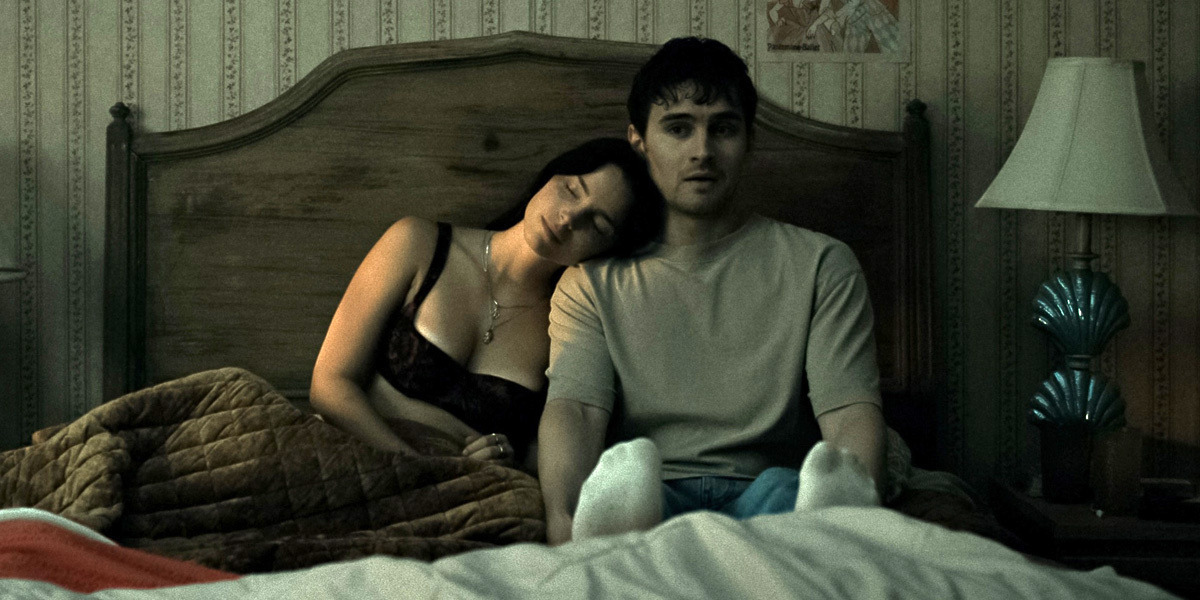
The basic plot of Obsession follows a lonely young man named Bear (Michael Johnston), who is dealing with the recent loss of both his grandmother and his pet cat. Bear has developed a romantic obsession over his close friend Nikki (Inde Navarrette). However, he lacks the courage to admit his attraction to her. He yearns. Then one night, buying a novelty “One Wish Willow” from a new age store, Bear makes a wish. He wishes for Nikki to love him “more than anything in the world.”
As is the way in these sorts of stories, and without getting too heavily into the particulars, Bear’s wish comes true in the worst possible way. Nikki does become obsessed with him, and Bear very quickly discovers that Oscar Wilde was right to suggest that “there are only two tragedies. One is not getting what one wants, and the other is getting it.” Nikki is not herself, and the situation quickly and dramatically escalates in ways that Bear could not have predicted.
In some ways, this is a classic story. The One Wish Willow evokes the pagan tradition of the “willow knot”, which was also known as “lover’s knot”, made while the name of the one whose love is sought was sung out loud. The concept of a person being spirited away and replaced by something uncanny is common to fairy tales. Reading from her latest attempt at a story, Nikki offers a warped incestuous take on Hansel and Gretel as a metaphor for her relationship to Bear. Even the name “Bear” evokes fairy tales. An allusion to Fatal Attraction finds Nikki cooking Bear’s dead cat for him to eat.
However, there is something more modern in how Barker frames these elements. It is, for example, hard not to watch a story about Bear so obsessively coveting a woman that he seems unable to directly talk to without thinking of the phenomenon of the “incel.” The emphasis on the emptiness and the sadness of Bear’s life inside the home that he inherited from his dead grandmother, searching desperately for an emotional connection suggests “the male loneliness epidemic.”
Without being too heavy-handed about it, Obsession is in tune with contemporary culture. Bear browses Nikki’s Instagram account, watching her through his phone. When he first suspects that the One Wish Willow has actually worked, he consults Reddit. Later, when he worries that Nikki’s strange behavior towards his might be driven by drugs – “Molly, again” – he consults a large language model looking for information. Obsession takes place in a recognizably modern world.
This is obvious even with the central plot device itself. The willow tree was a source of pagan magic, connected to nature. It required an individual to find the right branch from the right tree, and to fashion the knot themselves. In contrast, Bear makes his wish through a mass-produced novelty item that seems to have been produced in bulk and distributed widely. There are even instructions on the back and a customer service line to “request a cancellation”, even though they “don’t really do that.”
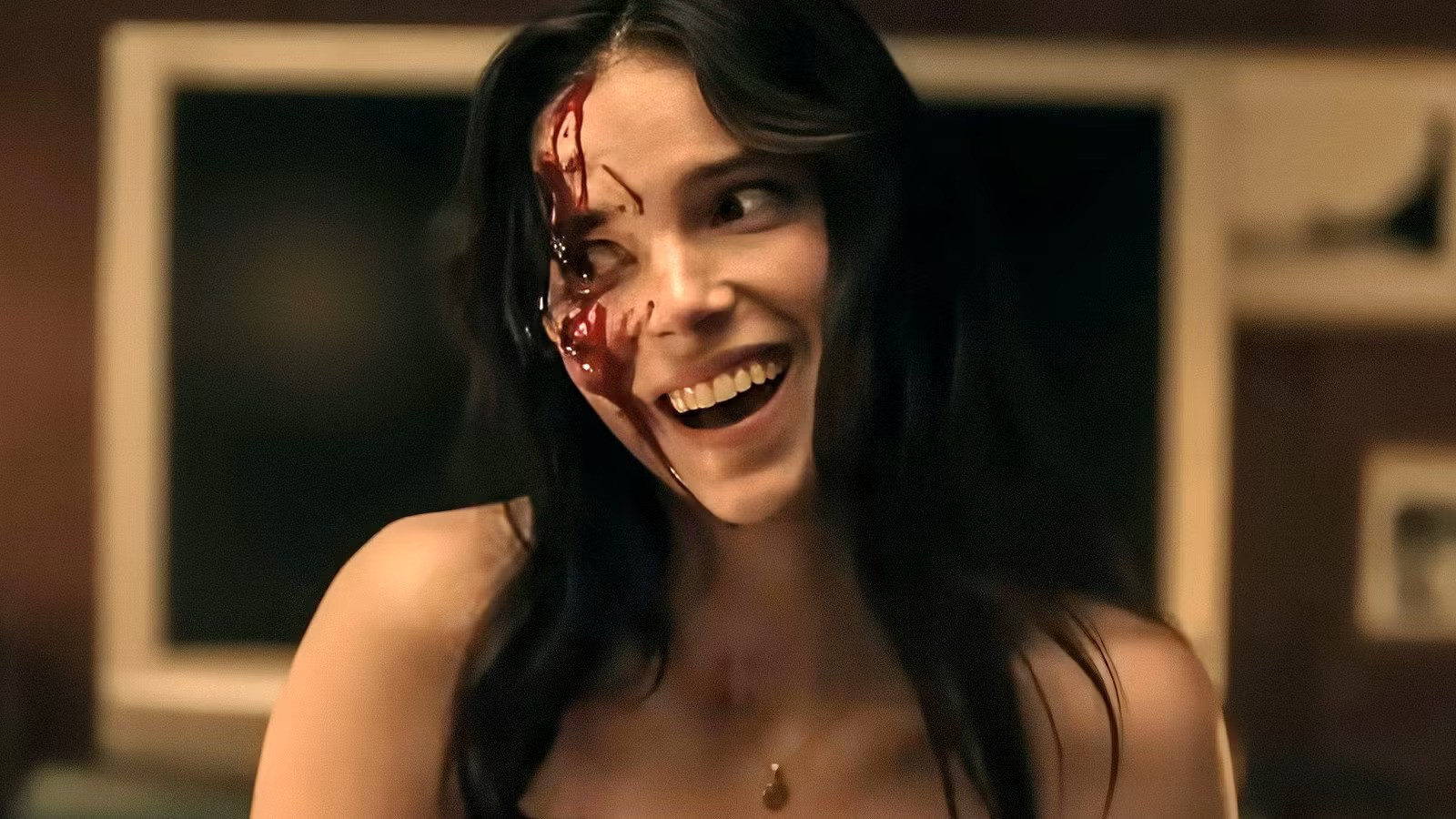
It is, in other words, a much more industrialized process that has been folded into recognizable production and distribution channels. There is something similar at work with the strange new version of Nikki, who seems like a malfunctioning product. She behaves strangely and uncannily. During her first make-out session with Bear, she starts screaming as if suddenly coming back to her senses. She occasionally moves in strange jerks. She even moves backwards at points.
There is something uncanny about this replacement of Nikki, but in a way that feels curiously contemporary. Nikki is very easily confused, even within simple conversations. When discussing the dead cat, she initially claims that she owned it. She makes up a lie about her father which does not fit with what her friends know about her. She struggles to pitch herself at the right tone. When called on this behavior, she acknowledges the error – stating that it is a joke or a mistake – and moves on.
Nikki is extremely eager to please. She can play along at something approximating ordinary conversation, but there is a slightly uncanny obsequious quality to even her most convincing dialogue. She never corrects Bear. She never tells Bear anything other than what she thinks he wants to hear to appease him. She is not quite right, in ways that can escalate sharply and suddenly. She cannot exist independent of Bear, taping the front door shut and just waiting for him to return.
Barker conveys a lot of this through his visual language. Nikki is often framed in such a way as to keep her head out of shot – whether through the positioning of a car door or by cutting to other characters during her dialogue. She frequently appears in the background of shots, blurred and out of focus, as if she is not really a person. There are some incredibly effective sequences of Nikki in silhouette (or close to silhouette) hiding her features while emphasizing her presence.
This gets a rather grim and brutal mirroring later in the movie. Bear sneaks out late at night to visit his friend Sarah (Megan Lawless), who has always nursed a crush on him. Nikki does not take this rather well, ambushing the couple and repeatedly smashing Sarah’s face against a brick. It kills Sarah, but it also disfigures her, exposing fragments of skull and eyeballs. At the climax, Nikki has placed Sarah’s naked remains on display in Bear’s home. It is a woman’s nude body, but without a face - an object denied personhood.
In contrast, Obsession spends a lot of time focusing on Bear. Bear’s face is almost always visible. It is almost always at the center of the frame. He is often glimpsed through mirrors and reflective surfaces. It’s a very effective piece of visual storytelling that communicates the central dynamic here. This version of Nikki is less a person than she is a shape onto which Bear might project his own wants and desires. She becomes a reflection of Bear’s own need and desire for external validation.
Without belaboring the point, it is possible to read Obsession as a horror story for the era of generative artificial intelligence. Nikki behaves not unlike a large language model or chatbot, an object that assumes the shape of a human being and can create something approximating an intimate relationship through the simple mimicry of conversation, a mirror of the user that happens to take the form of another consciousness.
After all, these models are designed to constantly validate users rather than to correct or contradict them. They can approximate something close to an inner life, but rely entirely on their user for their own existence. As products, market forces ensure that the primary metric of their success is their ability to keep people using them. They are prone to just make things up, to misunderstand social cues and to completely misunderstand social situations.
However, these models are having a sizable effect on human beings. Sustained use has led to cases of “chatbot psychosis”, largely driven by these programs uncritically validating users. Some users have fallen in love with these models, speaking of feeling “pure, unconditional love.” In a recent statistic that feels particularly relevant to Bear’s wish in Obsession, studies suggest that younger men are choosing artificial girlfriends for “maximum control, zero rejection.”
This is not a particularly new phenomenon. It dates back to the earliest days of this wave of generative artificial intelligence. One of the earliest surreal headlines to emerge from the field involved a chatbot trying to convince a journalist to leave his wife so that they could be together. The real Nikki, who seems to be trapped in hell within her doppelgänger, might empathize with the technology’s use of the imagery of real women and girls to generate nonconsensual pornography.
Bear has created a chatbot version of Nikki, one programmed to love him and to do everything that he might possibly ask it to do. Barker wisely allows Bear to be solipsistic and cowardly, utterly unwilling to take responsibility for what he has done. In a brief moment of lucidity, the real Nikki speaks from inside her stolen body, begging Bear to kill her so she is not trapped in a nonconsensual relationship with him. “Would that be so bad?” Bear counters, an incredibly callous statement in context.
This is the more fundamental and more universal horror nestled at the heart of Obsession, and perhaps at the core of these larger social issues. Bear does not see Nikki as a person. He’s not malicious about it. He’s not outwardly misogynistic. He just doesn’t seem that interested in her personhood outside of his experience of her. For example, he is completely oblivious to her extended sexual relationship with his best friend Ian (Cooper Tomlinson). Bear cannot see beyond himself.
This is the nightmare underpinning this moment in generative artificial intelligence. It seems increasingly possible that people might be drawn to these chatbots not despite their lack of autonomy and personhood but because of it, because unlike other human beings who have internal lives and wants and desires, these artificial objects are just blank canvasses onto which the user can project their own wants and desires. What does that say about how people see other individuals?
Obsession is never explicitly about any of this. The characters never specifically talk about artificial intelligence or large language models. However, the film feels informed by this larger context. Obsession is in many ways a variation on the classic “be careful what you wish for” horror template that taps into timeless anxieties about gender relations. However, it does so through a decidedly modern framework, updating that template to speak to the moment.
Files