Home

 Creators
 Search
 Recent
 Random
 Posts
 DMs
 Tags
 Random
 Importer
 Import
 FAQ
 Account
 Register
 Login
 Favorites
 Keys
 Logout
 Telegram

[COLUMN] The Mandalorian and Grogu is Peak Post-Human Cinema | by Darren Mooney (Patreon)
Content
Note: The Mandalorian and Grogu is not really a movie that it is possible to “spoil” in a conventional sense, in that a bunch of things happen within it that have no real consequence. However, this article will discuss some of those things that happen, particularly in the second half, so consider yourself warned. The film itself is pretty bad, a lame and inert blockbuster without any particularly interesting choices or beats within it, slathered in references and nostalgia for other Star Wars media. The force is not strong with this one.
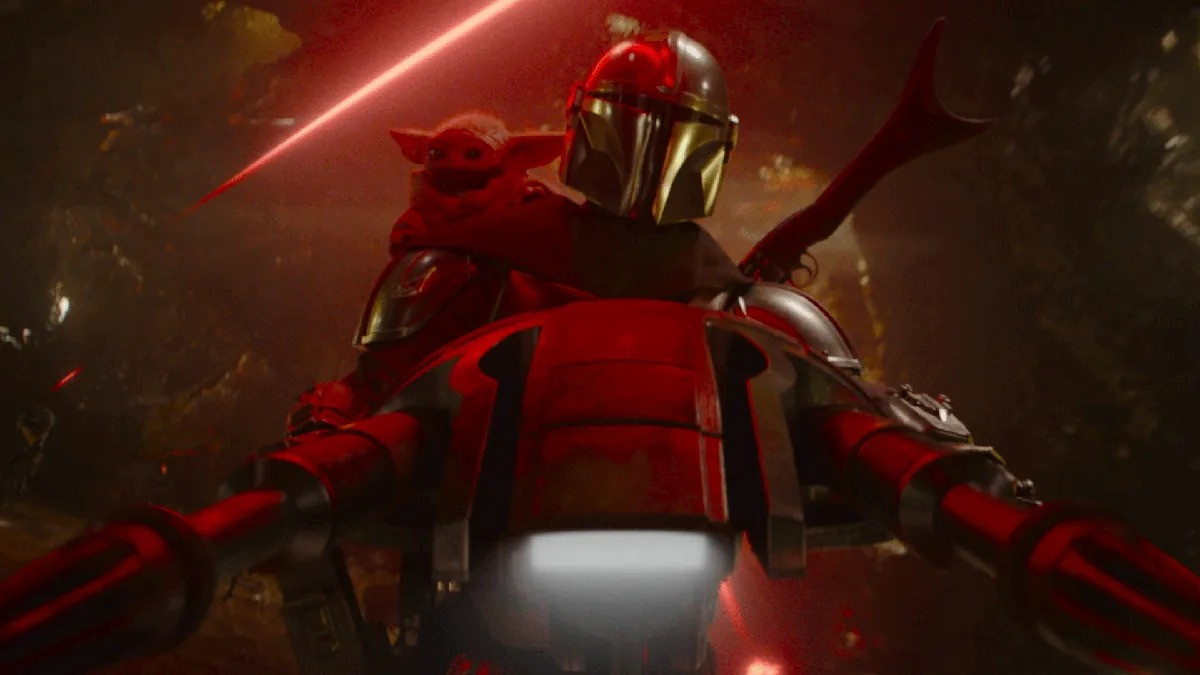
There is a literal emptiness at the heart of Jon Favreau’s The Mandalorian and Grogu, a film where dozens of minutes can pass without anything resembling a human face on screen.
The most interesting segment of the film comes in the second half, after bounty hunter Din Djarin (Pedro Pascal) has been abducted by the silent (computer-generated) goon Embo, who works on behalf of the (also computer-generated) Hutt Twins. Din’s (puppet) ward, Grogu, leads an expedition of (puppet) Anzellans on a mission to rescue his surrogate father. After Din is poisoned by the Hutts’ pet monster, Grogu has to tend to him and survive in the wilderness.
This is a technically impressive sequence. In some ways, it recalls the work of the Jim Henson studio of films like Labyrinth and The Dark Crystal. The puppets are visually interesting. In a film that feels largely digital with environments simulated by the Volume and computer-generated characters like Din’s pilot Garazeb “Zeb” Orrelios (Steve Blum), the puppets provide a sense of tactility and tangibility. Although they are never entirely “realistic”, they look like they have weight and mass.
A lot of the authorial intent in The Mandalorian and Grogu can be traced to producer and co-writer Dave Filoni. The film is populated with references to characters and concepts drawn from the expanded universe. The film’s third lead, Rotta the Hutt (Jeremy Allen White), appeared in the Clone Wars theatrical film. Embo was a character on Filoni’s Clone Wars television show. Zeb was established in Filoni’s Rebels.
Of the film’s villains, the first half’s primary antagonist, Commander Coyne (Jonny Coyne) was introduced during an exposition-laden scene in “The Spies”, the penultimate episode of The Mandalorian, while the Hutt Twins had previously appeared as secondary antagonists in The Book of Boba Fett. All of this pointless lore referencing fan service is par for the course with how Filoni approaches Star Wars, most obviously in his own Ahsoka series.
However, this emphasis on puppets feels more in line with Favreau’s current directorial and creative impulses. Of course, Favreau has changed a lot over his extended career. Favreau emerged as a darling of the independent film scene. He wrote and starred in Swingers, directed by Doug Liman and co-starring Vince Vaughn. He would also co-star with Vaughn in Made, a movie that he wrote, starred in and directed. These were very grounded buddy comedies.
From those humble beginnings, Favreau quickly pivoted into more special-effects-driven work. Elf was a family comedy with an endearingly simple premise – the idea of a human (Will Ferrell) raised as one of Santa’s (Ed Asner) elves – that relied heavily on the use of forced perspective and even stop motion. Favreau followed Elf with the largely forgotten Zathura: A Space Adventure, a standalone follow-up to Jumanji that Favreau himself likened to Star Wars.
He started the Marvel Cinematic Universe with Iron Man, a film that was largely improvised in collaboration with Favreau and actor Robert Downey Jr., with co-star Jeff Bridges describing it as “a $200m student film.” However, this approach seemed to reach breaking point with Iron Man 2, a film on which Favreau compared his experience to that of El Cid, “strapped onto his horse by his men and sent into battle dead.”
Although Favreau drifted away from the creative side of the Marvel Cinematic Universe, he remained on screen in the role of Happy Hogan. He pivoted away from the shared universe with another big effects-driven blockbuster, Cowboys & Aliens, starring Harrison Ford and Daniel Craig. However, following the critical and commercial disappointment of that attempt at a big studio blockbuster, Favreau retreated to the relative modesty of Chef, a film more in line with Swingers or Made.
It is possible – in fact, it is almost inevitable – to read Chef as semi-autobiographical. Favreau casts himself as a food truck owner content to make more modest and artisanal snacks in what feels like a statement of artistic humbleness. It’s hard not to read some level of personal fantasy into this, with Favreau casting Scarlett Johanssen as his character’s girlfriend, Sofia Vergara as his character’s ex-wife and Robert Downey Jr. as his ex-wife’s supercool new other ex-husband.
However, Favreau could not resist the siren call of the blockbuster. He went on to direct both the computer-generated remakes of both The Jungle Book and The Lion King for Disney. The Jungle Book made $966m worldwide, and The Lion King grossed $1.6bn, substantially surpassing the lifetime gross of The Rise of Skywalker, the Star Wars film released that year. Favreau shifted into managing the Star Wars brand during its pivot to streaming, becoming showrunner on The Mandalorian.
Favreau was basically the auteur of The Mandalorian. He has a writing credit on twenty of the show’s twenty-four episodes. He also has a writing credit on all seven episodes of The Book of Boba Fett. While he did not direct the bulk of the show, he was the key creative force. While Favreau clearly has a love of Hollywood history and of Star Wars as a property, a lot of Favreau’s work on The Mandalorian tended towards the technical.
Much was made, for example, of the show’s early adoption of the technology known as “the Volume” to render convincing backdrops on a soundstage. With all due respect to Pedro Pascal, the show’s true breakout was an animatronic puppet so incredibly charming that co-star and arthouse director Werner Herzog was brought to tears by it. It can often feel like the puppet has been doing more press for The Mandalorian and Grogu than Pascal.
Favreau comes across a very likable person. As the joke on Family Guy goes, Favreau seems like the kind of person who would help you move if you asked him to. He is a really good interview subject, talking honestly and frankly about the subjects that interest him, demonstrating a thoughtfulness and consideration about the technical aspects of filmmaking. A lot of Favreau’s press around The Mandalorian and Grogu has been engaged with technical issues like artificial intelligence.
It really does seem like this mechanical dimension of movie production is what interests Favreau as a filmmaker, to the exclusion of organic elements like human beings or actors. In hindsight, it makes Iron Man feel like something of a thesis statement for the director, the story of a human being (Robert Downey Jr.) literally encased in a cold mechanical shell, the recognizable human form swallowed whole by computer-generated imagery.
This explains a lot of The Mandalorian and Grogu, a film which works very hard to push any recognizably human elements into the background. The film’s central character, Din Djarin, spends all but about ten minutes of the movie with a helmet covering his face, making him less a person than a posable action figure. It is no wonder that there have long been rumors about how much or how little time Pedro Pascal spends on set, and how much of the show was outsourced to his stand-in.
Favreau is largely disinterested in his human actors. Sigourney Weaver shows up to slot into an exposition role that could largely have been given to Mandalorian recurring guest star Paul Sun-Hyung Lee. Legendary director Martin Scorsese has a two-scene cameo as the voice of a computer-generated creature. Shirley Hendrson returns as a voice of the Anzellans. Jeremy Allen White voices a swole computer-generated slug monster.
The closest that The Mandalorian and Grogu comes to feeling alive is during those extended sequences where Favreau doesn’t even have to pretend to be interested in human performers, whether actors or stunt doubles, and can just live among his puppets. It is certainly far more interesting than endless references to Rebels or The Clone Wars or The Book of Boba Fett. Grogu wandering through pipes and swamps seems to genuinely engage Favreau as a filmmaker.
Appropriately enough, there is something almost Lucasian about this. Like George Lucas, there is a sense of Jon Favreau as a middle age man getting lost among his toys less interested in the human stuff. For Lucas it was digital imagery and filmmaking. For Favreau, it is puppets and models. The Mandalorian and Grogu feels like a version of Attack of the Clones that has been created entirely by committee and focus-grouped to hell and back, shorn of anything remotely resembling a perspective.
However, while Lucas certainly got lost among his toys in his later years working on Star Wars, constantly tinkering with the older movies and pushing the prequels into the uncanny valley, Lucas had interests beyond the technical. Lucas was never a great writer or director of character or dialogue, but he had a curiosity about the larger world. His prequel trilogy was a clumsy and mishappen epic about how democracies die, but it had meaningful things to say about the world.
This is the biggest difference between Lucas and Favreau, and why Favreau is a both a much less interesting and a much safer choice to act as the steward of the franchise in the Disney age. Favreau doesn’t seem to care about having anything to say. He doesn’t seem to have any interest in the world outside the studio. Favreau is a creative talent unburdened by anything as gauche as a point of view. It is impossible to imagine Favreau ever resisting a studio note.
In some ways, The Mandalorian and Grogu feels like a clumsy and less-competently executed version of the “posthuman cinema” crafted by director Joseph Kosinski. It is a film that approximates the look and the feel of a live action film, but with no room for any humanity in it. While Kosinski’s films are anxious about this new world, Favreau seems perfectly content within it. It is a little unsettling at a time when actors find themselves struggling to survive in the industry, subject to replacement.
This is perhaps what The Mandalorian and Grogu has to say about the modern world. It feels appropriate that the film emerges from the Walt Disney corporation, the major studio that is most eager to work with generative artificial intelligence, which was most openly hostile to creatives during the recent writers’ and actors’ strikes, and which is most eager to convert its films and shows into mass market replicable “experiences” like theme park rides and cruises.
This is the reality of The Mandalorian and Grogu. The film is not only set in a galaxy far, far way, but one stripped of any recognizable humanity. This is not the way.
Files