Home

 Creators
 Search
 Recent
 Missing
 Random
 Posts
 DMs
 Tags
 Random
 Importer
 Import
 FAQ
 Account
 Register
 Login
 Favorites
 Keys
 Logout
 Telegram

[COLUMN] Lanterns Asks Who Gets the Privilege of Being 'Without Fear?' | by Darren Mooney (Patreon)
Content
Note: This piece contains spoilers for the first episode of Lanterns, which premiered on HBO last night. It also contains broad spoilers for the sixty-odd years of Green Lantern mythos that may or may not be ideas that the show is playing with in the longer run. If you’re looking for a capsule review, having seen seven of the season’s eight episodes: it’s incredible. It’s really great. It’s the best superhero adaptation so far this year, finally surpassing Wonder Man. It’s a thoughtful, character-driven take on the concept produced to the highest standards. It’s maybe not quite as good as Damon Lindelof’s last DC adaptation for HBO, Watchmen, but that’s not the harshest of criticisms.
Central to Lanterns, the new HBO reimagining of the Green Lantern mythos from Damon Lindelof, Chris Mundy and Tom King, is the question of what it means to live “without fear.”
The Green Lantern is a longstanding DC comic book superhero, dating back to the Golden Age. However, the modern conception of the character is rooted in the Silver Age reboot that imagined the Green Lantern Corps as an intergalactic police force. These heroes were gifted a magic ring tied to the eponymous lantern, which granted them the power to manifest anything that they could possibly imagine through sheer will.
In the character’s origin story, the Green Lantern Abin Sur is fatally wounded when his ship crashes on Earth. Writer Alan Moore would eventually explain why an alien with a ring that allowed him to fly was using a spaceship, but the important thing is that the dying Abin Sur tasked his ring with finding a viable replacement. “He must be one entirely without fear!” Abin Sur commanded in those fateful panels. It was so important that he repeated: “Entirely without fear!”
Over the years, the idea that the Green Lantern is defined entirely by the absence of (and opposition to) fear has developed into a central part of the mythos, with writer Geoff Johns famously retroactively inventing the demonic monster known as “Parallax” into the mythos as the anthropomorphic manifestation of fear and as an explanation for the rings’ longstanding weakness against the color yellow – itself tied to the idea of fear.
This idea is central to the television series Lanterns, from its opening moments. The show begins in 1996, with young John Stewart (Aaron Pierre) watching a 60 Minutes interview with Hal Jordan (Kyle Chandler), the first Green Lantern from Earth. Asked whether he is nervous about the interview, he quips, “I don’t get nervous. Part of the job description.” Asked what he did to earn the incredibly powerful ring on his finger, he explains, “It’s only one question: ‘are you afraid?’”
The question of how Hal Jordan came to be granted one of the most powerful weapons in the universe is a recurring preoccupation of Lanterns. The bulk of the series unfolds in 2016, when Hal has been tasked with taking John Stewart under his wing as a trainee. This is very clearly a different process than the one that Hal went through when he received the ring thirty years earlier. Hal was “chosen.” In contrast, John has clearly been groomed.
Sitting at a bar in Rushville, Nebraska, the pair contemplate the absurdity of coming into such power based upon a single question. “I got it the old-fashioned way,” Hal confesses to John. “I sure as hell didn’t interview for it.” John understandably seems a little unsettled by this casualness. “Power like that, shouldn’t you have to work for it?” John ponders. “Excel, prove yourself? Instead of just getting randomly selected?” The possibility of having to prove himself seemingly never occurred to Hal.
The reason for this is abundantly clear. Hal is white. And John is Black. And, as such, the two men have very different perspectives on the way that the world works. It is a lot easier for somebody like Hal to move through the world without experiencing fear. Hal is less likely to be shot during a random police stop than John. Hal is less likely to be a victim of homicide than John. Hal is less likely to be wrongfully convicted for murder than John.
Hal has the privilege of living without fear. For a young Black man, fear is a survival mechanism, with families having to give their children “the talk” about how to behave during police interactions to avoid getting shot at a very young age. That scene at the bar ends with Hal starting a fight so that he can be arrested and taken into police custody in the hopes of talking to a suspect (Chris Coy). It is the sort of stupidly reckless decision that Hal has the luxury of making as a white man that John doesn’t.
“You want to go to jail so you can talk to that guy,” John observes. “This is a stupid plan.” Hal flippantly replies, “I’ve had stupider.” John responds, “I don’t doubt it.” There is an incredible air of entitlement and unexamined privilege to how Hal behaves in Lanterns that plays off the larger themes of the franchise – and the larger superhero genre – in interesting ways. To put it frankly, Hal has much greater freedom to do what he wants and to be himself than John does.
Hal seems to understand this. Early in the premiere, Hal picks up John for training. Hal makes it clear that he is being extremely disrespectful to the young recruit, “disappearing for two weeks, no explanation; [showing] up hung over, late.” He pokes and prods at John, asking if John is “angry.” John would certainly be within reason to be angry. Hal would certainly be angry. Indeed, Hal is angry at the perceived indignity of having to train a substitute.
After Hal provokes John by driving him off a cliff to test his use of the ring, John calls his father (Sherman Augustus). “He can’t kill you,” John’s father reassures him. “He’s just trying to put you on tilt.” John replies, “I’m not on fucking tilt.” John’s father reminds him, “Then he’s testing you. They’re allowed to have tantrums, we’re not. So breath in, button down and bottle up. You need to be cool, son. Can you be cool?” Black men are not allowed to express anger for fear of becoming stereotypes.
Even in the idea of being “chosen” there is a racial subtext. There is a lot of online insanity over the introduction of diverse characters or characters of color into existing superhero franchises, with a lot of fans arguing that diversifying these mythologies represents a failure to be “comics accurate”, because many of these characters were white in the original comics from the 1930s through 1960s. It is an argument that overlooks the institutional racism that ensured those characters were white.
So, for a certain set of comic book fans, Peter Parker gets the luxury of being white because he was created that way in the 1960s. He was just “chosen” to be Spider-Man, and doesn’t have to vindicate or validate his existence. But a younger diverse character like Miles Morales has to justify being Spider-Man, to the point that it’s a driving thematic engine in Into the Spider-Verse and Across the Spider-Verse. That context informs the dynamics between Hal and John in Lanterns.
Hal has the luxury of just being asked “are you afraid?” and being able to answer honestly because of the life he was lucky enough to lead. In contrast, John had to be trained by his father to live without fear – and trying to raise a young Black man in 1990s America to live without fear is so far outside the bounds of social possibility that John’s father used to play William Tell with live rounds to condition John not to be afraid. Hal just gets the job. John has to earn it. There’s no ignoring that.
Race is very central to what Lanterns is exploring. It is no coincidence that the bulk of the series unfolds against the backdrop of 2016, at a time when racial anxieties were really bubbling to the fore in contemporary American culture and politics. The premiere draws attention to this tension when Hal does finally get to sit down with his suspect, Waylon Sanders. Convinced that Sanders is an alien undercover, Hal presses him about contemporary issues.
“Barack Obama is President of the United States,” Waylon states, as if proud that he got the reference. Hal is not exactly convinced that Waylon has proved he’s human. “That’s it?” Hal replies. “As a rural Nebraskan, that’s the breadth of your opinion of Barack Hussien Obama?” Waylon rises to the bait, recycling bullet point talking points. “He’s the 44th President,” he elaborates. “He followed George W. Bush, there’s some controversy surrounding his birth certificate.”
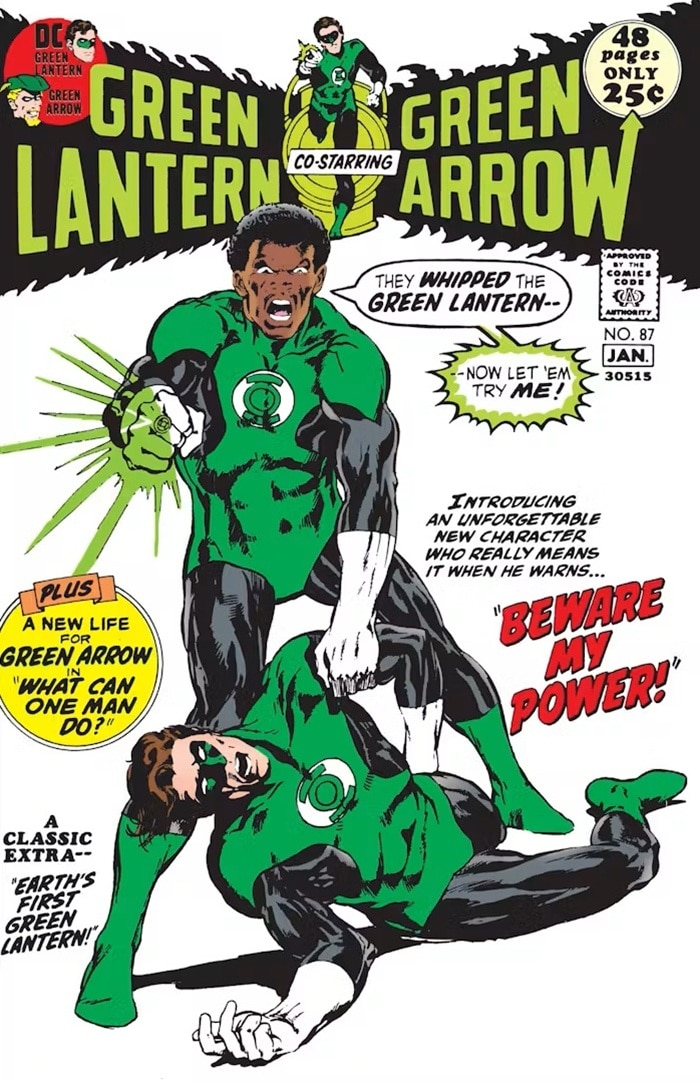
While there has been some handwringing online about this more grounded contemporary take on the Green Lantern mythos, the truth is that Green Lantern has a history of lending itself to this sort of storytelling. The comic book character of John Stewart was introduced during the Hard-Traveling Heroes era of Green Lantern, in which writer Denny O’Neil and artist Neal Adams had Hal Jordan wander across contemporary 1970s America confronting social issues like racism and drug addiction.
Lanterns feels very much like an attempt to adapt Hard-Traveling Heroes for the modern era, which is perhaps confusing to fans who are more familiar with the recent Geoff Johns epic that provided the basis for the underwhelming Martin Campbell film. In truth, it’s nice to see an adaptation drawing from different parts of the character’s long and storied history. The company already tried to adapt Johns’ run to film, and has been a major influence on various animated films and series.
If the reader will indulge a little comics nerdery, it also fits with the 1970s and 1980s influences on James Gunn’s DCU: the Watchmen influence on Peacemaker, how The Suicide Squad and everything flowing out of it is drawn from the underrated work of John Ostrander, the heavy influence of John Byrne’s Man of Steel on James Gunn’s Superman and so on. It feels oddly appropriate that Hal’s career in Lanterns began in 1986, the year that the Bronze Age of Comics ended.
As much as modern fans might bristle at the presentation of Hal Jordan as an over-the-hill hero in Lanterns, this take on the character defined the late 1980s and into the 1990s, with his greying hair introduced in 1987 and the addition of drink driving to his origin story in 1989. Just as the Silver Age Flash was put on trial and then died via heroic sacrifice, the Hal Jordan of the late ’80s and early ’90s was a complicated figure whose defining beat was failing to save his home city before turning evil.
These influences might not necessarily be what vocal individual fans want, but they are perfectly valid. Indeed, one of the more charming aspects of the DCU slate so far is that it does feel esoterically drawn from runs and approaches to these characters that honestly appealed to these creators rather than being something crowdsourced to social media. However the projects turn out, it is clear that those involved are drawing from works that matter to them.
More to the point, Lanterns is clearly a companion piece to creator Damon Lindelof’s last adaptation of a classic DC property, Watchmen. That series used the framework of intellectual property to engage with contemporary America through the lens of pulp fiction, in the way that the best comic books do. Watchmen was a series about racism and policing, about liberal overreach and white supremacy. It was also a fun comic book show.
Lanterns touches similar nerves. It digs into the subtext underpinning these sorts of stories and uses that as a prism to examine a divided nation. This is a show not just about racism, but about the anxieties underpinning racism. Hal is an old white man who is being challenged on the privileged life that he has enjoyed and never questioned, and he is clearly pushing back against that. However, Lanterns makes it clear that this anxiety does not exist in isolation.
One of the smarter ideas threaded in the premiere is that Hal himself was seen as something of a diversity hire for the Green Lantern Corps, explaining the chip on his shoulder. “A human getting a ring, isn’t it a fucking fluke?” he muses. He warns John, “I’ve been doing this job since you were a baby. I’m the only person on this whole goddamn planet who’s ever done this job.” There is a recurring sense that Earth is a backwater and the larger cosmos sees it almost as a hick planet.
After Hal gets himself arrested for the bar fight, he is bailed out by the mysterious local billionaire William Macon (Garret Dillahunt), who is concerned about the aliens. “There are thousands of planets out there with intelligent life,” William explains. “And here we sit, low-hanging fruit of the galaxy just waiting to get gobbled up. This land we’re on right now. It was Kiowa, then Sioux. But across the ocean, boats were coming.” It’s very pointed imagery, particularly in the context of 2016.
As with Watchmen, Lindelof is playing with the superhero as a quintessentially American genre. After all, Superman (David Corenswet) is the living embodiment of the American Dream, a refugee from a dying world who comes to America and reinvents himself as the best he could be. The superhero is in many ways the spiritual successor of the cowboy as an avatar of American mythology. Watchmen and Lanterns dig into the more complicated aspects of that dynamic and the American character.
“Colonization is ugly from any angle,” William explains to Hal. “But, I tell you, it is particularly bleak if you’re the one being colonized.” There is, throughout Lanterns, a palpable sense that much of the anxiety over immigration or even equality is rooted in fear that these disadvantaged, disenfranchised groups are going to do to those in positions of power and privilege what those people did to their own predecessors. Hal clearly worries that John’s ascension means his own demise.
There is a clear sense that Lindelof, Mundy and King are drawing this theme organically from the comic book lore. The Green Lantern mythos has always been about replacement and succession. Hal inherited the ring from the dying Abin Sur. In the comics, Hal cemented his reputation as a Green Lantern by deposing his mentor Sinestro (Ulrich Thomsen), a decidedly Oedipal arc. Even the Green Lanterns themselves were the successors to an earlier peacekeeping force, the Manhunters.
Lanterns is a remarkable work of adaptation, a show that draws on the source material in clever and inventive ways to construct a story about what the underlying logic of that franchise in particular and superhero stories in general mean in the context of contemporary America. It’s a bold work. Fearless, even.
Files