Home

 Creators
 Search
 Recent
 Random
 Posts
 DMs
 Tags
 Random
 Importer
 Import
 FAQ
 Account
 Register
 Login
 Favorites
 Keys
 Logout
 Telegram

[COLUMN] On Lanterns, There Are Rings Within Rings Within Rings | by Darren Mooney (Patreon)
Downloads
Content
Note: This piece contains spoilers up to the fifth episode of “Lanterns”, which is now airing on HBO and streaming on HBO Max. You should be watching it, it’s great. But be warned that this piece opens by discussing the final moments of the most recent episode.
At the climax of “Lights Out”, the fifth episode of Lanterns, as John Stewart (Aaron Pierre) makes his way through the ruins of Rushville, Nebraska, Bon Iver’s “Things Behind Things Behind Things” starts playing on the soundtrack. As the superhero moves through the wreckage created by the epic superhero battle that destroyed the town, having finally claimed the Green Lantern ring he thought he wanted, singer Justin Vernon intones, “There are rings within rings within rings.”
It is a cute soundtrack choice, but also a very clever one. Lanterns is very obviously a show about rings. “Only one can wear the ring,” boasts the series’ poster, referring to the magic power ring at the center of the narrative, one which allows the user to manifest anything that they can imagine. One of the central driving forces of the first five episodes of Lantern is the struggle between John Stewart and his mentor Hal Jordan (Kyle Chandler) over who gets to wear the ring.
The ring is more than just a prop. It is a symbolic expression of one of the central motifs at the heart of Lanterns. There is a lot to praise about Lanterns. It is the rare superhero show that is willing to tackle thorny and pointed political topics like race, privilege and immigration head on. It is also just incredibly well-made television. In an era where so many of these franchise properties (including movies) are content to be content, Lanterns is crafted with a remarkable care for form and story.
For example, it is a rare pleasure that Lanterns understands the importance of the episode as a unit of narrative. The show does not feel like an eight-hour movie that has been arbitrarily cut into hour-long chunks for broadcast or release. On so many of these shows, the individual episodes blur together. On Lanterns, each of the individual episodes serves a function, has its own narrative and thematic arcs, feeding into the season.
It’s clean and old-fashioned storytelling, reflecting co-showrunner Damon Lindelof’s pedigree as a veteran of shows like Lost, The Leftovers and Watchmen. More than that, though, the series has a very clear sense of structure and storytelling. The ring is an organizing principle within the show’s narrative framework. Watching Lanterns, there is always a sense that there are rings within rings within rings. Characters are often mirrors and reflections of each other. Events and choices echo.
A recurring criticism of Lanterns has been that the show is not sufficiently “cosmic” to capture what some fans demand of the Green Lantern mythos. This criticism requires some context. Pragmatically, Lanterns is a television show and so has budgetary concerns. The streaming wars are over. These properties no longer have infinite money. Creatively, the franchise tried the cosmic approach with Martin Campbell’s Green Lantern in 2011, and it was a cultural punchline level of disaster.
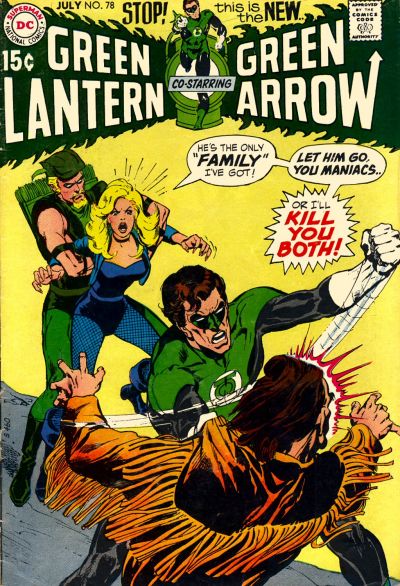
More to the point, despite the massive impact of Geoff Johns’ run on Green Lantern, the most important and influential comic book run on the character remains the grounded Denny O’Neil and Neal Adams take in Hard Traveling Heroes in the early 1970s, a comic so culturally significant that it may have started a new era for the medium, “the Bronze Age.” That story found Hal Jordan wandering across the continent, facing contemporary issues like racism, cults and drug addiction.
One of the things that the show does to communicate a sense of scale is to emphasize the cyclical nature of the story being told. There is a sense in Lanterns that the story unfolding on screen is just the latest permutation in something that has been rippling through existence, across time and space. It is something immeasurably larger than the characters or the world of the show, but it is improbably coming to a head in a small town in Nebraska, near the geographical center of the United States.
Lanterns takes place in the shadow of a vast cosmology, and things trickle down. Central to the show’s mythology is the idea that, relatively recently, there was an attempted coup within the Green Lantern Corps, led by Thaal Sinestro (Ulrich Thomsen). Sinestro was Hal’s mentor. Though Sinestro managed to kill one of the Guardians, a seemingly impossible task, he was seemingly stopped singlehandedly by Hal and thrown into prison.
Though Sinestro’s attempted coup is not depicted on screen, it informs pretty much every aspect of the show. For example, it is very clear that the Guardians have been shaken by this attempted coup, and their actions in the show are driven by their fear not only of Sinestro, but of the man who stopped him. The Guardians respond to this coup by assigning John Stewart to train with Hal Jordan, and to replace him.
Hal nurses his own trauma from the coup. One of the Guardians (Laura Linney) suggests Sinestro was a “father figure” to Hal, and so Hal having to take down his former mentor left a scar. The problem is compounded by the fact that the Guardians’ response to Hal’s incredible act of devotion to them, defeating his friend to protect them, has led them to treat him with paranoia and skepticism. Hal took Sinestro’s ring to protect the Guardians. Now John will take Hal’s ring to protect the Guardians.
The idea of “replacement” simmers through Lanterns, the anxiety felt by a person or a group that they are being displaced. William Macon (Garret Dillahunt) claims to be anxious about alien invaders, justifying his own anxieties by pointing out that the original inhabitants of the United States were displaced by European settlers. “This land we’re on right now,” he warns Hal. “It was Kiowa, then Sioux. But across the ocean, boats were coming.”
This is the anxiety that Hal feels about John, on a deeply personal level. However, it is also a broader cultural fear. The plot of Lanterns focuses on Hal and John traveling to Rushville in pursuit of an extraterrestrial robot that has taken the form of Zoe Macon (Poorna Jagannathan), Will’s wife. Zoe is the last surviving Manhunter, the army of robots that were created by the Guardians to police the cosmos, who were eventually discarded to be replaced by the Green Lantern Corps.
This is far from the only cyclic anxiety bubbling through Lanterns. So much of John’s arc is defined by race. John’s father (Sherman Augustus) was the first choice to wear the ring, but he was too afraid, because he was a Black man in the United States. “How the fuck was I not supposed to be scared?” his father recalls of his encounter with the ring. John’s mother (Nicole Ari Parker) challenges the Guardians, “Do you understand how unfair it is to ask a Black man in America if he’s afraid?”
Race even informs John’s interactions with Hal, who patronizingly describes John’s parents as “the Midwest Huxtables”, and who shows up late to training to try to provoke John into displaying his anger. “Come on, you gotta be a little angry,” Hal goads him. As John’s father reminds him over the phone, anger is a privilege that men of color rarely get to enjoy. “They’re allowed to have tantrums, we’re not,” he warns John. “So breathe in, button down and bottle up. You need to be cool, son.”
Lanterns suggests that this is itself the reverberation of something larger. The show repeatedly implies that Hal is subject, in his own way, to the same sort of racial prejudices. Hal is “Earth’s First Green Lantern”, and the Guardians don’t think much of it. “Earth’s way off grid, out of their jurisdiction,” he tells John. “Galactic fucking backwater. A human getting a ring, isn’t it a fucking fluke? The big, blue bosses, they’d never wanted any Lantern coming near our little shithole planet.”
Indeed, for all the conflict between the two men, there is a recurring sense that they each have some variation of the same chip on their shoulder – they were both told that they were not good enough, that somebody like them could never have the ring. The tragedy is that this sets the two men on a collision course with each other, putting them at odds. It prevents them from working together as efficiently as they might. It makes them both extremely easy for the Guardians to manipulate.
Other big ideas ripple down through the fabric of the show. In particular, the insidious nature of fear that manifests through the performance of fearlessness. Hal claims that he has nothing to fear following the death of his father, but he clearly fears losing the ring – perhaps because he worries he is nothing without it. John’s parents raised him to never show fear, but he fears not being good enough. The Guardians created a police force without fear, but then manipulate their officers out of fear that they might otherwise lose power.
All of this provides the drama with a sense of scale. It evokes the idea of Milton’s “war in heaven”, the idea of a conflict taking place on some abstract plane beyond basic human comprehension, manifesting across different levels of reality. The X-Files was a television show that was very good at this, with the human-centric conspiracy revealed to be just a manifestation of a larger conflict burning across the universe between the “colonists” and the “rebels.”
And even this cyclical approach to violence and fear is itself reflected at different levels within the narrative. Not only are Hal and John manipulated and defined by the fear that the Guardians feel, they are also both defined by the trauma they inherited from their parents. Hal watched his father die at a young age, something that clearly defined him. John was raised by his parents to be the perfect Green Lantern, in a way that has clearly left scars on his psyche.
It is not just big ideas. Lanterns is exceptionally graceful at capturing this idea of “as above, so below” in terms of basic plotting. At the start of “Lights Out”, for example, Zoe helps Kerry Kane (Kelly Macdonald) escape the men pursuing her from Gotham, understanding that Kerry’s fugitive status mirrors her own, albeit at a more parochial level. This sequence ends with Kerry chopping off her own finger so that the men can bring it back to Gotham as proof of death.
It is a small character beat, but it neatly prefigures two climactic beats involving John Stewart later in the episode. Much as Kerry faked her own death by cutting off a finger, John relieves Hal by prying the ring off of his finger. Much like the gangsters bring home Kerry’s severed finger as proof of a job well done, John cuts out Zoey’s heart to present it to the Guardians as proof that he has completed his assignment. It’s very effective narrative symmetry within an individual episode.
This symmetry even recurs within the visual language of the show. In the season’s fourth episode, “The Weenie”, John and Hal visit an abattoir owned by Will Macon. There is a lingering shot on a sign quoting the philosopher Immanuel Kant, “We can judge the heart of a man by his treatment of animals.” It is a very wry statement on a number of levels. It’s a funny sign in an abattoir. It is an allusion to Zoe’s heart, which crystalizes upon her death – not a heart, but a simulation of one.
It is also a fairly overt allusion to what Zoe is doing in Rushville. Zoe is a Manhunter. She is an alien intelligence. She is not human. She is in many ways more than human. Zoe has arrived in Rushville and has transformed the community. She heals the residents. She invests in the town. She allows Rushville to thrive. However, she does not do this out of altruism. She manipulates the town so that it might protect her. These are just animals to Zoe, cared for like the cattle at the abattoir.
The same laser technology that the abattoir uses to slaughter the cattle is ultimately turned against the town of Rushville, raining destruction down on the community and killing the town. It is very effective visual storytelling. Similarly, there is a nice visual reversal in John’s meetings with Guardian in the third episode, “OutKast”, and the fifth episode, “Lights Out.” In “OutKast”, she interviews him from behind a table. In “Lights Out”, he interviews her from across a bar, the sequences shot to mirror each other, communicating shifting dynamics.
In some ways, this helps to define Lanterns as a comic book show. The nature of comic book storytelling, in which characters and series can exist for decades in an unending second act, tends towards the cyclical. Patterns and arcs repeat, playing out in different permutations and configurations. In some ways, this is perhaps the closest that comics come to being mythology, iterating over the same stories time and time again.
Lanterns weaves this idea into the very fabric of the show - everything is iterative, everything reverberates. The personal conflict between Hal and John reflects broader cultural anxieties and larger mythic struggles within the continuity of the property. Hal and John both nurse the same wounds and insecurities, but lack the ability to meaningfully recognize that in each other. Hal deposed a rogue Green Lantern, only to be deposed as a rogue Green Lantern. Antaan (Paul Ben-Victor) watched his world die at the hands of the Manhunter, and brings the apocalypse with him to Rushville. It’s all one big ring cycle.
Lanterns is remarkable television. It’s big, ambitious, character-driven storytelling of the kind that is relatively rare in the context of these sorts of intellectual properties. However, it is also just very well constructed. Appropriately enough, Lanterns understands that there are rings within rings within rings.
Files