Home

 Creators
 Search
 Recent
 Random
 Posts
 DMs
 Tags
 Random
 Importer
 Import
 FAQ
 Account
 Register
 Login
 Favorites
 Keys
 Logout
 Telegram

[COLUMN] The Missing Heart of Clayface | by Darren Mooney (Patreon)
Content
Note: This piece contains spoilers for DC’s Clayface, which is in theatres now. The film is mostly fine. Like James Watkins’ adaptation of Speak No Evil, it takes thorny and interesting source material, sands down a lot of the potentially provocative elements, and mostly offers an enjoyable and functional horror film. It features some properly gnarly body horror, and a delightful fun third act night club action scene, but most of the movie feels extremely functional and formulaic. It’s solid sturdy stuff, if a little empty. A clay vase.
It is, perhaps, easy to be skeptical of Clayface, the latest entry in the DCU.
It is an attempt at a different sort of comic book movie than these sorts of shared universes have usually developed. It is a modestly-budgeted horror movie costing just $30m from British director James Watkins. It was largely shot in Liverpool, with a primarily British cast including lead Tom Rhys Harries, along with supporting performers including Naomi Ackie, Max Minghella, Eddie Marsan and Rob Brydon. There is a lot riding on this film, in terms of the genre’s long-term sustainability.
However, it is also a film about a somewhat C-list comic book villain who is notable primarily due to his longstanding relationship to an A-list superhero, Batman. There is a sense that, just as Sony announced the end of their “Sony Pictures Universe of Marvel Characters”, a series of Spider-Man films starring everyone but Spider-Man (Tom Holland), from Morbius to Kraven, DC have stepped into the gap, producing a Batman film in a universe that has yet to even cast its Batman.
On the other hand, there is a reasonable argument to be made that any character could theoretically justify a feature-length film, if that film is good enough. Clayface (Rhys Harries) isn’t even the first Batman villain to get his own solo film without the Caped Crusader in tow. Todd Phillips’ Joker grossed over a billion dollars at the box office, won the Golden Lion at the Venice Film Festival, and made Joaquin Phoenix the second actor to win an Oscar for playing the Clown Prince of Crime.
And there is certainly a case to be made for Clayface as the kind of character who could theoretically support a compelling body horror film. The character is a mainstay of Batman’s rogues’ gallery, introduced in June 1940. The original take on the character was disgraced actor Basil Karlo, named in honor of two icons of the silver screen, Basil Rathbone and Boris Karloff. Karlo was simply a master of disguise, a classic pulp villain who was not yet a superpowered monster.
As is the way with comic book villains, the character’s continuity expanded and developed. Over the years, multiple characters came to take on the name Clayface: Matt Hagen, Preston Payne, Sondra Fuller, Cassius "Clay" Payne, Peter "Clay-Thing" Malley and so on. There were so many different takes on the character that writer Alan Grant and artist Norm Breyfogle banded them together to form “the Mud Pack.” Still, the character came to be defined as a gooey shapeshifter, often a former actor.
During the 1980s, something really interesting began to happen with Clayface as a character. A central metaphor began to develop around Clayface. This was most obvious with the third Clayface, Preston Payne. This Clayface had to live trapped inside a containment suit. His very touch could kill. He was defined as a monster through his habit of “transferring his curse.” Whether Payne had been intentionally created as a metaphor was incidental. In the era of HIV and AIDS, he became one.
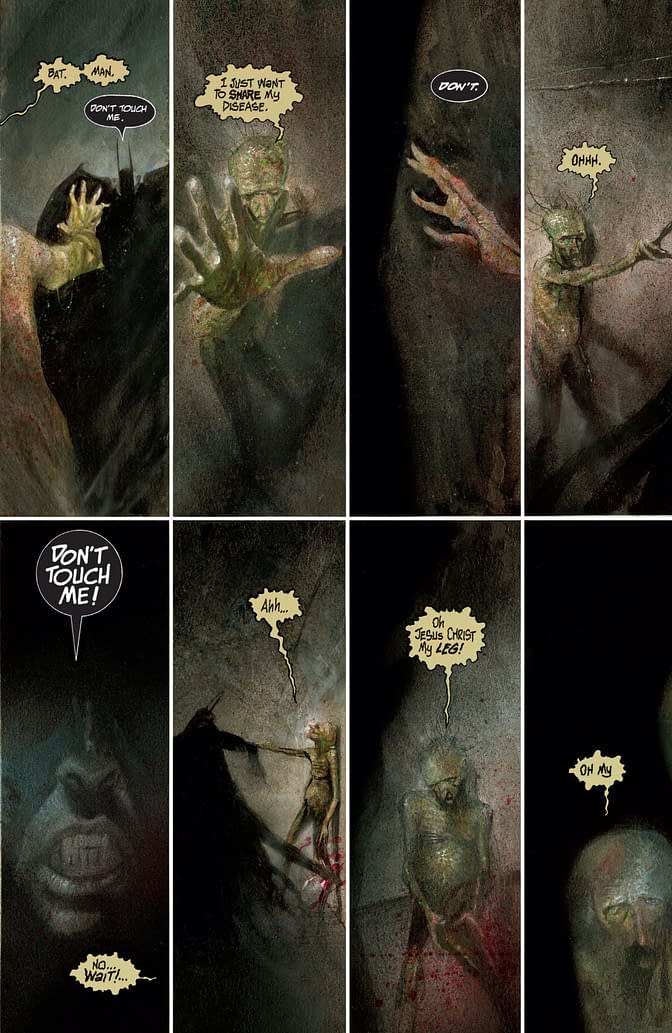
This metaphor was made explicit in the pages of Grant Morrison and Dave McKean’s Arkham Asylum: A Serious House on a Serious Earth, which featured Batman encountering a sickly deformed Payne in the “Tunnel of Love” that the Joker had constructed in Arkham Asylum. “I just want to share my disease,” he promises Batman, reaching out. “Alert readers will perceive him as AIDS on two legs,” Morrison noted in their script. Rhys Harries has cited this take as an influence on his interpretation.
Although the character stumbled upon it by accident, there is a strong subtext to Clayface that emerges across the first fifty years of the character’s publication history. He was an actor who was infected with something that transformed him, rendered him toxic and dangerous. He has to disguise himself to pass among the general population. Clayface is a fundamentally queer character, one that is almost impossible to read outside the context of Hollywood history and the AIDS epidemic.
Hollywood history is full of famous stars and other professionals who had to conceal their sexual identity to continue to work in the industry. For decades, queer content had to be buried and sublimated within cinema, the people working on these movies having to disguise the parts of themselves that they put in their work, in what was known as “the Celluloid Closet.” Horror movies and monster movies were often modes of veiled expression of this queer sexuality.
It has been argued that legendary filmmaker James Whale seeded queer subtext into his classic horror movies, most obviously The Bride of Frankenstein and The Invisible Man. These were stories about people cast out and alienated from society, labelled freaks and weirdos often by virtue of simple difference. It’s worth acknowledging that the body horror subgenre, where Clayface is squarely placing itself, really exploded in the 1980s and into the 1990s, with many critics linking the subgenre’s anxieties over the human body to the AIDS crisis that was unfolding in parallel, sometimes coincidentally.
It is also worth acknowledging that the superhero genre itself, which emerged around the same time, has always been somewhat queer coded with its emphasis on “transformation, disguise and duality.” These are stories about people who have to hide their true selves from the world, who conceal their identities before venturing out into the night to engage with unconventional characters living unconventional lives. This queer subtext was a large driver behind the moral panic that led to the establishment of the Comics Code Authority.
This queer subtext within the larger movie and entertainment industries became inexorably tied to the AIDS epidemic during the 1980s and into the 1990s, raising public awareness about and empathy towards those afflicted by the condition through high-profiled cases like the death of actor Rock Hudson and the public diagnosis of athlete Magic Johnson. Even today, coverage of the diagnoses of celebrities like Charlie Sheen does a lot to dispel the stigma around the illness.
This context around the character really galvanised in his introduction in Batman: The Animated Series, in the two-part episode “Feat of Clay.” There, Matt Hagen (Ron Perlman) is a disfigured actor caught in the throes of addiction to industrialist Roland Daggett (Ed Asner), dependent on the “ReNuYu” cream to maintain his movie star good looks. His addiction makes him volatile, reckless. “Once they’re hooked, they stay hooked,” muses one of Daggett’s goons (Scott Valentine).
Central to the episode is Matt’s incredibly close relationship to Teddy Lupus (Dick Gautier). Teddy is seemingly the only person in the world who cares about Matt, the only person who truly knows and understands him. Matt is free to be himself around Teddy. No matter how temperamental Matt is, Teddy remains loyal and loving and considerate. Even to many of the children in the audience, even with concessions to broadcast standards and practices, the subtext was clear.
It was, in the words of director Kevin Alteiri, “an intentionally gay relationship.” In I am the Night, the recent history of the show, storyboard artist Brad Rader conceded, “What was in front of me was an unspoken gay relationship that I immediately clued into. It informed how I boarded that episode and I tried to make it more sympathetic.” The production team have openly acknowledged that Matt and Teddy are a queer couple, albeit one forced to maintain the appearance of a heterosexual friendship.
The story’s closing moments find Teddy wandering alone through Gotham after Matt’s seeming death, mourning the loss of a man who was so close to him that he cannot even articulate it. Matt, who inevitably survived, is hiding in the background, disguised as a beautiful woman. He watches Teddy stand there as Bruce’s (Kevin Conroy) closing narration suggests that Matt played “a death scene so real, it fooled us all.” The episode suggests that there was another drama playing out.
It is no exaggeration to suggest that “Feat of Clay” is a sizable influence on James Watkins’ Clayface. “That two-parter knocked me out,” writer Mike Flanagan admitted. “The short answer is that is absolutely what inspired my script. That is the world I wanted to live in.” The Clayface in the movie is Matt Hagen. He is a star working at Imperial Pictures, the same Warner-Bros.-inspired studio from the cartoon. And he even has a close male friend, Corey Bowery (Joshua James).
There are small beats in Clayface that suggest a more interesting film, one far more in line with Flanagan’s other work. There are hints of the addiction subtext carried over from the episode, with Matt raiding the minibar on a private jet and drinking shots on a commercial jet leading to a meltdown. At one point, he grows so dependent on the nanites that he injects a reckless amount into himself in a sequence that the movie itself describes as “an overdose.”
There are other touches drawn more obviously from Flanagan’s fascinations. When Gotham mobster Markos Szabo (David Dencik) shows up to threaten Matt, he pauses first to monologue about the fact that the two men share abusive fathers and to ruminate on the possibility that their own destructive impulses are inherited. Doctor Caitlyn Corr (Ackie) is motivated to pursue cellular regeneration over guilt for her brother’s death due to an inherited degenerative condition that she avoided.
There is a recurring emphasis in Clayface on self-harm. Matt repeatedly scars and re-scars himself in the same pattern that Szabo disfigures him. First when trying out his new regenerative powers, going from pricking his finger to cutting his face. Later, attacking Szabo, Matt cuts his face open in the same way Szabo did, so the blood runs over Szabo. Corr runs experiments on her own peeled flesh, wearing bandages on her wrists, a nice metaphor for the idea of self-destruction as almost ritual.
However, one of the strangest aspects of Clayface is how insistent it is that there is no queer subtext or reading of the work. It represents almost a complete rejection of the most interesting strand of the character’s history. Matt and Corey are not a closeted couple. Matt is introduced trying to set up Corey with one of the girls in the make-up trailer. Matt is defined by his attraction to women. Szabo only ends up scarring Matt because Matt sleeps with Szabo’s girlfriend, Mia (Joana Ribeiro).
When Matt murders Corey for his betrayal, literally smothering him inside his body, the film is quick to contextualize this intimate act as fraternal rather than sexual. “You broke my heart,” Matt sobs, holding him close, in a direct invocation of Michael (Al Pacino) discovering his brother Fredo’s (John Cazale) betrayal in The Godfather, Part II, leading to Michael murdering Fredo and completely dooming his already tainted soul. Matt and Corey are not lovers, they are brothers.
After Szabo scars Matt, Matt seeks Caitlyn’s help. Matt immediately falls in love with Corr, entering into a love triangle with her fiancé, Gotham City Police Detective John Borrelli (Max Minghella). Clayface really firmly and confidently wants its audience to know that Matt Hagen is straight. Indeed, it turns out that Corey betrayed Matt to Szabo by revealing his deepest darkest secrets. Those deepest darkest secrets were that his school friends hated him, it seems.
There are fleeting moments when it feels like Clayface might acknowledge the queer subtext of a movie about an actor who can shape and reshape his body in any imaginable ways. While sleeping, he transforms into Caitlyn as a manifestation of his desire, and starts to suggestively caress himself. Disguised as midlevel goon Sal (Corey Johnson), he forced a random guard into a men’s room stall for a bit of rough play. Disguised as a woman (Francesca Corney), he grabs another guard’s crotch.
However, these moments are few and far between, and somewhat undermined by how hard Clayface works to assure the audience that Matt Hagen is a completely, unequivocally, uncomplicatedly straight man. Even when he turns into a strange amorphous creature, Matt is seemingly even more of a straight dude. The final confrontation of the movie is between Caitlyn and Matt, with a closing scene finding Matt sculpting a copy of Caitlyn from his own clay.
It is very strange, particularly given the long history of queerness associated with the character and the long history of queerness in horror cinema. A large part of the thrill of Jane Schoenbrun’s Teenage Sex and Death at Camp Miasma lay in the film’s understanding of the importance of even thorny or problematic queer sexuality in these sorts of films. It is strange to imagine that Morbius is more comfortable with its homoerotic subtext than Clayface.
It is hard not to read this in a larger context. There has been something of a cultural retrenchment over the past few years, particularly in terms of queer representation. Disney removed an episode of Moon Girl and Devil Dinosaur featuring a trans character. A trans plotline was cut from the Pixar show Win or Lose. Queer elements were trimmed from the Pixar film Elio. Warner Bros. was recently purchased by Skydance, a company owned by a family aligned with the current administration.
This is not to suggest or imply that the Skydance acquisition had any direct influence on the plot of Clayface. The film was finished before the deal completed. Rather, it is perhaps an acknowledgement of a shifting landscape. It is striking that James Gunn’s streaming show Peacemaker could feature an explicit orgy in its second season premiere, but an R-rated horror movie within the same superhero shared universe cannot even gesture at the possibility of a queer reading.
This latest entry in the canon is built on foundations of clay.
Files