 Home

 Creators
 Search
 Recent
 Random
 Posts
 DMs
 Tags
 Random
 Importer
 Import
 FAQ
 Account
 Register
 Login
 Favorites
 Keys
 Logout
 Telegram

Paul's Preview: McGregor vs. Cerrone (Patreon)
Content
The last time Conor McGregor tasted victory, Barack Obama was still in office and Donald Trump just won the US presidency. He used his status as the first double champion in the UFC to set up a lucrative boxing match against Floyd Mayweather Jr. After that spectacle (in which he lost), McGregor returned to the Octagon only to suffer a one-sided defeat against Khabib Nurmagomedov. His lackluster performances inside the cage are only compounded by his many legal problems outside of it. Desperate to bounce back and win the crowd once again, McGregor is moving back up to welterweight in a match-up against Donald “Cowboy” Cerrone. Despite going 0-2 in his last two fights, Cerrone is confident in his chances against McGregor and welcomes the challenge regardless of the weight class. On paper, this is a fight tailor-made for McGregor to win. He can notch up a victory against someone who has 3 different records in the UFC (most victories, most finishes, most post-fight bonuses) and parlay that into any number of future fights. He can demand a rematch against Nurmagomedov, challenge Jorge Masvidal for his BMF “title”, or complete his trilogy with Nate Diaz. All this however is moot without a win first. Cerrone isn’t the top ranked lightweight or welterweight he used to be but is still dangerous enough for McGregor to not take lightly. Are his chances as limited as the critics say they are?
Truth be told, Cowboy is now the person you must beat to complete for a title. Everyone who has beaten him has gone on to become #1 contenders or fight for titles themselves. Despite his best efforts to break from the “always a bridesmaid, never a bride” label, Cerrone has lost all his major MMA title fights, and just when he looks like he’s on another indestructible run, he falls short. To be fair to him, he has lost only to the best in the lightweight and welterweight division, and no one can accuse him of taking easy fights to pad his record. It’s the unfortunate truth that when you compete against the best in the world, the chances of you losing rises significantly. Even his last two fights (and losses) were against Justin Gaethje and Tony Ferguson, former world champions that can give anyone at lightweight a run for their money. Cerrone’s 2019 was filled with four fights and he went 2-2, and even though he lost his most recent fights he still ended up with a TKO over Alexander Hernandez and won a unanimous decision over the always tough Al Iaquinta. Cerrone has had more fights in the past year than McGregor has had in the past four years. There is something to be said about staying active, and Cerrone has been doing just that. Let’s take a closer look at his last four fights in greater detail.
Fresh off a submission victory over Mike Perry in November 2018, Cerrone jumped right back into the fire and faced off against Alexander Hernandez just two months later. The young Hernandez felt that Cerrone’s time was coming to an end, and he felt confident that he had the veteran all figured out. Hernandez started their fight by charging straight forward and pressuring Cerrone, hitting him with short punches and crowding him against the cage. Hernandez would stance switch and hit Cerrone with some clean strikes, and it looked like Cerrone was in trouble early. However, Cerrone has been fighting in the UFC longer than Hernandez has been fighting as a profession, and experience counts for something. After taking Hernandez down and slowing down the pace, Cerrone got to work and began to pick apart his upstart opponent. Cerrone’s counter right hands, knees and elbows from the clinch, and high kicks all began to tire out Hernandez and keep him guessing as to what was coming next.

(Cerrone baits Hernandez with his lead hand before blasting him with a kick. Notice how Hernandez is off balance and absorbs the strike basically on one leg.)
Cerrone has never been a Thai clinch specialist, but it was a treat to see him utilize it to blast Hernandez with elbows and knees whenever they separated. Hernandez had no answer for Cerrone’s intercepting knee and ran into it, solar plex first, and this ended up tiring him quicker than anticipated. Cowboy is at best when he’s throwing combinations and getting opponents to defend against multiple strikes from different angles, and he showed shades of it in this fight. A head kick sealed the deal and gave Cerrone the TKO victory, and he followed that up with a match-up against Iaquinta.
Iaquinta had just won a decision over Kevin Lee, and he felt that a win over Cerrone would be more than enough to give him another shot at Nurmagomedov (who said the UFC rankings made sense?). Even though he held his own and tagged Cerrone with some crisp punches and round kicks, Cerrone dug deep and started turning things around in round 3. What made the difference for Cerrone was his ability to flick out the jab and pester Iaquinta with inside/outside low kicks. Granted that Iaquinta’s defense has never been stellar, it was good to see Cerrone at lightweight keep a consistent pace for five rounds without tiring. He proved that he could weather a storm and dig deep if necessary, although that hasn’t always been the case throughout his career.

(A front kick to the face would be a nice threat against someone like McGregor, it comes up the middle with very little tell.)
Just when it seemed like another title run was possible, Cerrone got matched up with Tony Ferguson. “El Cucuy” has built a reputation as the best lightweight in the UFC outside of Nurmagomedov. With the massive McGregor vs. Nurmagomedov fight already booked, Ferguson needed a dance partner to stay busy and build on his incredible win streak. Cerrone is never one to back down from a challenge, so the fight was made for UFC 238. The fight was clash between the tried and true methods of Cerrone against the unorthodox attacks of Ferguson. It became clear towards the middle of round one that Ferguson was finding his groove and figuring out Cerrone’s patterns. His constant stance switching, straight punches, spinning elbows were giving Cerrone fits, not to mention badly damaging his eyes and nose.

(A beautifully timed jab at Cerrone followed by ducking out of harm’s way, ending with a spinning elbow.)
Ferguson also had a lot of success with front and low kicks against Cerrone, slowing the pace down and giving him the opportunity to switch stance and throw those spinning elbows. It was interesting to see that even Cerrone got caught a few times flush with the spinning elbow, he almost instinctively kept going Ferguson when his back was exposed. Even though the doctor stopped the fight at the end of round 2, it was clear that Cerrone was no match and the bout was mercifully called off. Not wanting to end 2019 without another fight, Cowboy accepted a match against Gaethje for September 2019.
Gaethje didn’t necessarily back Cerrone up to beat him, instead he used smart feinting and a solid counters to win. Even though Cerrone is vaunted for his kicking game, it was Gaethje who consistently chipped away at the legs of Cerrone and kept him in place for his straights right into the clinch (where he could sneak in an uppercut or two). Cerrone looked a step slower in this fight, almost as if he was expecting a different Gaethje. With his lead hand low and noncommittal jab, it was tough to see the once quick Cowboy simply reacting to attacks. The improvements that Cerrone showed in his jab against Tony Ferguson and Al Iaquinta didn’t appear against Gaethje, which is a shame considering that it’s how guys like Dustin Poirier and Alvarez were able to occupy his forearms and keep him from swinging his hooks and straights. Gaethje soon realized that Cerrone wasn’t fast enough to react to his punches and a counter right puts Cerrone down.

(Gaethje times a missed jab from Cerrone and counters with a right hand, dropping Cerrone. It’s a bit worrisome that this was 6 months ago.)
The loss meant Cerrone is now 2-2 in 2019, not the way he wanted to end the year. This doesn’t mean that he can’t fight anymore, and please keep the caliber of opponents that have beaten Cerrone in mind. On the other hand, it’s clear that enough damage has accumulated for Cerrone to require more time to analyze and break down his opponents and figure out the best approach at beating them. Unfortunately, if the opponent can hurt Cerrone early or has prepared a specific game plan just for him, it becomes harder for him to adapt and pull out a victory.
Cerrone’s activity has kept him constantly working and in fighting shape. The downside of fighting so frequently is that even though you’re physically conditioned for the rounds, you’re not be able to work on anything new or sharpening up on the things that can be game changers. Cerrone is more or less a finished product. He never developed an answer to forward pressure, straight hitting, and body shots. His best weapons are usually on display against wrestlers, whom he usually has more success against than people expect. His intercepting knees are a great deterrent for fighters looking to pressure him and go for a takedown, and his slick submissions from his back give many opponents pause when it comes to keeping the fight on the ground for long stretches.
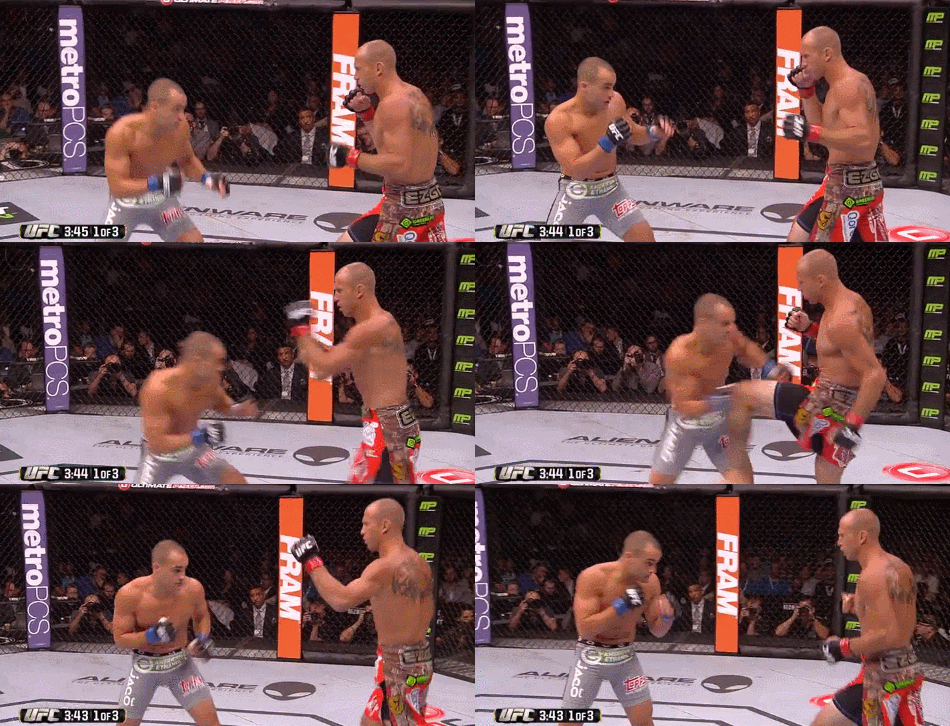
(There’s a reason why Alvarez was hesitant to shoot in, and it’s due to the multiple knees he took to the midsection when he tried to close the distance.)

(He’s not vintage BJ Penn, but if Cerrone has you hurt he won’t hesitate to hunt for the submission if it presents itself.)
Cerrone also has near 90% takedown defense, and you can count on one hand how many times he’s been taken down in his past 20 fights. His right straights and occasionally active jabs combined with his kicks are enough to give anyone at welterweight and lightweight a tough fight, but he does seem to struggle against the top of the division. The question now is if McGregor is still good enough to count himself in that company.
McGregor usually takes the center of the Octagon to establish himself, standing tall in the southpaw stance. From here, he cautiously paws at your lead hand and throws left straights to cut off your exit to the right and will throw the occasional front kick to keep your back to the fence. Usually the opponent will panic and charge directly at him, giving him a chance to take a step back to let the punch whiz by, only to come back with a left straight counter. This was demonstrated beautifully in his fight against Eddie Alvarez, by far McGregor’s best performance to date.

(Chin high in the air with his lead hand low, McGregor baits Alvarez into rushing into his left straight, followed by some more strikes to seal the deal to win his second title.)
McGregor’s ability to skip back and allow Alvarez to miss with his punches meant that he could fire back with his southpaw straight, often multiples times. This requires a great deal of timing and accuracy, since McGregor is relying on head movement and reactions to evade his opponents strikes. When it works, it looks like poetry in motion.
In his last fight against Nurmagomedov, McGregor seemed committed to his strengths and came forward, daring Nurmagomedov to try and take him down. Any decent MMA coach worth their salt will advise that lateral movement and defensive footwork are key to avoiding takedowns from strong wrestlers, but for whatever reason McGregor fought differently. Despite his best attempts at staving off the takedowns, he was grounded multiple times by Nurmagomedov’s single leg, double leg, and high crotch takedowns. In the second round, Nurmagomedov’s awkward striking rhythm and threats of the takedown clearly had McGregor off his game, and he absorbed an overhand right flush to the jaw. I mentioned earlier that McGregor’s style requires a great deal of timing and accuracy, and when it works well it’s like poetry. When it doesn’t work, he leaves himself dangerously exposed and open to shots like this.

(Bottle added for dramatic effect, but this was the only time McGregor was dropped from a punch and it was from Nurmagomedov, of all people.)
Although it was clear that he was losing, McGregor wasn’t entirely out of the bout. He did a good job of preventing Nurmagomedov from getting the body lock and showed good grappling ability in working two hands on one, in addition to blasting Nurmagomedov with elbows whenever he was pressed against the fence (it’s only fair to point out that a fair number of these elbows were illegal blows, which only angered Nurmagomedov further).

(This level of feinting and circling was nowhere near present in the first round, and it could have kept McGregor in the fight longer.)
McGregor’s usual front kicks and straights to the body were on point, but not thrown often enough. Nurmagomedov had clearly done his homework, mixing in well-timed feints and kept McGregor at the end of his jabs, setting up his right hand straight into a clinch attempt. By the time the 4th round rolled around, an exhausted McGregor gave up a body lock, giving Nurmagomedov the perfect opportunity to take his back and submit him. This marked McGregor’s second loss in the UFC, and it was done in identical fashion to his first. This begged the question in many fans minds: was McGregor ever that good, or was he a product of good match making?
The truth is a mix of both: McGregor is clearly talented and has a skillset that few can match up against, but he’s also been protected during his rise and was given fights that were favorable to him. He towered over most featherweights during his time in the weight class and has never defended a belt successfully. McGregor’s ability to get inside his opponent’s heads and suck them into his game is astounding, and very few fighters can claim to have that ability. Even though McGregor hits hard, let’s remember that most of his knockouts (actually, all of them) have come against fighters that he has a height and reach advantage over. A look at his record shows that when the opponent is taller (or bigger), he either wins by decision (Max Holloway, Joe Duffy, the second Nate Diaz fight) or loses (Khabib Nurmagomedov, the first Nate Diaz fight). It could be that since McGregor relies heavily on countering his opponents, trying to punch over a taller opponents jabs and straights prove much more difficult and takes some of the power off. Not to mention the fact that if the opponent is bigger, they’ll simply be able to absorb the strikes better than most other featherweights. Seeing as how this fight is against Cerrone at welterweight, what are some keys to victory?

(McGregor’s took full advantage of Aldo’s habit of leading with his face and timed the perfect counter left.)

(Even though the left is thrown perfectly, it’s not enough to knock out the larger Diaz who eventually rallied back.)
At 6’1” with a 73” reach, Cerrone is on the bigger side of opponents that McGregor has faced. Even though he towers over the 5’9” Irishman, McGregor actually has a slightly longer reach (even if its by 1”). Being as battle tested as Cowboy is, he’ll have to be on his A-game to effectively beat McGregor. Cerrone has an effective ground game, and he can (and should) try to take the fight to the ground whenever the opportunity presents itself. A front kick (like the one he threw against Iaquinta) can hide a stance switch just long enough to get in close enough to initiate a clinch.

(Let’s not forget that when Cerrone goes high and low with his running combinations, it can spell trouble for even the toughest of fighters.)
Cerrone’s double and single legs might be too slow, but clinch to trip takedowns can still be effective. If he thinks that the takedown isn’t there, he can always throw elbows and knees off the break, much like he did against Alexander Hernandez. If McGregor does move forward to pressure Cerrone, his intercepting knee is one of his best weapons and can drain McGregor’s gas tank as the fight wears on. McGregor also dislikes low kicks, and it should be something that Cerrone is working consistently on. Cerrone’s fight against Iaquinta showed that he can definitely throw low kicks over 5 rounds, and he should be throwing these (along with low line kicks) to keep McGregor at a distance.
Speaking of body work, McGregor has his hands low inviting you to strike him at his seemingly vulnerable head. This is to bait you to take a swing so he could counter with his straights. When you ignore this ruse, it does give you an opportunity to attack the rest of his body, especially the legs and midsection. Mayweather showed that consistent body work can drain your gas tank (making you vulnerable for the finish) and Diaz also focused on volume to get McGregor to overcommit and expend more energy than necessary. Cerrone doesn’t have to cover up and absorb strikes on his forearms (ala Gaethje) but getting McGregor to throw often can get him tired sooner and leave him open to counters.

(A commitment to body work pays off in the later rounds as Mayweather so aptly demonstrates.)

(Another great way to tire out the body without risking a tie-up at close range.)
McGregor’s footwork is going to be key in beating Cerrone. The good news is that McGregor’s style naturally gives Cerrone a lot of problems. He loves moving forward and pressuring you against the fence with just his footwork alone. Even though he’s limited the use of his kicks, McGregor does have an arsenal of kicks that he employs to keep opponents in place long enough for his left straight.

(If you throw enough kicks early, it can dissuade your opponents from trying to close the distance.)
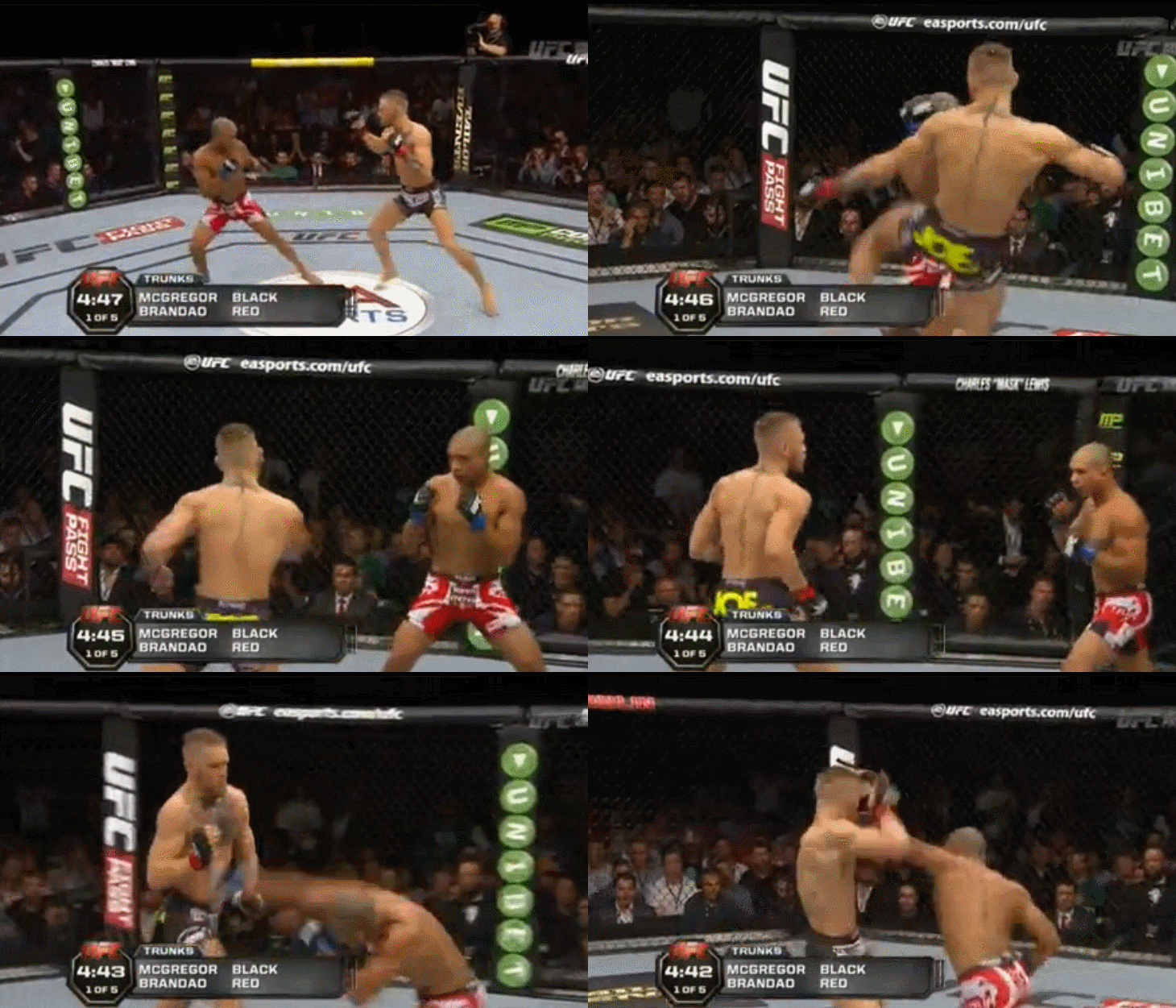
(A bicycle kick and spinning back kick has Brandao lunging back wildly with punches, just the reaction that McGregor was looking for).
Against the likes of Diego Brandao and Max Holloway, he used a barrage of hook kicks, bicycle kicks, wheel kicks, and even side kicks to the body. It might seem counter-productive to kick with someone like Cerrone, but keep in mind that Gaethje and Ferguson also had a lot of success by kicking first and keeping Cowboy from advancing forward.
If for whatever reason McGregor wants to employ a boxing heavy game plan, he can employ a similar strategy that Jorge Masvidal utilized with some slight tweaks. Masvidal took advantage of Cerrone’s dislike of straight punching by constantly moving forward and landing his jab repeatedly, blurring his vision and pounding his head. It didn’t matter if they weren’t powerful, it was a constant annoyance and kept Cerrone from landing his own strikes. To keep Cerrone from spamming him with teep kicks, Masvidal would raise his lead leg and jab when he came down. This also had the serendipitous side effect of checking Cerrone’s kicks and deterred him from throwing recklessly. Adding in his own knees and strikes to the body further lowered Cerrone’s hands, giving Masvidal an opportunity to land with his right straight. Masvidal’s best strikes came when he would catch Cerrone’s kicks, carry it across his body, and land his right hooks. Given that McGregor is a southpaw, some adjustments will have to made for the stance difference but the fundamentals are the same: forward pressure with constant jabbing and push kicks can thwart even the best version of Cerrone.


(Everything described in the paragraph above can be shown quite nicely by these two clips.)
If McGregor is able to beat Cerrone, expect the UFC to give him either Masvidal, Nurmagomedov, or Diaz for his next outing. It’s never a guarantee when he’ll fight again (or what shenanigans he’ll get himself involved in), so the brass is going to have to take advantage of his availability when they can. For Cerrone, a win means that he can still beat someone that stylistically is a terrible match up. Even if its against a former 145 pounder, it’s still a big feather in his cap and should grant him the ability to call out another top tier fighter who’s not tied up, possibly against someone like Colby Covington, Stephen Thompson, or Vincente Luque. The rest of the card isn’t much home to write home about, but this fight should satiate fight fans until Jon Jones faces off against Dominick Reyes.
