 Home

 Creators
 Search
 Recent
 Random
 Posts
 DMs
 Tags
 Random
 Importer
 Import
 FAQ
 Account
 Register
 Login
 Favorites
 Keys
 Logout
 Telegram

WTF happened to Anthony Pettis (Patreon)
Content
By Paul
At UFC 181, Anthony Pettis became the first fighter to submit Gilbert Melendez, a former two-time Strikeforce lightweight champion as well as a former WEC lightweight champion (much like Pettis himself). Melendez has lost before but has never been finished, let alone submitted. Everyone knew that Pettis was a phenomenal striker, but his back to back wins over Ben Henderson and Melendez proved that his submission game isn’t anything to take lightly: he is a threat everywhere and anywhere. Much like Lyoto Machida before him, Rogan declared that the Showtime era was upon us. Unfortunately, also like Machida, it seemed as if this prediction was woefully incorrect. He went from being labeled as the future of the division to a sub-500 fighter in the span of five years. At UFC 246, Pettis lost by submission against Carlos Ferreira (who was previously ranked outside the top 15). It raises the question, "What the fuck happened to Anthony Pettis?" Let's unpack it by answering three questions...
What made him so good?
At the peak of his abilities, Pettis was an explosive striker known for his excellent kicking game that he could execute from both orthodox and southpaw stances. With his taekwondo background serving as the base for some of his more creative attacks, Pettis had little fear of being taken down since submissions off his back are a great way to end the fight, or create scramble opportunities to get back up to his feet. Of particular note was his roundhouse kick. During his first run up to the UFC title, he was destroying the likes of Donald Cerrone and Joe Lauzon with it, and Ben Henderson ate a couple of them and didn’t ask for seconds. What made it particularly frightening wasn’t just the speed, but the accuracy of the kicks. What I mean by that is traditional kickboxers (like in muay Thai) are taught to connect with the middle of the shin bone since its tougher and will land with more power. Pettis’s taekwondo training has taught him to be lightning quick and connect with the lower end of his shin, sacrificing power for speed. The thing is, if a kick is fast and accurate, it’ll do damage if it lands anywhere the opponent isn’t expecting it. Pettis doesn’t always cut the outside angle to throw a kick. Even if his lead foot is inside the opponents lead foot, he’ll throw the kick anyways since he’s confident in his ability to land. By changing up the location where he’ll hit with (middle of the shin, lower end of the shin), it’ll disburse on the opponent differently, not knowing if they’ll be on the receiving end of a quick strike or a powerful one. If he feels like the opponent will block attacks from the side, Pettis can throw a kick right up the middle.

(After throwing out his left straight to keep Cerrone’s hands occupied, Pettis launches a kick to Cerrone’s midsection that mostly lands with the lower end of shin. Cerrone absorbs the kick and moves forward, uncomfortable but not too hurt.)

(30 seconds later Pettis throws the same kick and despite Cerrone’s attempt to block it, he’s too slow. The kick now connects again, but this time it’s even higher on shin bone closer to the knee.)
(Melendez has his lead leg raised to either cross check his kick or block from the outside. What he wasn’t expecting was for the kick to come up the middle and strike his face.)
The fight with Cerrone took less than a round for Pettis to finish, and keep in mind that Cerrone himself is a decorated kickboxer. By shortening the length of his kicks, Pettis landed his second kick with more power in an area that Cerrone wasn’t expecting to get hit. Even though he did everything right by lowering his elbow and body to block and brace for the kick, it wasn’t enough and he ended up at the painful receiving end of a body blow. It’s also worth pointing out that because he pivots so quickly, it’s hard to tell if Pettis is going to throw a kick or a punch. In Fight Study 54: UFC 246, I mentioned how McGregor used the ol’ Cro Cop setup of throwing his left straight and left kick with the same starting motion, confusing his opponents as to what strike to defend. Making matters worse, Pettis doesn’t mind throwing multiple kicks repeatedly from the same side. Last but not least (regarding his kicks), I’d be remiss if I didn’t mention how Pettis can mix in some of the flashier kicks to throw off his opponents and keep them guessing.

(Joe Lauzon’s defenses are all over the place. He doesn’t know if he should be blocking a low kick, parrying the left straight, or ducking under. He tries all three and eats a brutal kick to the head.)

(Take a close look at the clock and you’ll see that even though only a few seconds have passed, Pettis has already landed four kicks on a retreating Ben Henderson. Every single one of those landed on the same side, clearly hurting Henderson.)
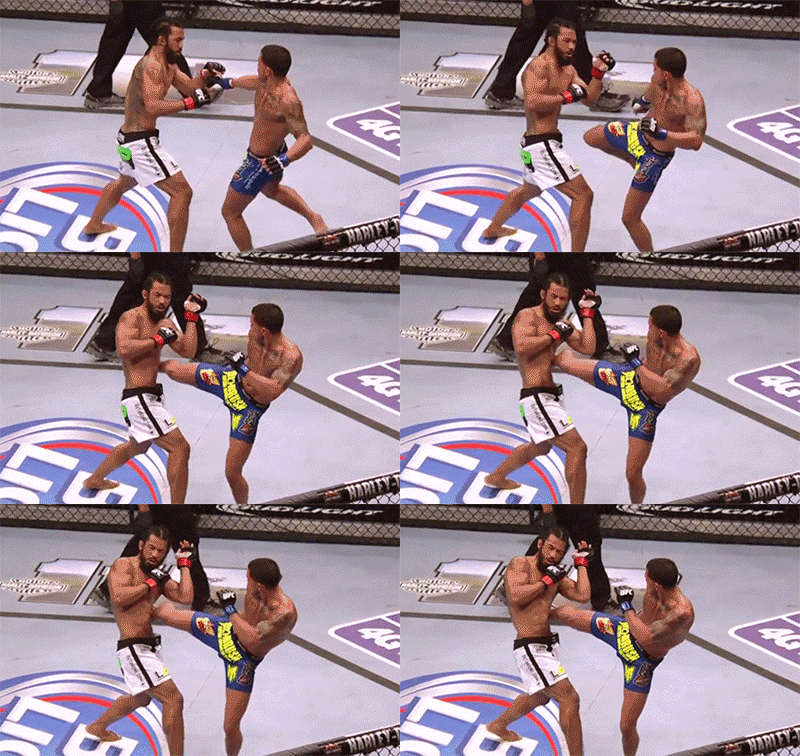
(In slow motion, you can see Henderson expecting a high kick only to be hit squarely in the ribs. His expression says it all.)
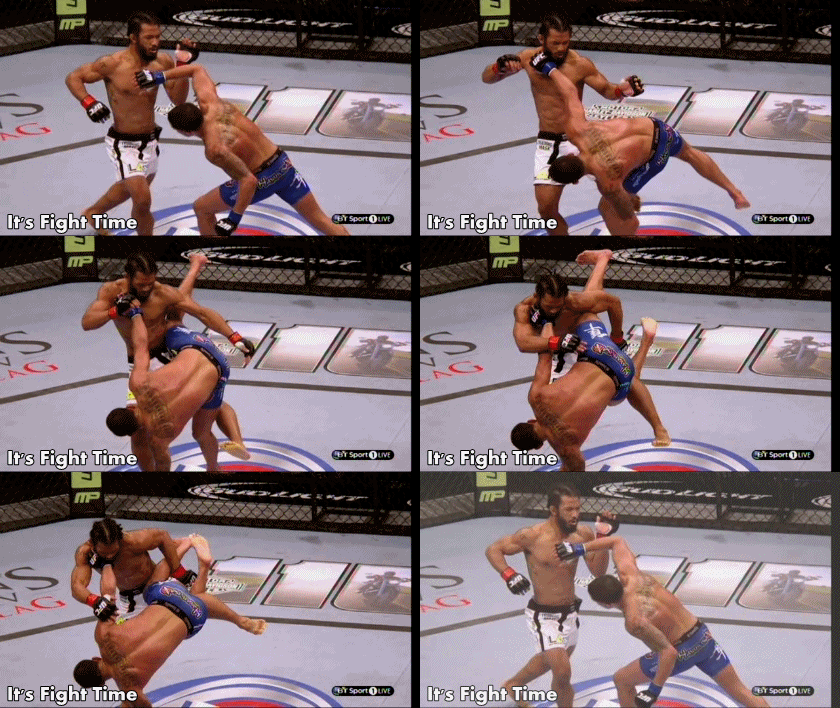

(No Pettis highlight is complete without some of his flashier moves, especially the now famous Showtime kick.)
Outside of a superman punch KO win over Stephen Thompson, Pettis’s punches were always serviceable and did a decent job of setting up his kicks. He would throw the odd straights to the head and body to keep the opponent’s guessing, but for the most part they were distractions he used before he started his barrage of kicks. If he was taken down, Pettis’s quick hips helped him secure submissions (most commonly by guillotine or armbars). This made him a dual threat both standing and on the ground. For a moment in time, it looked as if he was unstoppable.
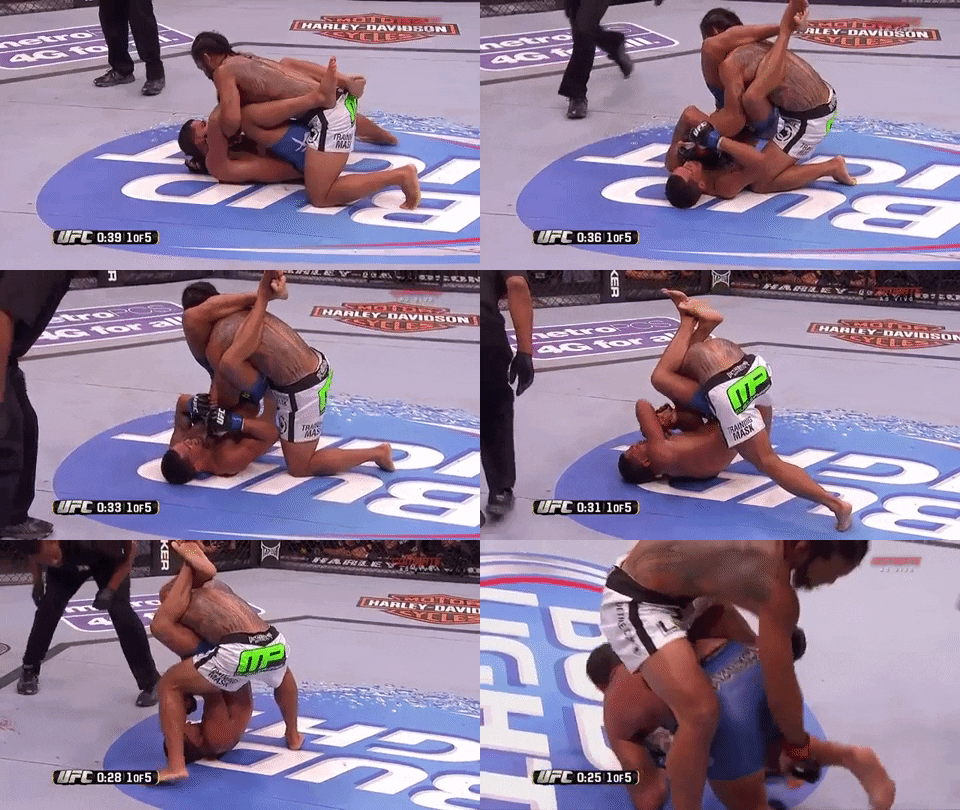
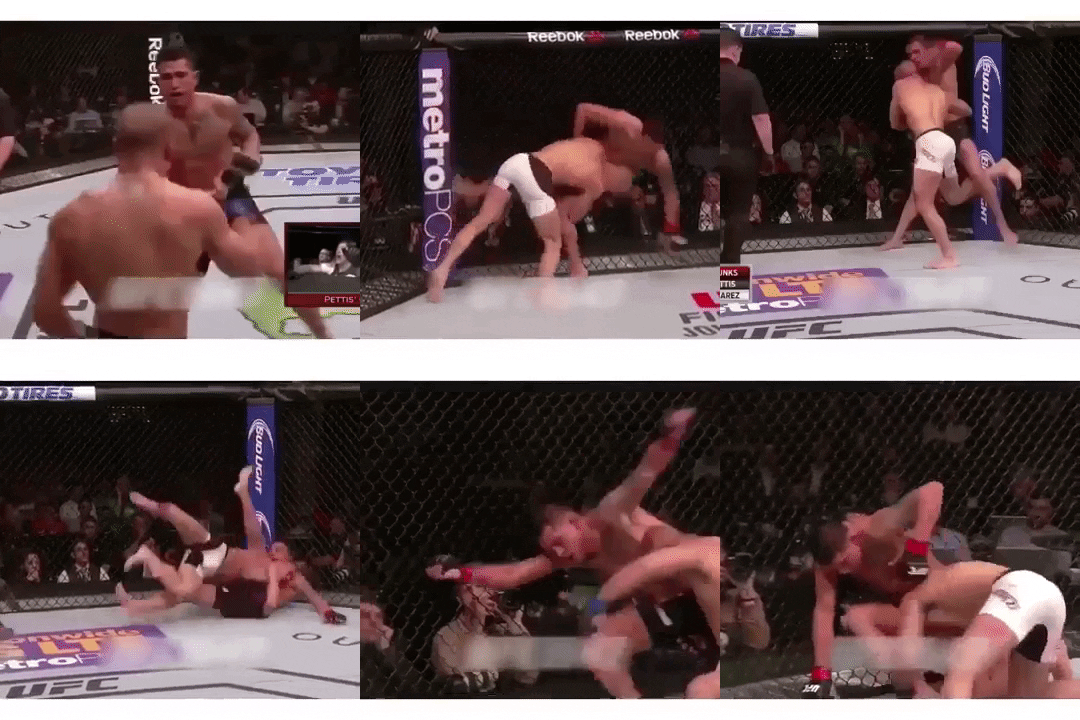
(A second is all Pettis needs to snatch up one of Henderson’s arm, and the UFC lightweight title.)

(Melendez attempts a sloppy takedown, exposing his neck and giving Pettis the opportunity to seize his neck and wrap his legs around for a guillotine choke.)
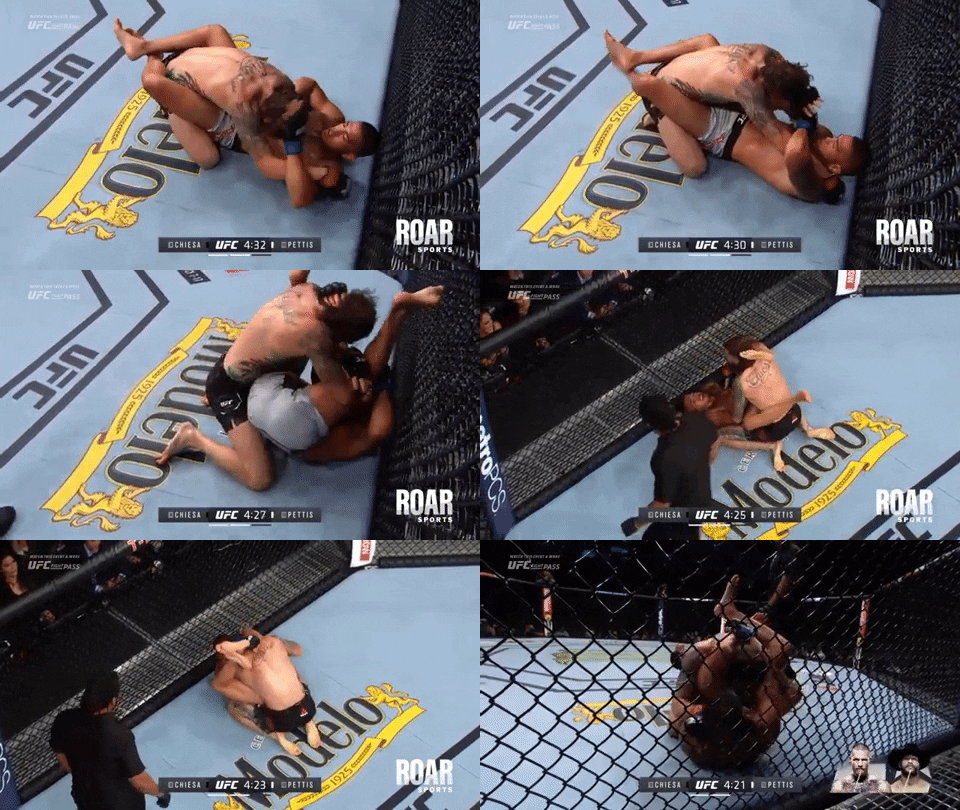
(Just like Henderson before him, Michael Chiesa made the mistake of hanging around too long in Pettis’s guard and gets caught up in a triangle/ armbar.)
How did people figured out his flaws and expose him?
During Pettis’s rise to the top, there was one other lightweight who was making his way up the rankings. Rafael Dos Anjos wasn’t flashy or charismatic, he was simply a well-conditioned athlete who planned meticulously for every single opponent. He found gaps in the armor of Pettis while others panicked when they couldn’t penetrate his defenses. Dos Anjos noticed that Henderson had success whenever he drove Pettis closer to the edge of the cage and made sure he was denied the open space needed to be creative with his strikes. Dos Anjos also took note that when Melendez pressed Pettis against the fence, his go-to defense would be either the guillotine attempt or spreading his legs apart to widen his base. Dos Anjos definitely re-watched the Clay Guida fight and knew that if the fight was taken down to the ground, he would need to impose a stifling top control game to ensure that his limbs wouldn’t be snatched up. Knowing all this is one thing, but putting it all together is tricky, especially against a quick opponent like Pettis. Dos Anjos didn’t care though, he knew he would have to take a few strikes in order to land his own, and he was game.
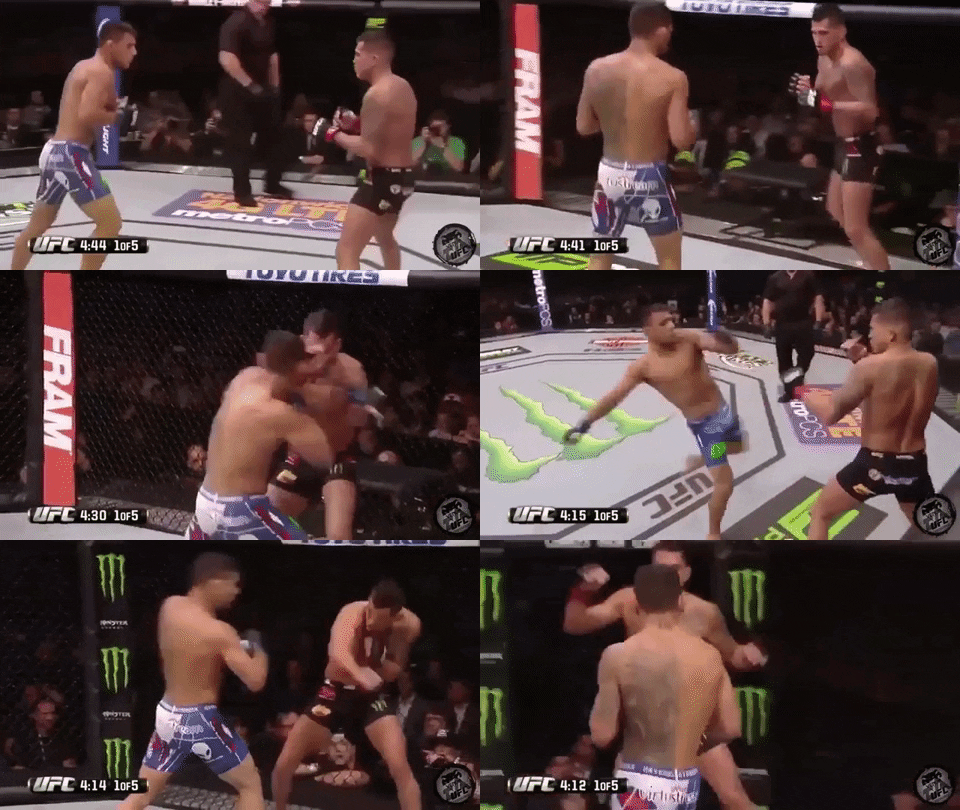
(Dos Anjos wasn’t afraid to move forward and pressure Pettis, and by focusing on straight punching he could land the quicker blows while forcing Pettis into a square stance.)
Not only was pressuring Pettis effective at keeping him from launching his kicks, it also had the serendipitous effect of removing a lot of the power from his strikes and causing Pettis to throw with more panic. This was great news for Dos Anjos, who knew that if he kept calm and took the blows on his forearms and shoulders, he could counter strike with hooks to the body and head. He also wasn’t afraid to trade kicks with Pettis, and with his back dangerously close to the fence, Pettis wasn’t able to kick effectively.
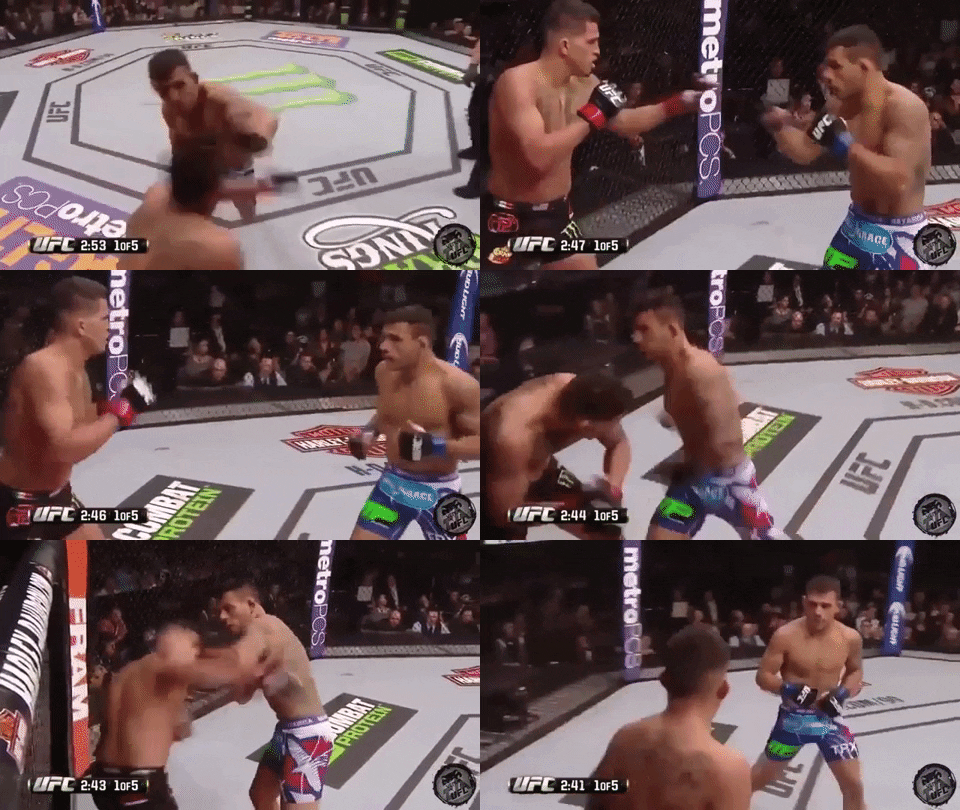
(Even though Pettis landed plenty in this fight, Dos Anjos took the punches and kicks since it meant that he could return the favor, often with more vigor.)
This doesn’t mean that the entire fight took place on the feet. Dos Anjos would time Pettis’s punches and duck under them to lift Pettis off the ground and press his back against the cage while standing upright and killing his hips. This was huge since Pettis wasn’t able to go to his usual line of attacks and simply had to take the punches from Dos Anjos, waiting for any moment to try and scramble up.
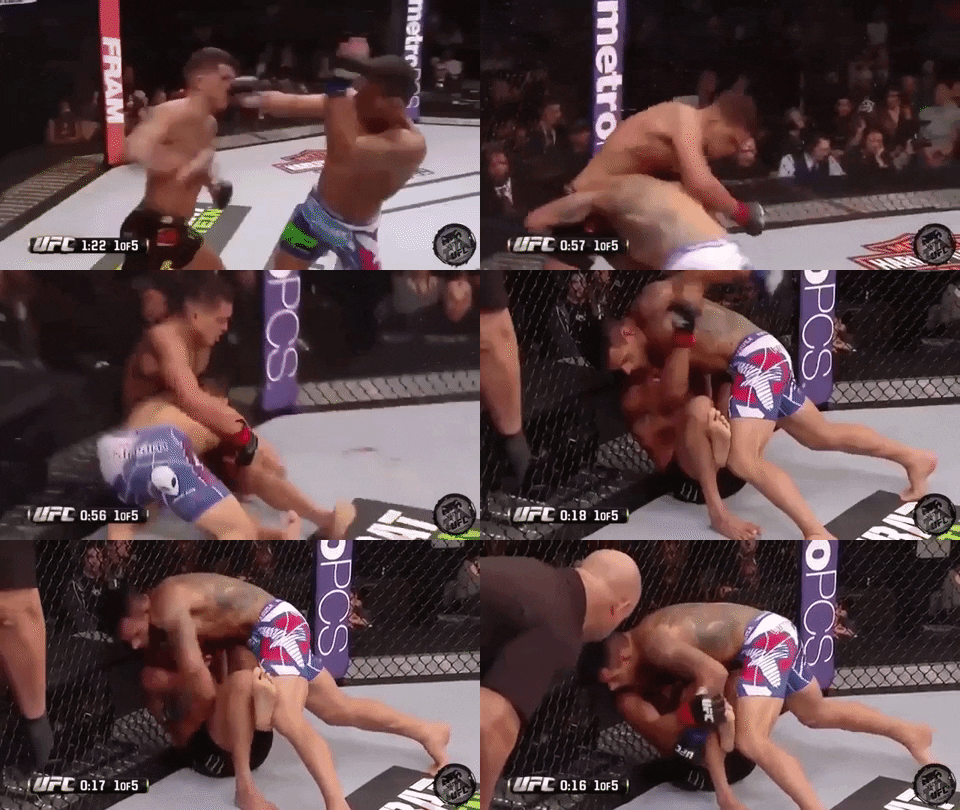
(Dos Anjos made sure to continue his assault on the body of Pettis, draining his gas tank and making any explosive movements quite difficult.)
By the third round, a visibly exhausted Pettis was more flat-footed and losing the exchanges with Dos Anjos, who continued to pressure Pettis against the fence and ground and pound him.
(This would unfortunately be a familiar pattern for most of the fight.)
Towards the end of the 4th round, it was clear who was winning. Outside of a miracle, Pettis looked like he was headed towards a one-sided loss.
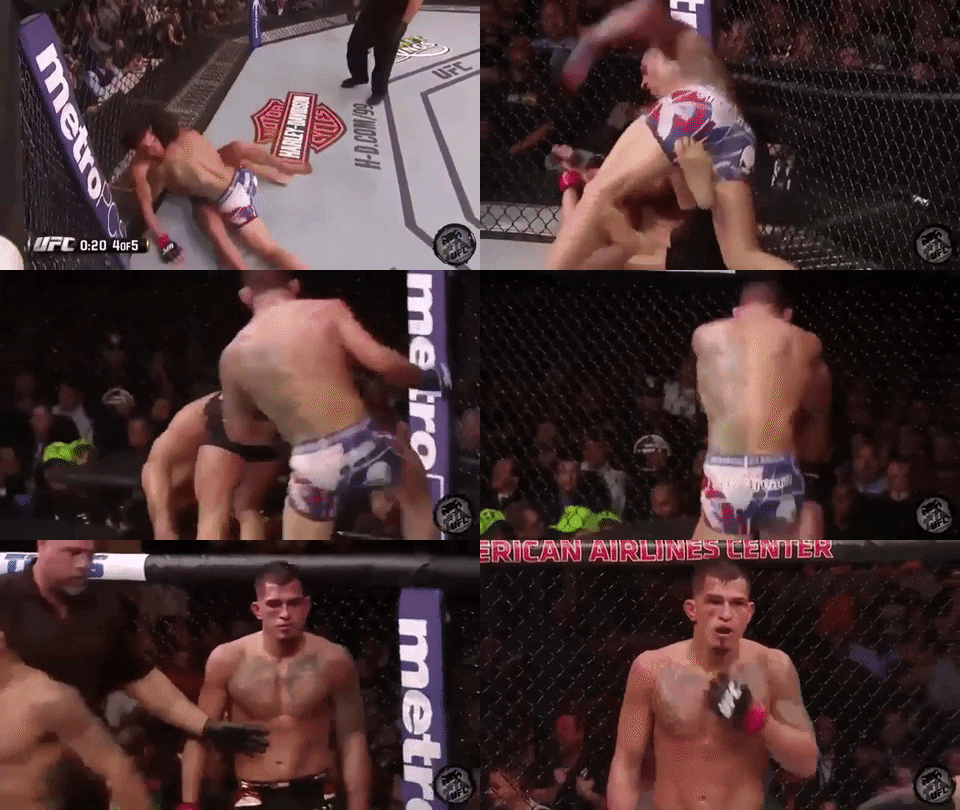
(The look on Pettis’s face says it all.)
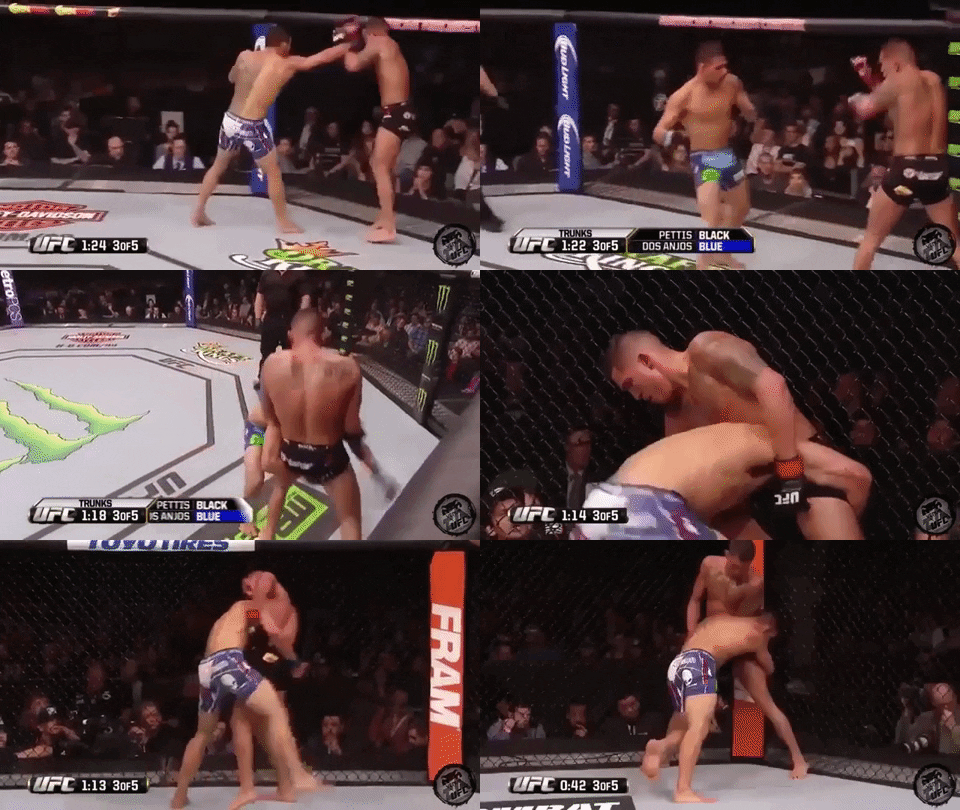
Now, just because one fighter has cracked the code doesn’t mean that everyone can do it. You still need to have a certain amount of skill, physicality, and mental toughness to pull this off. And even then, there’s always the risk that Pettis shores up his weaknesses and corrects a lot of his mistakes. Fortunately for the likes of Eddie Alvarez and Dustin Poirier, Pettis did not adjust accordingly and they used the same game plan as Dos Anjos to notch a victory over the former WEC and UFC lightweight champ (granted that Poirier won by body triangle, the game plan was still very similar to Dos Anjos).
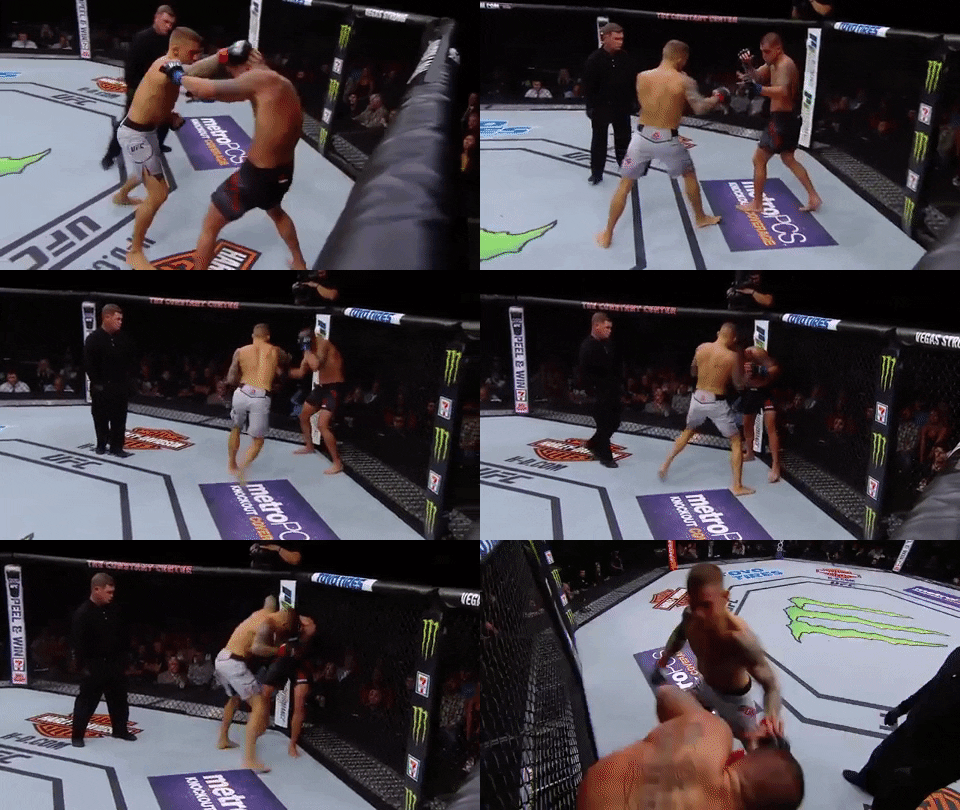
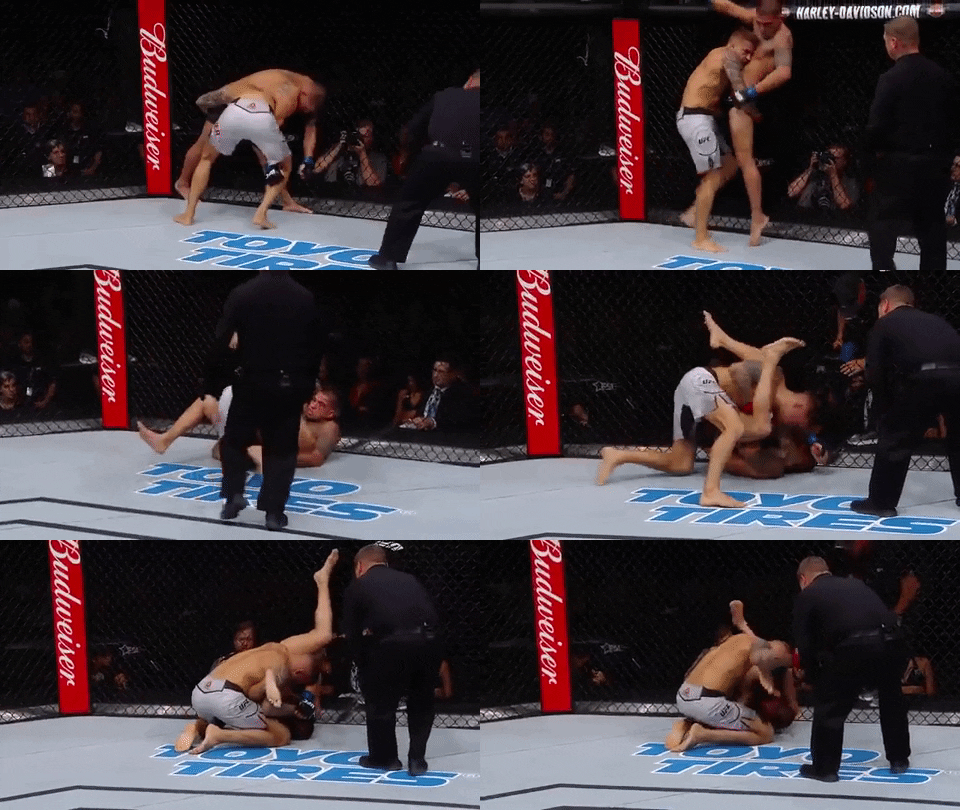
(All the things you saw in the Dos Anjos vs. Pettis fight, but with some slight differences.)
This doesn’t mean that there’s only one way to beat Pettis. Max Holloway’s constant stance switching, low line side kicks, and prolific use of his jabs and straights to the body ended up tiring Pettis (which set him up for the finish quite nicely). Tony Ferguson’s similar wild style of striking also flummoxed Pettis, not to mention that Ferguson’s pressure is also nothing to scoff at. Even Edson Barbosa matched him kick for kick and boxed Pettis up on the inside.
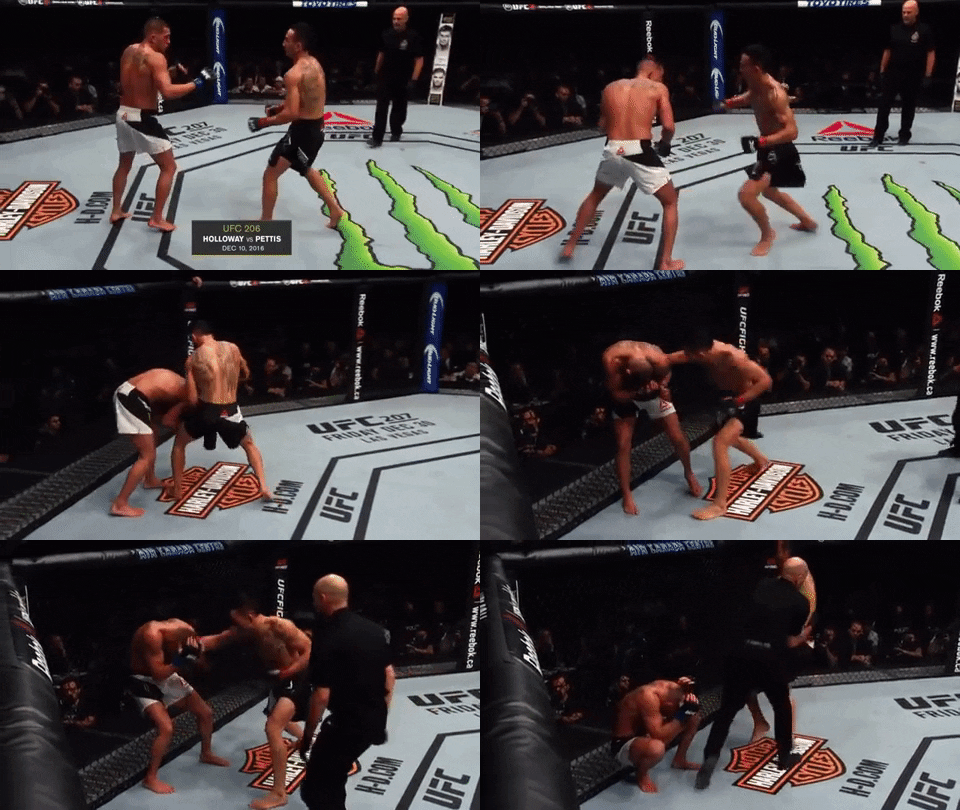
(Holloway uses one of Pettis’s favorite kicks against him, a roundhouse to the body which sets up the finish with hooks)
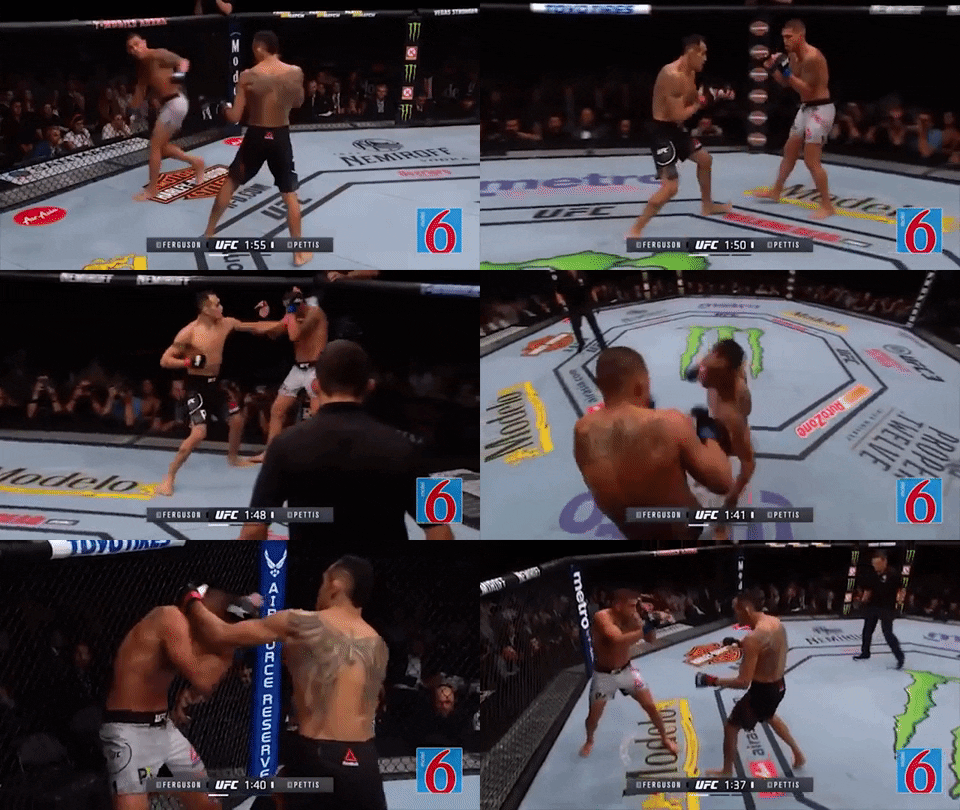
(Ferguson’s long lead right coupled with his stutter steps create an awkward rhythm that Pettis has trouble adjusting to, and it leads him right to the fence in a square stance.)
Speaking of the sweet science, Nate Diaz also overwhelmed Pettis with his volume striking and once he had him hurt on the feet, he took Pettis down and beat him on the ground. Pettis got submitted by the unranked Ferreira. Losses by strikes and decisions were normal, but submission? Things are starting to take a dark turn, especially when you consider that he is now 4-8 in his last twelve fights.
How has he deteriorated in even the things he used to be good at?
Let’s address the obvious: age is a motherfucker. Although he’s only 33, Pettis has been involved in martial arts since he was 5 years old. This is over 20 years of kicking, punching, and grappling all adding up and taking a toll on the body. There’s simply no way around it, Father Time comes for us all. For Pettis, it doesn’t mean that he’s a dead man walking, but it’s clear that his athletic prime is long gone. No longer can he move seamlessly and kick with lightning speed. At best, they are reactions to after his opponents have launched their own attacks. Take a look at other prolific kickers like Shogun Rua and Jose Aldo and you’ll see that they also don’t kick as much as they used to, after all the knees can only take so much. There are other factors that compound the wear and tear.
A quick glance at his record shows that he’s been bouncing around different weight classes, with a disastrous weight cut that saw him show up over the featherweight limit, costing him a title opportunity against Holloway. Lack of consistency keeps him from building any real momentum, not to mention his body is in a constant state of flux, unsure if it should bulk up to accommodate his weight gain or keep his metabolism high in case he needs to drop a couple of pounds. Fighters usually trend up or down, but rarely do they yo-yo.
The environment can’t be ignored either. Pettis is the first home grown UFC champion of Duke Roufus, and he’s been with him since he was 18 years old. Even though it’s led him to the pinnacle of the sport, it’s entirely possible that it’s made him too comfortable and unwilling to change. Growth doesn’t happen in a vacuum; you need to be pushed beyond your normal limits to see what new heights you can reach. Let’s say for arguments sake that the physical preparations are great, firing on all cylinders and he’s in the best shape possible. It still doesn’t explain why he hasn’t shored up his defensive flaws and lack of wrestling. With both Tyron Woodley and Ben Askren in the training room, it’s odd that this wasn’t something that was diligently worked on in between camps.
Even if you’re being generous and say that he’s just had rough match ups, it doesn’t explain why he hasn’t developed an answer for pressure fighters. Hell, even Cerrone added an intercepting knee to deal with wrestlers constantly shooting in. Pettis defaults to getting pressed against the fence and attempting submissions. Perhaps Pettis has reached his fight IQ ceiling, and he never got over the beat down from Dos Anjos. There are some fights that just break you to the point where no matter what happens, you’re never the same again. After his first streak of losses, Pettis seemed to lose a lot of creativity and showed that he can be beaten on the feet and on the ground as long as you’re willing to take some strikes and stick to a strategy.
There isn’t one single culprit as to what caused the rapid decline of Anthony Pettis, but we do know when a fighter is on such a decline, they almost never make a comeback. He’s right at that age when he’s a finished product, incapable of making any real significant change. Being a hero in his hometown of Milwaukee, Wisconsin, here’s to hoping that people remember the best of Showtime and not just his recent slump. Too often do we toss aside a fighter when they’re no longer in their prime and say that they were never any good. That’s not true with Pettis, he fought anyone and everyone that was offered to him and has victories in multiple weight classes and two different champion titles in premier organizations. Even with his recent troubles, there’s tons of fighters that would love to have the record and accolades of Pettis, like Donald Cerrone. With all that being said, he should definitely re-evaluate how he wants his exit from the game. Otherwise, Uncle Dana will keep giving him fights then toss him aside when he feels he's too expensive to keep around.
Files
Previews only

