 Home

 Creators
 Search
 Recent
 Random
 Posts
 DMs
 Tags
 Random
 Importer
 Import
 FAQ
 Account
 Register
 Login
 Favorites
 Keys
 Logout
 Telegram

Paul's Preview: Jones vs. Reyes (Patreon)
Content
No matter how you personally feel about Jon Jones, there’s no denying that he is a step above his light heavyweight contemporaries. Despite the failed drug tests, the criminal arrests, and the multiple rules infractions, Jones remains the current champion and looks to cement himself as the greatest ever in the division. If you look at the current top ten ranking for light heavyweight, Jones has wins over half of them, while the other half are still trying to build up some momentum to justify a title shot. Of the latter, there are two guys that have built up win streaks greater than 3: Corey Anderson and Dominick Reyes. With Anderson already booked to face Jan Błachowicz in February and Reyes coming off a KO win over former middleweight champion Chris Weidman, the UFC figured that it was time to give Reyes a shot at Jones. The division is thin and Jones is a heavy favorite, but it doesn’t mean that this can’t be an exciting fight. Reyes has yet to deliver a dull performance and Jones has been around long enough for people to study and break down his habits. Jones has played down to the level of his opponents in the past and fights have looked far more competitive (the first Gustafsson fight, the match-up against Anthony Smith, and his most recent showing against Thiago Santos). MMA is unpredictable and we all know that all it takes is one strike to change the course of a fight. Let’s see how this could potentially unfold.
At Southpaw, we’ve talked about Reyes since the start of the podcast and have covered his growth extensively. The former collegiate football player had an unusual path to the UFC. After his NFL aspirations fizzled out, he settled into working as IT technical support (his B.S. in Information Systems probably came in handy) but still craved athletic competition. After training at his brother’s MMA gym in southern California, Reyes started competing in local amateur fights before he made his way onto the regional circuit. Going 11-0 in his burgeoning MMA career, Reyes finally got called up to the UFC in 2017. Six fights and four finishes later, Reyes is at the cusp of a world championship title. The 6’4” Reyes is on the taller side of the division, but his 77” reach isn’t as long as others in the weight class (Aleksandar Rakić, Ovince Saint Preux, and Tyson Pedro all have longer reach). What truly makes him such a hard opponent is his striking, aided by his southpaw stance. Given that he loves throwing the left high kick and left straight, he draws a strong comparison to one of the most feared strikers in MMA history: Cro Cop. This simple attack combination wasn’t invited by the Croatian, but he did show how effective it could be if you were fast enough. Opponents are constantly playing a guessing game by trying to decide if they must defend against a high kick, a left straight, or the occasional body kick. The defenses to all of them require different adjustments, and a wrong choice could prove devastating. Reyes also incorporates leg kicks from time to time, adding another offensive wrinkle that opponents must worry about. While at close range, he also sneaks in uppercuts and hooks and opponents look genuinely surprised at how quickly these punches seem to land.
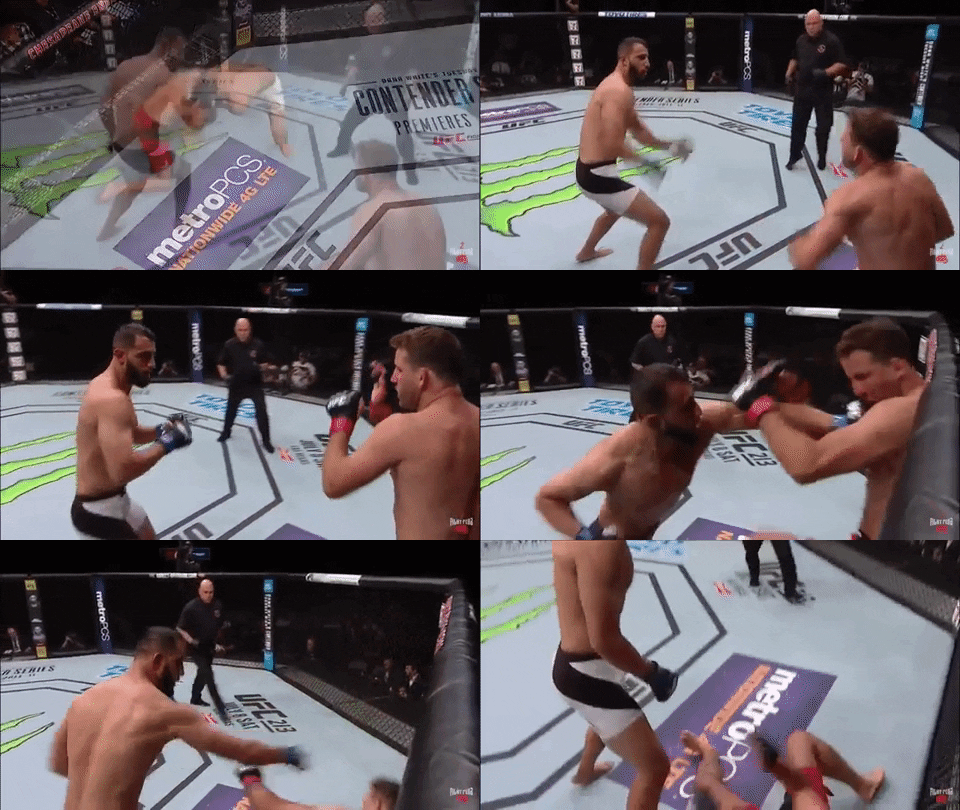
(Reyes feints with his hips to make Christensen think a high kick is coming, so he keeps his arms raised. Instead, Reyes blasts him with a left straight.)
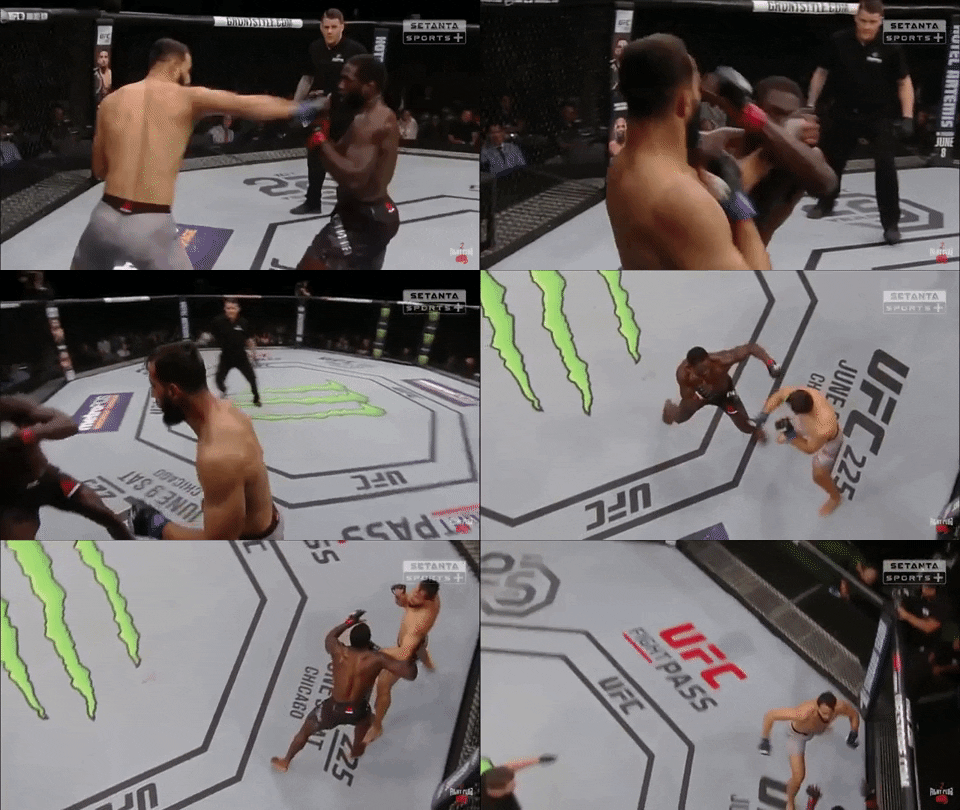
(After slipping a right hand, Reyes answers back with a short uppercut, sending Cannonier stumbling forward before reeling back.)
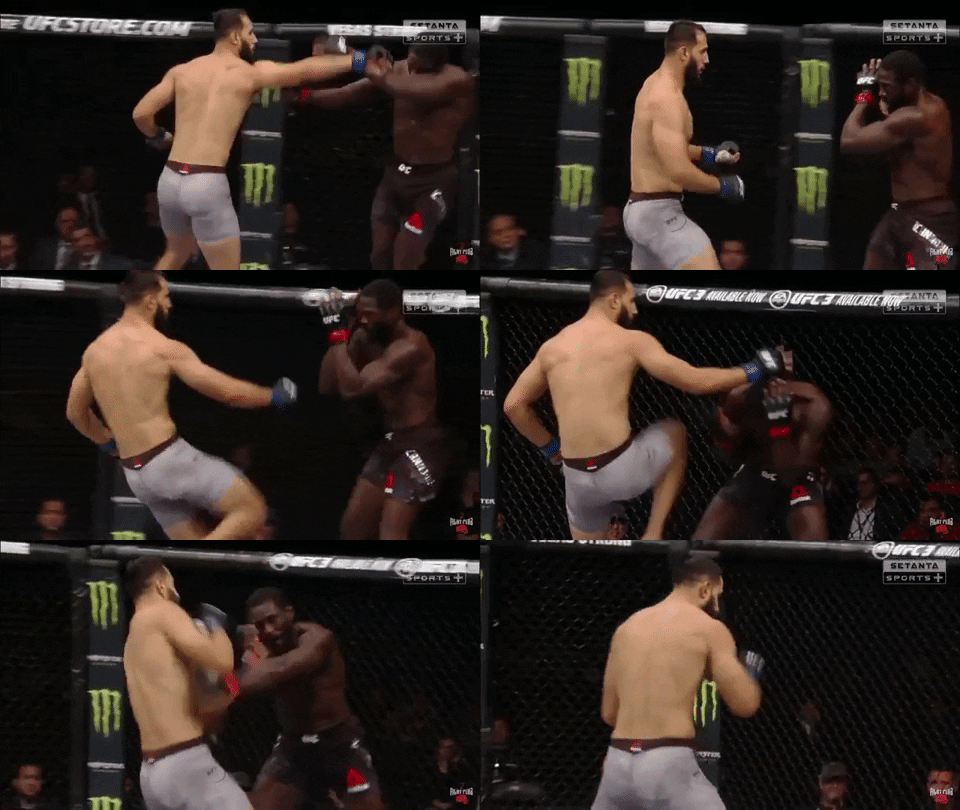
(A jab and a front kick from the same side has Cannonier covering his body, giving Reyes another opportunity to land that left uppercut.)
It might be easy to write off Reyes’s style as a one-dimensional but consider for a moment why twelve different opponents haven’t found a way to overcome this. The reason that Reyes is successful with this kind of striking is the same as Cro Cop’s: speed. Other southpaws can attempt this tandem combination but if they aren’t quick enough to fool their opponents on what their true intentions are, they end up eating counters all night. If they decide to go for volume and utilize the combination too frequently, they can become predictable and easy to slip away from. Speed is what makes the left straight/left kick so dangerous. By throwing both kicks and punches from the same side with the same initial hip/shoulder movements, opponents can’t tell what strike is incoming (this is no different than what makes great pitchers in baseball so valuable to a team). Add in some jabs, feints and a few low kicks and you got yourself a dangerous striker. Look at the UFC’s last PPV main event and what do you see? McGregor faking the left straight before throwing a high kick to Cerrone’s head.
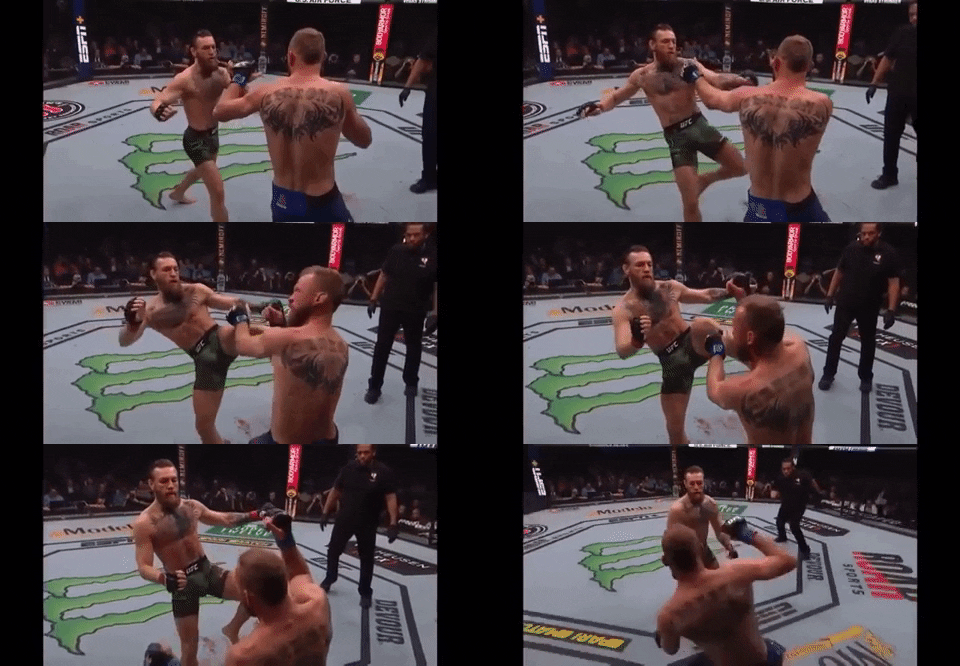
(Cerrone’s right hand moves forward to parry a left hand that isn’t there, giving McGregor the perfect opportunity to land his kick.)
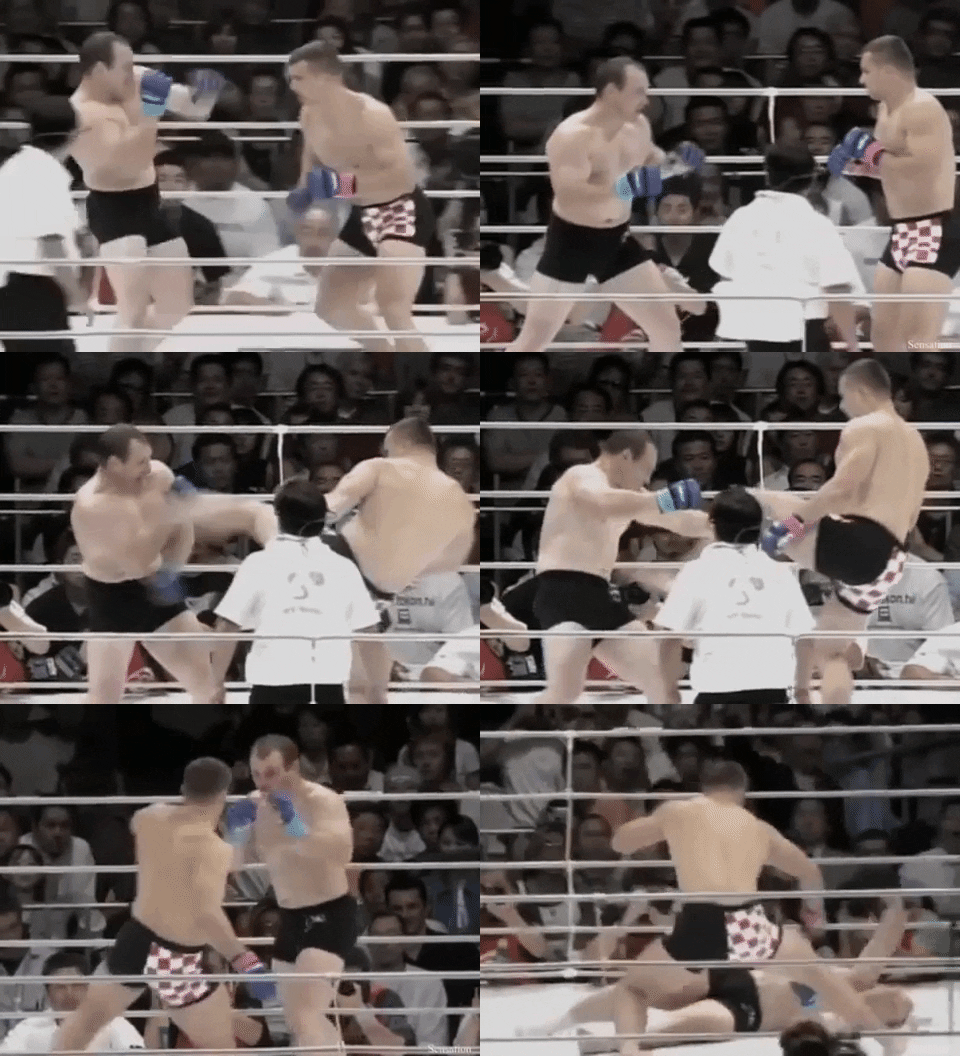
(Igor Vovchanchyn was a fearsome striker in his own right, but even he was fooled by the southpaw double attack of Cro Cop. Notice he kept his right hand closer to chest to parry the left straight only to eat a high kick instead.)
Think of that setup like you would an anesthetic, give it time and it’ll always work. After three first round finishes, Reyes got matched up against Ovince Saint Preux (OSP) and he made him look like an amateur. Reyes’ athleticism and footwork allowed him to frustrate OSP and had him constantly shooting in early and grabbing at air. Even without a wrestling background, his quickness and commitment to staying at range kept him out of danger. The difference in footwork between Reyes and OSP were night and day. OSP had two left feet and constantly had a hard time moving fluidly, but Reyes stayed focused and made sure that his outside foot was always in the right position (which helped him punch OSP with his full range of motion). This was perfectly illustrated in the last seconds of round 3 when Reyes slipped a right hand and uncorked a perfect left straight. This was the fight that announced Reyes as a serious player in the division and definitely someone that Jones should keep an eye on.
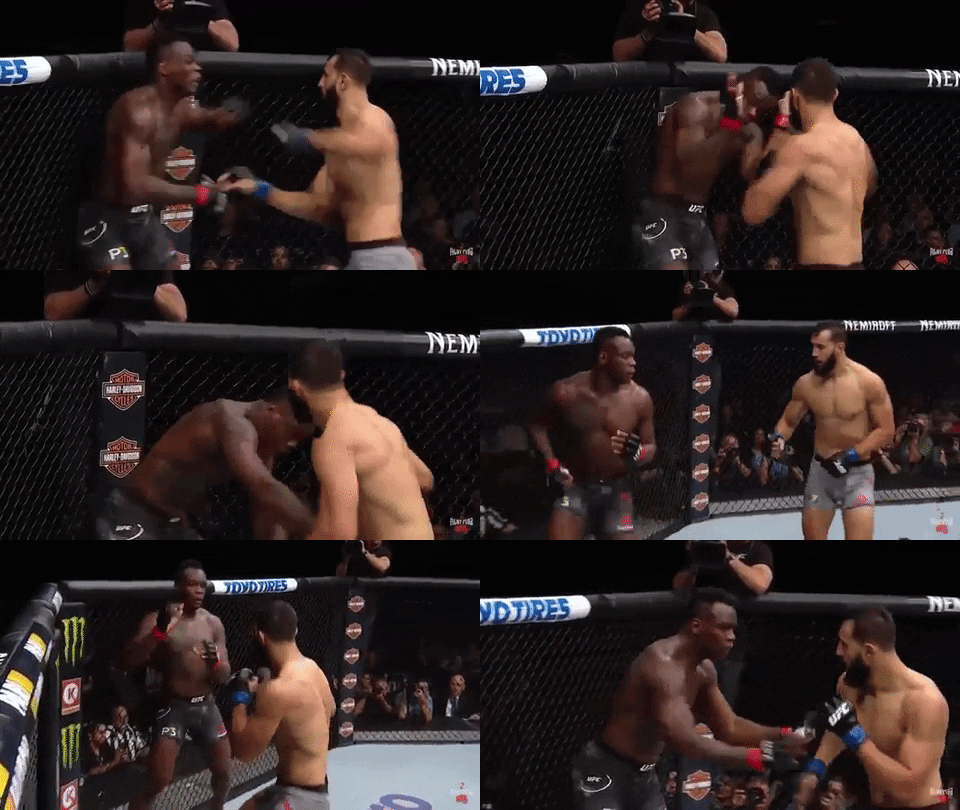
(Nothing fancy, just constant 1, 2s with feints and some kicks. Reyes does a fantastic job of keeping OSP’s back to the fence and circling to his power side.)
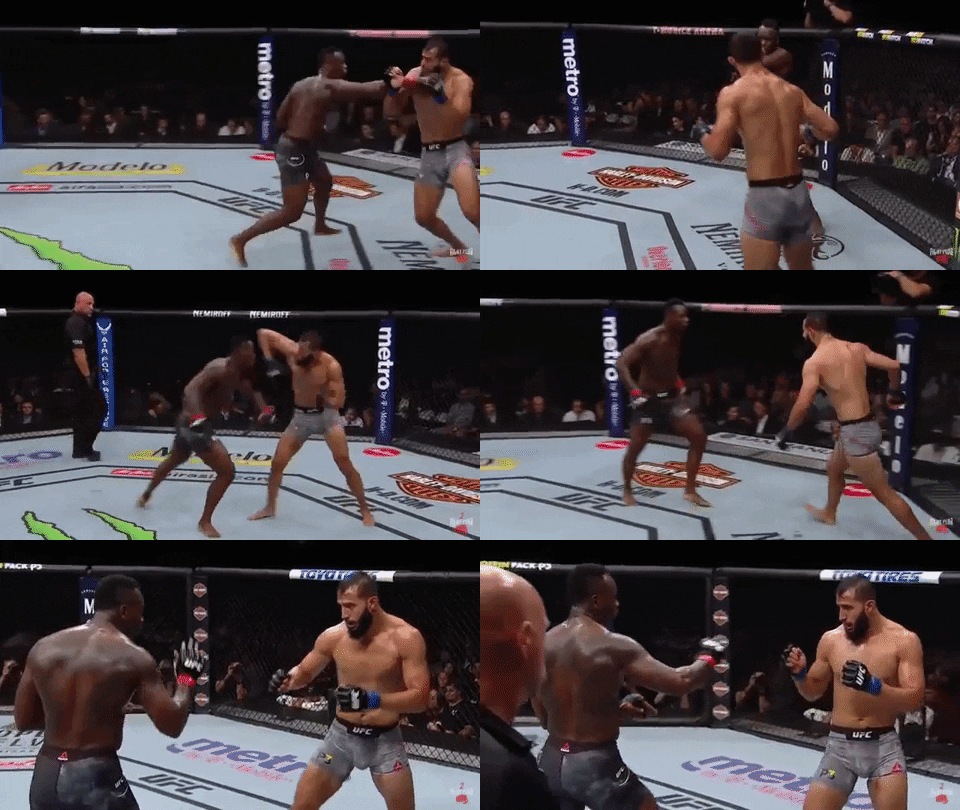
(Another swift uppercut, a beautiful intercepting downward elbow, and a low kick thrown for good measure.)
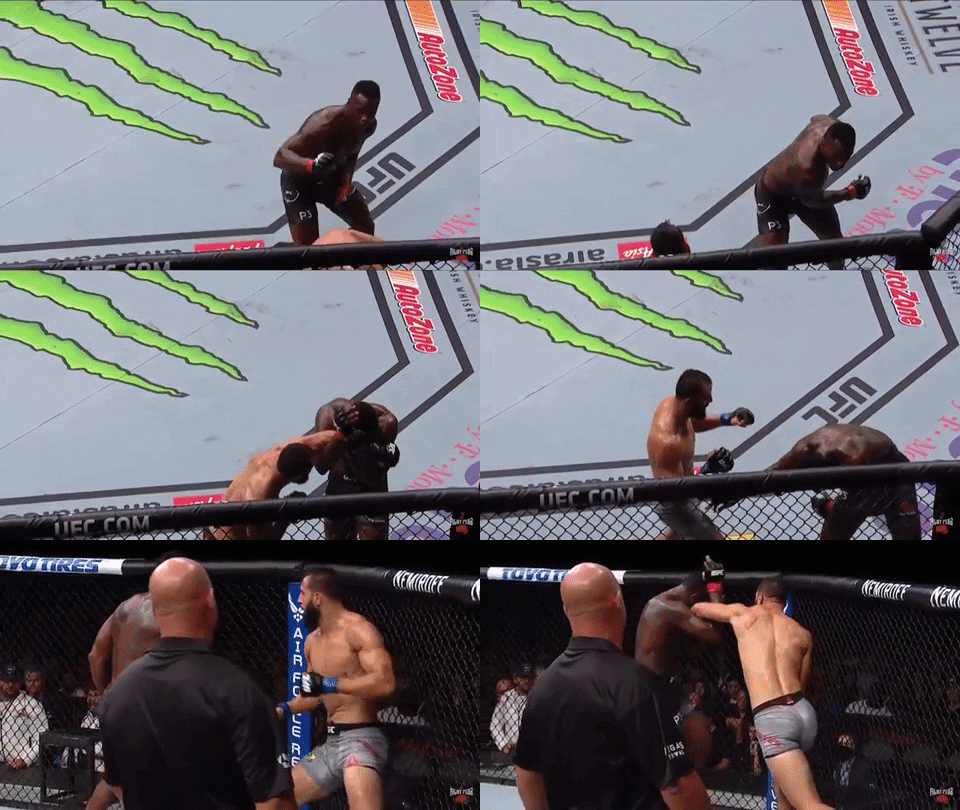
(Just like Cannonier, OSP throws a right hand that Reyes slip, only to counter nicely with a left straight that drops him at the buzzer.)
Reyes’s footwork gives him optimal positions to fire back and stay ready to defend takedowns (a favorite tactic of former bantamweight champion Cody Garbrandt and current heavyweight champion Stipe Miocic). After a competitive back and forth fight against Volkan Oezdemir, Reyes made short work of Weidman, who was moving up and making his light heavyweight debut. Despite being damaged goods, Weidman still poses a threat with his wrestling chops and strong ground control (for 7 minutes anyways). Reyes needed less than two minutes to put Weidman away, dropping him with another left straight before finishing him off with hammer fists. Say what you want about his takedown defense and limited arsenal of striking tools, Reyes can still make the most of his gifts and no one has been able to stop him. Has the champion seen enough from the challenger to know how to neutralize him?
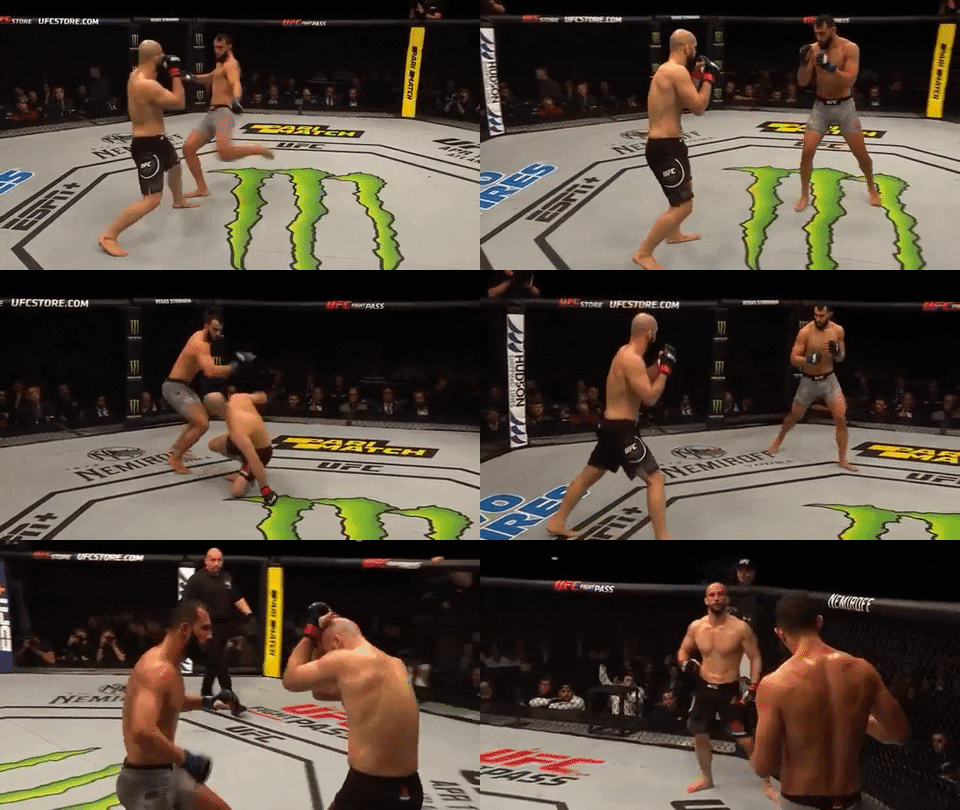
(Kicks were the key in keeping Oezdemir busy, along with hooks to strike around the high guard.)
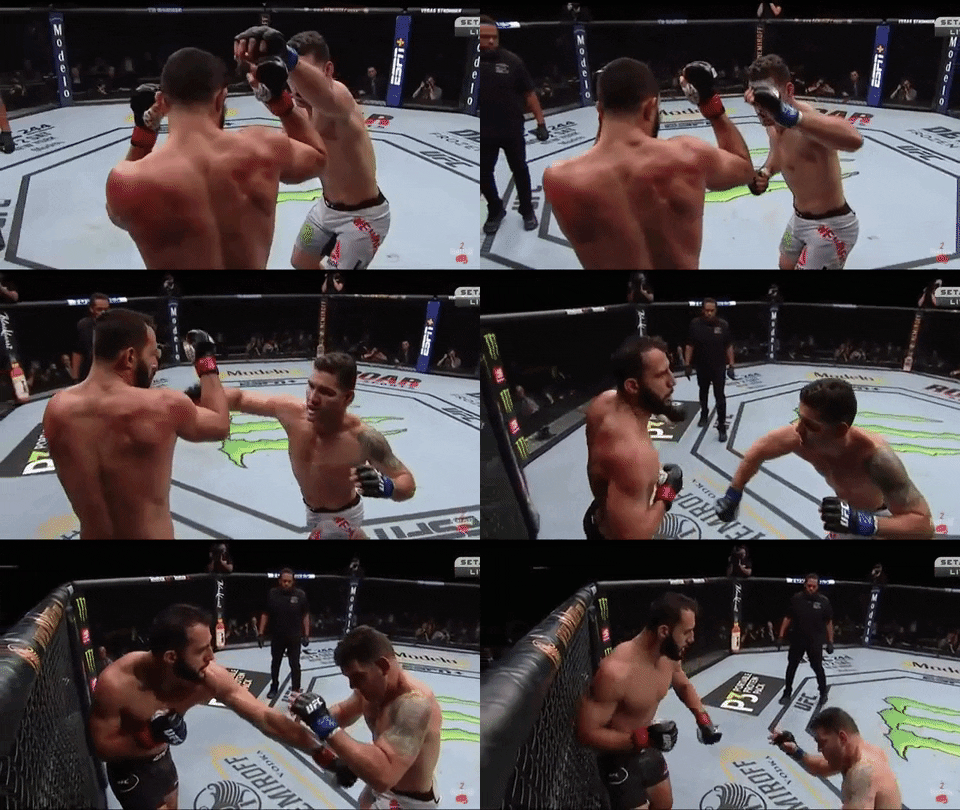
(Even though Reyes is moving backwards, the forward momentum of Weidman adds force behind Reyes’s left straight and it drops him early in round 1.)
Let’s get this out of the way: Jones is really, really good and is champion for a reason (or two). What makes Jones such a nightmare for fighters is that no matter what range you engage him in, he’s dangerous. Standing at 6’4” with a near 85” reach, he can hit you from a distance where you think you’re safe, only to be hit with a jab or an elbow. At kicking range, Jones batters you with oblique kicks to your knees and front kicks to your stomach, all while adding in low/high kicks and jabs to the face. If you’re able to get close enough to Jones to be within boxing range, he will establish the clinch where he can punish you with knees to the body, hooks to the midsection, and throws elbows all over your head. Once Jones feels you wilting, he’ll take you down from the clinch and either viciously pound you for a TKO or go for a submission.
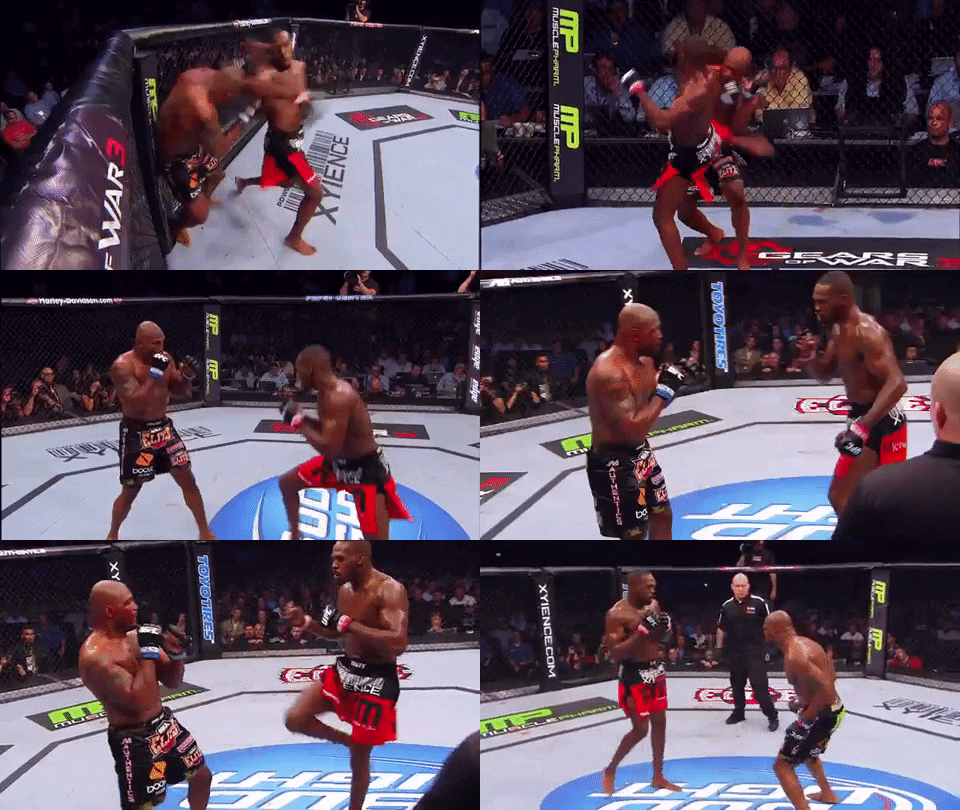
(Jones hit Rampage Jackson everywhere and anywhere there was an opening and at no point did Jackson have an answer for such a varied attack.)
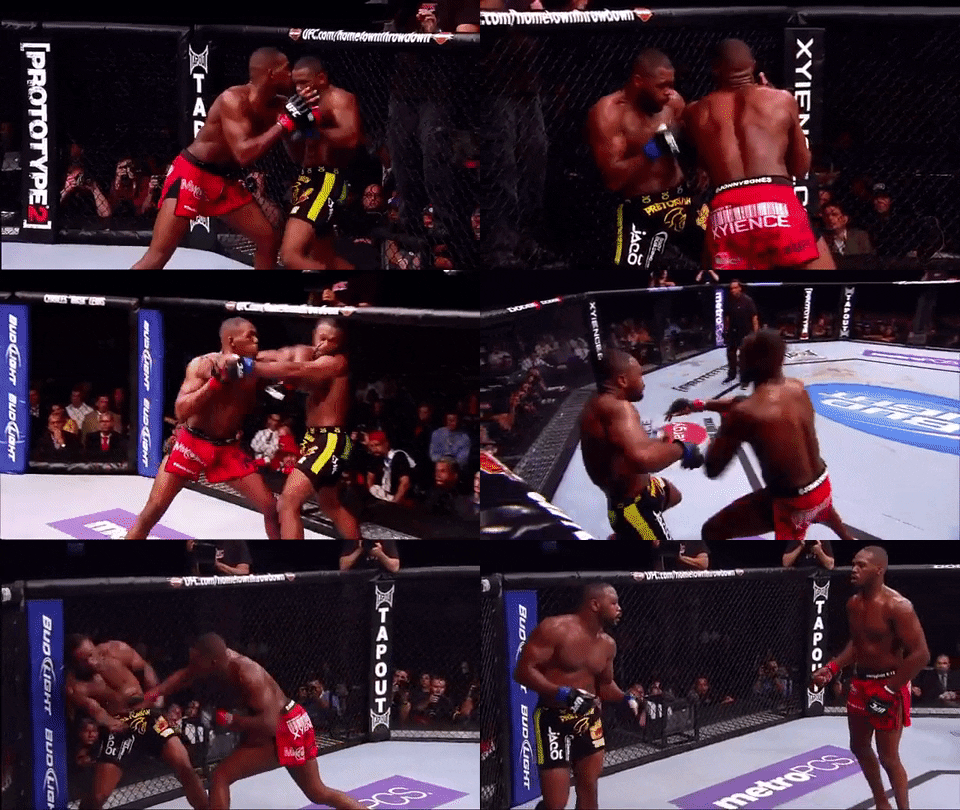
(Despite having trained extensively with Jones in the past, Evans always looked surprised at how quickly Jones’s elbows covered distance and it allowed him to sneak in a right straight later on.)
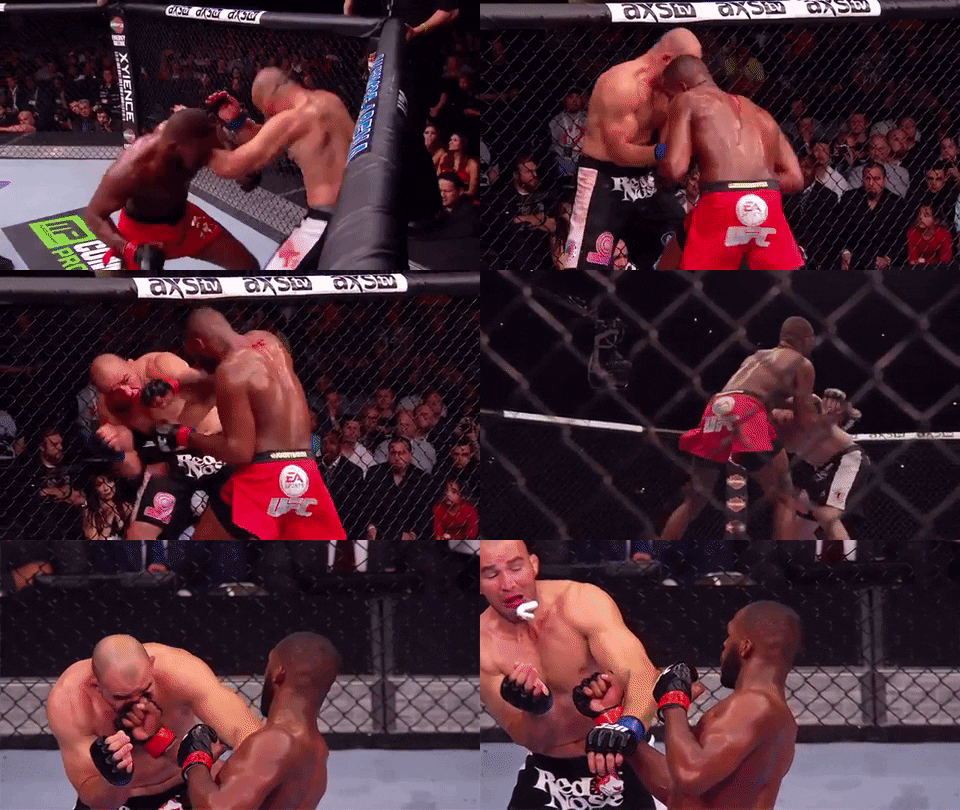
(Close range was supposed to be where Teixeira had the advantage, but Jones smothered him and blasted him with hooks and uppercuts while effectively utilizing the cross guard, a George Foreman favorite.)
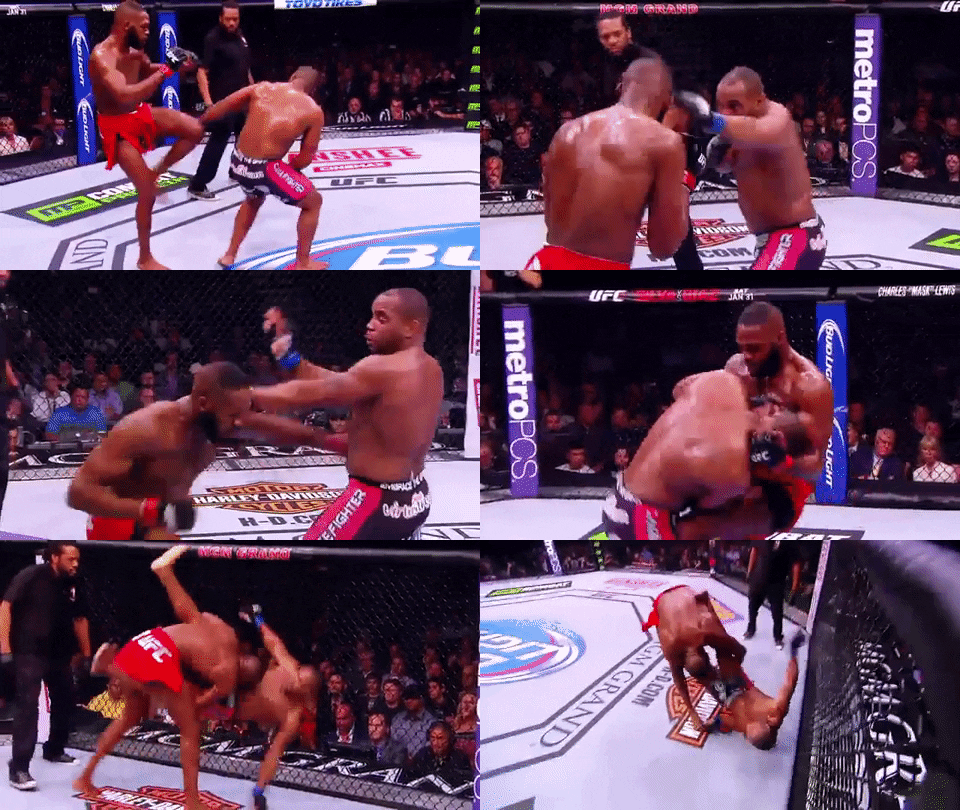
(Cormier was never going to be an easy fight, but softening up his midsection with punches and kicks made the takedowns come easier as the fight went on.)
Jones is interesting to watch live because you get to see a fighter with who can stick to a game plan and improvise when necessary. Let’s look at his last three fights. The rematch with Alexander Gustafsson showed that Jones lost the first fight due to lack of preparation and being surprised by Gustafsson’s attacks. Early on, Jones established a takedown threat by constantly shooting in to get into the clinch position and disengaged only to hit Gustafsson on the way out. Even though Gustafsson cornered Jones multiple times in the early rounds, he was limited in his attacks due to the fear of the takedown. Jones was able to neutralize Gustafsson in the boxing range by throwing a high volume of kicks and constantly making Gustafson uncomfortable. In the first fight, Jones was constantly pivoting and moving around to meet Gustafson, and he was eating punches while doing so. We can see through Jon Jones how well Greg Jackson and Mike Winklejohn scout their opponents since the same opportunities that were there for Gustafsson in the first fight simply weren’t there in the rematch.
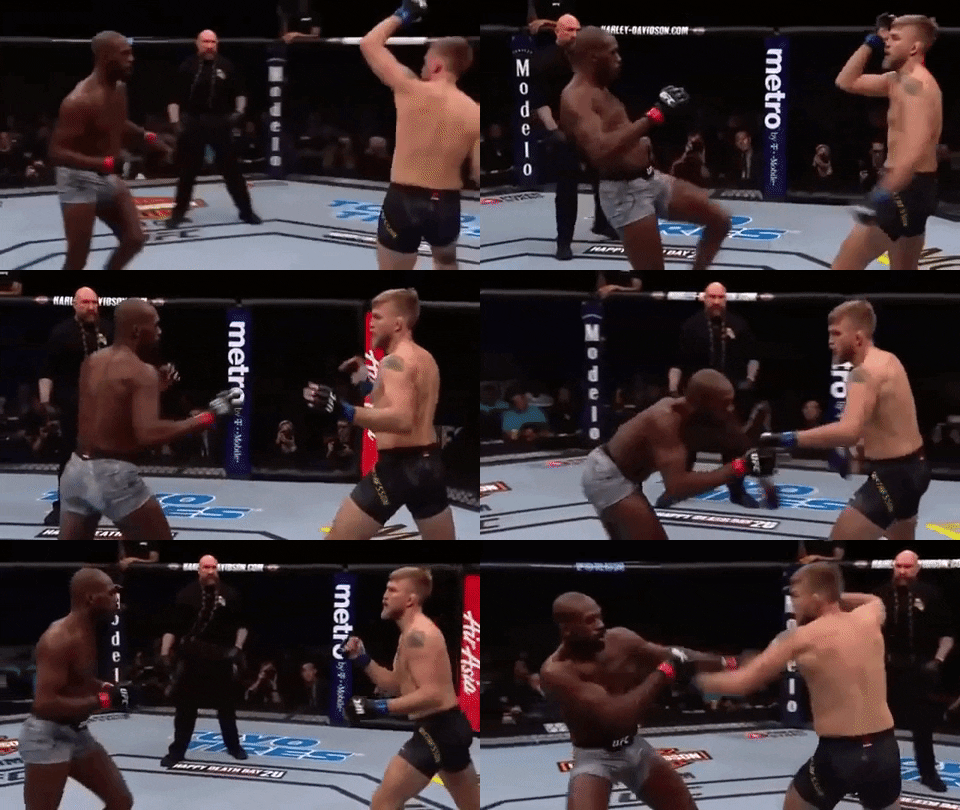
(Gustafsson opted to move forward instead of laterally, eating kicks and a jab to the body. Notice the subtle stance switch that Jones employs, this kept Gustafsson from being comfortable while striking.)
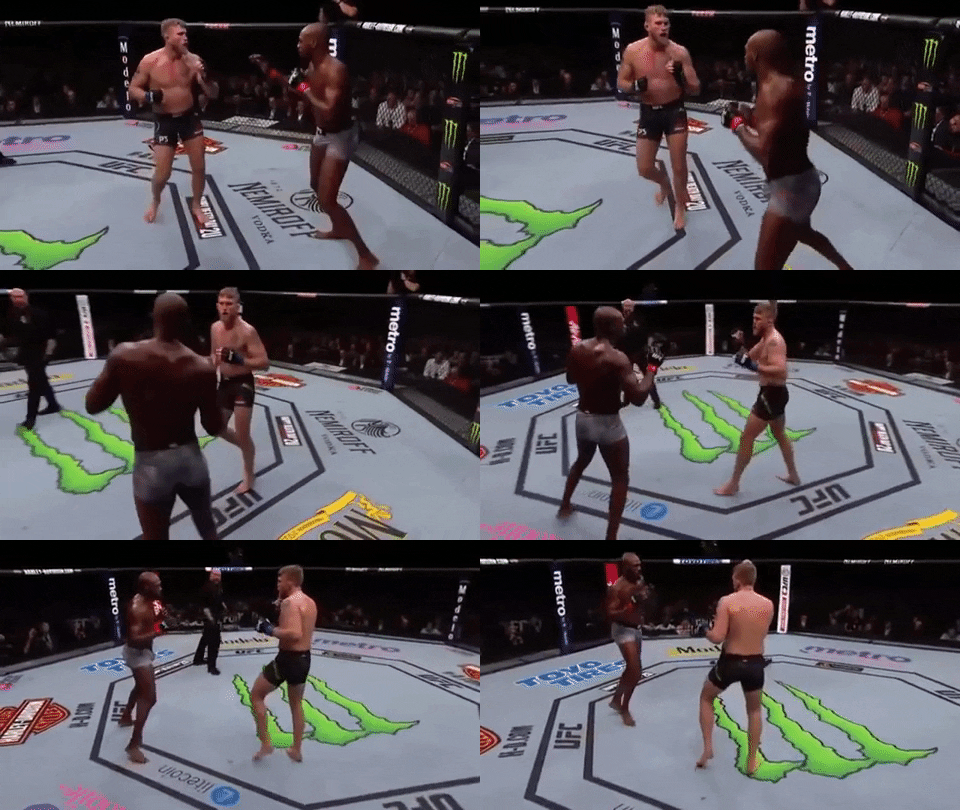
(In the rematch, it was Jones who kept moving side to side, forcing Gustafsson to follow him.)
Against Anthony Smith, Jones looked even more relaxed and he was never really in trouble. Jones came at Smith with that left leg striking from all angles, attacking from the clinch to soften up the body, and eventually taking Smith down and punishing him even more. The left leg alone was able to do so much damage since constantly kicking at Smith’s lead leg caused him to abandon his southpaw stance, giving Jones only one side to worry about (Reyes should be wary of this). Throughout the fight, the biggest threat to Jones was himself. In the 4th round, Jones kneed Smith while he was downed, and if Smith took the DQ win, there isn’t much that Jones could’ve done since it was such a blatant rule break (and his second in the fight). It’s not really a sound strategy to wait and see if Jones breaks the rules, but it’s definitely something that future opponents can capitalize on if they feel like milking an injury.
In his most recent match-up, Jones ended up going the full five rounds against Thiago Santos and the fight went to the judges’ scorecards. It’s not the first decision win of Jones’s career, but it was the first split decision victory for him. You can make the argument that the first Gustafsson fight should have gone to the challenger (or at the very least a split decision) but in the record books, Santos is the only fighter to have this distinction. Jones put in a good performance, but Santos put in the fight of his life. Even with the extensive injuries that he incurred during 25 minutes, Santos fought on and was still able to give Jones all he could handle. His extensive kicking game, distance management, and controlled blitzes were all part of a smart game plan put together by the American Top Team coaches. Speaking of his kicking game, there were some kicks that were clearly giving Jones trouble, particularly the inside low kicks and the outside calf kicks. Despite Jones being a prolific kicker himself, he doesn’t do a great job of checking them, and the damage clearly started to add up.
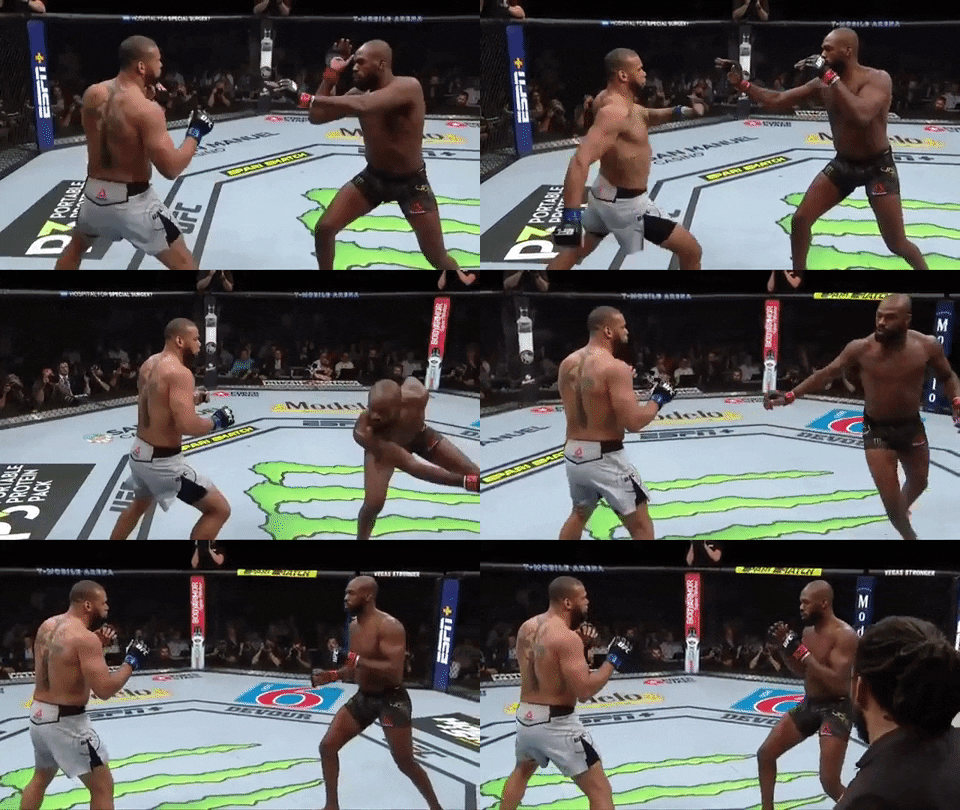
(The calf kick is notoriously hard to defend against, and even guys like Jones can sustain serious damage if they’re not careful.)
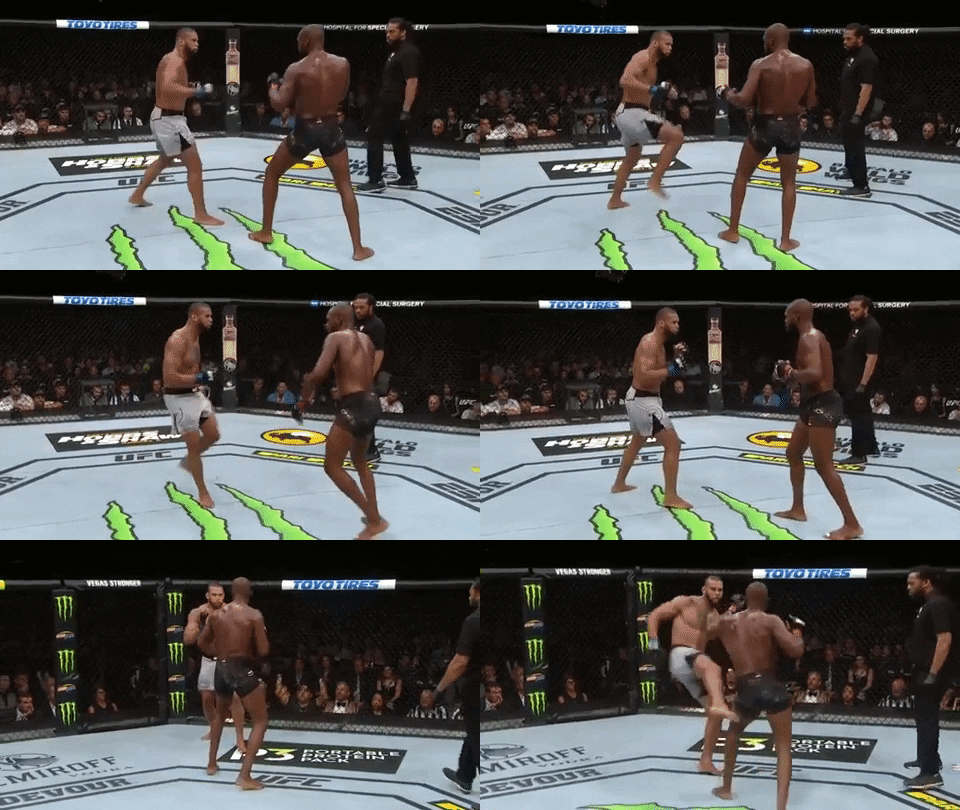
(Constant kicks to the lead leg had Jones switching stances, and not by choice.)
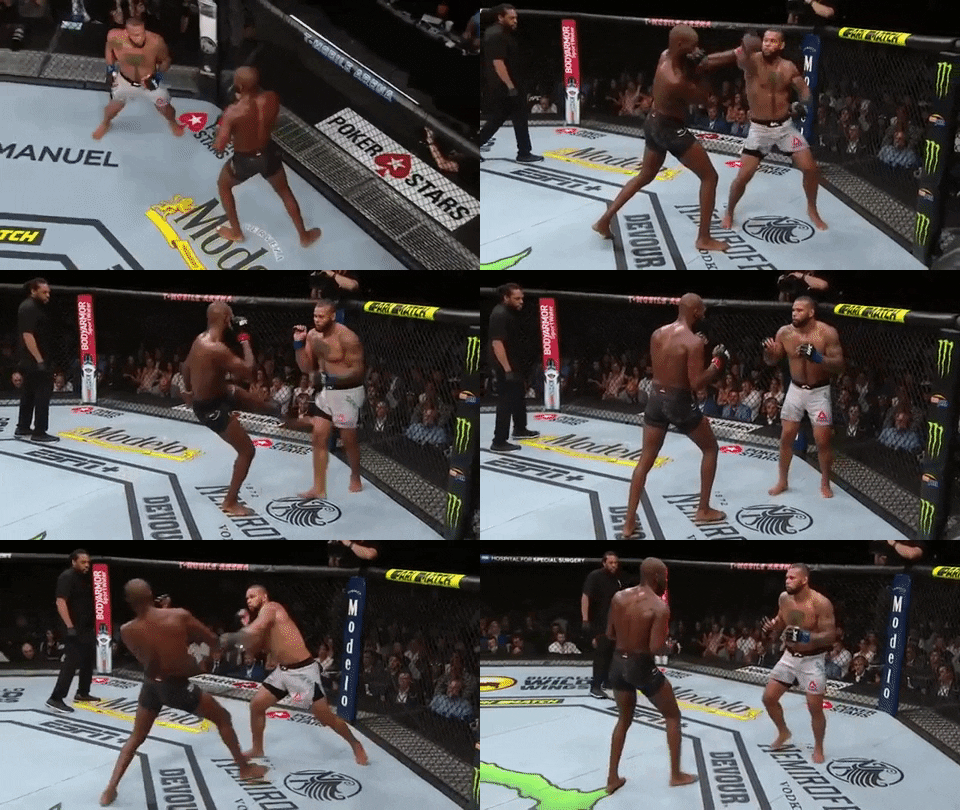
(Santos did better than expected, but Jones still did just enough to earn a split decision by taking advantage of moments like this.)
What’s interesting to note that is that Jones has had more decision wins nowadays compared to his initial run where he was buzz-sawing former champions. It could be that he wants to avoid long term damage and risk getting knocked out, or that he’s facing guys that are a lot more cautious and won’t give Jones the looks necessary for him to calculate his counter attacks. His last two finishes were against Daniel Cormier and Gustafsson, but he went five rounds with them before so he had a thorough understanding of their styles and habits.
A lot of pundits talk about how close Santos made the fight, but it would be a disservice to not mention the things that Jones did well. You’ll notice that even though Jones doesn’t throw a lot of combinations while striking, he will throw strikes at different levels with a high level of variation. Instead of punching with a set combo that he drills with pad work, he’ll throw a right hook followed by a left front kick. He might follow that up with a long break, stalking his opponent before throwing a jab followed by maybe a low line side kick. It’s harder to time and by going high and low, Jones can keep his opponents on edge and dictate the pace of the fight. Floyd Mayweather Jr. is a master of this, and it’s something that all of his opponents spoke about (mostly in frustration). Andre Berto openly described how when he fought Mayweather, he was amazed at how Mayweather knew every inch of the ring, how many breaths he was taking, and exactly how much energy he was exerting with every strike. Many fighters are simply trying their best to execute a game plan, very few can be so calculating and exact during the chaotic moments of an actual fight.
Watch video
(Berto goes into great detail in how tactical Mayweather gets in his matches, and a lot of the same qualities are present in Jones’s fights.)
Think of Jones as a skilled project manager that must juggle multiple deadlines, team members, and key performance indicators all while getting punched in the face. The comparison sounds lame, but have you ever seen a really good project manager in action? They are worth their weight in gold, and there’s a reason why there’s so sought after by upper management. It’s going to take a special kind of fighter to beat Jones along with a finely tuned strategy that will have to be executed with precision. Or a really lucky strike. Is Reyes capable of either? He sure is, and there’s plenty of footage to draw upon.
Reyes will have to combine elements from different fighters and their specialties in order to win, but it’s not impossible. One of the ways that Jones probes distance is with his kicks, and many opponents don’t punish him for it. When Badr Hari fought Semmy Schilt the first time, he made sure to check Schilt’s kicks with a cross check. A cross check is performed with the lead leg, and it checks the round kick whenever it’s thrown. The benefit for Reyes is that when he settles his foot down, he will be closer to Jones, giving him the distance needed to land one of his uppercuts without having to cover as much distance. Gustafsson showed that it is possible to cut off the cage against Jones, although the threat of the takedown kept him from pushing his offense further. In addition, Gustafsson found a way to counter Jones’ kicks by withdrawing his lead leg and blitzing forward, something Reyes has already shown that he’s more than capable of. If Reyes feels that he’s fast enough or Jones won’t react in time, he can try to parry Jones’s outside hand and blitz forward (Machida is another southpaw that had success with this in the first round against Jones). On the chance that Reyes prefers a more methodical approach, he can use the same method of smothering hands that Daniel Cormier does to keep Jones from engaging in the clinch and throwing hooks and uppercuts off the break. Cormier’s uppercuts were giving Jones fits before he decided to grab his hands with 2 on 1 and keep him from effectively clinching again.
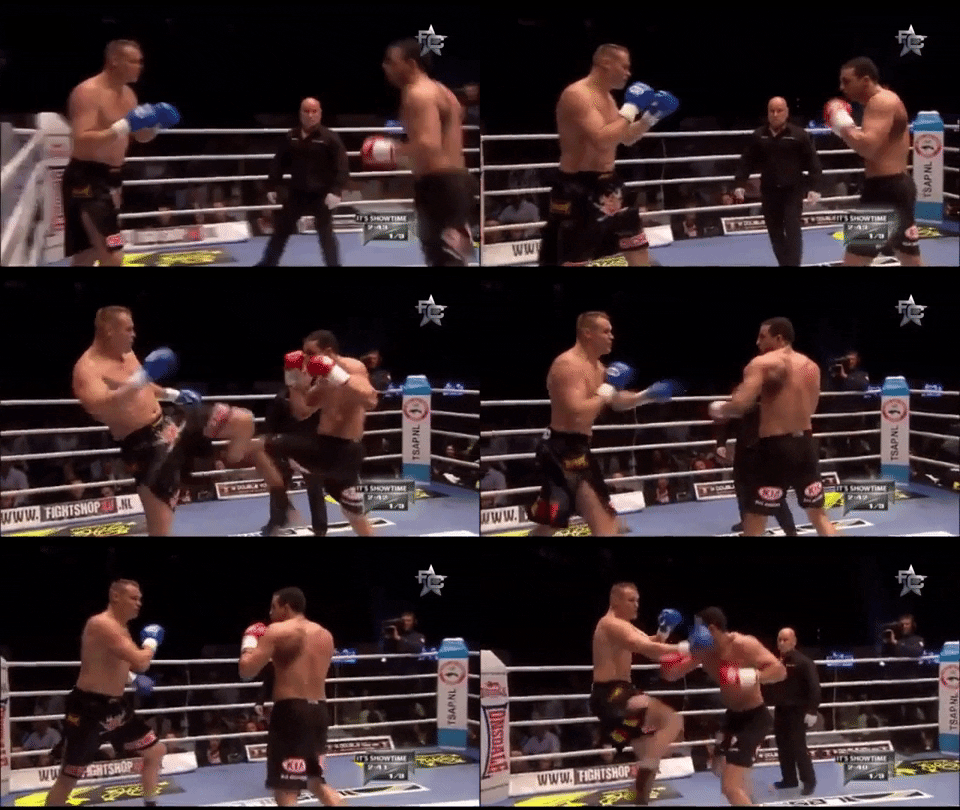
(Semmy Schilt throws a round kick that’s cross checked by Badr Hari, allowing him to advance without having absorbed the full force of the kick.)
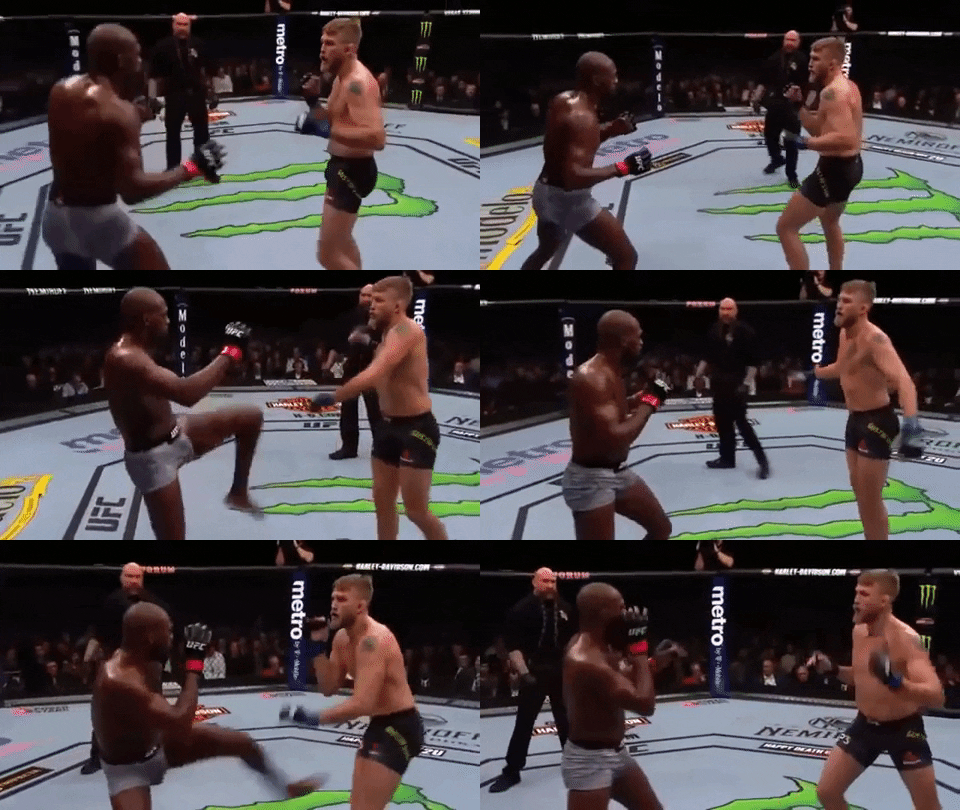
(Even though he throws two kicks and switches stances, Gustafsson avoids both by withdrawing his lead leg and switching stances himself.)
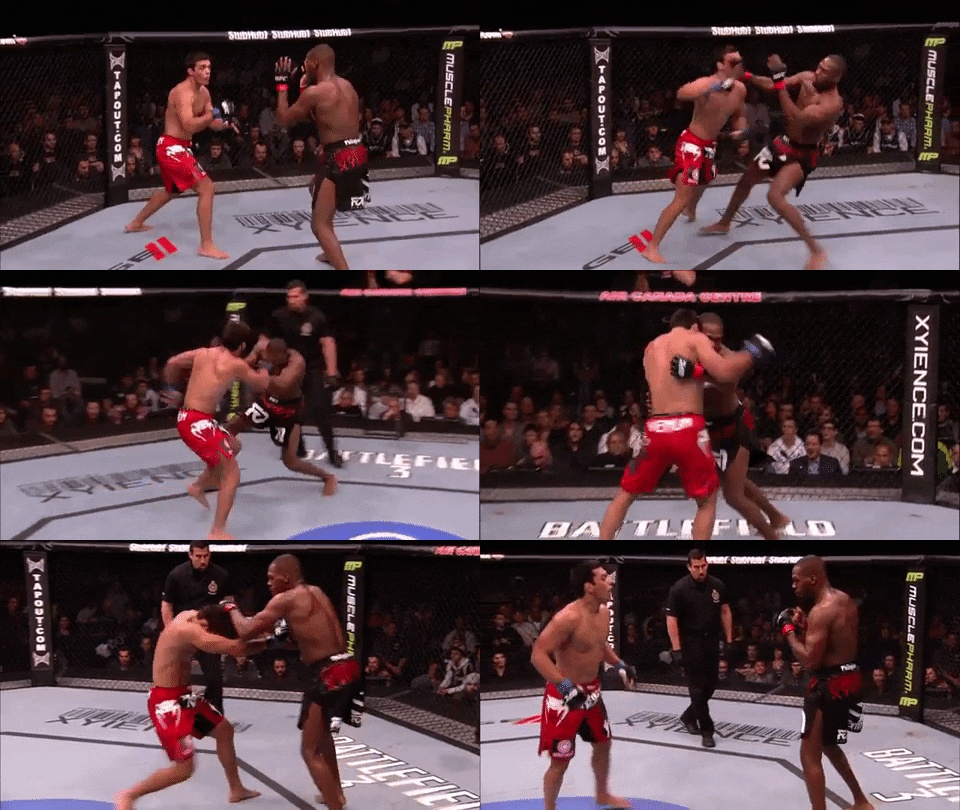
(A much younger Jones learns that if you get sloppy while throwing kicks against a southpaw, you can get blitzed up the middle quick fast.)
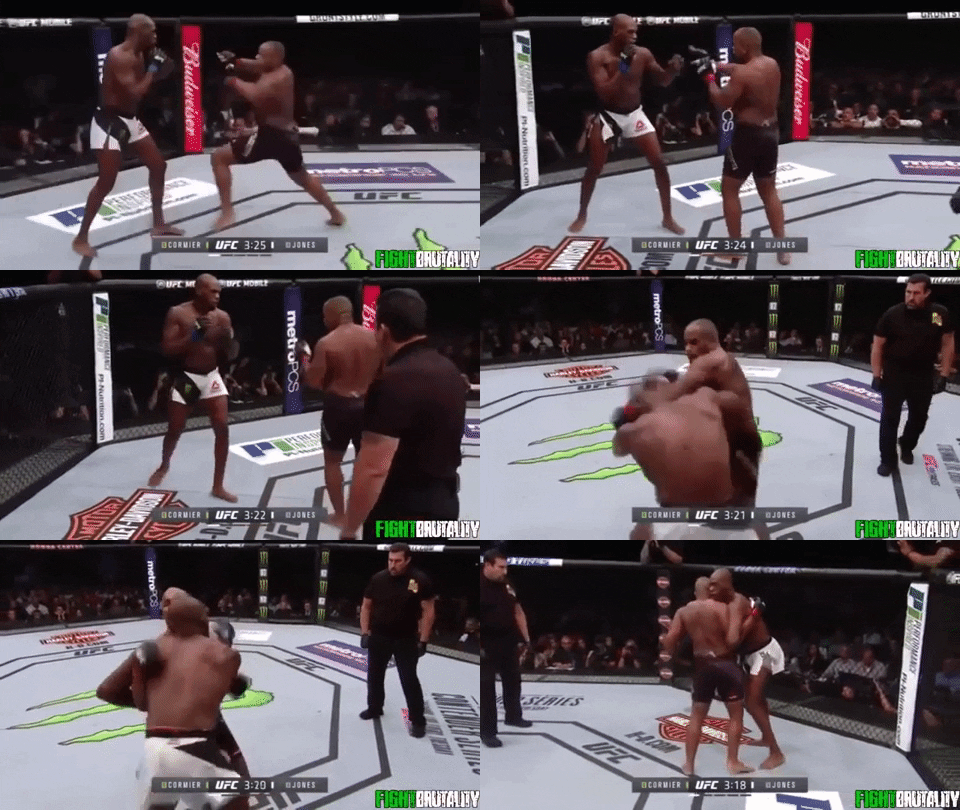
(Just like their first fight, Cormier ties up Jones’s hands and blasts punches up the middle and hooks whenever he gets the chance.)
Since Reyes has a decent kicking game, he should be throwing them on a consistent basis to keep Jones from utilizing his mobility. Even awkward low kicks thrown in a less than perfect fashion can slow down a fighter, and both Quinton Jackson and Daniel Cormier had some success with this. Even guys who throw “ugly” kicks like Justin Gaethje and Tony Ferguson can slow down more effective kickboxers like Cerrone and Pettis. Since it’s almost inevitable that Reyes will get clinched at some point (even an older Weidman was able to do so), it makes sense to develop some weapons against Jones in this range. In order to give himself the best chance, Reyes will want to make sure that his hands aren’t tied up by Jones, so making sure that he breaks those grips quickly is going to be key. Second, Reyes can’t let Jones dig his forehead under his jaw, since this is a position where Jones can start hammering away at the body with knees and hooks off the break before engaging and repeating the dance all over again. Perhaps a well-timed head placement (not headbutt!) could discourage Jones from coming in too quickly and trying to tie up. Henry Cejudo is the master of this technique and uses it quite effectively when opponents rush in on him, and Evander Holyfield frustrated Mike Tyson with it as well. Reyes should also consider adding in a trick move or two to throw Jones off his game. Not that he should be adding spinning back fists and kicks off the cage like Pettis, but perhaps a very low kick to scoop up Jones’s lead leg before blasting him with a straight left. Yoel Romero caught Tim Kennedy with it early, and moves like these sprinkled throughout the fight wouldn’t hurt.

(This might not be a huge game changer, but against Jones every little bit helps.)
In an ideal world, all this should leave Jones more hesitant and chasing Reyes, giving him a better shot at the southpaw left straight/left kick combination. Reyes will need to keep Jones on the outside and piece him up with kicks and left straights. Even though Jones is the better wrestler between the two, Reyes shouldn’t be afraid of throwing leg and body kicks to make sure that Jones is aware of threats at all ranges. This will also give Reyes a chance to have Jones overreact and shoot in early, similar to what OSP did. The earlier he can get Jones shooting in and missing, the better. The left straight to the body can also work a treat, since Santos was able to show that hammering shots to the midsection will slow Jones down as well.
The path to victory for Jones is much easier: slow down the pace and force Reyes to work in uncomfortable positions. For all his talent, Reyes is still very early in his development and has only been in the UFC for three years. Outside of guys like McGregor and Israel Adesanya, it’s tough to rise to the status of champion in such short fights, and Jones has seen it all. He’s fought tricky southpaws like Machida and Vitor Belfort and dealt with prolific kickers like Santos and Shogun Rua. Jones also fought Daniel Cormier twice and walked away as the winner in both occasions (failed drug test notwithstanding). Jones is comfortable enough stance switching and can fight Reyes southpaw as well, creating an open stance match-up and making it ugly. Jones doesn’t care about making the fight exciting, he only care about winning with a comfortable margin. Reyes also doesn’t always keep his immaculate footwork and has been pushed against the fence by guys like Weidman and Oezdemir. Jones is masterful at pressuring you towards the cage where he can beat you up on the inside with hooks, ala Teixeira. Let’s not forget that Jones has nearly 8 inches of reach on Reyes, and he’s had over twenty-five fights to perfect it. Jones is also left-handed but fights mostly from orthodox, which allows him to easily fight from either stance—adding further complexity to his already complex game.
At UFC 247, Reyes is going to try and do the unthinkable and dethrone Jones. He has all the physical tools to do it, but history indicates that this is a task which may prove impossible. Just don’t tell that to the challenger.
