 Home

 Creators
 Search
 Recent
 Random
 Posts
 DMs
 Tags
 Random
 Importer
 Import
 FAQ
 Account
 Register
 Login
 Favorites
 Keys
 Logout
 Telegram

Paul's Preview: Felder vs. Hooker (Patreon)
Content
Although Deontay Wilder and Tyson Fury are having their rematch this weekend, the UFC is also putting together a Fight Night card in Auckland, New Zealand, headlined by Paul Felder and Dan Hooker. Although this isn’t a star-studded event, it is an intriguing match-up between two top ten lightweight fighters (Felder is ranked at 6th while Hooker is at 7th). Heading into this fight, both are 2 and 1 in their last three matches and in a really weird coincidence, they both had fights against James Vick and Edson Barboza. MMA math isn’t accurate by any means, but it is interesting to point out that among their common opponents, both have a victory over Vick (Felder by decision, Hooker by KO) but Felder won a split decision over Barboza while Hooker got TKO’ed in the 3rd round. This isn’t to say one has the advantage over the other, or that since Felder beat Barboza while Barboza beat Hooker, Felder should win. MMA doesn’t work that way, nor do most sports for that matter. Each fight is different and the athletes improve from one match-up to another. With that said, there are some habits that both Felder and Hooker have shown in all their fights, so it’ll be crucial for the coaches to have done their homework and know what to expect.
For the lazy fight fan, think of Felder as a less active Donald Cerrone. There have been some comparisons between the two, but outside of both of them having trained together in the past, there isn’t a whole lot of things stylistically that they share. Felder is more active with his elbows while Cerrone loves the intercepting knee. Cerrone loves using kicks to set up his punches while Felder does the opposite. Felder is serviceable everywhere, but there isn’t one key area that makes him especially dangerous. He’s a solid striker that can stand with anyone in the division, but there are times when he becomes fairly predictable and textbook in his counters. A notorious slow starter, Felder is no stranger to losing the first round before making the right adjustments and winning the rest of the fight. Felder’s most recent victory over Edson Barboza was hotly contested, but what wasn’t up for the debate was that first round. Early on in the match up, Felder was still trying to figure out how he was going to approach the striking, and he ate a steady stream of kicks and hooks while doing so. Barbosa doesn’t need a lot of room to be effective and pressure alone isn’t enough to stop him. Just simply walking forward towards Barbosa won’t get him to panic, it just lets Barbosa set up traps that he can use on a moment’s notice.
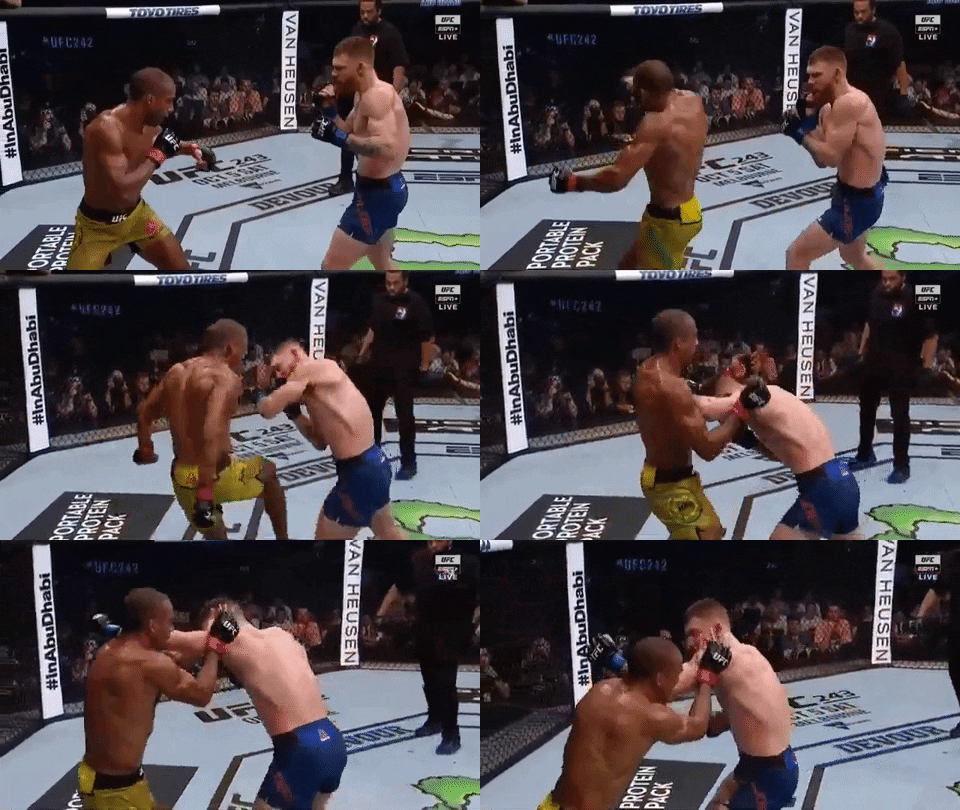
(Pressure without any real offensive means that Barboza can set you up for his attacks, in this case a spinning back fist.)
This isn’t limited to Barboza, there are tons of examples of Felder being down on points in the first round before he figures it out (eventually). Against Charles Oliveira, the entire first round was Oliveira putting on a grappling clinic and going after D’arces and rear naked chokes. Against Alessandro Ricci, Felder had trouble in the first round adjusting to Ricci’s southpaw stance and got hit every time he closed the distance with his step in jab. Eventually he turned the tables against both fighters and picked up wins, but it was clear that if you could frustrate Felder or keep him guessing as to your next attack, your chances of victory are much higher. An overall issue with Felder’s game plans are that he’s still in the mindset of traditional martial arts where he will wait for his opponent to finish their attacks before starting his own. Not everyone plays this game and if you stay still just absorbing strikes, they will figure out that they can continue their attack unabated. This was also a pattern in Felder’s fight again Daron Cruickshank. He would set up some great punching and kicking combinations, only to admire his handiwork and get clipped with an additional strike that he walks into. The old school Muay Thai mentality of “You hit me, now I’ll hit you” can only go so far, but Felder has had a decent amount of success with it.

(Instead of following up the axe kick or retreating out, Felder stays in place and gets counter kicked by Barboza.)
Even though I just wrote about how predictable Felder can get, his ability to adjust mid-fight is pretty remarkable. He does a great job of listening to his corner and following through with their advice (a trait that a surprisingly high percentage of professional fighters don’t share). In the second Barboza fight, Felder started to throw in jabs while stepping in forward instead of merely flicking them in hopes of getting Barboza to stay still. When Barbosa moved laterally, Felder would mix in the hooks to hurt Barboza. Oliveira looked like he was going to finish Felder in round 2 before he got reversed and elbowed right on the chin, dropping him and giving Felder to the opportunity to score the finish. Have Eugene Bareman (Hooker’s head coach) and the rest of the City Kickboxing team put together a plan to stop Felder?
Having the home court advantage, Hooker will look to try and win another fight in his backyard. The last time he fought in Aukland, he put on a beautiful performance against Ross Pearson which was also his lightweight debut. Prior to moving up to the 155 division, Hooker was a .500 featherweight looking to rebound after a loss against Jason Knight. Hooker’s victory over Pearson showed that when he’s not draining himself to make 145, he can follow through with a solid game plan and give any striker a decent scrap. Pearson was still considered one of the better boxers in the division and was known for his ability to slip and counter against the best. In the fight, Hooker showed a smart jabbing game and mixed in low and high kicks to keep Pearson guessing. Once he was able to get Pearson’s timing, he caught Pearson flush with a knee and knocked him out in the second round.
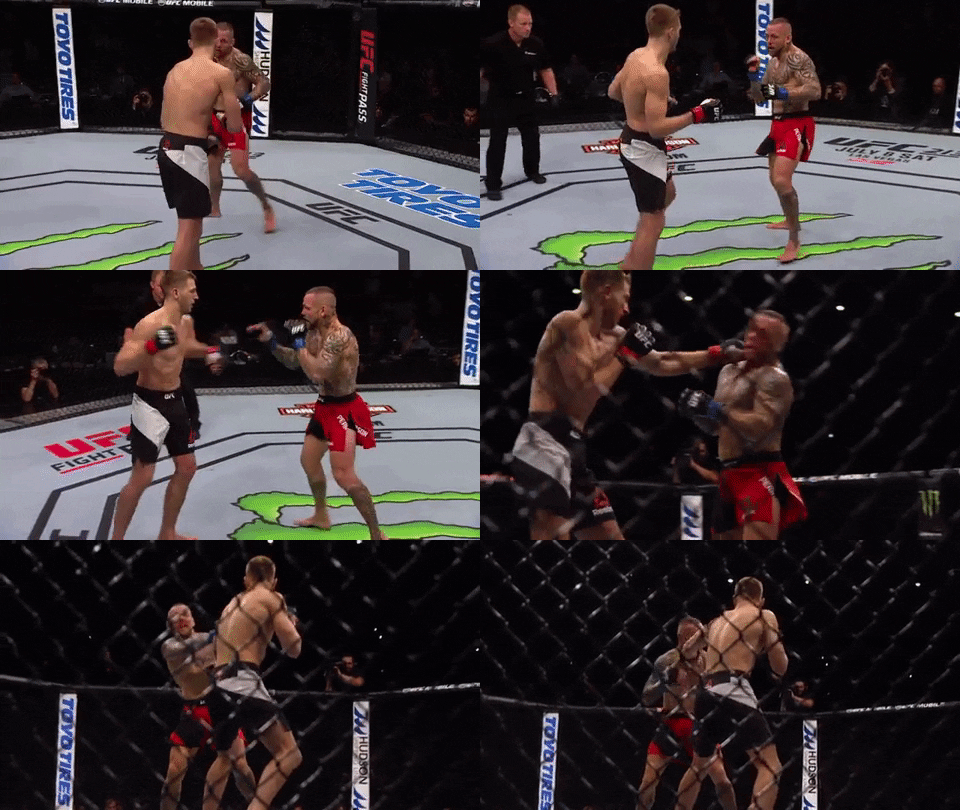
(Hooker does a beautiful job of jabbing Pearson constantly to keep him on edge and finishing up with a lead low kick.)
Hooker followed this up three straight finishes, allowing him to call out Barboza for a match-up in a striker’s delight. That… did not go well for him. It was an intriguing callout since the things that Barboza needs to do well are also things that Hooker favors. For Barboza to win, he needs two main elements in his favor: distance and a slow pace. Hooker also likes to pick his shots from long range and slow down the pace, but he was calling out a guy that is especially dangerous when both of those things line up. Hooker admitted in an interview with TAB New Zealand that an overhand right in the first round put him on auto-pilot, but once he recovered mentally both his legs were absolutely shot. Barboza had a field day, blasting low kicks and inside low kicks before getting in close enough to box up Hooker with hooks and uppercuts.
Video of Hooker explaining his loss to Barboza. (No excuses given, Hooker considers the loss a learning lesson.)
Despite not having the fight go his way, Hooker went right back at it and got matched up with James Vick. One counter left hook later, Vick was knocked out cold and Hooker was on the win column again. Knowing another win was needed in order to climb back up to the top 5, he got matched up with Al Iaquinta in neighboring Australia. In a performance that reminded people of how well Hooker can follow a game plan, he outstruck Iaquinta and put on a leg kick clinic. When Hooker can draw you into his range, he has a better than average chance of implementing his strategy: soften you up with kicks to draw out reactions so that he can find his mark with counters. Against the likes of Pearson, Vick, Marc Diakese, and Jim Miller, Hooker would slowly pressure you and start showing feints to see how you would respond. Even grizzled veterans like Miller would start swinging like he’s in a fire fight before getting countered (and finished) with a knee. Hooker is going to have to make sure that whatever strategy he has going into the Felder fight, he’s prepared for the best version of him.
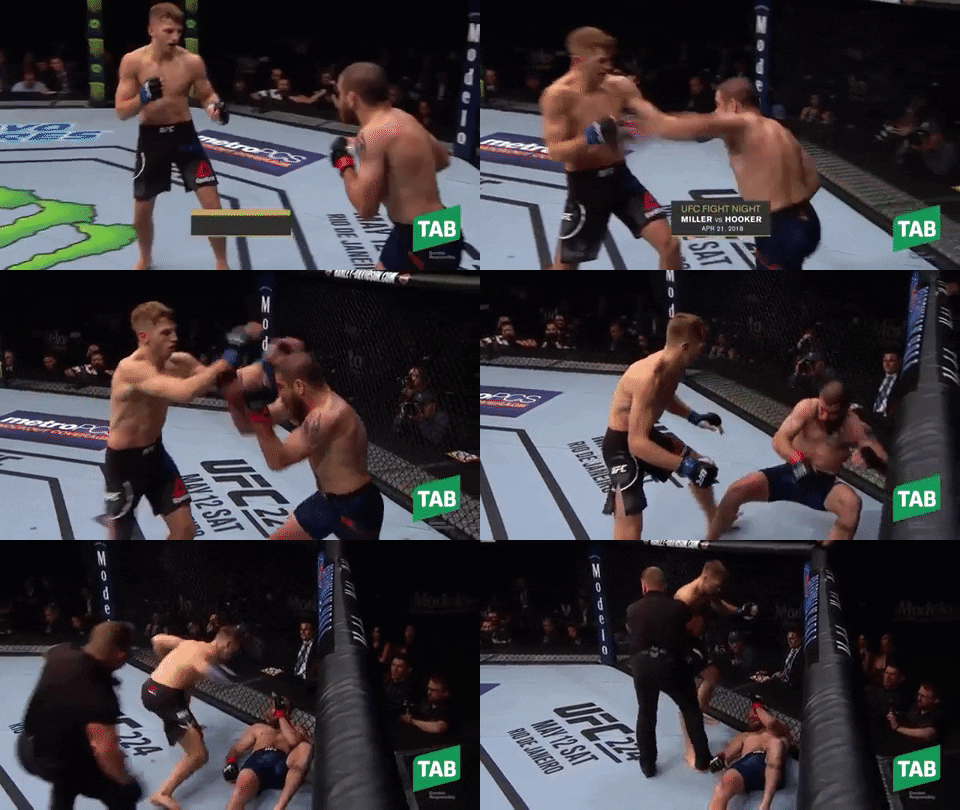
(Mixing in feints, jabs, and slipping the hook from Miller give Hooker the chance to throw a powerful rear knee right on the button.)
Both Felder and Hooker present some interesting striking habits that can be exploited. As mentioned earlier, Felder likes to slowly chase his opponents and he usually suffers for this in the first round. Hooker has shown that he can set a pace and find openings as the fight wears on. Hooker can exploit this by feinting with his jabs and hips only to actually return fire when Felder strikes back (and hangs out too long in the open). If Cruickshank was able to do it to Felder, there’s no reason to believe someone with Hooker’s arsenal can’t do the same. Hitting Felder with kicks before swarming in with punches is also a solid move, considering that Felder’s preferred method of defense at close range is to cover up and wait it out before striking back. Doing this a couple of times can get Felder to open up prematurely and get cracked with strikes he’s not expecting. Given that Hooker has the height and reach advantage (Hooker is 6’ with a 75” reach, while Felder is 5’11” with a 71” reach), the distance does favor him slightly. For Felder to win, he’s going to have to prepare to make this a fight for all five rounds and figure out early how to adjust Hooker’s strategy. Barboza is a wickedly fast kicker, and he had a lot of success by firing off a variety of kicks while boxing up Hooker on the inside. Felder doesn’t have the same speed, but he can utilize a lot of the same strategy. In a main event fight, it’s going to be important to start hitting the body early and sapping the gas tank of Hooker. This was something that Barboza was keenly aware of, and in the third round a well-placed left hook to the midsection finished off Hooker who was barely hanging on at that point. Although this fight doesn’t do much to set up the next contender for the winner of Khabib Nurmagomedov vs Tony Ferguson, it does provide one fighter the opportunity to crack into the top five, setting himself up for a future shot at a #1 contender’s bout. If there’s one thing you can count on the lightweights for, it’s always full of talented fighters that are swimming in a shark tank and this main event is no exception.
