 Home

 Creators
 Search
 Recent
 Missing
 Random
 Posts
 DMs
 Tags
 Random
 Importer
 Import
 FAQ
 Account
 Register
 Login
 Favorites
 Keys
 Logout
 Telegram

The Legacy of the Shamrocks (Patreon)
Content
By Paul
When the UFC first started, it was designed more or less as an advertisement for Gracie jiu-jitsu. Royce Gracie ran through the competition, winning 11 in a row and 3 of the first 4 tournaments. Despite being the lightest competitor on the card, Gracie proved to be a threat on the ground, where almost no one had any idea on how to defend against his submissions. However, there was one man who not only knew of submissions but was quite adept at them. Ken Shamrock is widely mocked nowadays as a caricature of his former self, but fans don’t realize (or care) about his contributions to modern MMA. Outside of the Gracies, the Shamrocks’ (both Ken and his adopted brother Frank) are responsible for many of the things that we now consider common in the fight game. It’s easy to scoff at their accolades and brash talk, but there was a time when what they did was considered revolutionary and deserves our respect. Here are some of the ways that both Shamrocks paved the way for what we enjoy today as fight fans.
Ken Shamrock’s rivalries helped early UFC PPVs
Even though it was Royce Gracie who won all his early UFC matches, people forget that after a little more than a year, he was done fighting. After UFC 5, he disappeared from the public eye, only to emerge 5 years later in PRIDE. His last UFC opponent during that time? None other than Ken Shamrock. Gracie insisted on his rules, where if there was no finish at the end of the time limit, the fight would be ruled a draw. The fight ended with Shamrock becoming the first fighter to take Gracie to the end without being submitted, and many felt that if judges were to score the fight it would’ve gone to Shamrock. With Gracie exiting the UFC, the promotion needed a new figure to rally behind and Shamrock was it. Taking a page out of boxing and professional wrestling, the UFC created the Superfight Championship. He got set up against Dan Severn, the UFC 5 tournament champion, and guillotine choked Severn fairly quickly. Shamrock then defended that title twice before his heated rivalry with Severn gave us a part two. Their rematch at UFC 9 was infamously dubbed “The Dance in Detroit” for the lack of action due to a last-minute rule change, and the less we talk about it the better. However, it was clear that Shamrock was a certified PPV draw, and his rivalries with Gracie and Severn showed the UFC how to create a narrative and use bad blood to sell fights. Even after he left to pursue professional wrestling and fought for a while in PRIDE, his return to the UFC was against none other than Tito Ortiz at UFC 40. By then, the UFC had been sold by its original creators to Zuffa, who was having trouble drawing viewers. With a feud simmering between Ken Shamrock and Tito Ortiz, the UFC put all their eggs in that basket and worked on promoting the fight, which was for Ortiz’s light heavyweight title. It got unprecedented coverage at the time, with both Shamrock and Ortiz gaining attention from mainstream media for the genuine bad blood and trash talk. Despite losing the match, Shamrock proved to the UFC that it could survive as long as they had compelling matchups, just like in the old days.


(Poster designs were so much simpler back then.)
The Significance:
How many fights do we watch now where one fighter runs their mouth, trash talking and swearing that the bad blood is real? Creating hype before a matchup is nothing new in combat sports or pro wrestling, but Shamrock was the first to do it in the UFC (and MMA at large). He wasn’t the best behind the mic nor was he a knockout artist like Mike Tyson, but there was a certain aura around him that made you tune in. With his American Gladiator physique, Marine-style haircut, and no-nonsense attitude, fans were drawn in and wanted more. His ability to form rivalries also helped build storylines at a time when the UFC was struggling with its identity. Gracie’s initial run was impressive and inspired a generation of Brazilian fighters to try their hand at MMA, but it was Shamrock who stayed behind and did a lot of promotional heavy lifting. Shamrock was also the first fighter to go on talk shows like Late Night with Conan O’Brien in 1996 to promote his matches, something that the UFC couldn’t do again until the early 2000’s. Shamrock’s ability to sell the fight before they happened was definitely a huge contribution, and something that the UFC still struggles with when it comes to some of their champions.
Ken Shamrock was the first unofficial UFC Heavyweight Champion
Remember that Superfight Championship that was mentioned earlier? It might have been a meaningless cash grab at the time, but it did morph into something legitimate: the first UFC heavyweight championship. At UFC 12, the promotion decided to unify the Superfight Championship with the UFC Tournament Championship, with the former held by Dan Severn (who beat Shamrock to get the title) and the latter by Don Frye (who won the previous Ultimate Ultimate 1996 tournament). UFC 12 was also the first event to have weight classes, with heavyweights being anyone over 200 pounds, and lightweights being anyone 199 pounds and below. Injuries kept Frye from competing for the inaugural title, so he was replaced by Mark Coleman. Even though it was Coleman who won the bout to become the first UFC heavyweight champion, tracing the lineage back leads to Ken Shamrock. Boxing uses this train of thought when it comes to their lineal heavyweight champion, and if the UFC were to do the same, they would go back to Shamrock. Tournament titles were great, but it often bogged down the winner since so many matches caused injuries, robbing fans of the finals they wanted when alternates got slotted in. The rematch between Shamrock and Gracie was attempted back in UFC 3, but with Gracie having to withdraw due to exhaustion and Shamrock bowing out due to injury, fans never got to see the fight (despite it being ON THE POSTER). The Superfight effectively guaranteed that the crowd would see the fight without the worry of either fighter getting injured or knocked off in the tournament. It’s undeniable that the popularity of both men was high enough that the top brass bent their own rules and allowed singular matches to take place out of the tournament format.

(Don’t let the picture fool you, this didn’t happen.)
The Significance:
There were plenty of singular and title matches taking place in combat sports, look at any boxing cards from that time period. What made this so important was that the UFC now had stars that they could use to build entire cards around instead of having to wonder who would make it to the finals. Having a Superfight Champion also meant that there was one singular fighter outside of the tournaments that they could rely on to carry a card and not worry about the threat of injury or withdrawal. UFC 6-9 had the advantage of having one champion defend their title as the main event while the rest of the tournament played out. Without it, the UFC would be at the mercy of however the night unfolded, the risk being a repeat of UFC 3 where the finals was fought by alternates. Shamrock essentially served as the main event for nearly half of the early UFC’s, and given his natural weight of 220, he was the first heavyweight champion of the promotion. Since Gracie didn’t win the Superfight Championship, it’s actually Shamrock that fight fans will trace the championship lineage to. An honor that is his alone.
The Lion’s Den was the first major MMA camp
Ask any fighter where they train out of, and they’ll usually tell you what academy they represent. American Top Team, Alliance, Elevation, AKA, Kings MMA, you get the idea. All that can be traced back to one source: the Lion’s Den. Before Pat Miletich and the Miletich Fighting Systems took root in Iowa, before Brazilian Top Team started off in Rio de Janeiro, and definitely before AKA become the well-rounded MMA powerhouse gym it is today, there was the Lion’s Den. Now to be fair, the concept of a fight camp wasn’t new, Ken Shamrock got the idea from when he spent time training in Japan. What made the Lion’s Den special was the high level of fighters it had at the time. They had four UFC champions, multiple King of the Cage title holders, and most of their fighters were always ranked within the top ten in the world. Guys like Tra Telligman were standing and trading with fearsome strikers like Igor Vovchanchyn, and Pete Williams knocked out Mark Coleman when Coleman was out there smashing his opponents faces.
Speaking of Coleman, guys like him and world kickboxing champion Maurice Smith, and Oleg Taktarov all came down to Lodi, California where they sought to increase their fight knowledge and round out their game. This is why even after the Lion’s Den, northern California still remains an MMA training hub.
Knowing what we know now, some of their techniques and training habits were downright barbaric, but it was miles ahead of its time when you compared it to what some of the other gyms were doing at the time. In fact, a lot of what they used to do are still being practiced by current MMA gyms. American Top Team and Jackson-Wink both house and feed their up and coming fighters in exchange for managing their careers and a percentage of their purse, which is what Shamrock did early on for his fighters. Affiliate programs are all the rage now, done by gyms like Roufus Sports, Chute Boxe, and AKA but Lion’s Den started them first in the states. If it ain’t broke, why fix it?
And the signature training program of the Lion’s Den was in the namesake, you go in the quote-unquote Lion’s Den with one fighter after another in a grueling marathon of sparring, all to prepare you for an upcoming fight. Even the use of tryouts—that all became popularized through the exploits of the Lion’s Den. Hell, they were the first team to even have their own book.

(Even by today’s standards, the logo still holds up.)
The Significance:
What fighter nowadays doesn’t represent a fight camp? You have the rare exceptions like Tony Ferguson, but even he has a coach like Eddie Bravo and 10th Planet helping him behind the scenes. It’s easy to look back at the level of the training then and laugh, but it was a concept that was unheard of at the time. Other MMA fighters and informal teams were still using concepts from traditional martial arts, including the Gracies, whereas the Lion’s Den was trying to train for the sport of MMA.
Even when Ken Shamrock left MMA to pursue a WWE career, his adopted father Bob Shamrock made sure to point future fighters in the right direction. Hometown kids like Nick Diaz wanted a place to train, and early on he got to have a glimpse of what an MMA career might look like. Future UFC lightweight champion and Miletich mainstay Jens Pulver was also there for a bit before he made his way over to Iowa. Guy Mezger, Vernon White, Jerry Bohlander, Roy Nelson, and Joe Hurley were all champions in their own right and called the Den their home.
The Lion’s Den is also where Frank Shamrock got to work with the aforementioned Maurice Smith. With a fairly poor MMA record, Smith knew that submissions were his weakness, and that no matter how hard he tried to keep the fight standing, opponents would eventually take him down. He offered his striking services to the team in exchange for extensive training in wrestling and submission defense. This came in handy when he faced off against Mark Coleman for the UFC heavyweight championship, a title you know by now that traces back to Ken Shamrock himself.
Professional fight camps now have top level coaches, each with their own specialties on deck, but this wasn’t always the case. Ken saw a need and filled it. Sure, it might have stemmed from a selfish angle of needing training partners, but he was able to surround himself with high level training partners, even other UFC champions. This brings us to Frank.
Frank Shamrock was the prototype for the modern MMA fighter
Ken Shamrock might have seemed like the first fighter that could punch, kick, grapple, and submit, but there were others like him that just never got the chance he did. Gokor Chivichyan, Marco Ruas, and Erik Paulson were all guys that could mix it up on the feet and the ground, but for one reason or another they were all denied the opportunity to compete in the early UFC’s. Even though he’s nowhere in the UFC’s Hall of Fame, it’s undeniable that Frank Shamrock is the best fighter to emerge from this era. Even though he lacked the raw strength and steely determination of his adopted older brother, Frank made up for it with his technique and charisma. Frank made it a point to be as well-rounded as possible, not afraid to kickbox with strikers or exchange submissions with BJJ black belts. He went to AKA to mix it up with Javier Mendez and the crew, and his photo still hangs on the walls as one of its early members. Frank also made it a point to stop by and train with Ralph Gracie, wanting to see how his grappling stacked up against Gracie’s jiu-jitsu. Keep in mind that this was still in the 90’s when cross-training was seen as taboo. Frank was supremely confident in his abilities and made sure everyone else knew it. He talked openly about how he was ahead of the curve and that all the other fighters wouldn’t be able to keep up. He armbarred Kevin Jackson for the inaugural UFC light heavyweight championship, and made four successful title defenses, finishing his opponents each time. He came into the UFC as a former interim King of Pancrase, and after he left the UFC, he went on to win the WEC light heavyweight championship as well as the Strikeforce middleweight championship. In every major promotion he fought in, Frank won a belt. There’s not that many fighters today that can make this claim.

(Missing: his WEC and King of Pancrase belts.)
The Significance:
Frank wasn’t just interested in learning how to fight, he was also one of the pioneers when it came to fight strategies. When he was asked how he planned on beating Tito Ortiz, who outweighed him by close to 30 pounds, he said that his conditioning would be the difference. Journalists and fight fans didn’t know what to make of it, was he going to take a pounding and hope to rally back? Was this going to be a repeat of the Enson Inoue fight? It turned out to be a bit of both. Frank kept Ortiz at bay with his submission defense and kickboxing, and he forced Ortiz to fight for every takedown and pounded his legs, body, and neck. In a 5-round fight, one needs to worry about pacing and ensuring you don’t burn out. He waited until round 4 when he saw a gassed-out Ortiz before going for the kill, reversing a takedown and hammering strikes to the head until Ortiz tapped. After he left the UFC, he focused on his striking and lamented the lack of crisp boxing work in the MMA world. He told reporters openly that he was focused on his hands and when he got the chance to show his improved boxing, he did it against Phil Baroni. Frank was also an early proponent of incorporating yoga into his training, aware of the benefits that being flexible offers you. To this day, there are still fighters with sub-par punching and head movement who refuse to expand their training to become more limber. Frank was preaching this message since at least 2007, but it has yet to be widely practiced. Who knows, maybe in another five years Frank’s ideas will be taken seriously.
Business-wise, the Shamrocks always called out the UFC for its shady dealings
Even though both Ken and Frank had a lot of bad blood between them, they had one common enemy: the UFC itself. Ken and Frank had serious issues with Dana White and how the company ran their business. For Ken, he thought the UFC unfairly released him from his contract due to his decision to coach in the now defunct International Fight League, and became the first fighter to sue the organization for breach of contract. He didn’t win the suit, but it showed that Ken wasn’t going to go lightly or keep his mouth shut. He also had no problem blasting Dana White openly despite knowing what kind of power he had, taunting him at every turn and insulting him whenever given the opportunity. Back in November of 2007, Ken gave an interview to Fight Network Radio and he let everyone know how he felt about Dana White. In his words:
“Dana White - and I’m going to prove that today - Dana White only says things that is going to benefit him and hurt others. And they’re not even factual - it’s just things that he makes up and that he says. The last interview that Dana White did was an interview to basically hurt me and put me down and hurt my credibility, and were completely, completely lies…He deliberately lied to hurt my credibility. He knows these numbers. This is a fact - this is not throwing mud around, this is a fact: Dana White throws mud around trying to hurt people. He uses the “F-bomb” to cover up his insecurities. He walks around using the “F-bomb” because he’s not a tough guy, and by saying the “F-bomb” he thinks that people think he’s tough.”
That quote can be applied to a number of fighters today and it wouldn’t seem out of place. Frank was no different, calling out the UFC for not taking care of the fighters and not giving them a higher percentage of the revenue. One of the best deals that Frank ever pulled off was getting equity in Strikeforce, a business move that saw him help launch the brand and get paid handsomely when it was eventually sold off. Frank was also one of the first to have a rematch clause built into his contract, written in for his fight with Tito Ortiz. This meant that if Ortiz were to win, Frank would have the guarantee to have a rematch right away, something that was not granted to previous champions. He knew early on that the brand shouldn’t be the star, it should be the athletes. Although he’s stayed out of the limelight recently, a lot of his words still ring true.
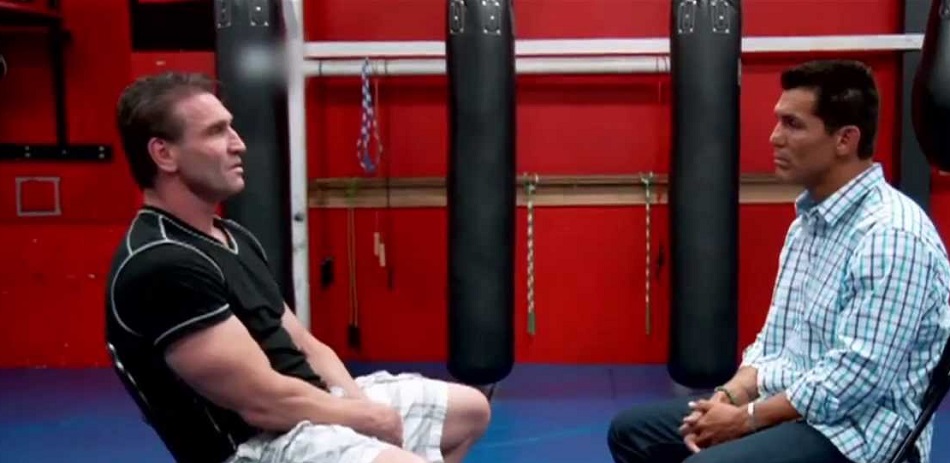
(They don’t agree on much, except that the UFC and Dana White go out of their way to screw the fighters.)
The Significance:
It’s no secret that the UFC has done some shady shit to its fighters, whether it's suppressing their fight purse, keeping them from organizing, or straight up negotiating one-sided contracts that only benefit the organization. There’s currently a lawsuit against the UFC filed by several fighters, and others have sued the UFC separately (Randy Couture and Mark Hunt come to mind). There’s always a general fear of speaking out against your employer, especially if they’re the leader in your industry. Both Shamrock brothers didn’t let this stop them from raising their voices and letting everyone know what they thought was bullying. Even if you disagreed with them, it was refreshing to see athletes speak openly against Dana White, something not even other promoters were willing to do. The UFC has definitely gotten more mainstream appeal, but the criticisms have also gotten louder as well. I’m not saying that Shamrocks made speaking out against the UFC cool, but what they did should be recognized as a fearless move, knowing that they would be the underdogs.
With all this said, both Ken and Frank also have a lot of issues that they brought to the table. Ken was mired in a couple of drug test failures and rumors that he threw fights to get out of debt. The Lion’s Den was unnecessarily harsh and had the vibe of a brutal frat house more than a martial arts dojo. When the UFC needed Ken and Frank the most, they both left for different reasons. They weren’t perfect by any means, but not enough fans acknowledge nor care about the direct and indirect contributions the Shamrocks made to the sport of MMA.
The sport, athletes, and even the promoters are better off for having both the Shamrocks around in the early days. The Gracies may have built the foundations for MMA, but the Shamrocks definitely improved it and made it what it is today.
