 Home

 Creators
 Search
 Recent
 Random
 Posts
 DMs
 Tags
 Random
 Importer
 Import
 FAQ
 Account
 Register
 Login
 Favorites
 Keys
 Logout
 Telegram

Preview: Poirier vs. Hooker (Patreon)
Downloads
Missing 1 file, as this post has not yet been imported.
Content
As it stands, the men’s bantamweight is the most stacked in the UFC. At any given night, any one of the members in the top ten can conceivably win the 135-pound title. Despite the recent hype, let’s not forget the original shark tank of the modern UFC: the lightweight division. With civil uprising and a pandemic going on, there are still fights to be made and contenders to be decided upon. Dustin Poirier and Dan Hooker are both members of the top five club in the UFC’s lightweight ranking, and an impressive performance can give one of them a shortcut to the winner of the Khabib Nurmagomedov vs Justin Gatethje title fight. This is the eighth UFC card to be held during the peak of COVID-19 lockdowns, and in a strange way this has become familiar territory, for both the promotion and the fighters. We no longer question the preparation of the athletes, instead we’re expecting them to perform at levels that they previously competed at. Given that Poirier is a former champion and Hooker recently competed in a five-round fight, we can modestly hope that conditioning will not be a problem and that we’ll still get a great match-up. Let’s see how these two stack up against each other.
Despite coming off a loss against Nurmagomedov, Poirier has made massive improvements in his striking, so much so that he was able to box up Max Holloway for the interim lightweight title back in April 2019. This wasn’t always the case. Poirier started off his UFC career with a 4-fight win streak before getting outclassed by Chan Sung Jung (better known as the Korean Zombie). The fight showed a predictable pattern in Poirier’s early career: he would win fights due to his toughness and brawling abilities, but his technical flaws would keep him from winning against the elites of the division. Although he never missed weight, Poirier was getting tired of cutting down to 145 pounds, so he made the trip up to lightweight for greener pastures. The 5’9” Poirier doesn’t exactly tower over lightweights, and his reach of 72” isn’t anything special. Nonetheless, not having to cut down an additional ten pounds seemed to really improve his performances. It was all going smoothly until he decided to start a little cross-town rivalry with Michael Johnson and found himself headlining another UFC card. This was the second main event that Poirier got to be part of, and unfortunately just like his first headlining opportunity, he ended up losing in spectacular fashion.
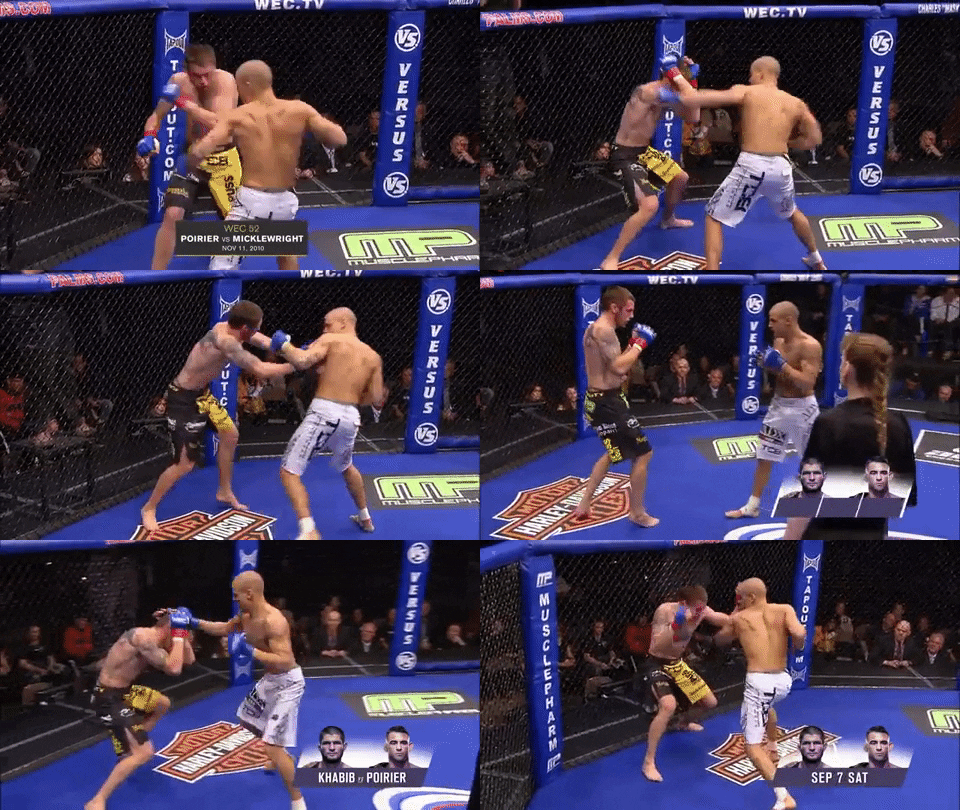
(Early in his career, Poirier was all about charging forward with 1-2’s until he got close enough to throw alternating hooks.)
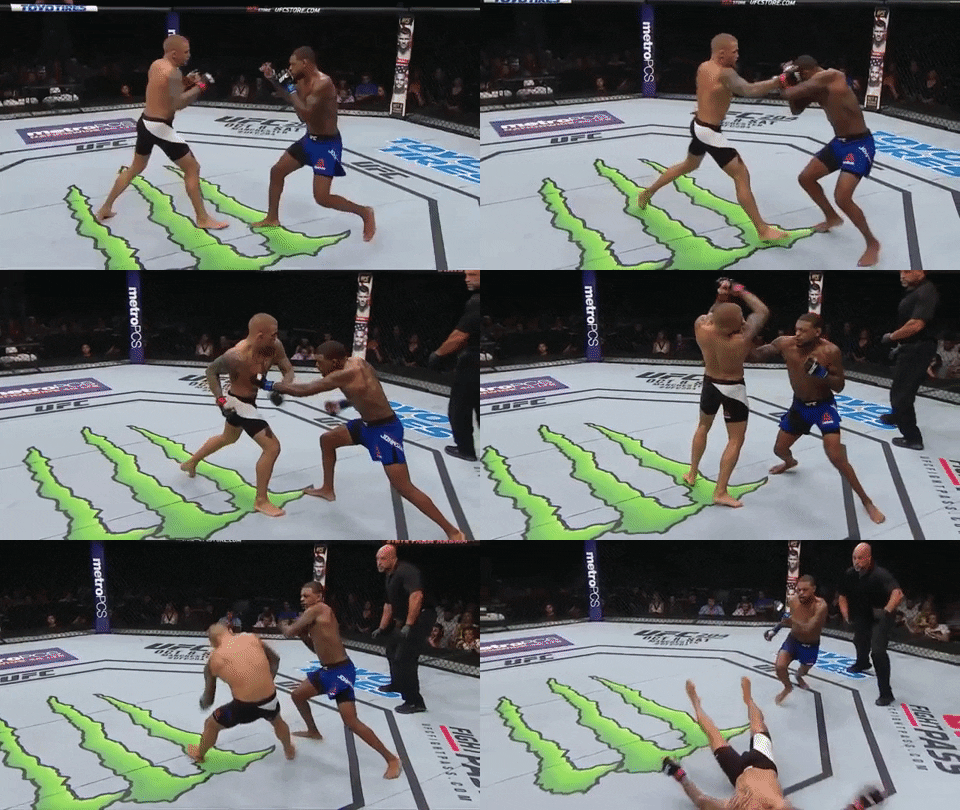
(While throwing a left straight-right uppercut down the middle, Johnson stepped back and caught Poirier with his own right straight-left hook, knocking him out cold and changing Poirier for the better.)
Poirier was on another 4-fight win streak before he faced Johnson, and despite stance switching and catching Johnson clean at times, Poirier’s old habit of rushing in head-first caused his downfall. It’s true that fighters learn more from losses than they do from victories, and Poirier is living proof of that. Suffering a knockout at the hands of Johnson was tough, but it did give Poirier a wakeup call for all his striking deficiencies. Poirier had a bad habit of bolting in after throwing his left straight, leaving his chin wide up in the air. He had moments where he recognized this flaw briefly from fight to fight, but this awareness wasn’t consistent. Before the Johnson match-up, Poirier showed improved defensive capabilities against Conor McGregor by bringing his right arm up immediately after he threw combinations to block McGregor’s southpaw straight. However, his strategy of using his elbow to cover up his chin protected him from the left straight, but not the left hook (resulting in an eventual knockout loss). Against Joe Duffy, Poirier leapt in and got hit flush to the body with uppercuts, causing him to struggle in the later rounds. Poirier’s recent success has been a case study of how it’s never too late to improve as a fighter. Since the Johnson fight, he’s gone 5-1-1, winning an interim title along the way. What helped him the most? It’s hard to pinpoint just one thing, but the biggest adjustment that Poirier made was to his jabs.
Against Jim Miller, Poirier displayed a type of jabbing game that he had rarely used before. By pressuring opponents with timing and accuracy, Poirier could now focus on setting his left straight properly whenever the openings presented themselves instead of rushing in. Adding in feints also caused overreactions in opponents, giving Poirier opportunities to counter. As a final cherry on top, Poirier’s preference to stand in southpaw let him utilize the open stance liberally. Miller was expecting the old Poirier to start swinging, but instead he got hit with the jab all night and countered every time he missed. Poirier was always a decent kicker, but these were often set up without any strategy. Once Poirier started jabbing consistently, the kicks augmented his offense. Opponents would expect the jab, only to be met with low and high kicks. It’s not uncommon to see Poirier double up on the jab, feint a left straight, and throw a low kick to an opponent who’s already shelled up to block punches. This kind of striking acumen was nowhere in Poirier’s previous arsenal, but now it’s the norm.
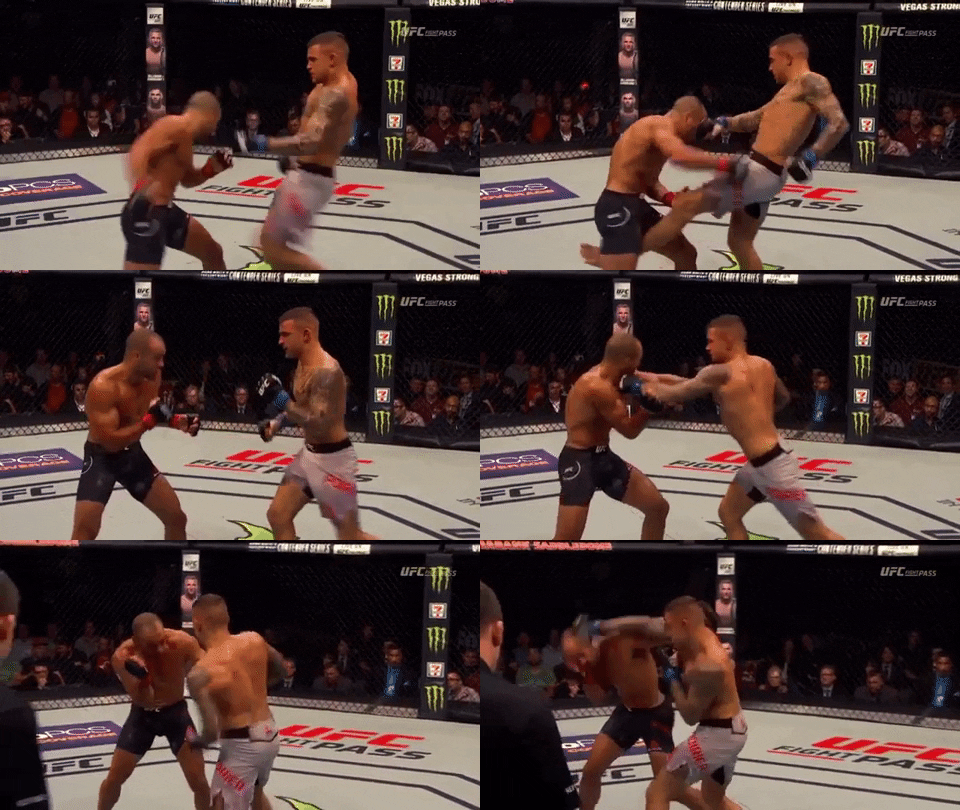
(Alvarez lands a hook to Poirier’s midsection, but gets hit with a knee and a 4-punch combination for his troubles.)
Improvements to Poirier’s game would be incomplete without mentioning his advances in defense. Poirier is still that brawler from Louisiana at heart and has shown willingness to throw down if properly challenged. To mitigate this danger, Poirier committed to moving his head off-line (either by slipping or moving slightly back) and using the shoulder roll more frequently to avoid getting caught like before. These two defensive moves give Poirier the visibility he needs to counter effectively, but still absorb strikes on his shoulders and forearms if necessary.
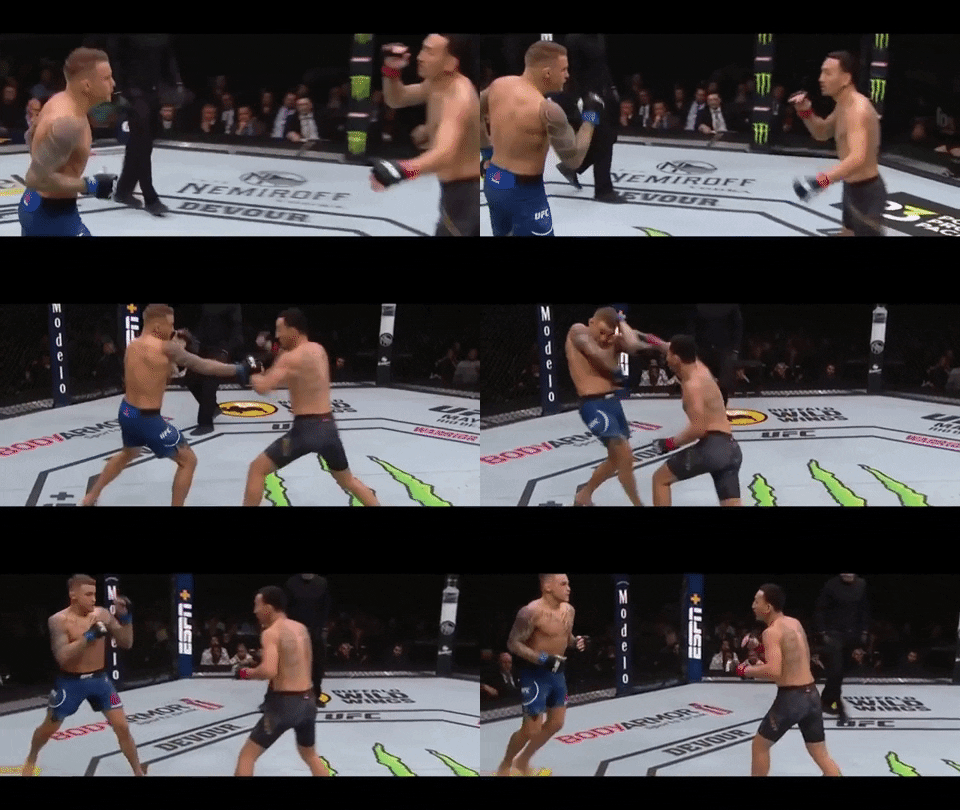
(The high guard/shoulder roll of Poirier might look odd, but it’s effective and Holloway had a lot of trouble breaking through.)
All these changes have served Poirier well, and it’s a sign of his evolving fight IQ. His fight against Pettis displayed smart pressure while striking with effective grappling against the fence, denying Pettis the space he needed to create offense. Poirier stayed heavy on Pettis’s hips, punching him from guard while avoiding submissions. Justin Gaethje low kicked Poirier’s lead leg repeatedly, but Poirier adjusted by throwing the left straight as a counter, which buckled Gaethje since he was on one leg. Eventually, one of these counter left hands caught Gaethje clean and set up the TKO finish. In his two fights against Eddie Alvarez, Poirier retreated whenever Alvarez pressed forward and jabbed constantly to keep Alvarez from lunging in. By throwing kicks at the end of his jabs (along with some well-timed knees), Alvarez’s reach was limited even further, and his gas tank was being drained the more he advanced. In his interim lightweight title fight, Poirier’s high guard and shoulder roll made Holloway hesitant to throw with volume, since it was clearly hurting his hands. By moving around laterally while blocking, Holloway was denied the stationary target he needed to accumulate damage. Poirier followed up his jabs with check hooks and left straights, which gave the usually striking savvy Holloway a problem he couldn’t solve in time. Despite a lopsided loss to Khabib where he was more or less rag dolled from start to finish, it would be foolhardy to discount Poirier’s chances at climbing back and winning the undisputed lightweight title. Standing in his way is Dan Hooker.
Another featherweight transplant who has had improved success at lightweight, Dan Hooker is 7-1 since his move back up. Before he made the trip back to the 155-pound division, Hooker was a middle of the road featherweight who bounced between wins and losses. Hooker’s win over Ross Pearson showed that when he doesn’t have to deal with a massive weight cut, he can focus on overall fight strategy instead of killing himself the entire training camp to make 146 pounds. During the time of their fight, Pearson was still considered one of the better boxers at lightweight and was known for his inside slip. In the match-up, Hooker showed a lot of the same strategy that Poirier uses: a calculated jab mixed in with high and low kicks to keep Pearson on edge to dull his reactions. Once Hooker got a read on Pearson’s timing, he caught him flush with a knee and knocked him out in the second round. Even crafty veterans like Jim Miller aren’t exempt from getting caught with this move.
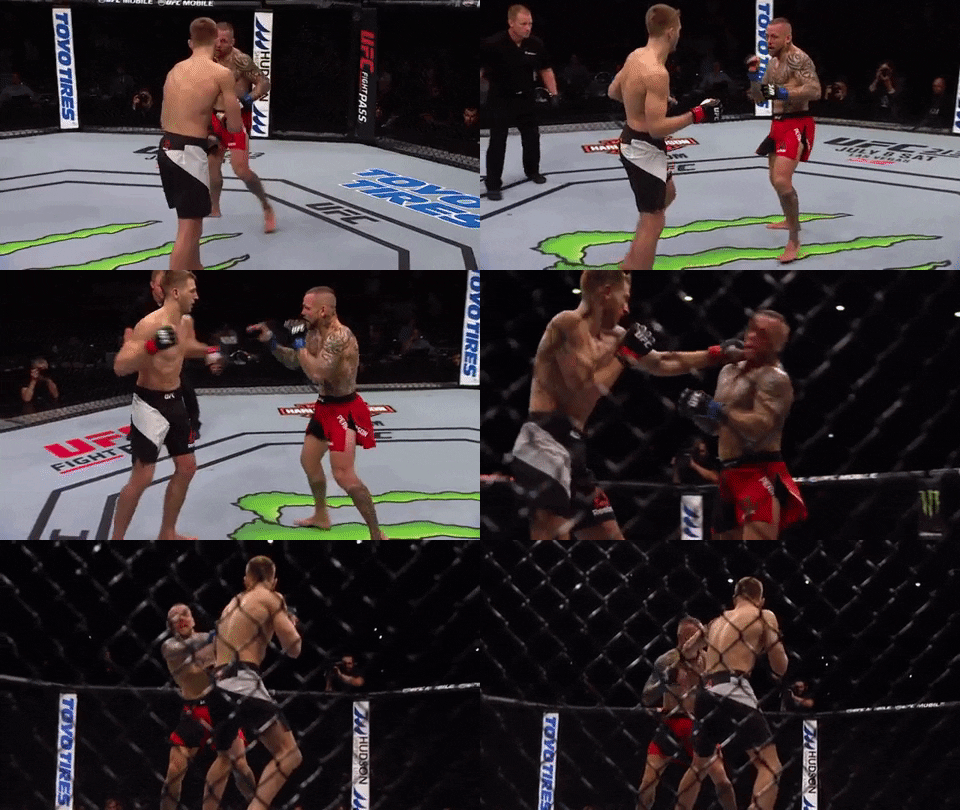
(Even on the retreat, Hooker kept finding Pearson’s chin with his jab, occupying his line of vision so he could throw the inside low kick.)
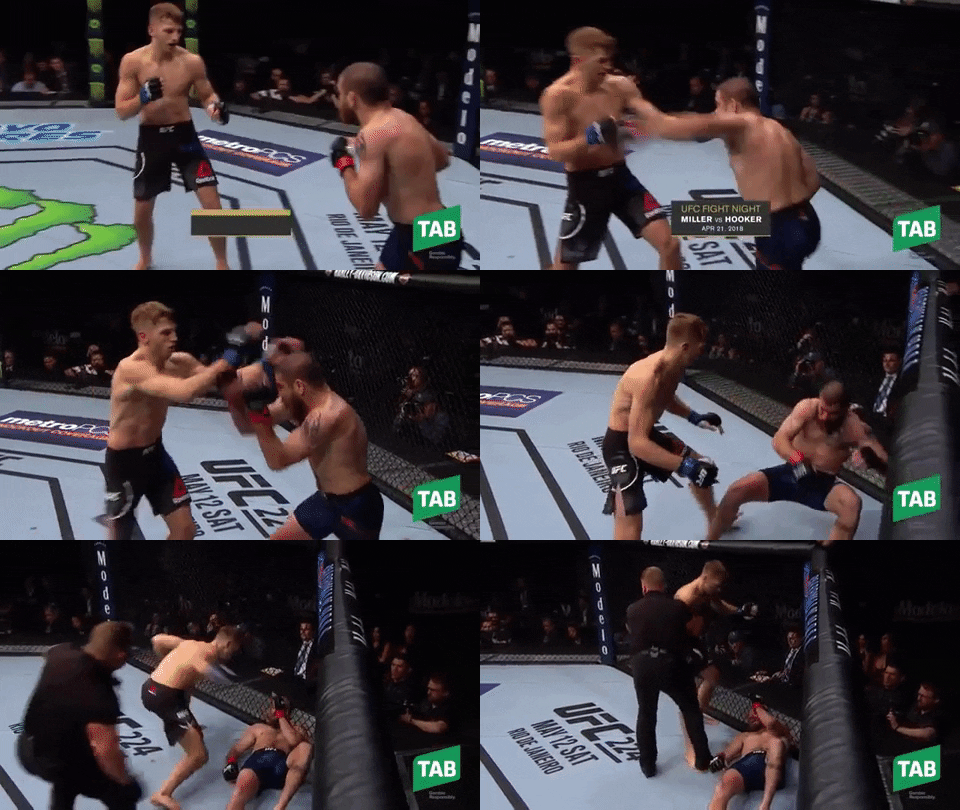
(Miller is under the impression that Hooker is exclusively striking, so he tried to change levels and get the takedown. This only led him straight into Hooker’s intercepting knee.)
Hooker’s win over Pearson started a streak of finishes, which resulted in a co-main event slot against Edson Barboza. For Barboza to win (or at least have success), he needs two things: a slow pace and distance. Hooker is good at picking his shots and keeping his opponents at the end of his strikes as well, but this just seemed like a bad stylistic match-up for him. Lo and behold, after getting caught with an overhand right early in the first round, Hooker went into survival mode and became target practice for Barboza and his kicks. It was Barboza at his best, throwing low kicks before closing the distance to throw uppercuts and hooks.
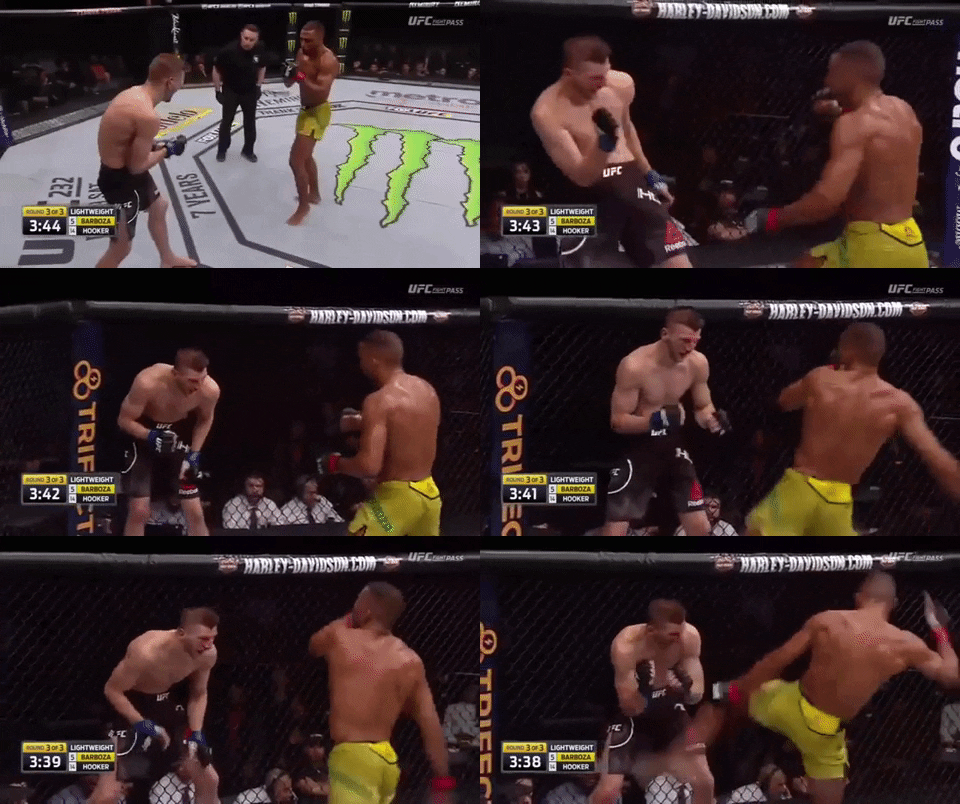
(After taking multiple kicks and punches to the body, Hooker was essentially a sitting duck. He ended up absorbing way too much punishment and fell for Barboza’s feints regularly.)
Even though he was badly beaten, he showed no sign of mental lapses against James Vick. Hooker’s counter left hook is great against fighters who press forward, and Vick was no exception. To prove his knockout win wasn’t a fluke, Hooker utilized another smart game plan against Al Iaquinta. He channeled his inner Barboza and put on a leg kick clinic. Whenever Hooker can keep you at range, he prefers to throw kicks to draw out reactions so he can counter accordingly. His slow cooker method served him well in most of his fights, and it was a key part of his victory over Paul Felder.
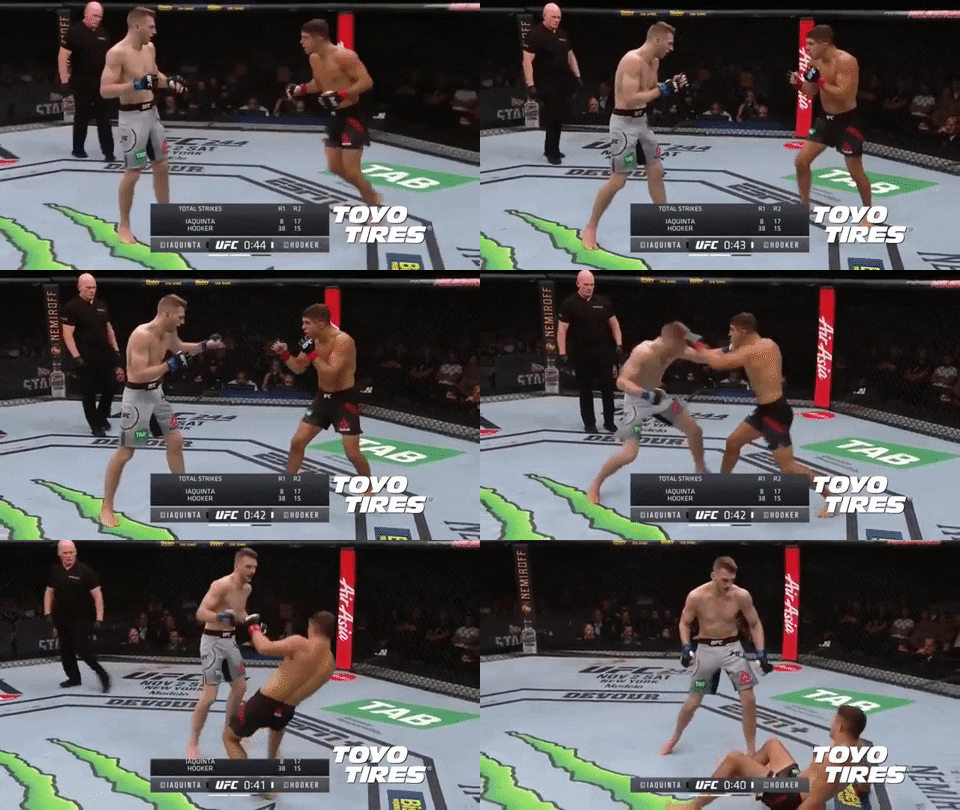
(Iaquinta bites on a feint from Hooker, only for him to duck down and hit him with a right hook that drops him.)
Early in the first round, Hooker damaged the right eye of Felder to the point where it was nearly swollen shut. Hooker’s leg kicks also found their mark, in particular the calf kicks. When it came to punches, the left hooks and right straights did plenty of damage. Hooker’s ability to set pace and find openings as the fight wears on has gotten better. What was neat about the Felder match-up was his exploitation of feinting with his hips like his teammate, Israel Adesanya, only to counter after Felder attacked or hung out too long in the open. Even though the fight was close, Hooker was able to score a split decision win, and is now facing his toughest opponent yet in Poirier. Both have similar styles and have definite paths to victory, so let’s start with the former champ first.
Poirier should try to keep his range and be diligent about his footwork. Hooker doesn’t mind opponents pressuring him, but out in the open he’s a lot more hittable. Volume striking isn’t always effective, but it could give Poirier an edge by dulling the reaction of Hooker, especially if he mixes in his feints. When Hooker was at the receiving end of Barboza’s jabs and straights, he moved his hands up at the wrong time and took kicks to the body. In a main event fight, it’s going to be important for Poirier to start hitting the body early and sap the gas tank of Hooker. Poirier should also double/triple his jabs (especially to the midsection). This was something that Barboza was keenly aware of, and in the third round a well-placed left hook to the solar plexus finished off Hooker who was barely hanging on at that point. To give his strikes some variety, Poirier can throw in some spinning backfists like Felder (who had some modest success with them). It won’t be enough to punch more, Poirier will have to move his feet after his attacks to avoid counters. If Poirier is going to plant his feet and throw, his best shot at a knockout is going to be his left straight, and if he can time it after Hooker throws leg kicks, even better. This would also allow Poirier to pivot out right after and follow up with a right hook from Hooker’s opposite side, a Pacquiao favorite.
Although Poirier cleaned up a significant portion of his game, some of his old habits are still there for Hooker and the City Kickboxing team to exploit. Even with an improved jabbing game and commitment to footwork, Poirier will still rush in here and there, shifting his weight and crossing his feet. This caused him trouble against Alvarez and Holloway, with Holloway briefly dropping him in the first round. If Hooker can get him to brawl in place, he remains vulnerable to combination striking or have his hips wide open for a takedown. Even Pettis was able to take advantage of this and got Poirier down to the ground, and he’s not exactly Nurmagomedov. Gaethje’s success against Poirier came when he feinted, creating hesitation so he could unload with alternating hooks on a stationary Poirier or punted his legs with low kicks. Also, Poirier’s frequent use of the shoulder roll means that his midsection is exposed long enough to be hit with jabs and straights (which Holloway took advantage of), and Alvarez was able to land some stiff uppercuts and hooks as well. The 6’ Hooker also has a 3'' reach advantage, and he should take full advantage of that. A nice stutter jab that Adesanya uses could come in handy, and if he’s around to show how it’s done, all the better.
With Nurmagomedov vs Gaethje set for some time in the fall (fight gods willing), an exciting victory by either fighter can make a strong case to jump in line and challenge the winner. Both Poirier and Hooker excel at feinting to get their opponents to strike first, only to counter beautifully. We’ll see who blinks first.
