 Home

 Creators
 Search
 Recent
 Random
 Posts
 DMs
 Tags
 Random
 Importer
 Import
 FAQ
 Account
 Register
 Login
 Favorites
 Keys
 Logout
 Telegram

FS 68 – Vet to Champ: Michael Bisping (transcript) (Patreon)
Content
Pillow-fisted, choke artist, overrated, not championship material—Michael Bisping has heard it all. Despite all his talents, it seemed at one time Bisping would remain a top ten contender that would be good enough to give anyone in the division a tough time, but remain short of becoming the 185-pound king. As a middleweight, Bisping would build up a nice win streak, only to lose to a top contender right before what seemed like a title shot. Before his title run, he was stuck alternating wins and losses, further cementing himself as a gatekeeper for the division. But in 2016, a series of fortunate events culminated with Bisping winning the middleweight title AND defending it. The UFC had its first British champion.
How was Bisping able to do all this in the twilight of his career? A lot of things had to line up for Bisping to win the title. First, he had to beat Anderson Silva to continue his win streak and start off 2016 on a high note. Then, he had to accept a short notice match-up against then-champ Luke Rockhold, who had previously choked him out in two rounds. Finally, Dan Henderson had to win his fight emphatically against Hector Lombard, something completely out of Bisping’s control. If any one of these events hadn’t played out exactly as they did, it’s possible Bisping never would have won the title or successfully defended it. The fact that he snatched the title from Rockhold and defended it against Henderson is poetic justice, given that both men hold memorable wins over him. Before we examine his banner year, let’s do a deeper dive into what Bisping does well, where he fell short, and how he seized the opportunity of a lifetime and made the most of it.
A once-promising fighter in the English circuit with a kickboxing background, Bisping made his stateside debut as a participant on The Ultimate Fighter Season 3. With a victory over Josh Haynes in the finals, Bisping made history as the second light heavyweight winner of The Ultimate Fighter and the first British fighter to do so. Undefeated and with the UFC eager to capitalize on the UK market, Bisping was groomed (and protected) with carefully selected match-ups and was put on cards mostly in England. Despite his undeniable skillset, his personality and trash talk rubbed a lot of fans and fellow fighters the wrong way. His critics were eager to see him lose, and the more often he faced top competition, the more these people got to see their wish come true. This didn’t mean he didn’t put up a good fight.
The most important striking arsenal of Bisping early on was his volume jabbing. Much like the Diaz brothers, Bisping believes in racking up as many punches as possible to build up his offense and overwhelm his opponents as time ticks on. Bisping’s jab in particular is a key to his success. The strike itself wasn’t thrown with precision nor with power, but it was consistent. If there was even a moment where the opponent’s hands strayed away from defending their chin, Bisping’s jab was there. Even though the threat of a knockout wasn’t present, the jab was a clear problem. Instead of a clean decapitation by one katana slash, you got death by a thousand cuts.
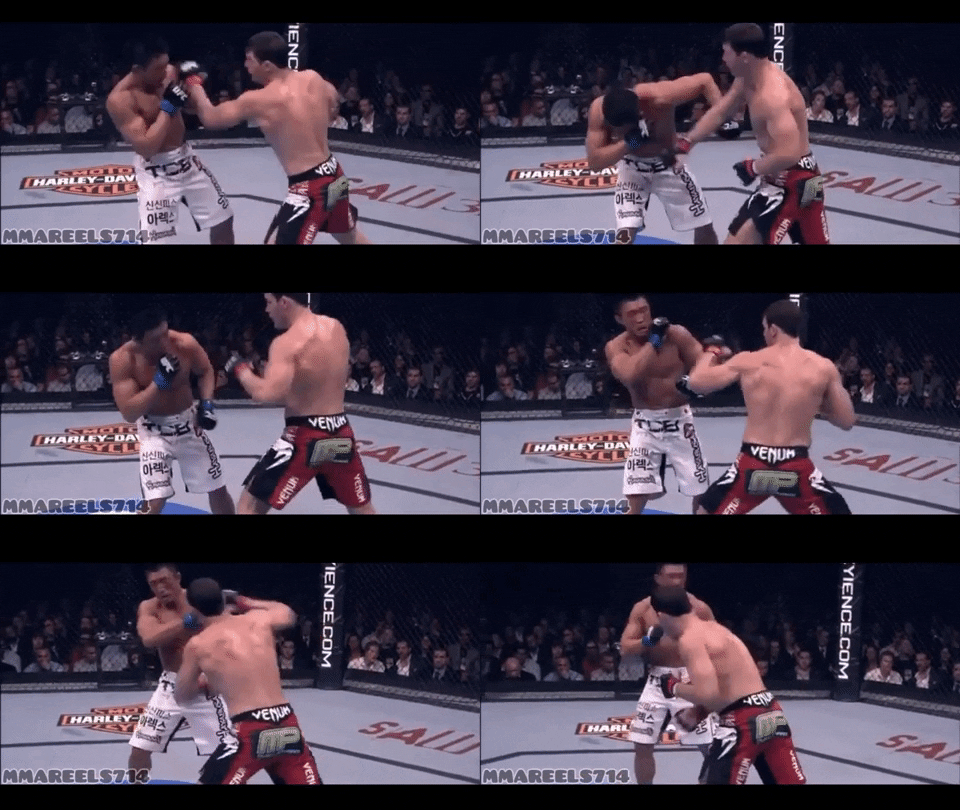
(Classic Bisping, jabbing with volume to set up the right hand. They’re not knockout blows but the damage accumulates over time.)
Bisping’s jab is non-committal and comes at his opponents quicker than anticipated. One of the things that Bisping has never been accused of is sloppy movement, and he's disciplined when it comes to shifting his weight and not leaning too forward, always staying over his hips and not lunging face-first onto attacks. The jabs are accurate and thrown with minimal effort—this economy of motion allows him to throw them endlessly. All this leads to a vicious cycle of him piecing up opponents with this singular attack. In their fight, Cung Le wore the damage of Bisping's jab on his face. Le was convinced that he had been eye poked, but the replay showed it was the accurate jabs, not foul play.
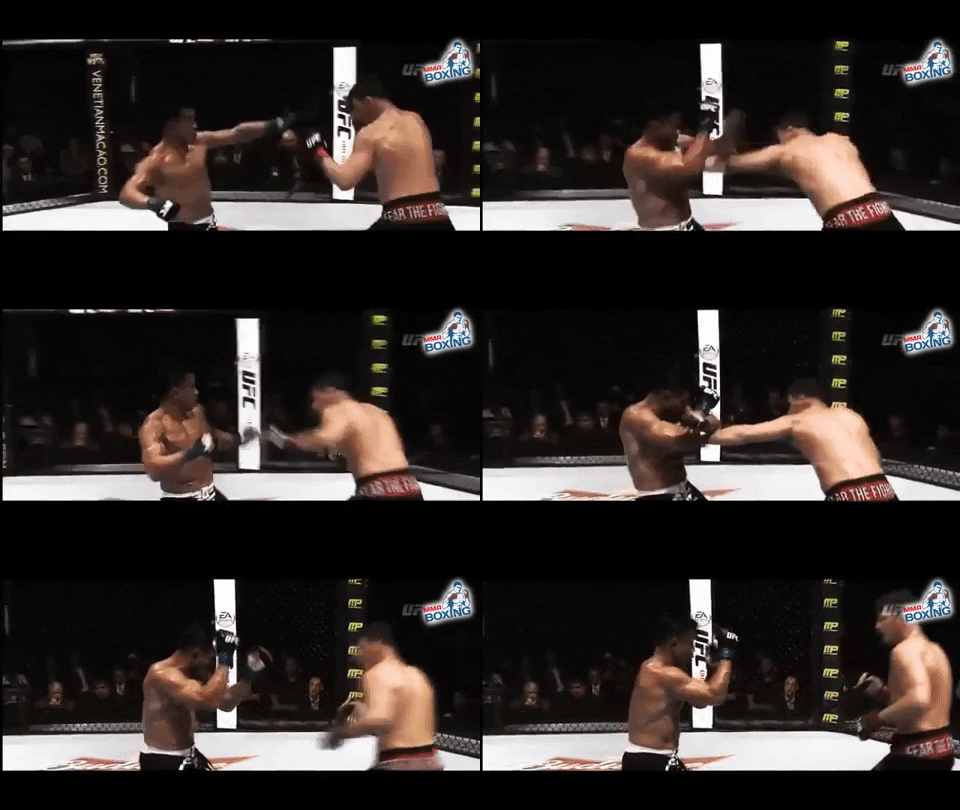
(Le tried to follow up a low kick with a blitz towards Bisping, only to be met by sharp jab to the face. Crashing into the punch definitely created more damage.)
If you go back and watch Bisping’s fights against Chris Leben, Jason Miller, and Yoshihiro Akiyama, it’s clear that he thrives when opponents try to walk him down. Since the jabs don’t feel powerful, opponents feel comfortable walking through them to close the distance and land their own punches. They don’t realize that the volume adds up and Bisping finds new ways to hit them with his hands. Against Miller, Bisping’s jabs fell short as Miller slipped inside, but this gave him an opportunity to grab the back of Miller’s neck and throw uppercuts and body shots. Leben was content swinging hooks and walking forward expecting to get jabbed, only to crash into right straights and uppercuts. Akiyama also charged at Bisping in a straight line, only to get hammered with combinations and right-hand leads. It’s clear that Bisping can strike, but it didn’t mean there weren't glaring weaknesses in his game.
A huge defensive problem for Bisping, however, was bringing his hand back low after the jab. When your hand drops down and your shoulders remain low, you’re inviting your opponent to counter as soon as you’re done with your attack. Whenever Bisping is hurt with punches, it’s a strike that lands over the top of his jab or as he withdraws his lead hand. This happened against the likes of Akiyama, Jorge Rivera, and Alan Belcher in fights that he was clearly winning. This issue is compounded by Bisping circling to his left when he jabs. If you remember Bisping for anything prior to his reign as champion, it’s probably from the overhand right that Henderson landed as Bisping circled to his left. This wasn’t a one-off gaffe but a habit.
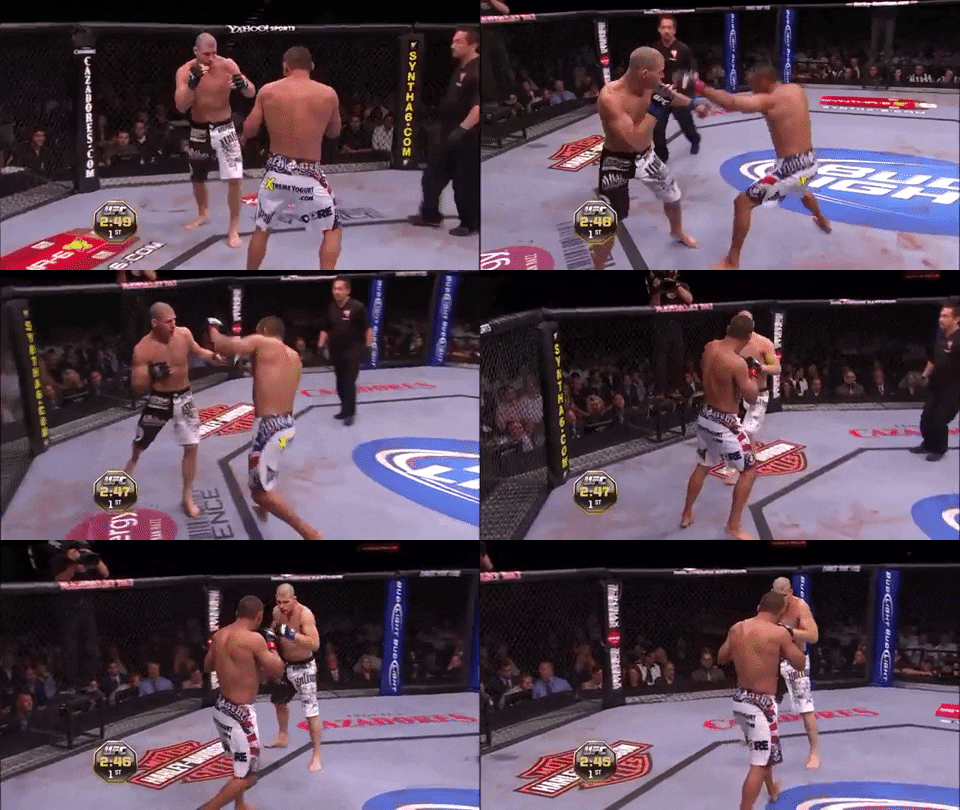
(Everyone remembers the knockout, but it’s important to remember that Bisping was making the technical error of circling to Henderson’s right for the majority of the first fight.)
It doesn’t help that the majority of Bisping’s defense when hit isn’t to clinch up or circle out, but to extend his arms out in hopes of creating distance. If you have your hands out, opponents can duck under for a takedown or swing hooks and overhands with no repercussions. Bisping’s jab might be his preferred offensive weapon, but it was also his go-to when it came to defense. The problem with this approach is that jabbing loses a lot of its potency when moving backward, and opponents are glad to take one to land a much harder strike. Power can be generated by either planting your feet and throwing or timing your opponents as they’re attacking. Spamming punches hoping it deters the opponent is a great way to get hurt, and Bisping found this out too often. Something had to change.
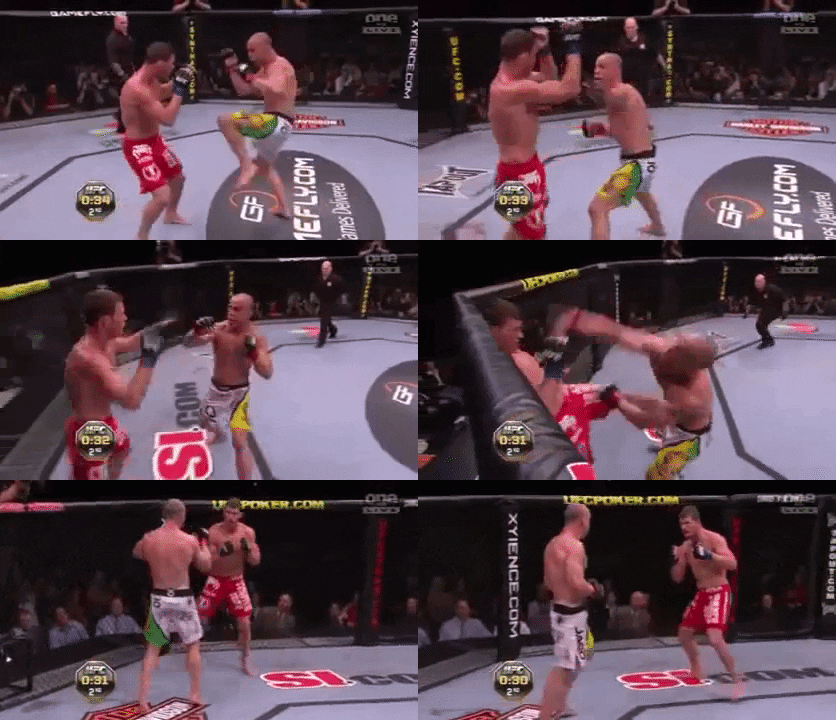
(Wanderlei Silva swarmed Bisping with hooks and his response was to extend his arm and throw a front kick while moving backwards. He also makes the same mistake of circling to his left.)
What seemed to help Bisping a great deal was when he left the comforts of his home country and made the permanent switch to California. After bouncing around different gyms, he settled into a nice groove with Jason Parillo, a boxing-based striking coach who has also worked with the likes of BJ Penn, Rafael Dos Anjos, and Cris Cyborg. Things didn’t improve overnight, but one match at a time, it was clear that Bisping’s punches were tightening up and a lot of his basics were being re-tooled. One of the things that Parillo made sure to work on was Bisping’s left hook. Despite being left-handed, Bisping was taught to strike orthodox and keep his dominant hand forward, a la Oscar De La Hoya and Miguel Cotto. Many of the criticisms that Bisping faced was that he lacked power in his right hand, but this could very well be due to it not being his strong side, to begin with. By further developing his left hook, Bisping was sharpening up a key striking tool that could be used following his usual 1-2’s. This isn’t a problem limited to Bisping. Georges St-Pierre, Gilbert Melendez, and Renan Barao were all champions who had great 1-2’s but always got clipped during exchanges due to not following this up with a hook to discourage counters. The left hook isn’t without its risks, but it did help Bisping quite a bit.
After managing to put together a two-fight win streak and making it through 2015 undefeated, Bisping got to headline a card against Anderson Silva in his home country of England. Even though this opportunity came after Silva’s long reign as middleweight champion and when Bisping was in the latter stages of his career, it was still a major milestone for Bisping. During Silva’s title run, Bisping has always claimed that he was a bad style match-up for Silva and all he needed was an opportunity to prove his point. While neither men were in the prime of their careers during this fight, it turned out Bisping was right, he was indeed a bad match-up for Silva. Bisping’s volume striking combined with a solid feinting game and constant movements gave Silva more trouble than people thought.
Bisping’s ability to feint while pressuring Silva against the fence had him whiffing on counters and unable to respond in time. The non-committal jab that had been a staple of his career did a wonderful job of bothering Silva and kept him from resorting to his usual head movements and slips to escape danger. Along with his varied kicking game, Bisping kept Silva from throwing effective counters and slowed his reactions. Working with Parillo also helped Bisping stay on top of his feet and always followed up his attacks with a defensive movement—an outside slip, ducking out of the way, or framing his forearm against Silva’s shoulders, all of which made it difficult for Silva to attack.
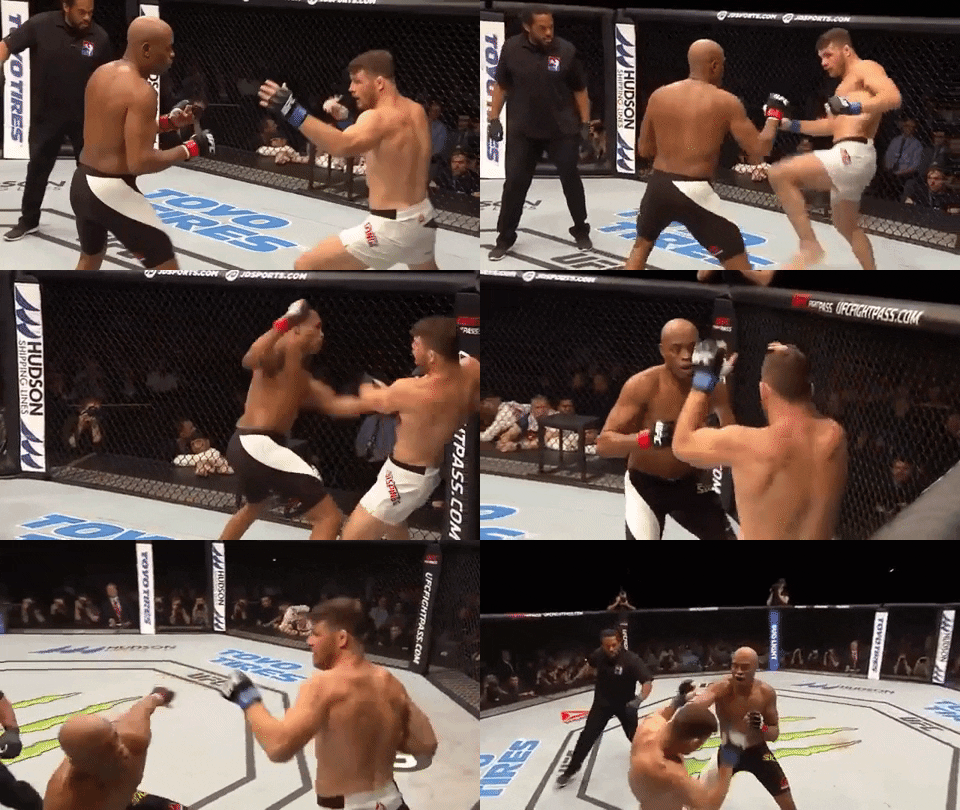
(A rare sight, Silva chasing down an opponent and being countered with punches and wobbled.Bisping moves his head out of the way while landing punches, proving his doubters wrong.)
While in his corner after the first round, Silva realized that Bisping wasn’t going to tire and that he was going to have to force an unwanted reaction out of Bisping. This resulted in Silva making the same uncomfortable choice as he did in the Weidman fight: taking the lead. Bisping had been doing great with the jab, stepping inside of the southpaw Silva's lead foot to shorten the distance and land quicker. While moving forward and hoping to catch Bisping by surprise, Silva was clipped with a couple of decent shots and dropped by none other than the left hook. Who was the pillow-fisted striker now?
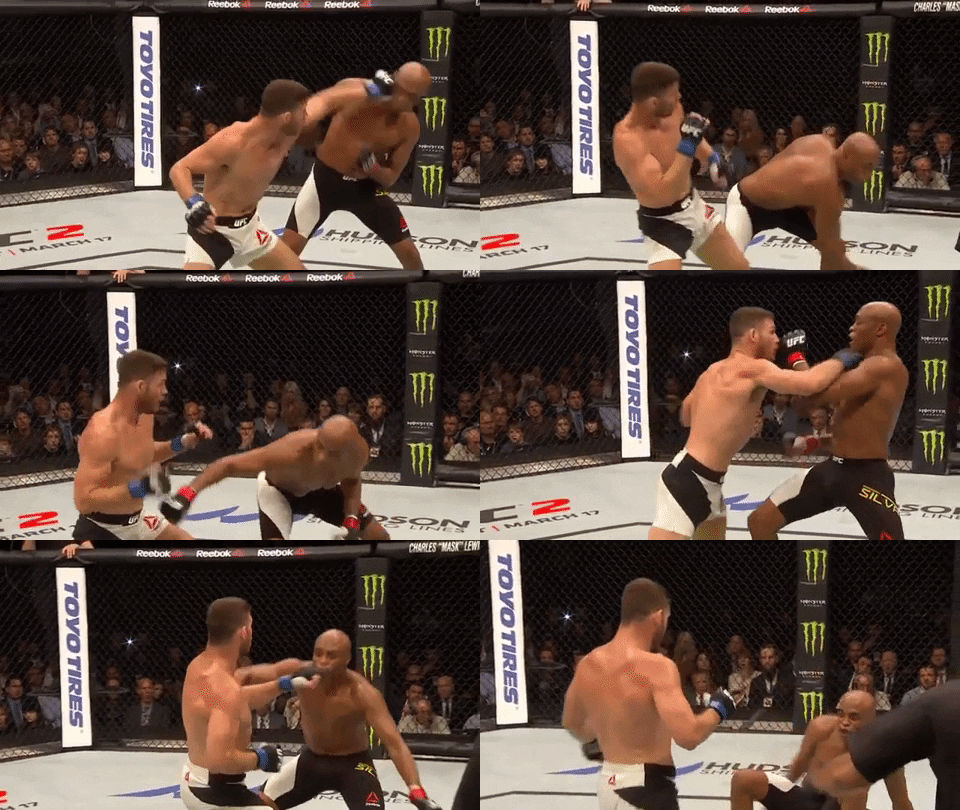
(After landing a picture perfect jab, Bisping moves out of the way to avoid a wild right hand only to land his own and end the combination with a left hook which dropped Silva.)
Even though Bisping was dropped late in the third round by Silva after what he thought was a break in the action, it shouldn’t take away from the fact that Bisping controlled most of the fight. Silva tried to lure Bisping into attacking him by dropping his hands from time to time, but he didn’t bite. Instead, he stuck to the game plan and kept up the volume while managing to hit and not get hit as often. It was clear that even if they had met in 2012, Bisping’s style of striking was going to give Silva fits no matter what. Although he didn’t get a title after beating Silva he was soon given the opportunity, albeit under less than ideal circumstances.
Luke Rockhold was slated to defend his middleweight title in a rematch against Chris Weidman at UFC 199, but an injury suffered by Weidman forced him off the card. With the event less than 3 weeks away, the UFC needed a middleweight that they could justify headlining a card against Rockhold without too much outrage. Bisping had recently beaten a former champion and could talk a good game, so why not finally give him his title shot? With 17 days’ notice, Bisping started the shortest fight camp in his career with the biggest stake on the line. For a fighter who has a long-documented history of over-training, this might have been a blessing in disguise. Since he was a last-minute replacement, Bisping was free from the pressure of having to overthink scenarios and relied on his most trusted weapons: volume striking and his now dangerous left hook.
Against a southpaw like Luke Rockhold, the left hook became Bisping’s secret weapon. Even though the right cross is the preferred method of beating a southpaw striker, it’s predictable and easy to evade. The southpaw can parry the rear hand, slip out the way, or even duck down and attempt a takedown. But when it comes to the hook, it can slip through the southpaw's defenses while they’re preoccupied with the right hand. In open stance (orthodox vs. southpaw), the hook remains hidden behind the southpaw's right shoulder until it’s too late.
There’s a strong argument that Rockhold figured that the Bisping that he fought in 2014 was the same one he was going to be facing at UFC 199. What he didn’t account for were all the defensive improvements that Bisping had been making. Instead of panicking when pressed forward, Bisping could now slip and return fire. Bisping’s counter right straights, left hooks, and head movement that he showed against Silva should have concerned Rockhold. Alas, Rockhold was expecting to be chased so he could land his own check hooks and make Bisping pay. In their rematch, Bisping feinted a lot more. Rockhold still wasn’t worried, he was leaning back and looking to swing his own hooks (even though most of them missed).
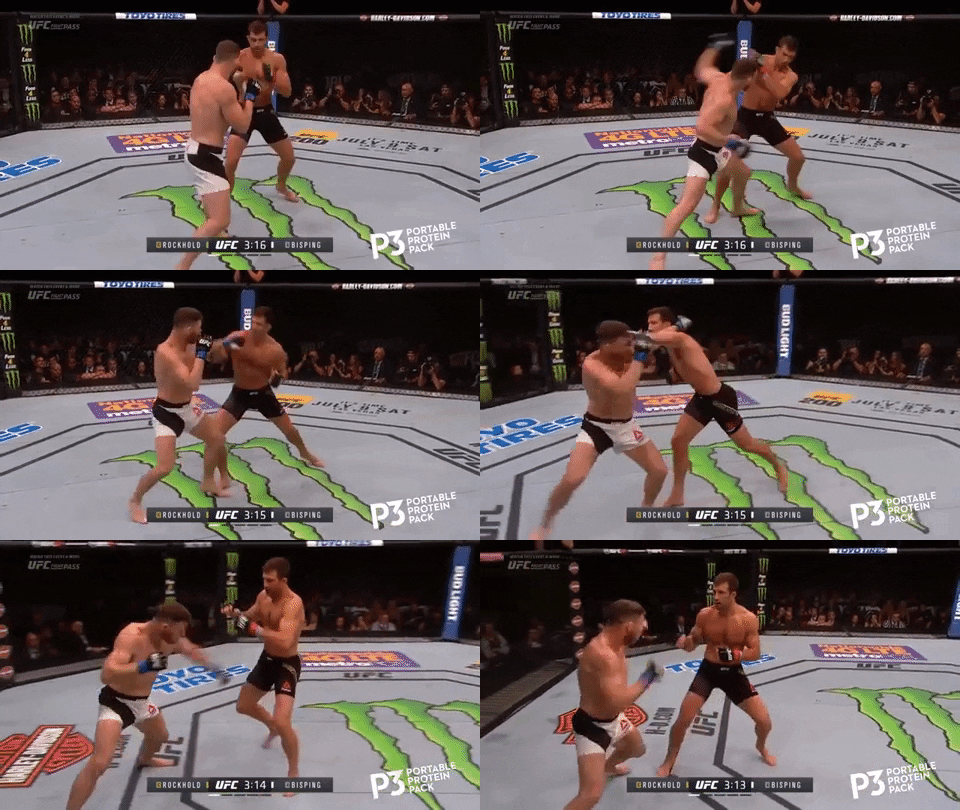
(By now, Bisping had seen enough of Rockhold’s reactions that a left hook could work. Rockhold’s own bad habit of dropping his lead hand and just moving his head proved to be not enough.)
Since he wasn’t chasing after Rockhold and getting kicked by his rear leg, Bisping made Rockhold come towards him. Rockhold’s counter right hooks are great as a defensive weapon, but they’re not the best offensive tools. By the time Rockhold decided he wanted to exchange punches, Bisping had already figured out that Rockhold retreated at an angle with his back slightly exposed, giving him the perfect angle to throw the left hook. Like clockwork, Rockhold missed the jab and then ducked down to his left to protect himself from a counter with his hands low. After doing the same thing one too many times, Bisping caught Rockhold clean with the left hook, dropping him once before following up again with the same combination, knocking him out for good.
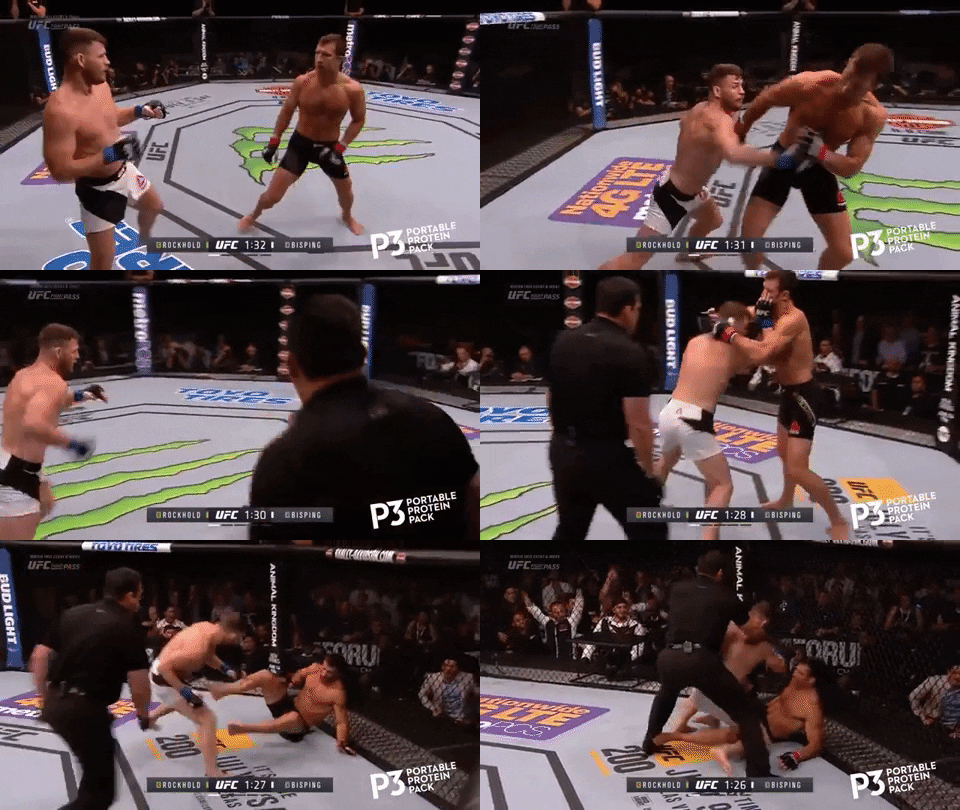
(Rockhold throws a jab and leaves his hands low and retreats straight back, leaving him open to a right-left hook combo. Bisping drops him once and again immediately after, ending the fight.)
It’s great to win the title against a cocky rival in your adopted home state, but what could be even better than that? How about making your first title defense against an even bigger rival in your home country? Bisping got that wish against Dan Henderson at UFC 204 in Manchester, England. In the same card that Bisping won the middleweight title, Henderson rallied back against a tough Hector Lombard and finished him in the second round. Even though he wasn’t on a win streak or even had a consistent winning record, Henderson was set to retire soon, and since the UFC was in the business of giving title shots to fighters near the end of their careers, why not have his final match be against Bisping?
The fight itself was built around two things: Bisping hitting Henderson with every striking tool that he had available and Henderson threatening to end Bisping’s title reign with his overhand right. This wasn’t a technical kickboxing match or a wrestling battle jockeying for position, it was Bisping trying to out-strike Henderson and not get knocked out like last time. Bisping’s constant feinting and newfound left hook helped defuse a lot of Henderson’s offense, but it didn’t always go perfectly. The problems started when Bisping thought Henderson was going to retreat and stood out too long in the open or started to move in with his straight punches, not realizing that Henderson’s right hand was still cocked and ready to launch.
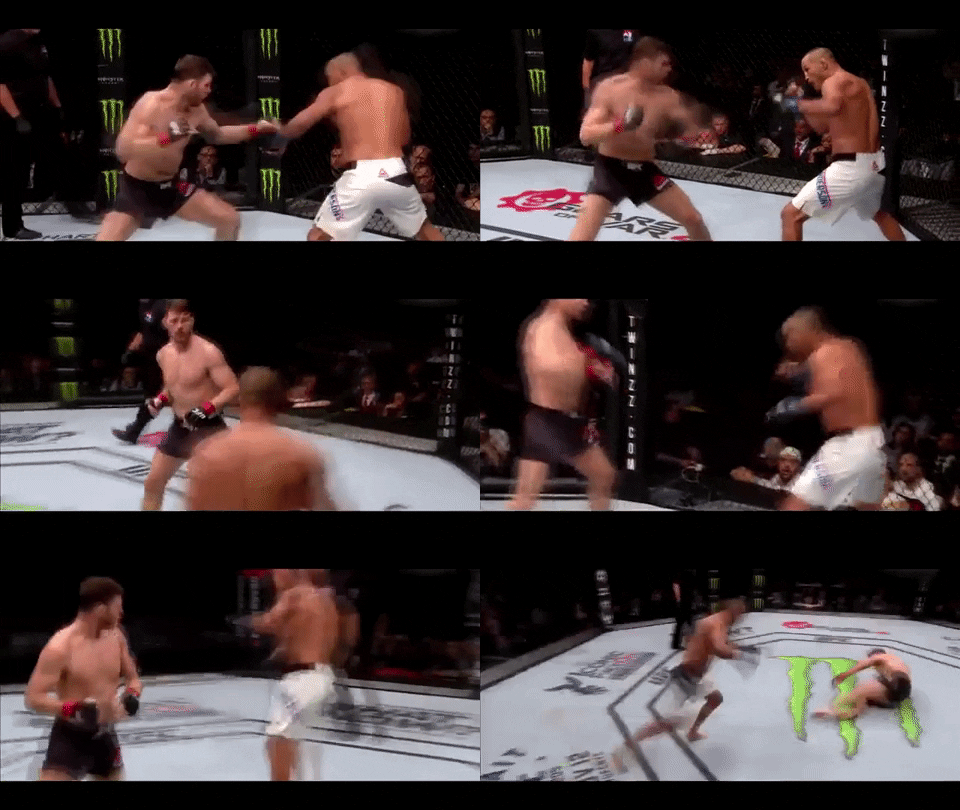
(The story of the fight: Bisping boxes up Henderson for most of the 25 minutes but gets caught by the right hand from time to time.)
Fortunately for Bisping, he does have one other characteristic that hasn’t been talked about yet: heart. It’s a nebulous term and it varies in description from person to person, but no matter how much damage Bisping takes, as long as he’s still awake and moving, he’ll continue to try and do what he’s supposed to be doing. Getting back on his bicycle and volume striking and staying light on his feet is something Bisping can do in his sleep, and against Henderson the second time around, he didn’t forget it. Hell, even a flying knee from Silva landing flush on his jaw didn’t keep him from forgetting what was working, and there was no way Bisping was going to lose in front of his home country to someone eight years his senior. Bisping kept up the pace and added in some nice high kicks to keep Henderson upright before blasting him with punches again, winning a comfortable unanimous decision.
If Bisping’s career ended after this night, he may have had a storybook ending. Unfortunately, a chance to defend his title one more time against the legendary welterweight champion Georges St-Pierre proved too alluring (not to mention the pay-per-view points the fight could generate). Even though St-Pierre was coming off a long layoff, he showed that he was the lighter fighter by landing his own jabs against Bisping at a much quicker rate. Whenever Bisping landed a jab, St-Pierre countered with a right. Bisping had a much better second round by staying disciplined and keeping his shoulder high after throwing out his jabs and only throwing it simultaneously whenever St-Pierre did so. When Bisping got taken down, he framed St-Pierre’s head with his forearms, only to let go so that St-Pierre’s forehead could crash onto his raised elbows. If this sounds familiar, that’s because it’s the same strategy that Tony Ferguson used to cut up Kevin Lee when he took him down in their title fight. It’s not pretty, but it does make fighters think twice before committing another takedown.
I tried not to bring this up at all in this article, but it can’t be denied that Bisping fought the last five years of his career with a huge handicap: he was clinically blind in his right eye. After suffering a detached retina at the hands (and feet) of Vitor Belfort, Bisping managed to somehow clear medical exams and got clearance to continue competing. This meant that whenever an opponent threw a strike that came from Bisping’s right side, he would have a much more difficult time catching it in time. St-Pierre took advantage of this and threw a left hook after abandoning a takedown attempt. That punch dropped Bisping and gave St-Pierre the opportunity he needed to pounce on his back and sink in a rear-naked choke, becoming the new UFC middleweight champion and ending Bisping’s title reign.
But there is another aspect to this fight that is often overlooked: GSP held onto Bisping's shorts to keep him on the ground. Something he's done throughout his career. When Bisping tried to stand up, GSP held on until it snapped the drawstring on Bisping's cup. This caused a stop in the action, which allowed GSP to catch his breath (as it was later revealed that GSP was fighting with an illness). Without a resolution for what to do with the cup, Bisping fought with the cup inserted into his athletic jockey. This was a major distraction for Bisping and was knocked down shortly after the fight resumed.
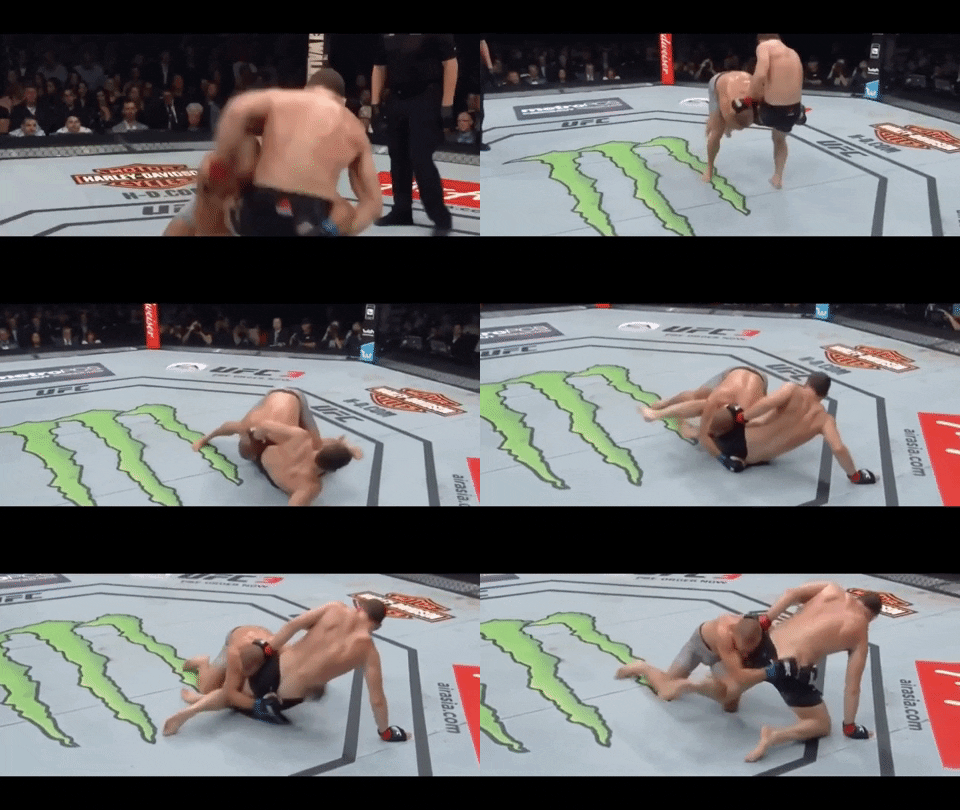
(The takedown itself was beautiful, but grabbing his shorts is definitely not cool.)
In an ill-advised move, Bisping accepted a short notice fight against Kelvin Gastelum just a few weeks later in China. In less than a round, Bisping swung his right hand only to get countered by…a left hook. If there’s a God out there, he has a pretty twisted sense of humor. The left hook giveth and the left hook taketh.
It’s a tragedy that Bisping ended his career on the heel of back-to-back losses while going blind in one eye. He never got the respect he deserved during his career, but when it was all said and done, it can’t be denied that Bisping was one of the best fighters in the middleweight division. He was proof that even if things weren’t going your way, there’s always tomorrow and to continue perfecting your craft. Ian Freeman made history by becoming the first British fighter in the UFC back in March 2000, but he never came close to winning the title. 16 years after Freeman’s debut, Bisping shocked the world and became champion. More than being an MMA inspiration in England, one could argue that he is more of an inspiration to all veteran fighters out there who now know, you don't have to be the best to be champion, sometimes you just need one hell of a year.
