 Home

 Creators
 Search
 Recent
 Random
 Posts
 DMs
 Tags
 Random
 Importer
 Import
 FAQ
 Account
 Register
 Login
 Favorites
 Keys
 Logout
 Telegram

Preview: UFC 251 (Patreon)
Downloads
Missing 1 full-res photo, 1 file, as this post has not yet been imported.
Content
When the UFC first announced that they would be holding fights on a private island, our imaginations started to run wild. What would it look like? Would it be something straight out of Mortal Kombat? Are fighters going to be set up in a tournament format like the old PRIDE days? To our disappointment, it turned out that the private island was none other than Yas Island, a man-made multipurpose entertainment center that the UFC had already visited three times in the past. Instead of a cool MMA show straight out of a video game, we’re getting a rehash of Bodog Fights. However, we do have three title fights in three highly competitive divisions.
With UFC 250 already satisfying our tournament fix, this pay-per-view makes up for it with sheer firepower. Kamaru Usman looks to defend his welterweight title a second time against last-minute replacement and BMF champion, Jorge Masvidal. Alexander Volkanovski is heading into his first featherweight title defense, and what do you know, it’s an immediate rematch against the former champion Max Holloway. And finally, Petr Yan and Jose Aldo have the chance to become the new men’s bantamweight champion after the abrupt retirement of Henry Cejudo. There’s not a moment to waste, so let’s start with the main event.
Kamaru Usman vs. Jorge Masvidal
Kamaru Usman is defending his welterweight championship against division rival Jorge Masvidal. Keep in mind that Masvidal has had a stellar 2019 but has yet to step foot in the octagon in 2020. Pay disputes and contract disagreements have mostly been to blame as this fight was originally slated to take place during UFC’s International Fight Week. Without a resolution in sight, the UFC played hardball and replaced Masvidal with Gilbert Burns. With eight days left until the fight, Burns tested positive for COVID-19, which forced him off the card. Unwilling to shelve the match-up until later on this year, it was now the UFC that was put in a hard spot and had to come to the negotiating table with Masvidal, willing to budge on certain grievances. Only those in that room know the terms that made Masvidal accept the fight on six days’ notice, but it must have been worth his time. Some hardcore fans who dig through event archives can point out matches such as Dillashaw vs. Soto and Nurmagomedov vs. Iaquinta being even shorter notice fights, but both new opponents were already scheduled to fight on the same card. Notably, Anderson Silva also stepped up on 48 hours’ notice to replace Jon Jones against Daniel Cormier, but on the condition that the fight be changed to a three-round, non-title bout.
The oddsmakers have Usman as 3 to 1 favorite, but are they sleeping on the experience of Masvidal? How much does Usman’s wrestling play into this fight?
A look at the stats shows Usman’s takedown percentage at an even 50%, not an amazing number on its own. Even though it might not seem impressive, once you consider how the rest of the division stacks up, it makes more sense. Consider this: Gilbert Burns, Demian Maia, and Rafael Dos Anjos are all welterweight grapplers, and their TD accuracy is much lower (Burns is at 37%, Maia is 26%, and Dos Anjos is 39%). “That’s not fair,” you might say. I didn’t include the percentages for Tyron Woodley or Colby Covington, fellow collegiate wrestlers known for their wrestling. I hate to inform you that Woodley’s takedown accuracy is 39% while Covington’s hovers at 51%. So, you can say that among the welterweights, Usman takedowns are among the highest. Do you want to know who has the highest takedown accuracy among 170 pounders at the moment? It’s Jorge Masvidal (with 59%).
Usman doesn’t have a signature takedown like Sakuraba’s single leg or T.J. Dillashaw’s outside leg reap. But what he lacks in originality, he makes up for with variety. The easier the takedowns, the better. Usman favors pressuring his opponents to the fence and dirty boxing his way in. Short punches from the clinch to the head, knees to the body, with the occasional hooks and uppercuts off the clinch break are some familiar moves you’ll see with Usman. Once his opponent’s back is close enough to the cage, Usman will attempt every takedown possible that can get a hold of his opponent’s hips and hoist them into the air. Usman’s ground and pound aren’t going to get any stoppage victories, but the constant stream of strikes never lets up.
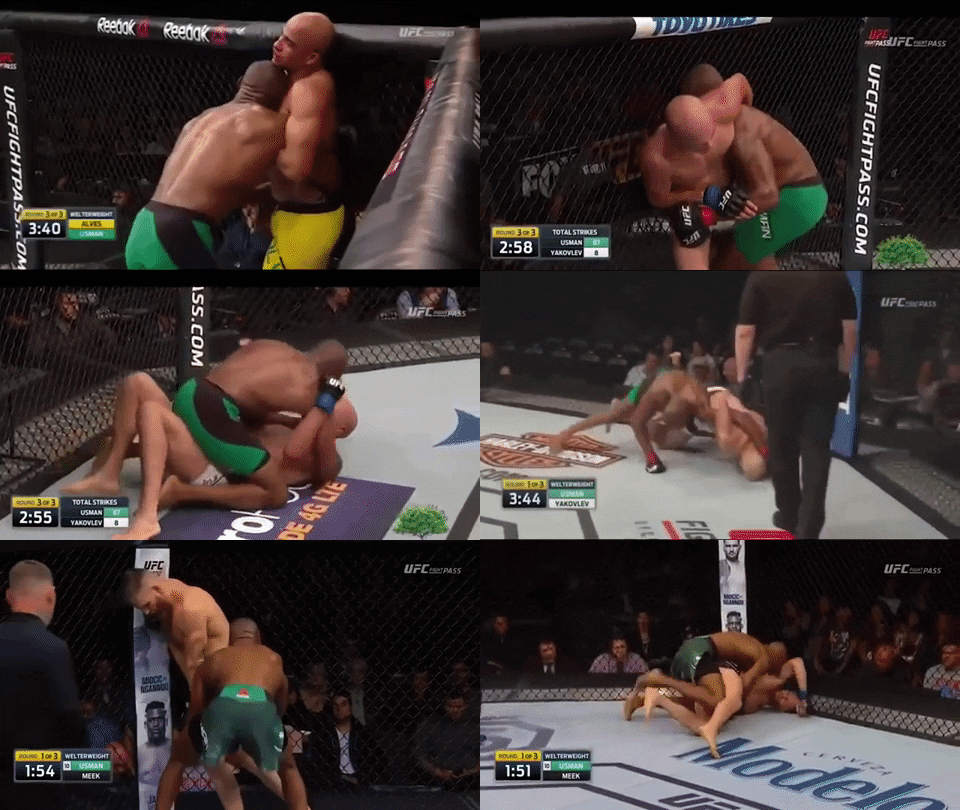
(It may not be as pretty as GSP’s double leg takedowns, but there’s no denying that Usman has more tools in his wrestling game than most in the division.)
In some respects, Usman is a lot like Jeff Monson during his ADCC prime: he would start slow and through a steady work rate and constant pressure, he would gain an insurmountable lead that opponents couldn't overcome. Unlike Covington, who would start fast but taper off in the later rounds, Usman favors cooking his opponents until their effectiveness drops. Go back and watch his old fights and you’ll see that his opponents' work rates drop round by round until they were effectively punching bags for Usman.
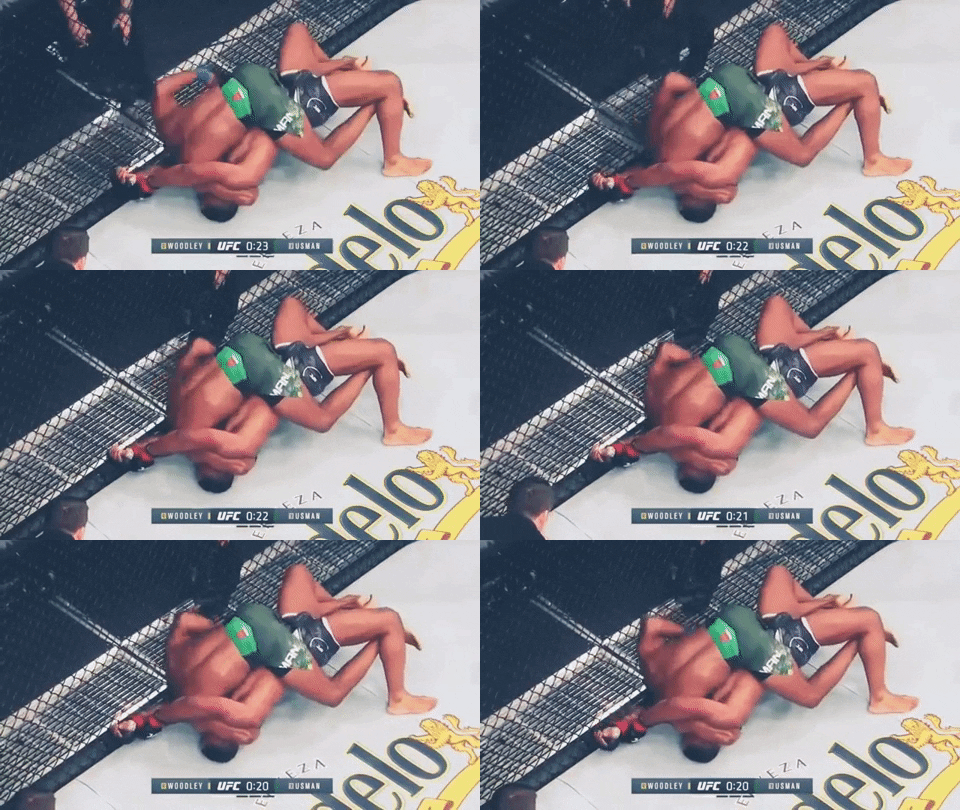
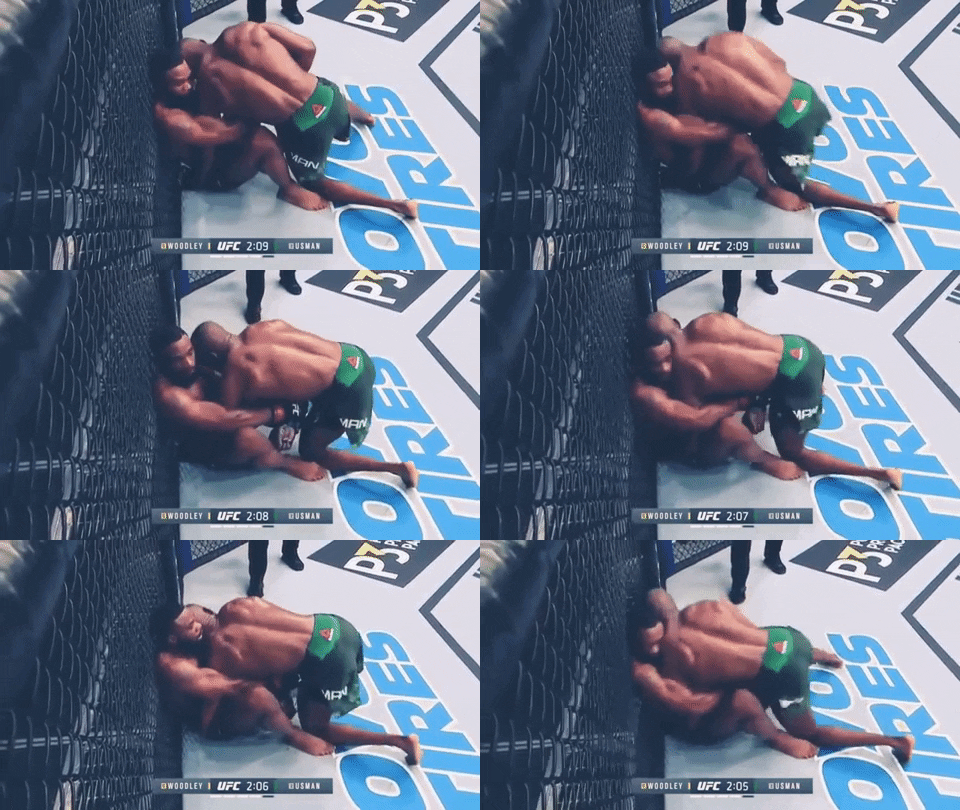
(These strikes alone weren’t going to end the fight, but they never stopped coming and Woodley had no answers for them.)
Prior to the Covington fight, most of the damage that Usman scored in his matches came from ground and pound. His bread and butter is to shoot in along the fence and beat you with short punches and elbows from top position. Before the Covington match-up took place, many were speculating who could succeed with the takedown first since both relied on them at different stages of the fight to win. To our collective surprise, the fight took place almost entirely on the feet, and it was an even exchange.
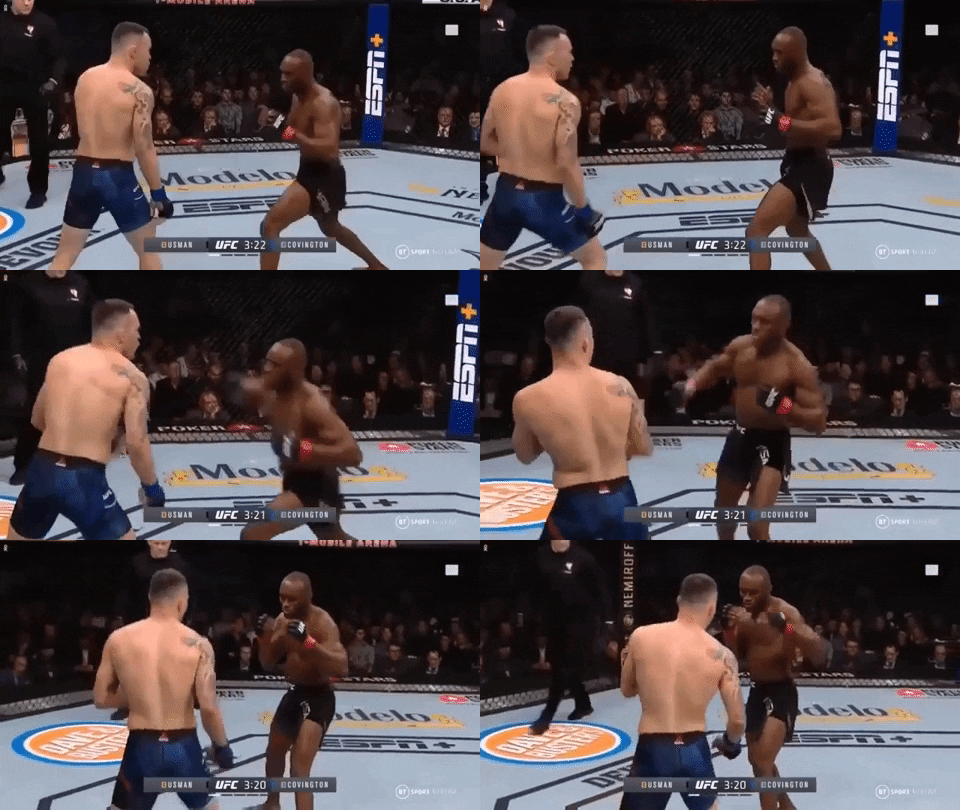
(Usman leads with a level change before throwing the right straight.)
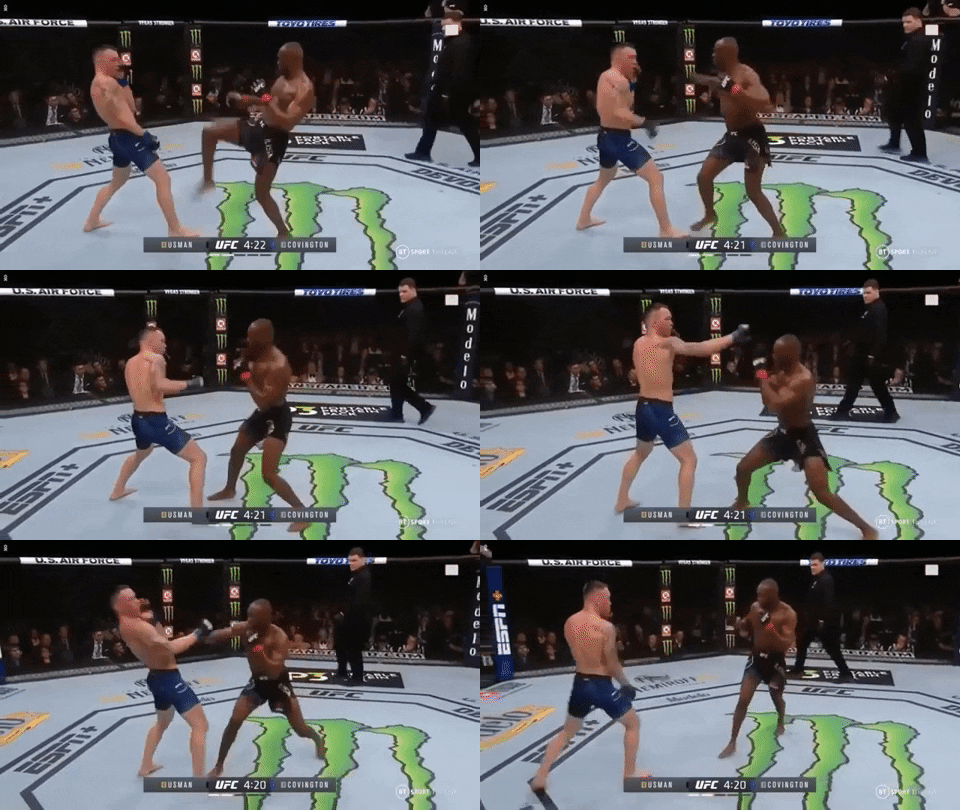
(Usman raises his lead leg before stomping down and landing with a jab, only to double up on in it after Covington thinks Usman is done striking.)
Usman’s striking has come a long way and it was a battle of who could land better shots as the fight continued. In the early rounds, Covington, the southpaw, seemed determined to absorb punishment if it meant that he could throw combinations to overwhelm Usman and get him to panic. This kept Usman’s head in one place for follow-up strikes. What started to turn the tides in Usman’s favor were the rear hand uppercuts to the body. People have this perception that Covington is a cardio machine (and he is impressive in this regard), but he does slow down as the fight enters rounds three to five. By hitting the midsection over and over again, Usman was making a deposit to the bank that he could cash out later.
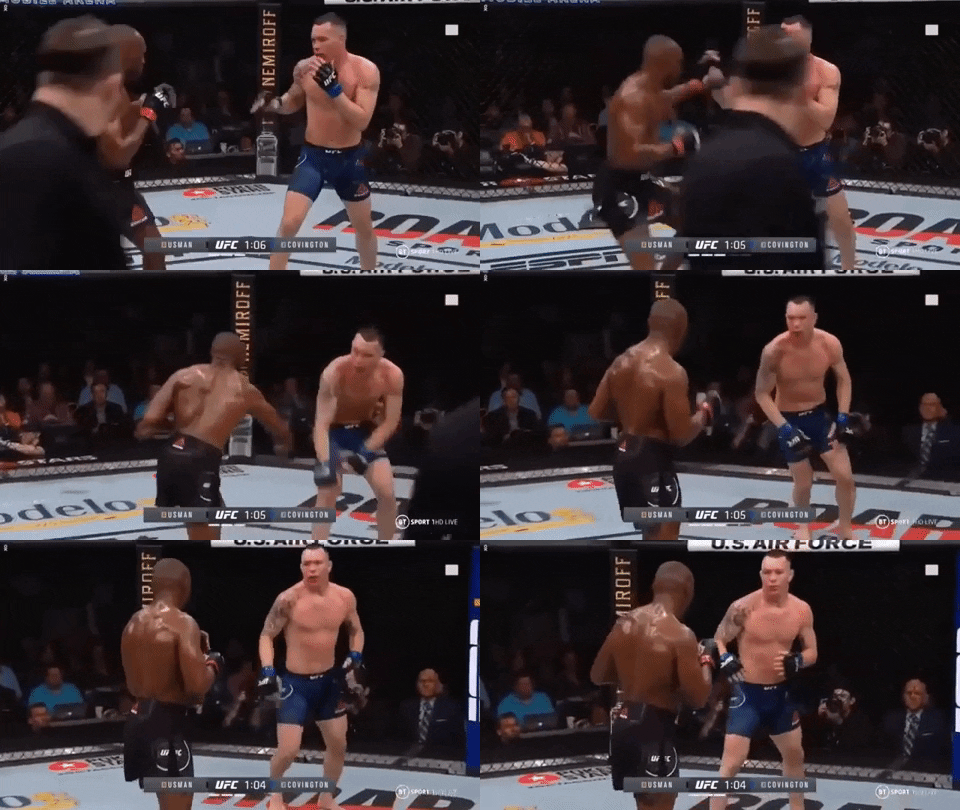
(As much as he tries to hide it, the rear hooks to the body definitely hurt Covington.)
As the fight entered the fourth and fifth rounds, Covington’s hands started dropping more and his punches became more labored. Gone were the combination striking and high pressure he displayed in the earlier rounds. The body punches were taking their toll and Covington had no choice but to keep the fight standing. Eventually, the slow and steady striking of Usman was able to drop Covington in the fifth round and finished him with less than a minute left. With Usman's improved striking, endless gas tank, and solid wrestling base, does Masvidal stand a chance on such short notice?
It's true that the odds don’t look good, but this is Masvidal we’re talking about. Usman might have a bit of a size advantage but what Masvidal lacks in size he more than makes up for with experience. Masvidal has more finishes in his career than Usman has fights. Despite only a three-year age difference, Masvidal was a professional fighter when Usman was still in high school. A year before Usman made his MMA debut, Masvidal had already competed for world titles. Masvidal is not entering the match-up with an ideal training camp and prep time, but let’s not forget the sheer amount of fight knowledge that Masvidal brings. Also worth noting, there are rumors that Masvidal has been in training camp all this time. You could also credit this to experience, anything really can happen on the way to a title fight.
Masvidal is also a veteran of Bodog fights, which all took place on a private island. “But what about Usman’s wrestling?" you might ask, "How is Masvidal going to handle it?” Well, let’s talk about his grappling.
One of the most underappreciated aspects of Masvidal’s game is his wrestling and how he’s able to use a bevy of different maneuvers to get up every time he’s taken down. Like Robert Whittaker, Masvidal likes to drag himself to the edge, post up, and build his frame to get back to his feet. Whittaker was able to do this repeatedly against Yoel Romero, an Olympic silver medalist. No matter how great of a wrestler you are, there are no fences in a wrestling match that you can use as a third leg.
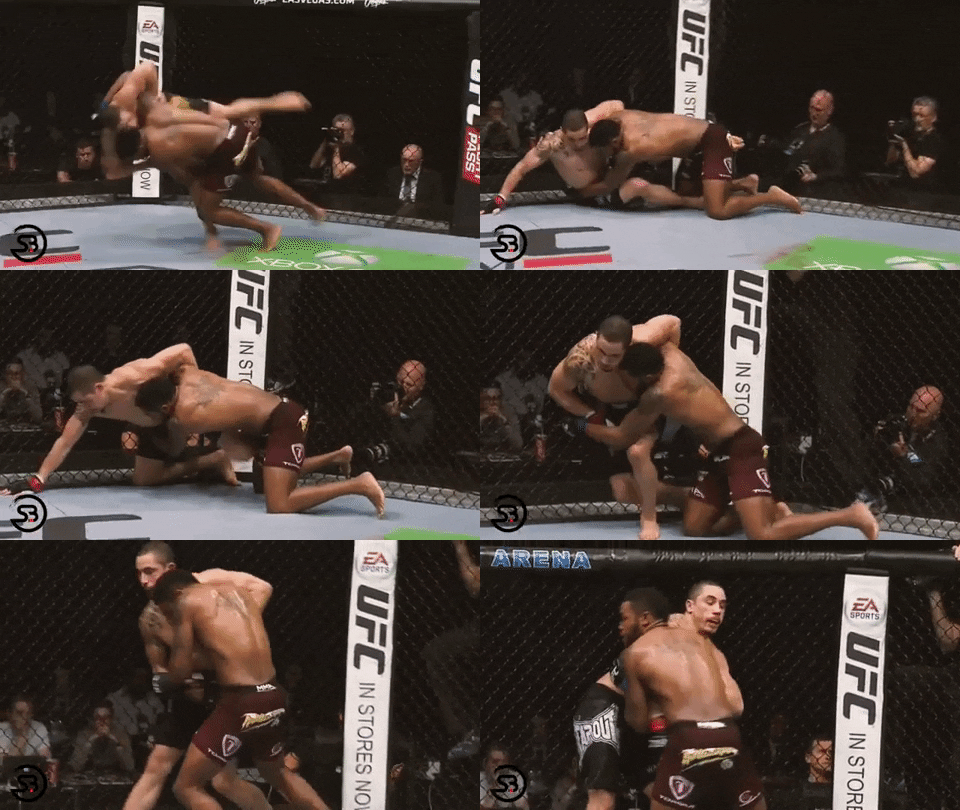
(Robert Whittaker doesn’t let the takedown stop him from immediately posting up and wall walking back up. Masvidal does much of the same.)
The thing that separates Masvidal from the other strikers in his weight class is his ability to threaten with submissions whenever he gets pushed. Frankly, he hasn’t been very successful with them (his last submission win was one over Michael Chiesa in 2013), but they serve their purpose of allowing him to scare his opponents enough to abandon their positions so he can create a scramble. Masvidal’s teammate Dustin Poirier commits to his guillotine in the hopes of submitting his opponents (like he did against Khabib Nurmagomedov and Dan Hooker), whereas Masvidal uses it to force his opponent to react so he can get back to his feet. Whether it’s attempting a D’arce choke, going for the switch, or even a basic sweep from guard, Masvidal actively looks to stand up rather than holding his opponents for the referee to intervene. In this regard, he shares a lot in common with other Team Alpha Male fighters during the Duane Ludwig era. During this time, many of its members never let their opponents keep them down for longer than a few seconds, they were using their wrestling in reverse to get back up to their feet.
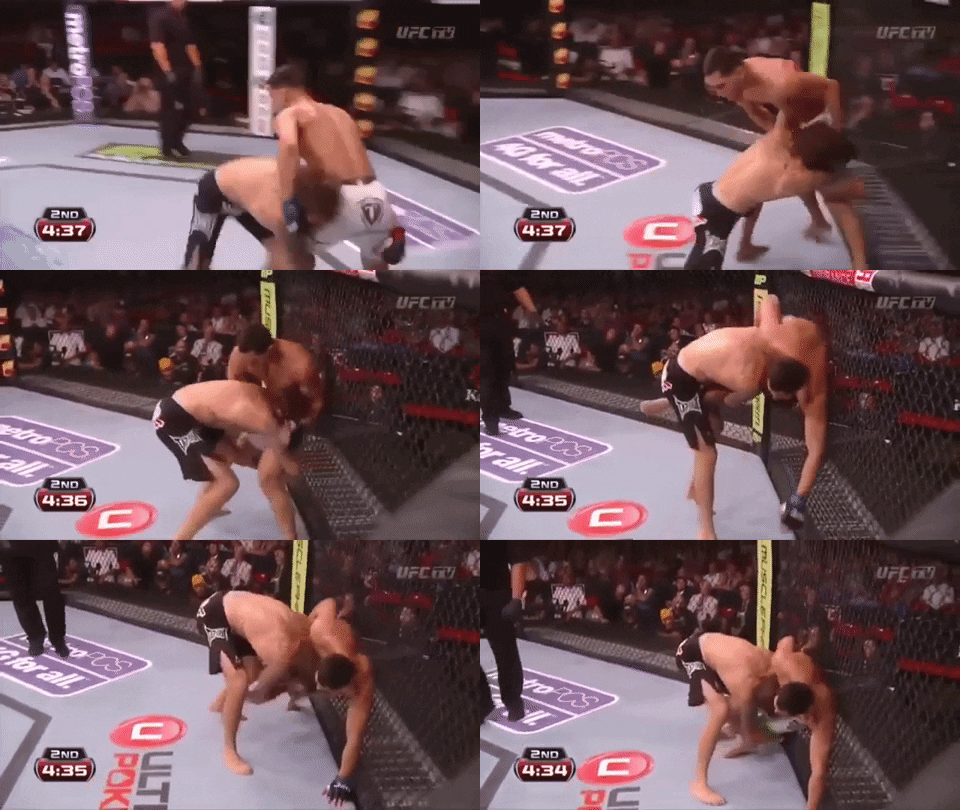
(Chiesa drives Masvidal back towards the fence, but Masvidal immediately posts his hands and keeps his hips from touching the ground.)
As such, Masvidal’s takedown defense is in the high 70’s/low 80’s (depending on how you score his scrambles). Masvidal isn’t afraid to get a little creative and will use Granby rolls and other neat wrestling tricks, a la Tony Ferguson, in order to get back to his feet and keep his opponents guessing. He had some beautiful reversals against Pat Healy and Daron Cruickshank, and it’s always there in his back pocket. Luckily for Masvidal, every fight starts on the feet and this where Masvidal does his best work.
Among the welterweights, it’s arguable that Masvidal has the best orthodox jab (with Leon Edwards taking the title for the best southpaw jab). Masvidal uses the jab as a tool to prod information from his opponents. Like a man on a recon mission, the jabs serve as a way for him to pick up intel on how you react to punches being thrown, and he can draw from his toolbox as to which counter he should choose as an appropriate response. If the opponent starts moving laterally, a lead leg kick to the body can stop them in their tracks. Parrying the jab means that Masvidal can either respond with the right straight or swing around the parrying hand with a long lead hook. Darren Till, Al Iaquinta, and Ben Henderson all found this out the hard way. On defense, the jab is there to greet his opponents whenever they get within range to occupy their vision before Masvidal throws a right straight. This is a common setup among prolific jabbers, and Michael Bisping made a career out of punishing guys that tried to walk him down.
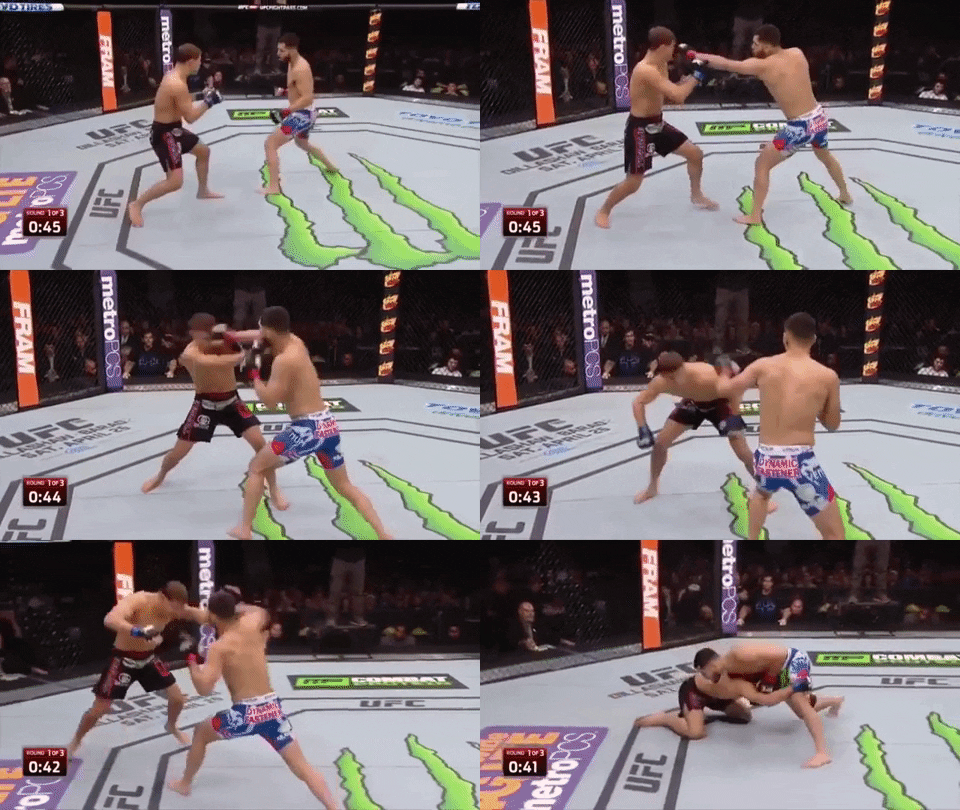
(Masvidal jabs at Iaquinta before landing a right straight-left hook. A panicked Iaquinta then shoots for a double leg only to get denied.)
Against the likes of seasoned strikers like Donald Cerrone, Ross Pearson, and KJ Noons, Masvidal threw off their timing and ability to counter by feinting and changing up his rhythm. His opponents never had time to get a good read and were either whiffing at air or getting clipped. Hard punches to the body also kept them in place and served as a great way to slow them down as the rounds continued. In addition to all the punches, Masvidal has a great kicking game. Most of the time, Masvidal opts to kick his opponents from the outside, battering their lead leg and killing their mobility, slowing them down and making sure they can’t chase him. This works best against other boxer-wrestlers who like to stay heavy on their lead foot like Iaquinta, but it also did wonders against the likes of KJ Noons. If you choose to stand southpaw, no problem, he’ll get to work by throwing kicks to your body from the open side, forcing you to absorb the full brunt of the power on your forearms or organs (a painful choice).
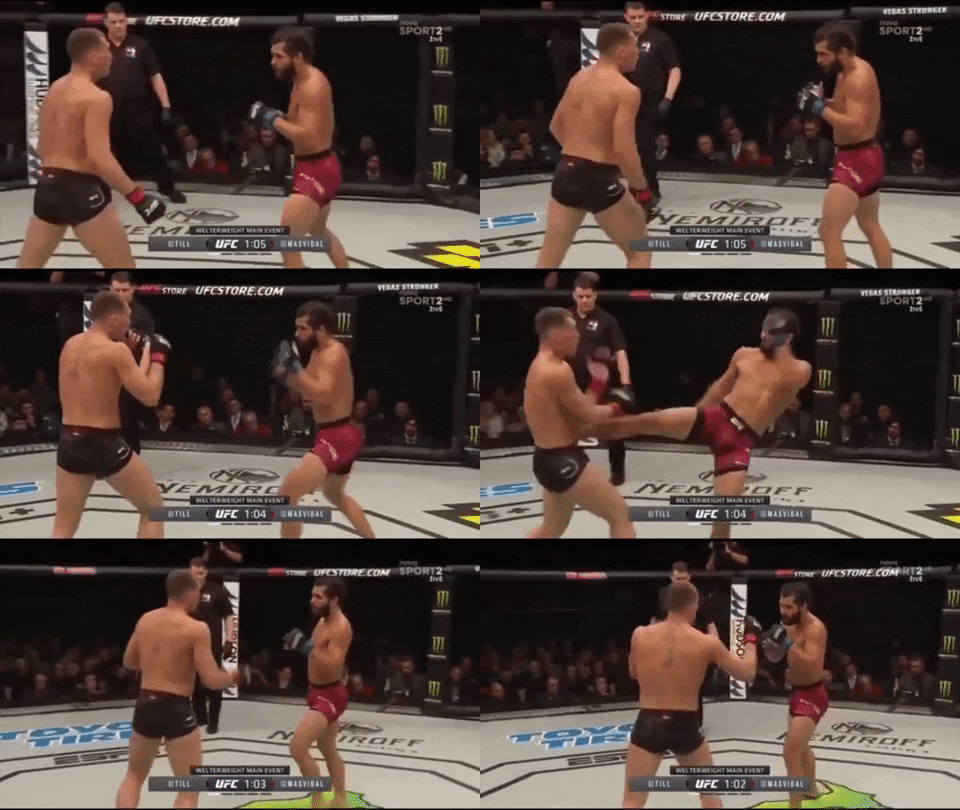
(Darren Till’s southpaw stance and feinting were giving Masvidal problems early on, but the rear kicks to the body kept finding their mark.)
For Usman, he should try to make this match-up less pressure heavy than his previous fights since Masvidal does his best work when opponents chase him. Although Masvidal can do a decent job at pressuring his opponents, it’s not his strong suit and he usually ends up absorbing more damage whenever he attempts it. Usman can use Masvidal’s aggression against him by tying him up in the clinch to neutralize his striking threat and throw elbows and hooks off the break. Masvidal’s most recent fight against Diaz showed that he can use elbows and knees effectively during clinch breaks, but it’s often inconsistent and there’s no guarantee he’ll try it against a fighter with a wrestling pedigree of Usman. If he does decide to use forward movement against Masvidal, Usman can use a lot of the same game plan that he did against Woodley. Usman was also able to back Woodley against the fence and pressure him effectively with feints and level changes and before he knew it, Woodley had his back to the fence. Instead of trying to pivot out, Woodley opted to defend the takedowns and attempt guillotines (as a side note: what is it with ATT fighters and the guillotine?). This resulted in Woodley getting out-wrestled and spending the rounds on his back. Masvidal can be susceptible to this approach, and Usman probably has no fear of Masvidal’s wrestling game. Where Usman really shines is his takedown defense. Unlike his peers, Usman’s takedown defense is at 100%. The next closest is Woodley at 90%, and Covington is at a distant third with 78%. If you try and take Usman down, good luck.
Masvidal has a trickier path to victory, but it’s not impossible. Masvidal has taken short notice fights before, the most recent one being against Ben Henderson on two weeks’ notice. Granted, he was already scheduled to fight on the same card, but he went from having to fight three rounds to five, and he did so without any real issues. Both Nate Diaz and Michael Bisping also took fights on very short notice and put on some of their best performances. If Masvidal isn’t too drained from his weight cut, he has the tools to give Usman trouble. Masvidal’s fight against Nate Diaz showed that even 45+ fights into his career, he’s still learning and improving. He does some of his best work on defense, and he was able to slide past Diaz’s forward movement by slipping laterally and hammering him whenever Diaz turned.
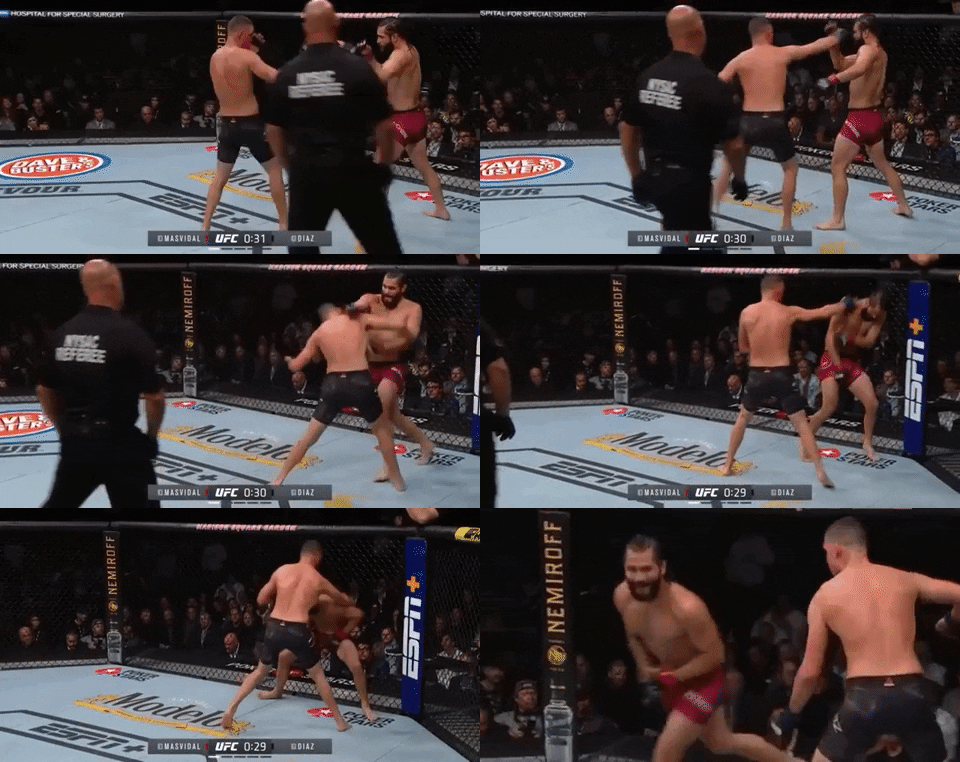
(Cornered to the fence, Masvidal is still able to land a two-piece before ducking under and weaving out of the way.)
He also battered the lead leg with low-line sidekicks and stomp kicks, halting Diaz before lancing him with a straight right. He also showed a much-improved clinching game which he sets up with kicks. After getting Diaz to come forward, he timed his steps with a right kick to the body, anticipating the takedown attempts. Masvidal then turned this into an extended clinch battle where he threw elbows and knees off the break, often from the same side. Against Usman, he can use a similar approach, and instead of worrying about getting taken down from kicks, he can throw them to the body. If Usman is able to clinch off the kicks, no problem, he can start throwing elbows and knees. Like all his other ATT compatriots, expect Masvidal to start scrambling or threaten Usman with chokes if he gets close enough to use his wrestling. Covington also had success throwing punches from the same side as his high kicks, and it caught Usman flush a couple of times. Masvidal might hate Covington as a person, but he’d be foolish not to at least try this. Masvidal’s underrated wrestling, submission threats, and evolving striking acumen present a well-rounded threat to Usman. Whether six days is enough to give him the edge is going to be the real question.
Volkanovski vs. Holloway II
Immediate rematches don’t happen often at featherweight, especially if the fight itself wasn’t particularly close. However, the UFC has allowed Max Holloway to run it back against Alexander Volkanovski, and it’s going to be interesting to see if he can make all the necessary adjustments in less than a year’s time. Unlike Burns who spent 2020 beating top-ranked opponents to get a shot at the title, Holloway is granted one due to the fact that he cleared up most of his division on the way to the throne. One could argue that there are other challengers that are more deserving, but most of the names that you can think of are already tied up in scheduled matches against each other (like Zabit Magomedsharipov and Yair Rodriguez) or haven’t put together enough wins (like Josh Emmett and Chan Sung Jung). Getting Holloway as a first title defense could be a blessing for Volkanovski, as he already had a lot of Holloway’s game figured out. Let’s examine the first fight in greater detail.
At no point during the 25 minutes did it look like Volkanovski was going to finish Holloway, but it was clear that he was prepared to strike for the entire five rounds. Whenever Holloway got close to kicking range, Volkanovski was ready. Inside low kick, calf kick, lead left high kick, rear kick to the body, Holloway wasn’t given a moment to set up his own punches. Holloway is at his best when he’s able to set the rhythm and build upon his volume striking early, but if you take that away from him he has to reset every time, resulting in him being pushed back further in the scorecards. Volkanovski also took a page out of the former champion’s playbook and feinted while moving to throw off his timing.
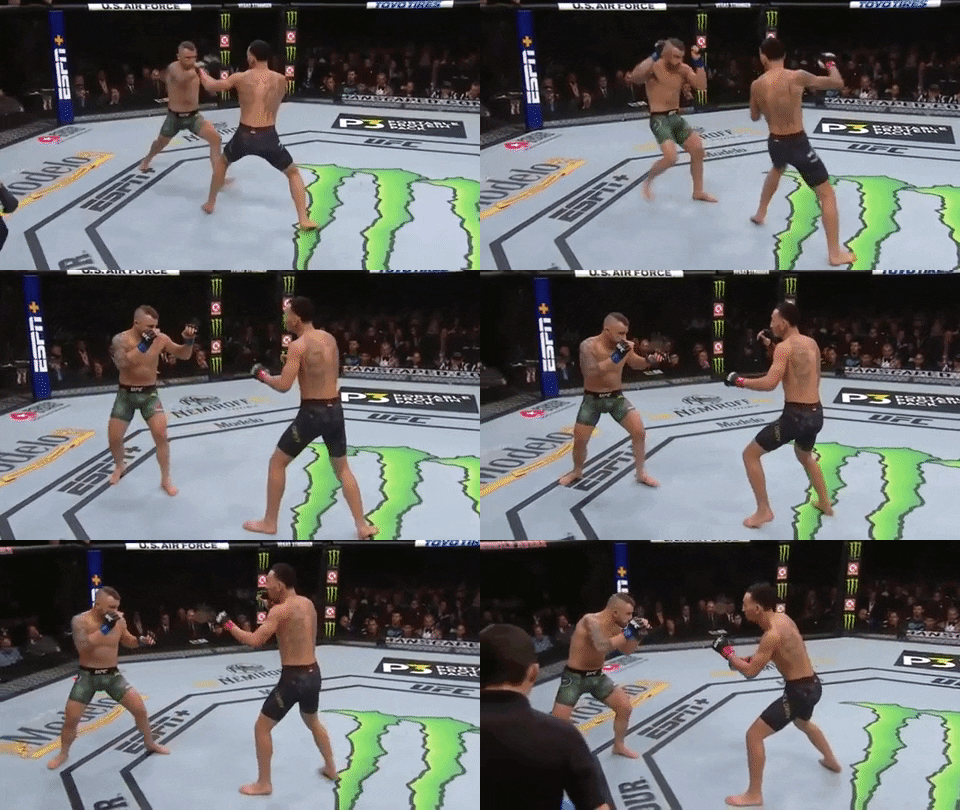
(Volkanovski throws a calf kick that momentarily sends Holloway stumbling back. From there, Volkanovski continues to move laterally, forcing Holloway to come to him and chase.)
What seemed to work well for Volkanovski in this fight were his jabs, low kicks, and pivots. Volkanovski throws his jab a lot like a prime Larry Holmes, thrusting with his shoulders so that a bit more power is put into his punch without sacrificing any speed.
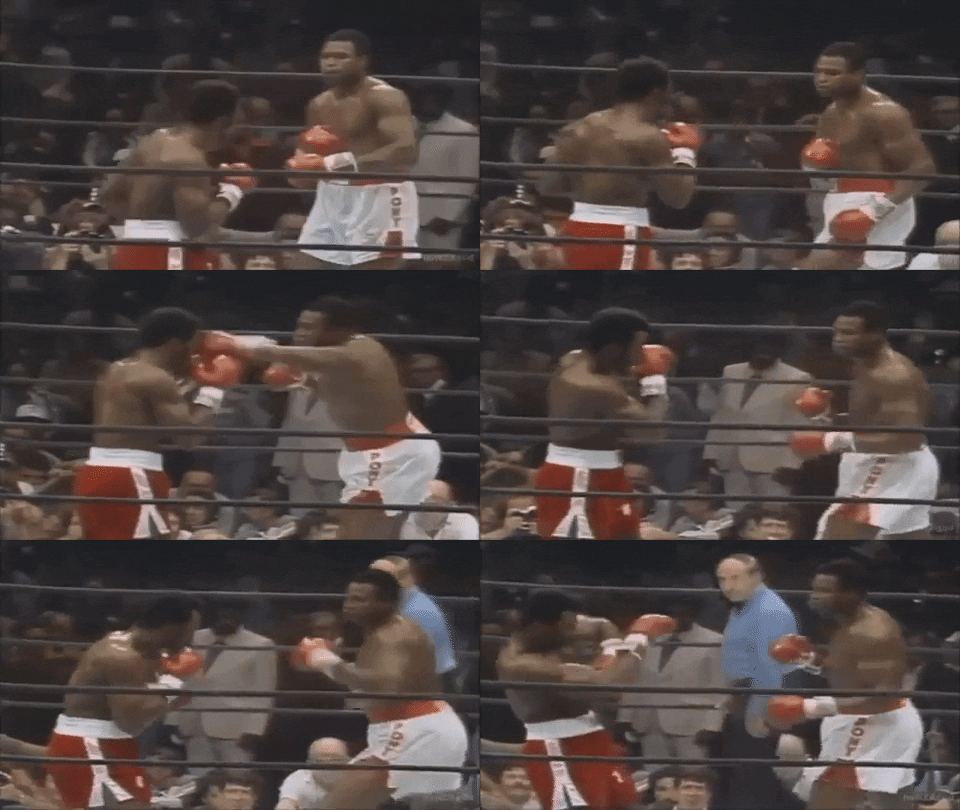
(Even with his hands low at his hips, Larry Holmes made sure to thrust with his shoulder and slightly lean forward. This gave an unexpected sting that dropped many opponents.)
Another boxer that Volkanovski seems to mimic is Sergey Kovalev, who squares his hips slightly before jabbing so that the punch feels more like a straight.
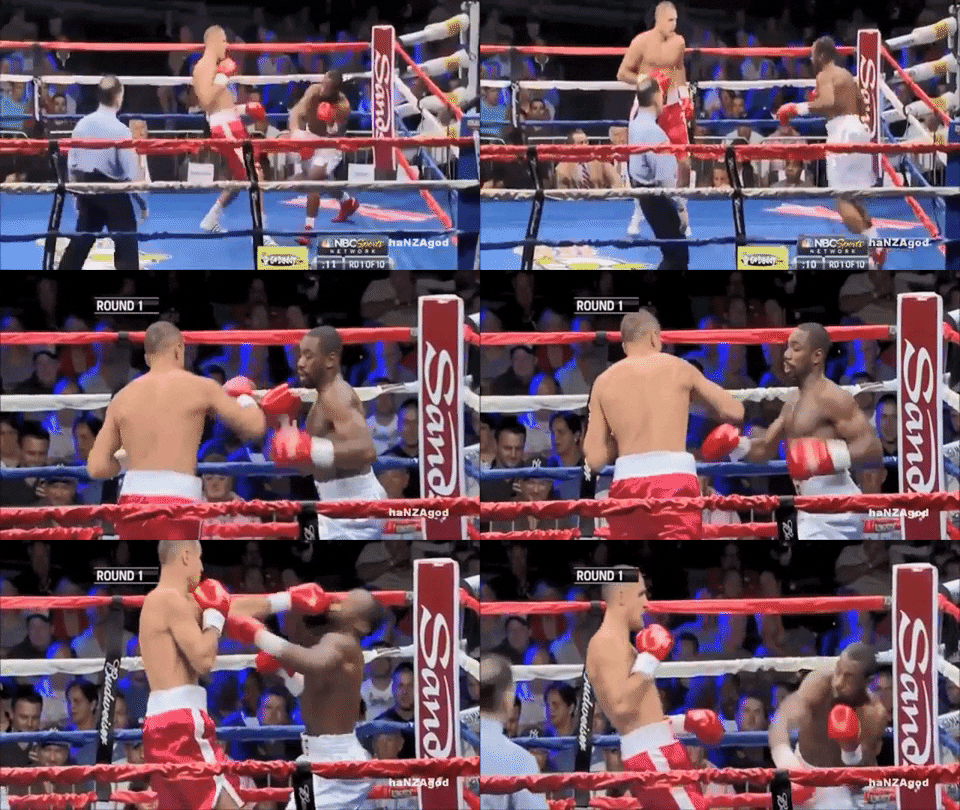
(It might seem like an exaggerated motion, but look at Kovalev’s hips. He fakes with the right hook before uncorking his lead left hand. With so much swing behind it, his opponent is sent stumbling back.)
Even though Holloway enjoys a height advantage over Volkanovski (5’11” to 5’6”), it’s the current champ who actually has a reach advantage (71” to 69”). Build might seem like a huge deal, after all, you look at some of the monsters at featherweight like Shane Burgos and you'd think that no one can beat them, only for someone like Josh Emmett to show that height and reach don’t matter if you can get your opponent to move in towards you. James Vick towers over all the lightweights (and most of the welterweights) but it didn’t mean anything when his opponents were able to get on the inside and blast him with hooks.
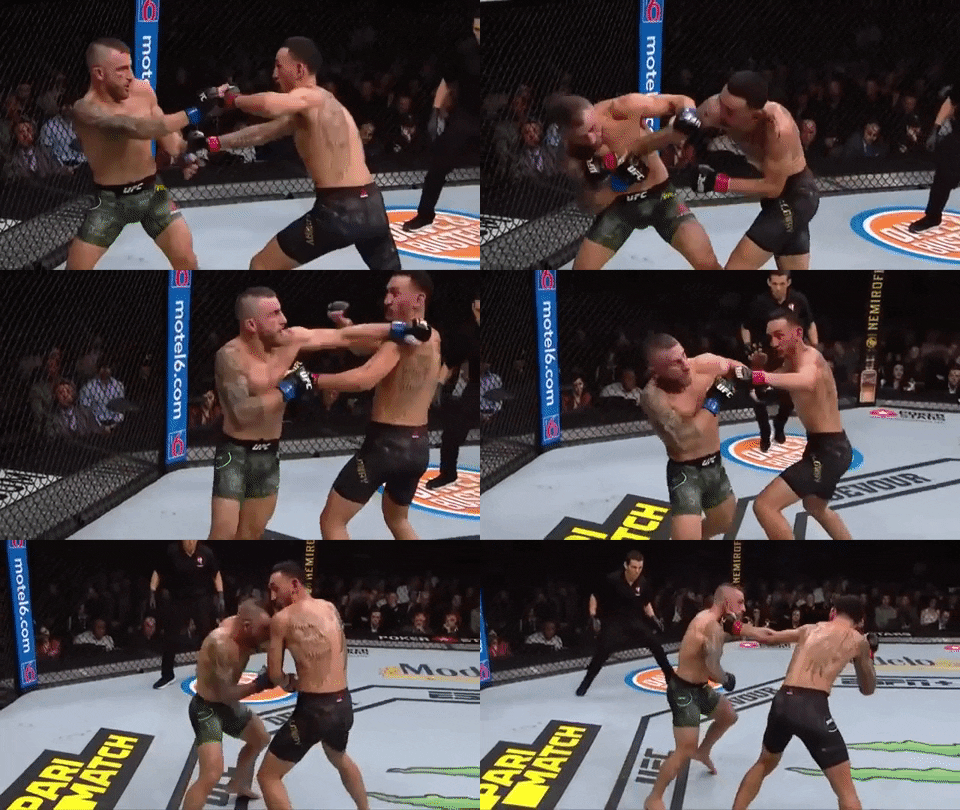
(Knowing that he would be eating some jabs while working his way to the inside, Volkanovski accepted this trade so he could land hooks of his own.)
As the rounds wore on, Volkanovski was becoming more and more comfortable following up his inside low kicks with combinations and moving away to avoid counters. This eventually led Holloway to switch to southpaw for a good chunk of the fight.
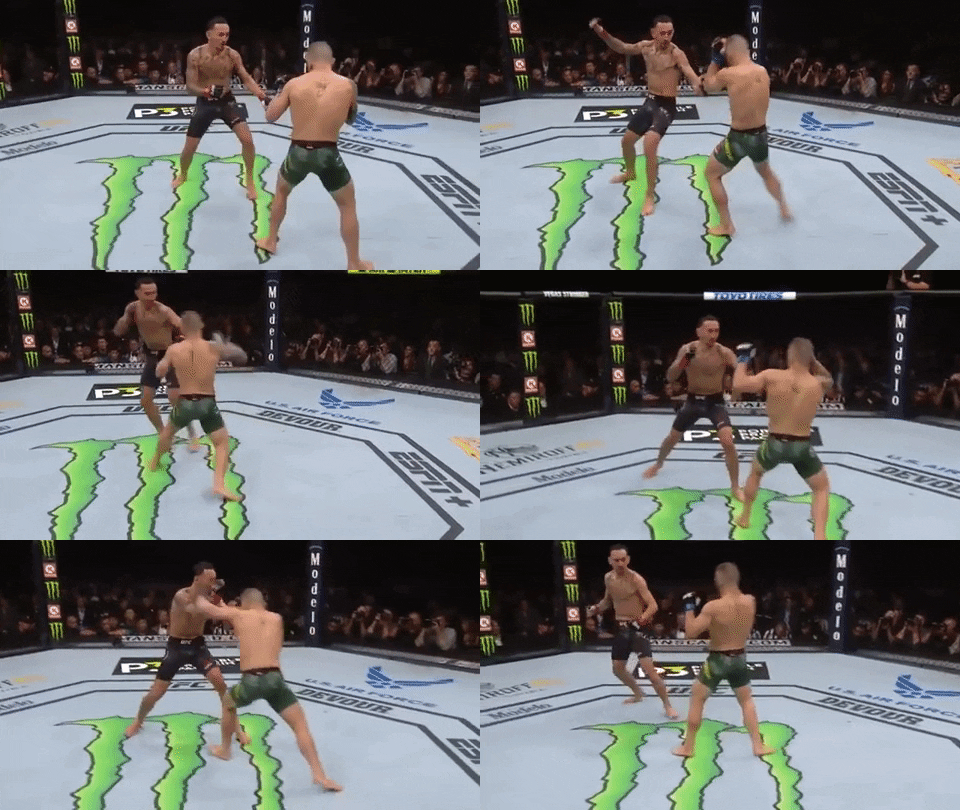
(This was pretty much the foundation for Volkanovski’s win. Throw plenty of low kicks to keep Holloway in place so he could follow up with the jab and straight/overhand. If Holloway presses forward, take a step back and counter.)
On the subject of mobility, Volkanovski also got Holloway to constantly turn, not giving him a chance to set up his offense. Dustin Poirier did something similar to keep Holloway from unloading with volume so there’s something to this strategy.
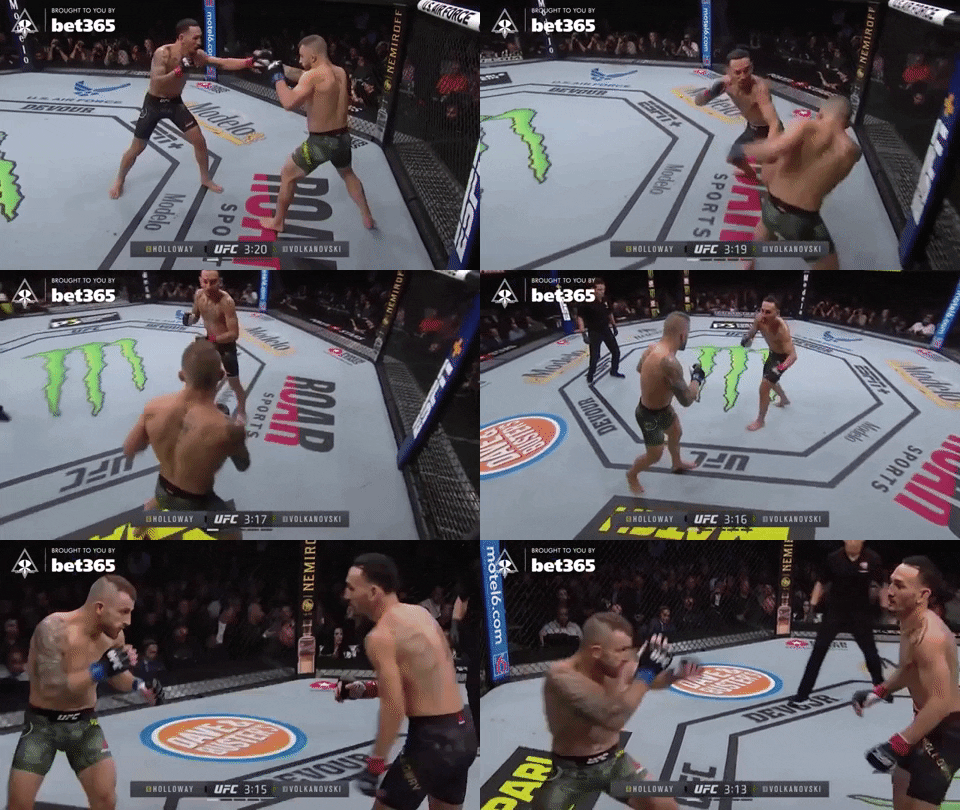
(As Holloway steps in with his jabs, he eats a counter left hook. What’s really impressive is Volkanovski’s commitment to movement. Notice how often Holloway has to turn to chase him.)
Alexander Gustafsson also utilized lateral movements to give Jon Jones a close fight in their first match-up. This is a gameplan that can be used universally across all weight classes.
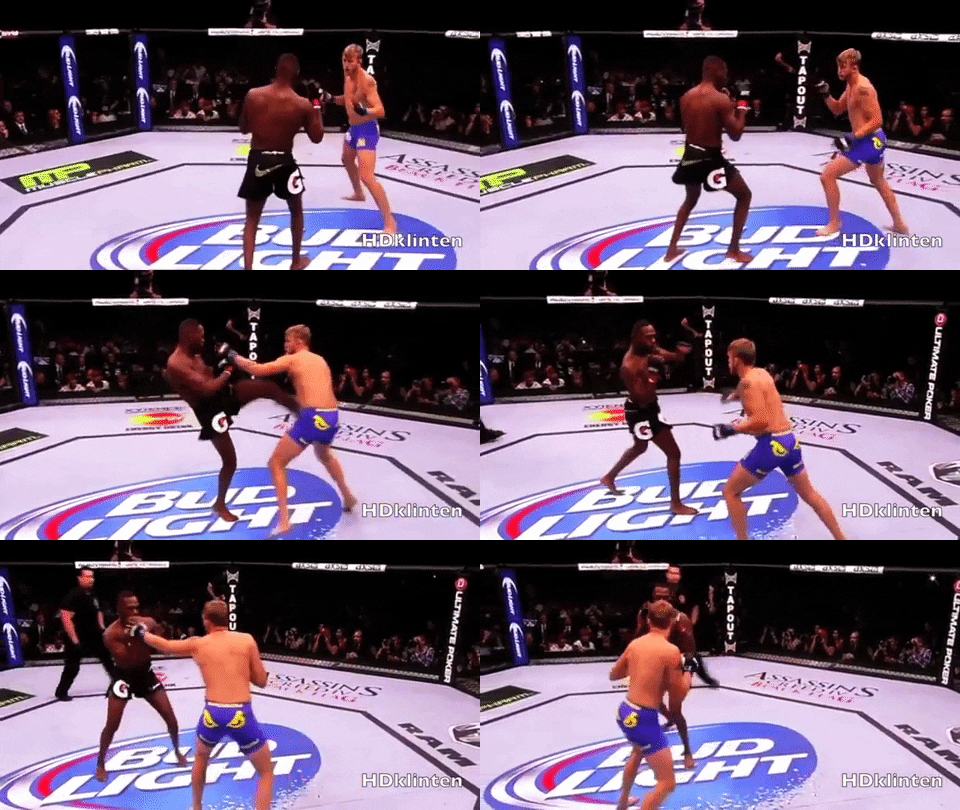
(The normally creative and smooth Jones was forced to constantly pivot to meet Gustafsson in the middle, giving the challenger a chance to strike with punches to the head and body.)
Even though the fight was mostly Volkanovski, Holloway wasn’t without his moments. Where Holloway had the most success was the sidekick to Volkanovski’s lead leg to keep him from advancing forward. Holloway also threw body shots early to Volkanovski’s midsection but seemed to abandon this strategy after a while. He was also able to out-box Volkanovski whenever he started jabbing without using the low kicks. And as Daniel Cormier pointed out, from orthodox stance Holloway had more success with his punches but took damage from leg kicks. Holloway is known as a stance switcher, and some considered him to be equally good from both sides. But as champion, he has done his best work from orthodox.
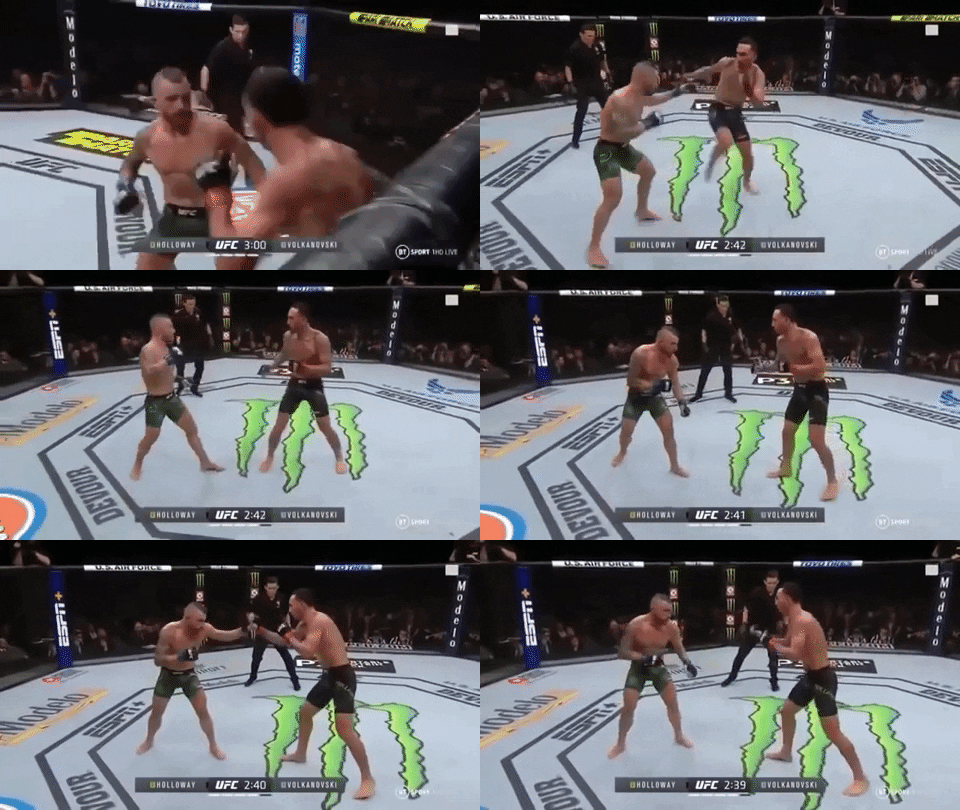
(It doesn’t look like much, but a low-line sidekick stops Volkanovski and has him dropping his hands and wary of future attacks from the same side.)
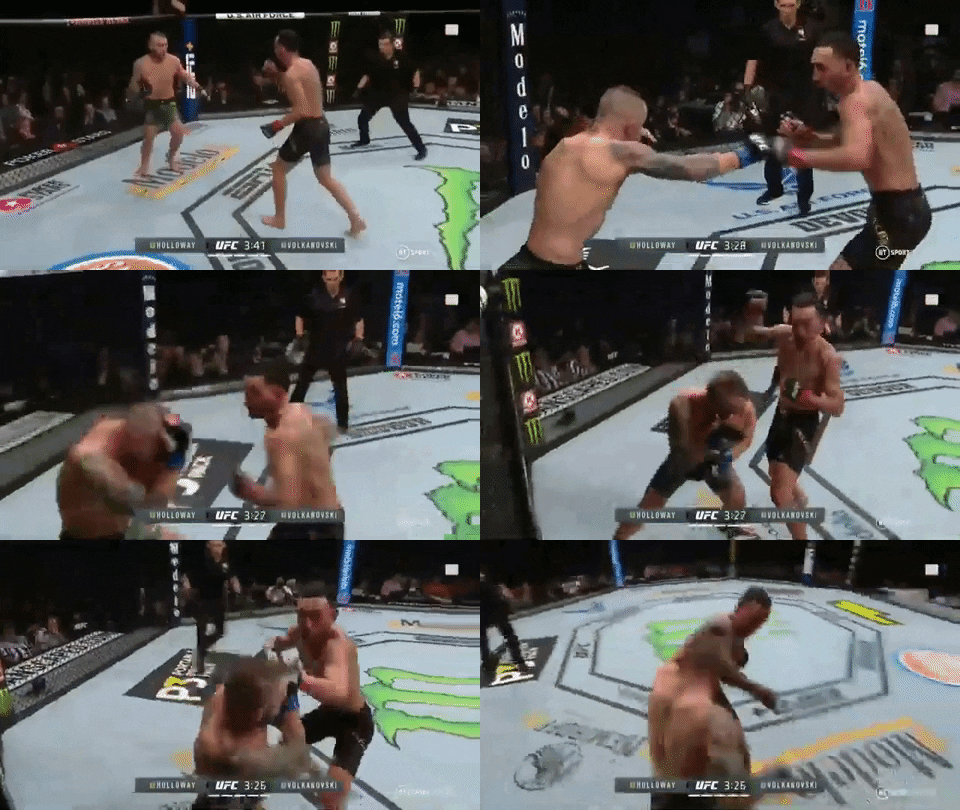
(Whenever Volkanovski got lazy on the offense and shelled up, Holloway was there to greet him with plenty of jabs and straights.)
Even though Volkanovski was winning, the numbers paint a much closer fight. Overall, both Volkanovski and Holloway attempted the same number of significant strikes, 303. Volkanovski landed 157 to Holloway’s 134. Not a huge discrepancy, but if you looked at the output round by round, Volkanovski did just a little bit more than Holloway in the first three rounds, and in the last two, Holloway out-landed Volkanovski by single digits. What may have made the biggest difference were where the strikes landed. Holloway landed 63% of his punches to Volkanovski’s head, 23% to the body, and 12% to the legs. By contrast, Volkanovski landed 42% of strikes to the head, 9% to the body, and a whopping 47% to the legs. If you couldn’t tell, this kick heavy game was built with Holloway in mind.
We know that Volkanovski has the tools to beat Holloway, he’s done it already. In addition to all the things that he did well the first time around, perhaps Volkanovski can throw some more hooks while shifting. This clipped Holloway almost every time Volkanovski threw it because he was able to hide it behind a pause before stepping off to a different stance. Holloway defended all of Volkanovski’s takedowns during the fight, but it was a shame that neither really scored with punches off the clinch break. This is definitely something that either fighter can take advantage of.
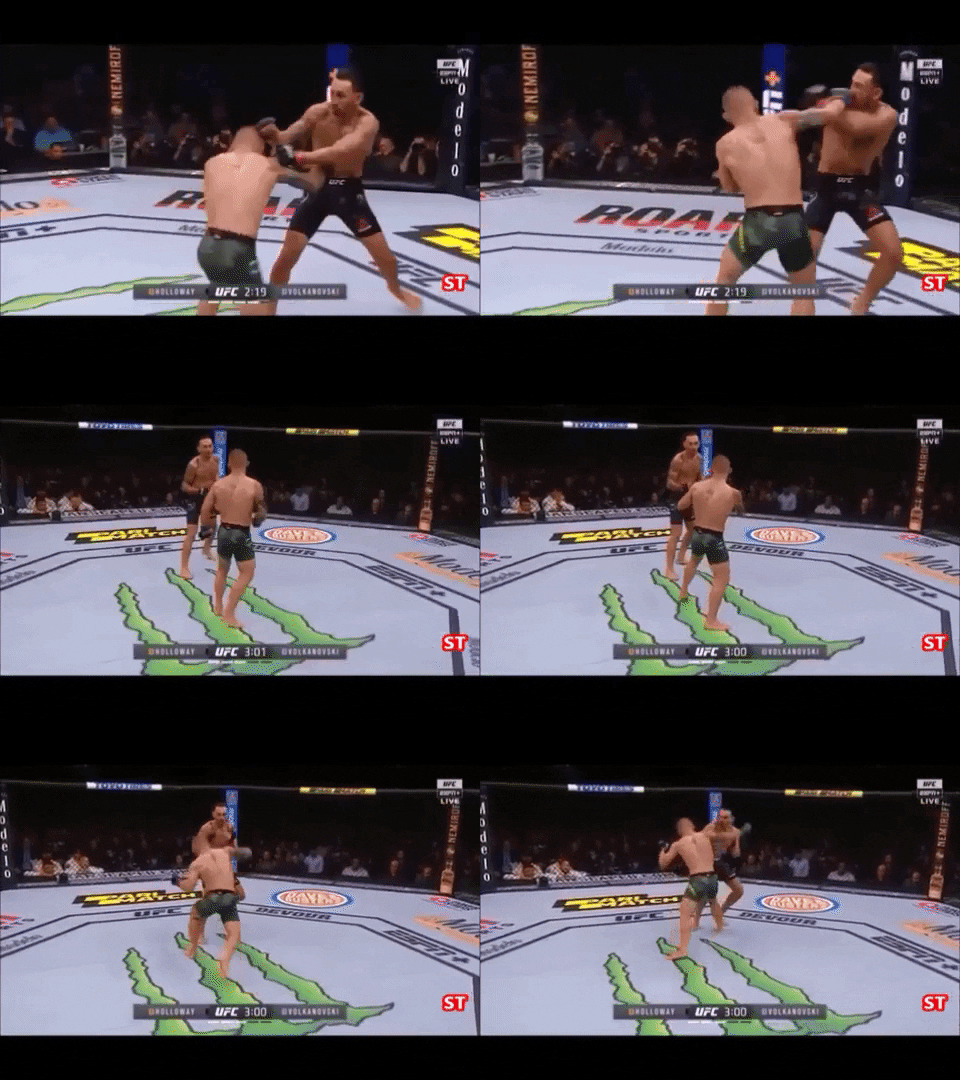
(This is actually a favorite of T.J. Dillashaw, the drop-shift into a hook. Notice how Volkanovski shifts to southpaw right after, and it’s the second consecutive hook that lands.)
Holloway is normally a good body striker, but it wasn’t until rounds four and five that he really started to target the midsection of Volkanovski. Even against Brian Ortega and Dustin Poirier, Holloway still found ways to sneak in hooks to the body, but Volkanovski's constant resets and defensive savvy reduced Holloway to headhunting. At one point, Holloway caught Volkanovski clean in the midsection with an intercepting knee, a favorite of Donald Cerrone. Due to his height and preference to strike it out, Holloway should consider using this move much more frequently.
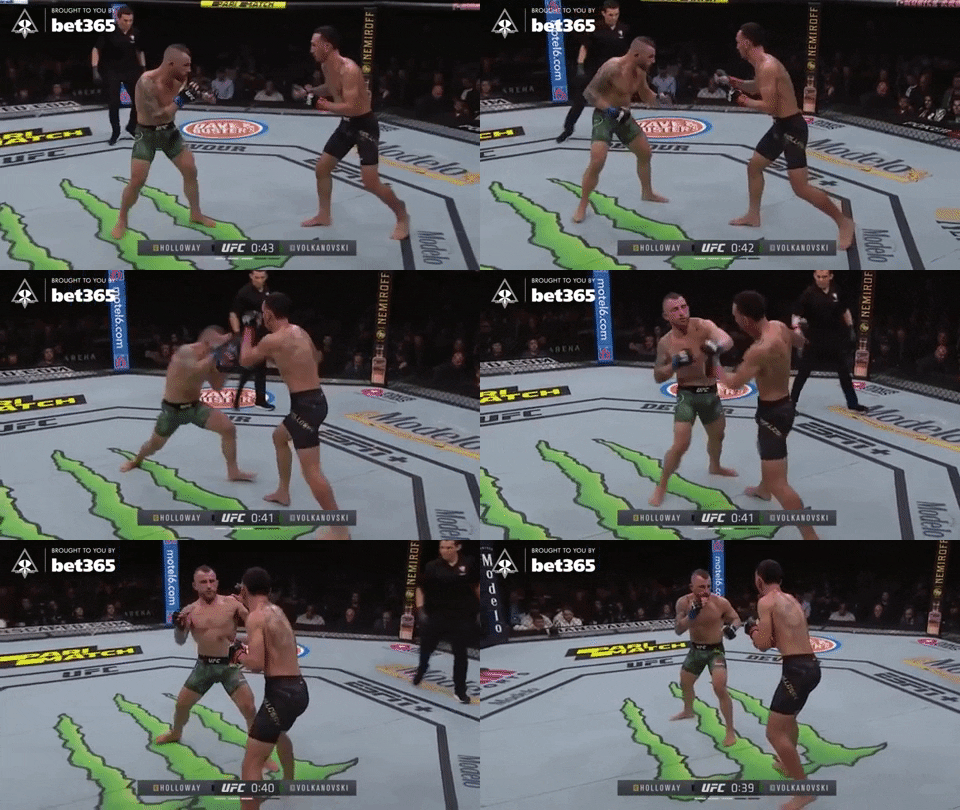
(Cerrone used this type of knee to keep Alex Hernandez and Eddie Alvarez from changing levels while they closed the distance.)
To execute his A-game and reclaim the title, Holloway can do what worked best in the rematch and start slamming the low-line kick to Volkanovski’s lead leg, and throw plenty of front kicks to keep him at a distance. Robert Whittaker used the same game plan against Yoel Romero to rack up points while keeping him at bay, and a lot of the same principles can work against Volkanovski. Despite having a lot of different attacks, Volkanovski is limited in his entries so the low-line kick can keep him from advancing, and if he starts to shift to southpaw to close the distance, the front kick can keep him in place. This can set up Holloway’s best weapons.
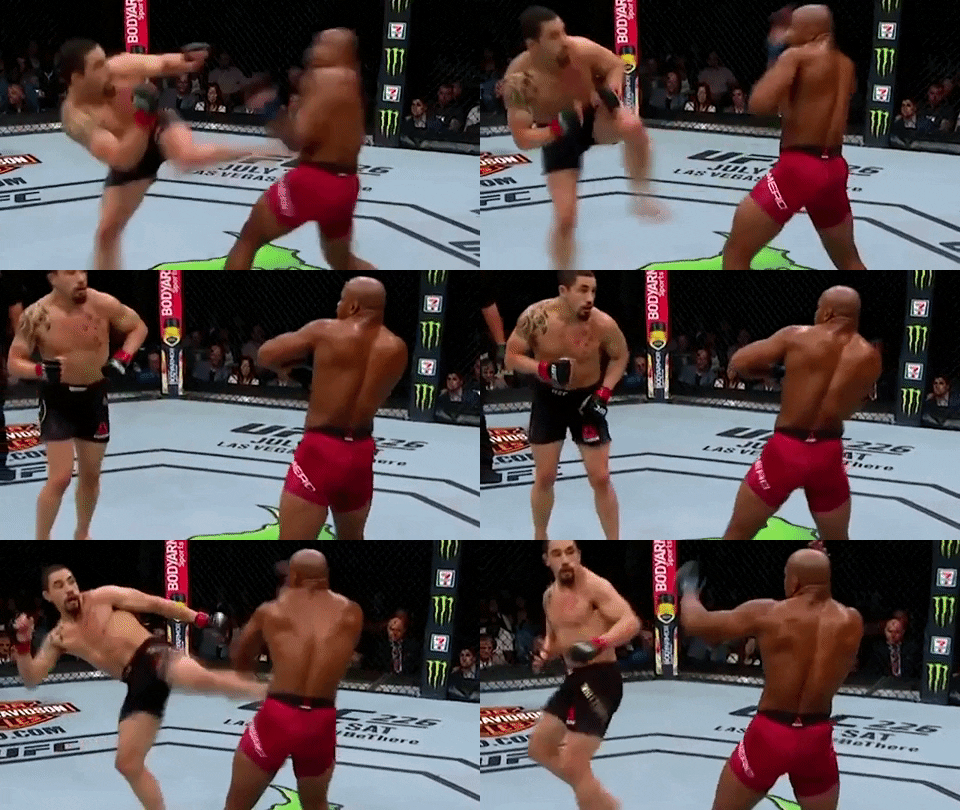
(Romero would like nothing more than to close the distance and take Whittaker’s head off with hooks, but the sidekicks make it difficult to do so.)
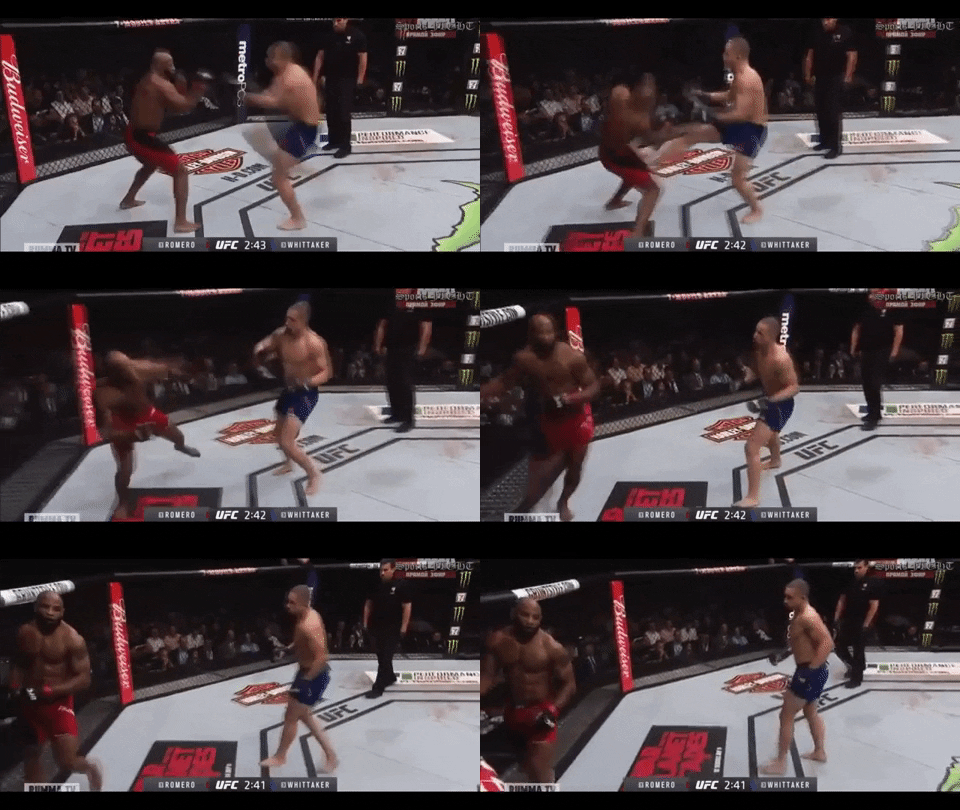
(A front kick a day keeps the Romero away. Also, Holloway should use this move as well.)
Holloway uses the jab as an information-gathering tool, it also happens to also be his go-to punch. The jab is his sword, his shield, and his spear. With a lot of the intel already scouted from the first fight, it would be ideal for Holloway to utilize his jabs as more of a defensive tool than an offensive one. When Holloway jabs, you can be sure that a right straight is soon to follow, and if Holloway can get Volkanovski to lunge in after slipping the jab, all the better. Hooks off the jab are somewhat of a specialty for Holloway, if used as a counter, it can make Volkanovski hesitate. He’s also successful whenever he doubles and triples up on hooks to the body, which could pay dividends as the fight goes on. He was having success withdrawing the lead leg and blasting up the center like Cody Garbrandt, but Holloway waited until rounds 4 and 5 to use this setup. It could be worthwhile to bring this kind of movement early on to make Volkanovski pay for every low kick.
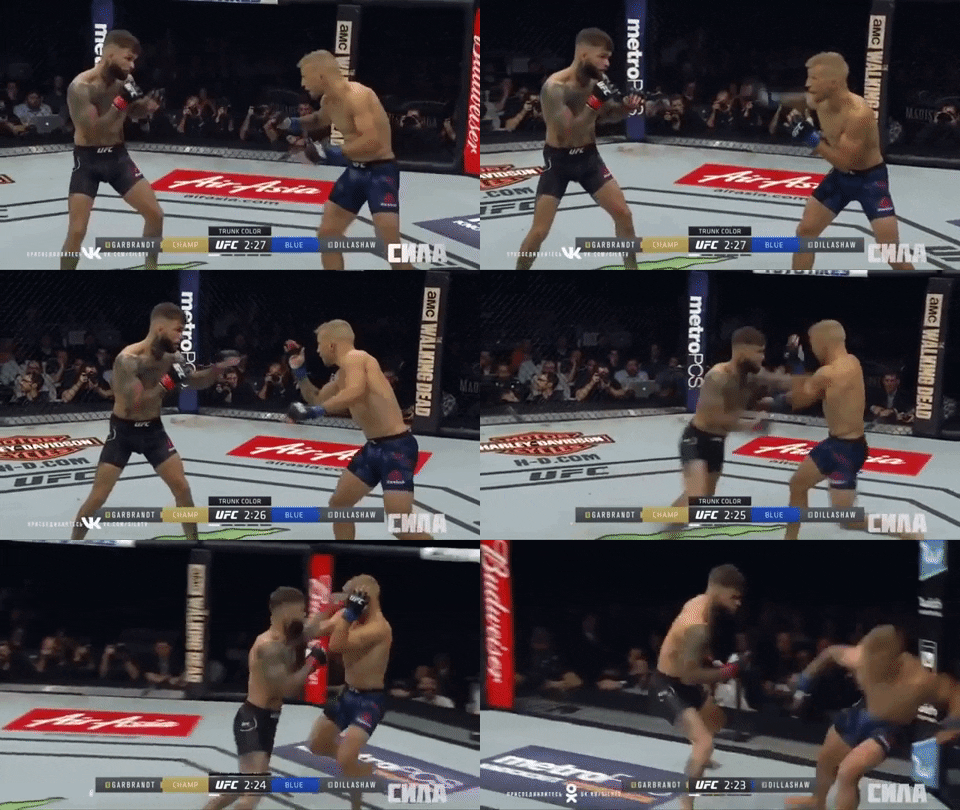
(The moment Garbrandt feels Dillashaw’s leg hit the inside of his thigh, he’s immediately plowing up the middle with hooks. If Holloway can alternate his hooks to the body and head, it could make a noticeable difference.)
All this will be moot if Holloway can’t figure out a way to nullify the lateral movements and jabs of Volkanovski. In this regard, Jon Jones could hold a possible path to victory, particularly in his rematch with Gustafsson. Like in the Cub Swanson fight, Holloway can fight out of the southpaw stance to check the lead hand of Volkanovski (much like how Jones did the second time around). But instead of chasing Volkanovski and getting hit, Holloway should play the matador and have Volkanovski come to him. Jones did just that against Gustafsson and was able to nail him with counters and kicks, and when it looked like Gustafsson was going to start with combination strikes, Jones simply disengaged and reset. There’s always the possibility that Volkanovski and the team over at City Kickboxing have already planned for this and have new problems for Holloway to solve on the fly. Luckily for us fans, we get to witness this real-time strategy game.
Jose Aldo vs. Petr Yan
Rounding out the trio of title fights, we have Petr Yan facing off against Jose Aldo for the bantamweight belt. Yan is undefeated in the UFC and is on a six-fight win streak while Aldo is trying to win a second belt in another weight class, a feat that would put him among elite company. Critics can argue that Aldo’s consecutive losses shouldn’t grant him a title shot, but let’s remember this is the same company that gave Yoel Romero a shot at the middleweight championship just because they needed to fill a slot. The UFC will do as they please, all we can ask for are compelling fights.
Yan fights a lot like another fighter from the Eastern bloc: Gennady Golovkin. Take a closer look at his style and all the punches are there. Yan throws plenty of looping hooks to the head which goes around an opponent’s forearm guard. By utilizing his hooks and jabs in an alternating fashion, Yan can get fighters to shell up so he could move in closer to set up his combination punching. Unlike other swarmers like Wanderlei Silva, Yan works to make sure his foot placement is correct and his head off center to reduce the chances for counters. He’s average-sized for bantamweight (5’7” with 67” reach), but his striking stands out even amongst the best in the weight class.
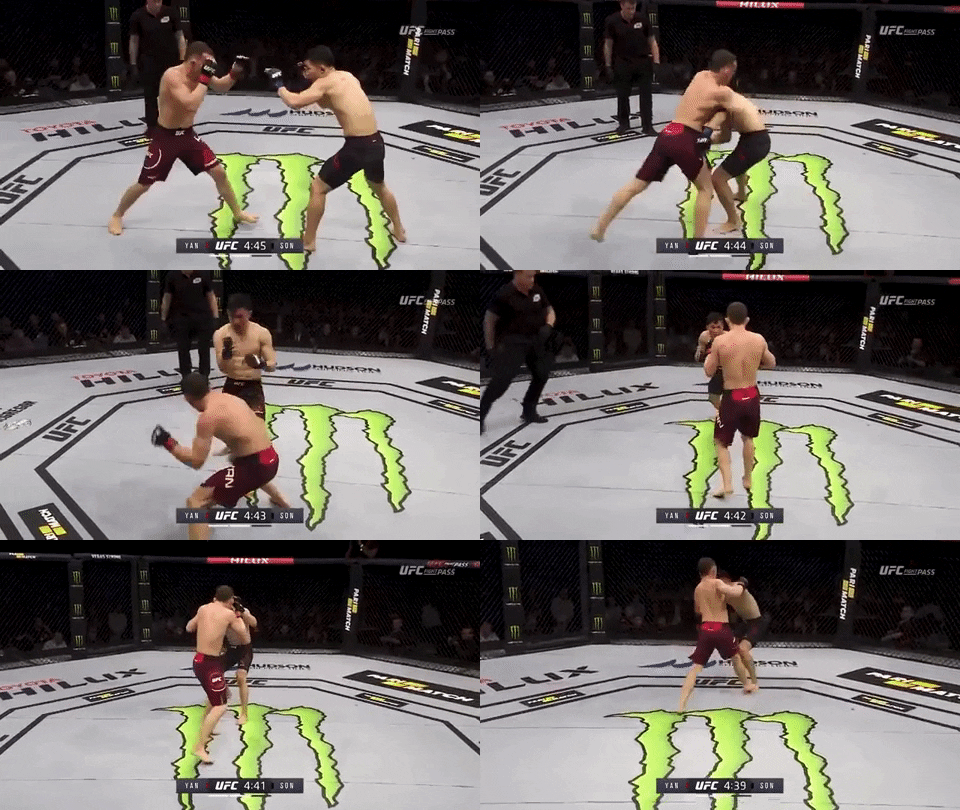
(The feet of Yan are always in position to support his punches and even when he swings, Yan doesn’t lose balance. He’ll also switch from orthodox to southpaw.)
To show off a well-rounded game, Yan also has basic but effective kicks that he uses to set up his punches. His penchant for throwing lead leg kicks to close the distance before throwing the left hook-overhand right is what made Dan Henderson famous. This simple but effective combo worked to cut the cage off against Teruto Ishihara so he could swarm in and finish him. The beauty of this kick is that it doesn't require a lot of energy, meaning he can save it for his fists.
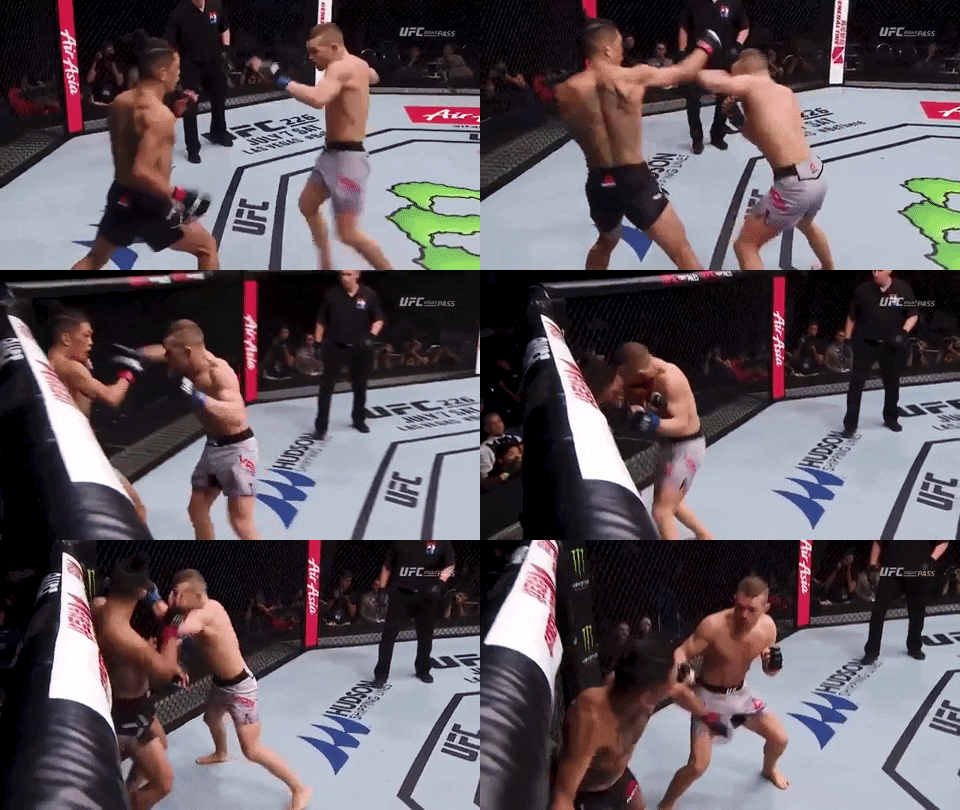
(The lead kick does its job of pinning Ishihara in place for Yan’s punches. Before he knows it, Ishihara has his back against the fence and is absorbing a right straight.)
If opponents duck under Yan’s lead hook, this sets up a chance for him to grab the back of their neck and throw uppercuts and elbows (a Michael Bisping favorite). The uppercuts caught Jimmie Rivera flush a couple of times and the elbows caught Uriah Faber whenever he dropped for a takedown. If they opt to move straight back, a shifting left hook will come from right below their line of sight.
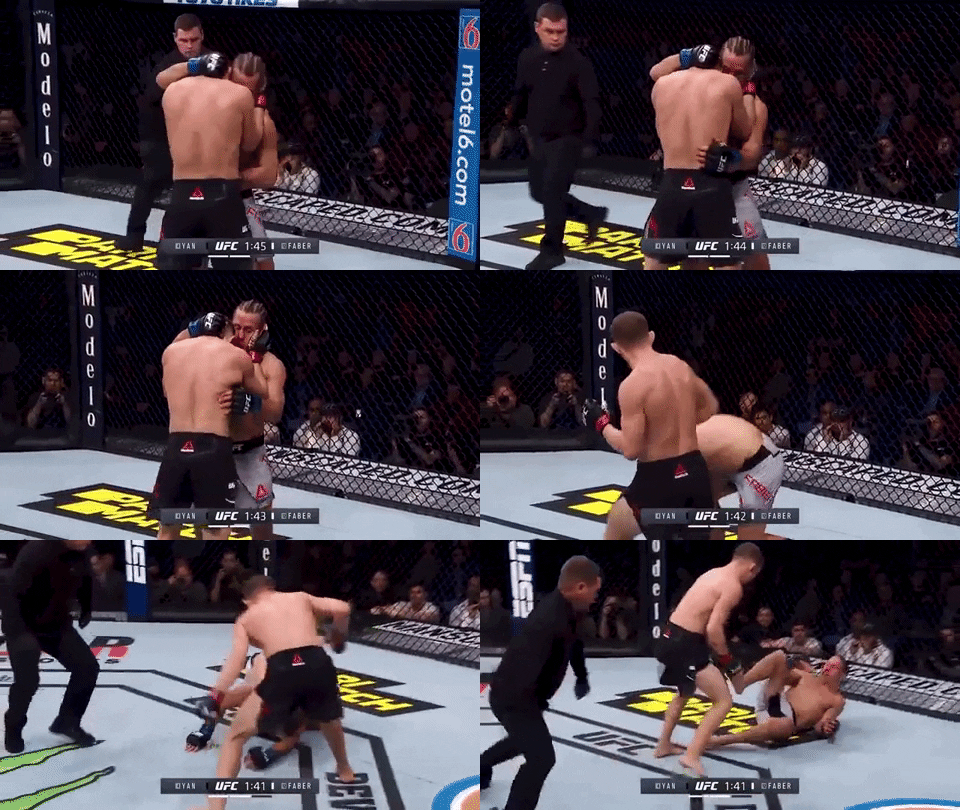
(After an attempted takedown goes awry, Faber finds himself in the clinch with Yan. After creating a little bit of space, Yan is able to unload right on the jaw of Faber.)
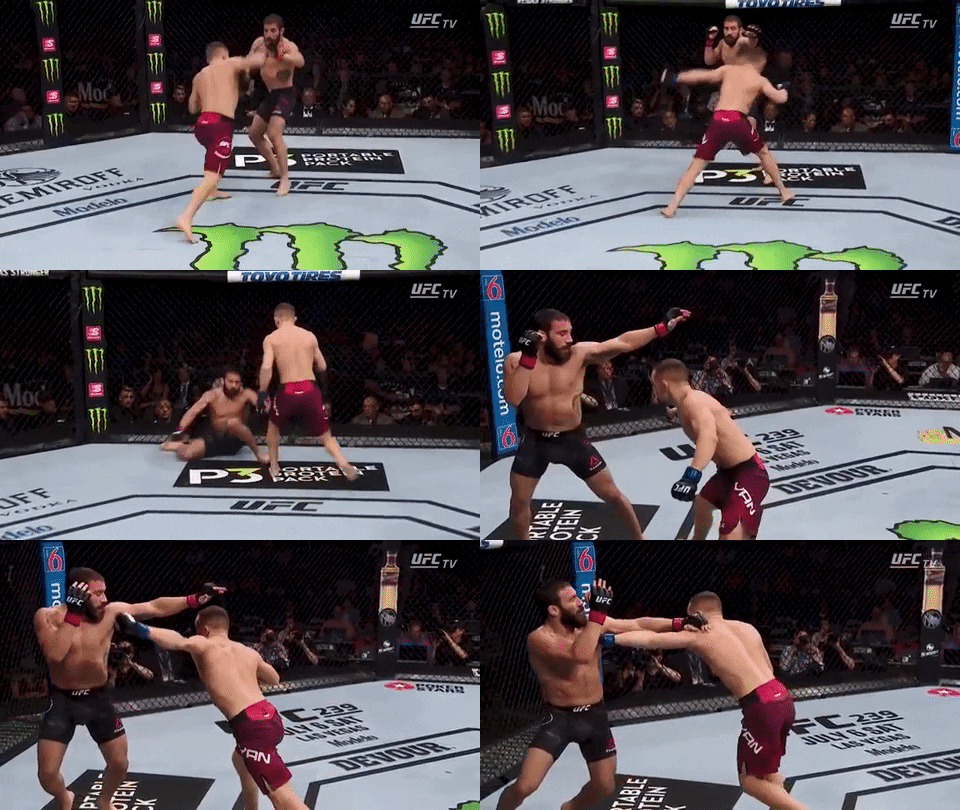
(The drop-shift hook is a popular option among switch hitters.)
Trying to break Yan’s winning streak is Jose Aldo. Despite being on a 2-fight skid, it’s important to point out the nature of those two losses. One was to Volkanovski, the current featherweight champion, and the other was a closely contested split decision loss to Marlon Moraes, still the #1 ranked bantamweight in the UFC. Speaking of the loss, Aldo looked better than he had in a long time, and although he’s always had problems making 145 pounds, the drop to 135 seems to have somehow rejuvenated his body. Moraes was having a lot of success with his kicks and lateral movements, but Aldo’s constant pressure and boxing game gave Moraes many moments of panic.
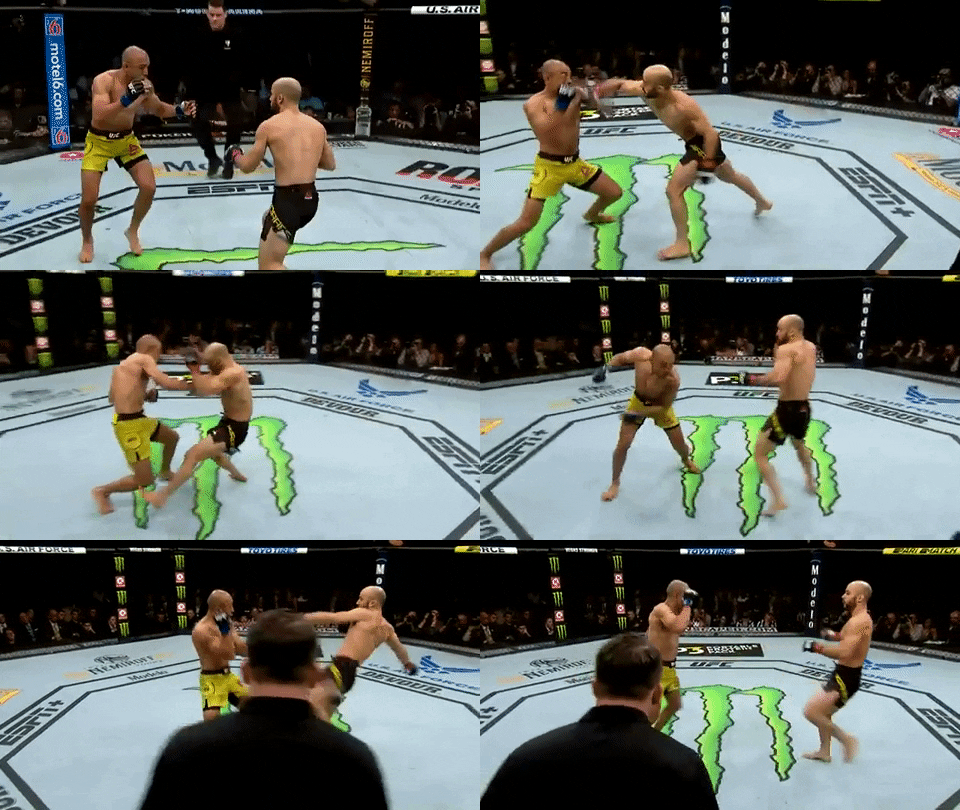
(Aldo does play a dangerous game by constantly looking for the counters, but every now and then it pays off. Moraes gets careless after throwing an overhand right, only to get cracked by a perfect right straight.)
Aldo hasn’t thrown low kicks consistently since the Holloway fights, but he showed shades of this threat in the Stephens match. He was able to time the low kicks to hit Stephens every time he marched forward and caught him clean with a counter right when Stephens was on one leg. The threat of the kicks alone is still enough to keep his opponents on edge the entire fight. At bantamweight, Aldo is still fast enough to land combinations on the counter. Against Moraes, Aldo was able to slip under lazy jabs and rip hooks and straights to the body on a regular basis. The right straight was also a great weapon for Aldo, and Moraes knew that he had to change things up to win (which he did in the third round).
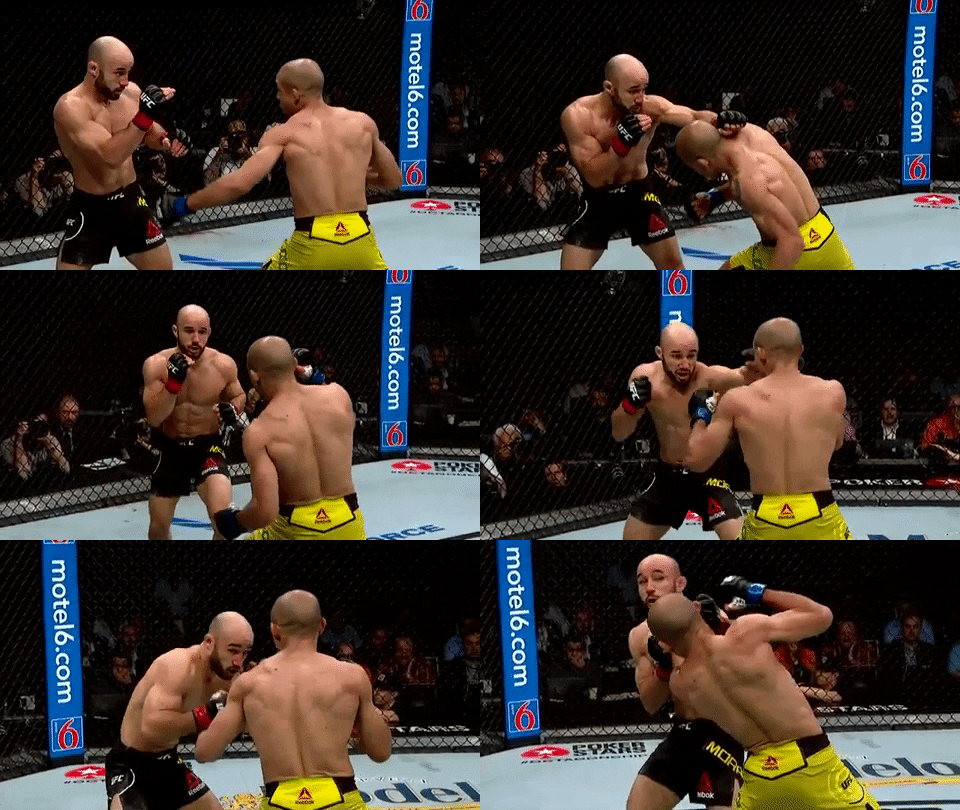
(Once he gets within range, Aldo’s ability to hit hooks and uppercuts are still among the best at both bantam-and-featherweight.)
It might also be unfair to write off Aldo’s past accomplishments based on two recent losses. This is still the same Aldo who was able to finish both Stephens and Renato Moicano with body shots. He stayed in the pocket against both and jabbed them up before ripping hooks to their body. In a strange way, losing the title has forced Aldo to become hungrier and chase the finish. What better way to prove he still has the mettle to be champion than to beat a younger, undefeated bantamweight for the 135-pound strap?
For Yan, he has the advantage of studying the greats in how to beat Aldo. What seems to be a common theme in all of Aldo’s losses is that a consistent jabbing game, feints, and forward pressure gives him a ton of problems. Volkanovski stutter-stepped and feinted to get Aldo to overreact, and once Aldo stopped to counter, he got hit with a low kick and jab to the face. Speaking of which, Yan shouldn’t be afraid of trading low kicks with Aldo. It’s been stated before many times in both our fight previews and studies, trading kicks with a kicker is a good strategy since it serves the purpose of keeping them in the place and stops them from establishing their own kicking offense. If Yan doesn’t want to trade kicks, he can time rear hand straights to counter every time Aldo throws a kick. Both Stephens and Holloway threw right straights as Aldo kicked, and he stopped throwing them almost immediately. If Aldo tries to flurry his way into the clinch to either throw hooks or catch his breath, Yan should throw elbows and hooks off the break to keep the action going. Moraes and Volkanovski didn’t let Aldo build momentum, so why should Yan?
Aldo’s path to victory is going to come down to what kind of strategy Yan wants to utilize. If Yan wants to play more of a wrestler/boxer type of game, that only helps Aldo. Yan’s use of stance switching presents Aldo with opportunities to time his shifts to low kick him.
Every prolific stance switcher has been dropped at one point or another due to having both of their feet squared up. Aldo has the elite timing to seize those types of opportunities. There’s also the curious fact that no one has really hammered Yan’s midsection, and Aldo has the boxing to do just that. It’ll be interesting to see how Yan reacts to a prolonged striking match on the inside since he hasn’t fought anyone with the kind of speed and power that Aldo possesses. If Yan does try to kick a kicker, Aldo can counter by taking Yan down as he used to do earlier in his career.
With three title fights in one evening, the UFC is definitely trying to get as many fights in as they can since the future is unclear. Hard to say what could be possible match-ups for the future. Let's just take it one event at a time.
Files
Previews only

