Home Creators Posts Import Register Favorites Logout

Downloads

Content

On satire of the bourgeoisie.

[Patreon Exclusive]

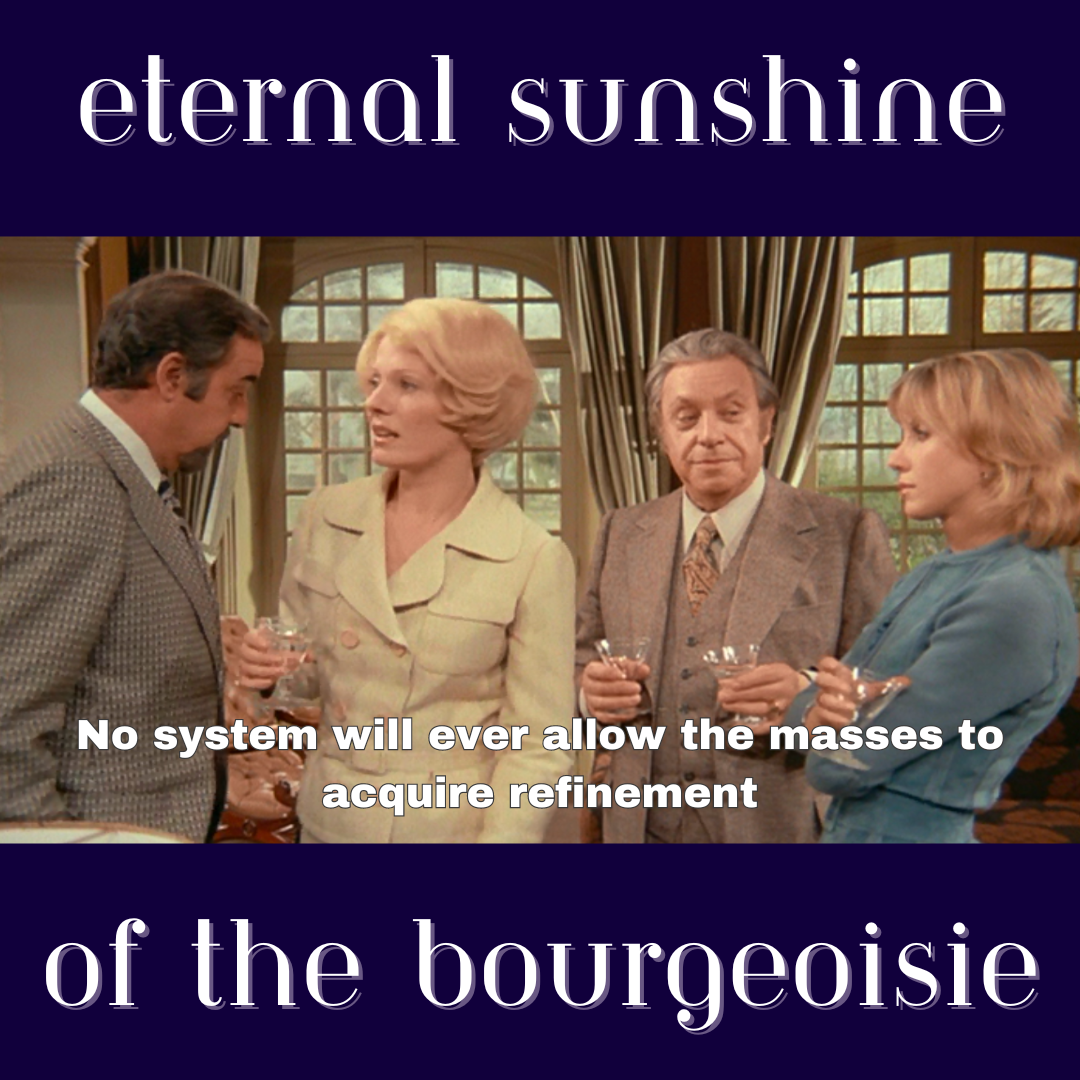
We discuss Luis Buñuel's "deranged masterpiece" from 1972, The Discreet Charm of the Bourgeoisie, and debate the social ritual of dinner, and why the guests in the film never get to eat theirs.

How does this early 70s surrealist film – which in many ways set the template for cinematic satires of the bourgeoisie – compare to more recent portrayals such as The Menu or Triangle of Sadness? Ultimately, who are the bourgeoisie and do they still exist, in a world of distributed ownership and managerialism?

Readings:

‘A deranged masterpiece’: why you should watch The Discreet Charm of the Bourgeoisie, Luke Buckmaster, The Guardian

What Have the Bourgeoisie Done for us Lately?, Stephan Bertram-Lee, Sublation

A Brief History of the Bourgeoisie, or We Are All Bourgeois Now, David Polansky, Strange Frequencies

The Bourgeois(ie) as Concept and Reality, Immanuel Wallerstein, New Left Review

Files
Comments

BlackPick7

Very much enjoyed this episode. Potential movie night in the future, Godard’s (and Jean-Pierre Gorin) Tout va Bien. I personally think it’s a definitive work reflecting on the failure of the May 68 moment. Or just do La Chinoise and talk about French Maoism.

Davka Smolah Collective

So I snark-tweeted about this ep that the bourgeoisie has socialized "downward and outward" its role in production to the PMC. I was glad to hear that point already hinted at in the episode itself. I think it could actually use some elaboration, and I'll give a story I personally participated in for color. (Rather than use the dreaded acronym over without definition, I'll do the Dan Evans move and separate professionals from managers.) Now for the personal story. I was once part of a team at a tech company who designed and built a new product -- hardware, not software. So, an actual product that had to be engineered and manufactured, in the proper sense. The funny part was, there was no individual "capitalist" in the entire process. The project was named for one man who had invented a key component (a novel kind of small-scale electromagnet he invented as part of his PhD/postdoc work), but he didn't *own* any of it. He, and we, were all actually subcontractors of a famous tech BigCo, and that BigCo determined at all times whether our project lived or died or had to change direction. Of course, being BigCo managers, they completely bungled it, and eventually the project was cancelled simply due to reshuffling of BigCo's internal corporate politics. So from "entrepreneurial" invention to engineering and design to actual manufacturing, *everything* was done by someone paid a salary and lacking an ownership stake (yes, even stock options). My impression talking to other people of my class is that this kind of thing is quite common, and actually accounts for the role in production of the PMC better than all the moaning about DEI seminars. Yes, a manager will run DEI seminars because the PMC is a "capitalist for hire", substituting for the penny-pinching banker. What's more interesting is the professional serving as a "capitalist for hire" by substituting for the "entrepreneurial" inventor or service provider, serving the role once served by Thomas Edison or Steve Jobs with much less individual autonomy and ownership stake.

Matthew Zarenkiewicz

Coming in for a movie recommendation of Zama (2017, Argentina) directed by Lucrecia Martel. Could be an interesting discussion of representations of colonialism and bureaucracy

Paris Nicholls

Martin Eden (2019) would be a great one for the pod - 20th century Italian history through an adaptation of the Jack London novel

Elias Braun

Phil's point about a certain type of self-conscious European bourgeois not existing anymore is true overall, but I think it varies a lot by country. Eg it's dissolved much more in Germany (where they never liked to acknowledge their social status that much anyway) than in France, where the Parisians bourgeoisie is still quite coherent as a powerful and tightly-knit social group.