Home

 Creators
 Search
 Recent
 Random
 Posts
 DMs
 Tags
 Random
 Importer
 Import
 FAQ
 Account
 Register
 Login
 Favorites
 Keys
 Logout
 Telegram

Second Self - chapter 1 (Patreon)
Content
The Pantages gives a long sound back. I send the first note of the last movement up into the dark and it comes home to me a breath later, rounder than I sent it, and the finale becomes a duet between me and the note I just let go of. Voldan lets me. He keeps the beat small, two fingers, no fuss, and the orchestra breathes around him, and past the lights the house holds so still I can hear the felt weight of eleven hundred people keeping quiet on purpose. The stage lights hum when a room is this quiet, a high thin whine under everything, and I've played under it for eleven years and told people I don't mind it, and I do notice it, every single time, so maybe that's its own kind of minding and I've just never called it that.
At the tuning the oboe gave the A, thin and sure of itself, and all of us leaned into it until the orchestra was one instrument, and I still love that trick, I don't think I'll ever stop loving it. In the green room beforehand I ate half a banana and wrapped the other half in a paper napkin, a conservatory superstition about potassium I've never managed to shake and, if I'm honest, never tried very hard to. The napkin is still in my case. It'll still be there next season.
My rosin has one good edge left. I've been meaning to replace the cake since the new year and keep not doing it, because the worn edge bites the C string exactly how I want it and a fresh cake would take two weeks to learn me, and every January I promise myself this is the year, and it never is, and I've stopped being bothered by that about myself. The endpin sits in a divot worn into this stage by cellists from before I was born, and I found it tonight without looking, same as every year. During the first movement a child up in the mezzanine swung her legs in time with the tutti until an usher leaned over, and she stopped, and I keep thinking about those legs, and about whether there was something I could've done, a look, anything, to keep the usher off her, which is absurd, she's a stranger's child three tiers up and I have a concerto to play, but I'm thinking it anyway.
The cello leans into me and I lean back. Its ribs sit against my ribs, the upper bout warm at the left side of my neck, where I've carried a red mark every season since I was twenty. Low notes come up through my breastbone an instant before I hear them, so for one suspended moment I'm the only person in the building who has them. A luthier in Fife took the top off last year to glue a seam, and whatever he did while he was in there, the instrument came back sounding younger. Tonight the seam holds under everything I can give it, and I lean on it harder than I need to anyway, just to feel it hold.
It rained this afternoon, and the house still smells of wet wool under the rosin dust warming in the lights. I had coffee with honey before I went on and I can still taste the honey at the back of the swallow. My back is bare where this dress opens, the black one with the hem I keep meaning to fix, and a draft off the stage door finds me there between phrases, and for one bar I worry, unreasonably, that it'll show on my face. A page turning in the second tier is loud enough to conduct. Bea sits close enough that I can hear her breathe in before her entrances, a small sip of air I've been hearing for six years. During my rest I glance over and she's already watching me, and she grins at a phrase before it's even finished, and it does something to me that I try to pretend it doesn't.
Chloe is out in the seventh row with her coat across her knees, because I told her this hall runs cold. She can't read a note of what we're playing and she's come to every program for nine years, and she sits where I once told her the sound is kindest. There are things I've decided not to think about until the season is over, and this is the last night of it, and every few minutes I feel one of them get close and I put it back down.
Recordings lie about me. I've never heard myself on tape and agreed with what I heard, and for a long time I thought that meant something wrong with the recording equipment, not with me. In a room, in live air, I know exactly what I'm doing, and tonight I'm doing it. Dvořák folded a song into the slow movement for Josefina, who was dying on the other side of an ocean while he wrote it, and every cellist knows, and we play it at tempo as though that helped. I learned the concerto at nineteen and sure of everything, and the first movement corrected me, and it's been correcting me since. Thirty performances now, maybe forty, no two alike, and I stopped expecting otherwise years ago.
The finale gathers itself for the climb. My teacher used to say a phrase that climbs is a question you get to answer once, at the top, with your whole chest, in front of everyone. Tonight the climb is long. I go up after it, thumb across the strings, weight forward over the endpin, and the hall comes with me. The note at the top is the one this movement has been walking toward for nine minutes. I know where it is. I'm going to arrive exactly when I mean to.
Something goes off behind my right eye, all at once and at full size, a light popping deep inside the bone. Nothing in my life has ever hurt like this.
I'm still playing. The phrase goes on without asking me, correct, in tune. It doubles. Doubles again. The long echo I've been duetting with all evening folds in on itself, the room going thin, backing away from me, and underneath there's another sound, a seam giving, a wire drawn tight and rising, and I reach for the end of the phrase and find -
The alarm panel by the side door has wanted a new battery since Christmas; it tells me so every forty seconds, a chirp I've spent three months training myself not to hear, and I can't not hear it tonight, which I choose to interpret less as an omen and more as evidence that my discipline has limits, same as anyone's. I code us in at 9:40. The lot holds two cars: mine, and Wes Toma's Civic, parked crooked under the lot light, a foot of empty asphalt on one side and the cart corral on the other. The air off the pavement is wet and forty degrees and smells of the sound; the door handle is cold and beaded and takes the warmth out of my hand on contact. Inside, the building has its night smell: carpet glue, copier dust cooling in the billing alcove, and under both, from the procedure suite, chlorhexidine and the canned-corn sweetness of the feed formula.
Wes has the rig warmed and his dinner open beside the keyboard, lo mein from the place on Pacific, steam long gone. His eyes stay on the impedance readout when I come in, which I'm choosing to read as diligence rather than as a man who would rather look at a screen than at my face tonight.
"Impedance check in ten," he says.
"Take fifteen. I want to look at her first."
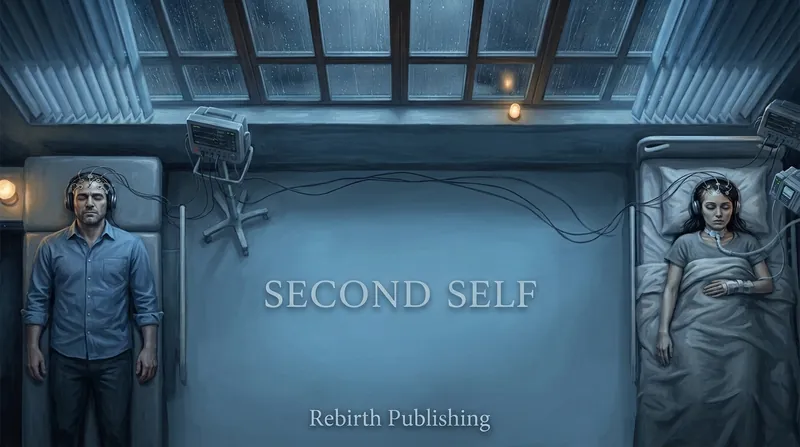
We built the rig here, in the bay between the two diagnostic bedrooms, because the wiring was already rated for overnight work and because nobody in a sleep lab asks what a third bed is for. It was the more elegant solution and, not incidentally, the only one we could afford; I've never been able to decide which of those facts I'm prouder of. The third bed is hers. Kass, Veronica, thirty-two, twenty-eight days post rupture of a left posterior communicating artery aneurysm, Fisher four, clipped through the left side, ventilated twelve days, no purposeful movement since. The hair over the scar is dark stubble now. She's lost twelve kilograms since the Pantages, where she went down onstage in the middle of the Dvořák with the cello still standing between her knees. The pump runs Jevity at sixty an hour, the compression sleeves sigh against her calves one side and then the other, and her face does nothing. The plant runs fine. She breathes over the stoma, swallows her own secretions, takes the penlight at the pupil and gives it back.
I flex her elbows against the starting contracture, one side, then the other, and work her left hand out of the resting splint, two velcro straps, loud in that room. The pads of her fingers are hard as horn; twenty-five years of steel string sits in that hand. I press my thumb against the index pad and her fingers close around it, slow and exact. A grasp reflex is a frontal release sign: it means the cortex has stopped telling the brainstem no. I've charted it in her twice and it means nothing about her, and I stand there anyway, her hand closed on my thumb, well past the end of anything the exam requires, listening to the pump knock its four soft knocks a minute, and if a resident stood here doing what I'm doing I'd take them aside about it. Then I put the hand back in the splint and press the straps flat. "Run the check," I say, and Wes types the time code.
The consent binder sits on the counter where it has sat all week. No institution means no board; the protocol in that binder is the whole government of this room. I wrote it. Forty-one pages, most of them variations on the word shall, which is either rigor or vanity and, four days from the deadline, I stopped being able to tell you which. Twelve months of proxy authority if the write holds, then it lapses on its own; I drafted that clause before either of us had a stake in it, back when the subject was hypothetical and so was the proxy. Behind it's the proxy authorization, Chloe Marchetti. She read every page before she signed, four days ago, in my office, with her coat on. Her initials are in the lower corner of each page, small and level, and where she dated a line wrong she corrected it with a single clean strike and initialed that too. I keep wanting the signature itself to look reluctant. It looks like her drawings: level, built to carry weight.
She asked one question the whole meeting, and it wasn't about power calculations or subject numbers. Whether what comes back would come back in order, oldest first or newest first. I told her what I'd have told a resident standing in for me: consolidation is a function of time; the last few weeks are the last thing laid down and the first thing a bleed like this takes; everything before that stops being a question of survival and starts being a question of retrieval. She nodded once and turned the page.
On the door of the procedure fridge the requisition for the induction kit has been taped for twelve days, midazolam and propofol racked with the flushes and the tape, in order of use, my initials in the lower corner where mine go. Twelve days ago I told Wes we were weeks out from a decision. The requisition was on the door the whole time, initialed in my own hand, and the fridge hummed its small compliance, and I'd apparently decided this in the third person and left the paperwork to find me out, which I could call foresight if I were feeling generous with myself tonight, and I'm not.
Two years of the research arm's money and most of my partners' patience have gone into hardware that has, to date, successfully read two cadaver heads and one paid volunteer who fell asleep in the array and dreamed, he reported, about his mother; it's not, measured against what I'm about to do with it, an especially reassuring track record, and I've decided not to think about that sentence again until it's over. Page thirty requires the investigator to state the indication aloud for the record before any mapping. There is no board to hear it, so it goes to Wes, who's heard it twice in dry runs and types the time code anyway, and to the room.
"Indication," I say. "Patient is a thirty-two-year-old right-handed woman, twenty-eight days post subarachnoid hemorrhage, no recovery trajectory. Everything she consolidated survived the bleed. The engrams are intact. What the rupture destroyed was the coherence of the network that retrieved them and answered to them. There is no one left in there to play them. Donor and investigator are the same person. Only one living human being can consent to both sides of this procedure, and he is talking."
Wes's hands stop over the keyboard, halfway through a word. Then the word finishes. He has a career in this building, and he watches the readout instead of me. A year ago I decided to count that as a kind of honesty.
I eat peanut butter crackers from the lobby machine, standing up, reading my own consent like a man checking a parachute he packed himself: signed in three places as investigator, once as subject, the signatures matching, which is the joke, and a better one than anything Wes tells at rounds, though I keep it to myself. Cracker dust gets into the binder rings. Then Wes gels the array; the gel is cold at the part line and runs once down my temple before he catches it with a gauze square, smelling faintly of the free lotion in a hotel bathroom. When the array settles, its weight pulls my head to center like a hand. My phone sits on the counter by Wes's dinner, running through the little desk speaker I bring for nights like this: an old Anselm Franck record, piano and strings, the one Chloe calls my dentist's-office music. Nobody turns it down. I keep the blue button-down on and roll the sleeves, because the room runs cold for the equipment's sake and because I want one thing about tonight to stay ordinary. The vinyl of the table comes up through the shirt immediately. Across the room her feet make two small tents in the blanket. By this time tomorrow I will know what they weigh.
The machine reads me. The machine writes there. Nothing travels. Tomorrow a man gets off this table and showers in my apartment and drives to work, and tomorrow someone wakes in the bed across the room, and both of them will remember tonight as theirs: the hand on this thumb, the sound of the straps. I've known this since the first power calculation, in the abstract, the way you know your own death, and it has never once felt true.
Wes dims the screens to standby and the room goes the color of lot light through blinds. The temazepam sits under my tongue, bitter as grapefruit rind. Eleven years of building, and it comes down to this: a man counting backward in his own sleep lab, aftershave from six that morning gone stale on his collar, and from the far bay, under the tones, the pump still knocking for someone who is finished needing it.
Franck is still going when I put the earbuds in my ears, three loops in, the piano climbing toward the same swell it climbs toward every time. Then even that goes under the tone.
"David," Wes says, checking the channel.
"Here."
"Count for the record."
The first tone comes in the left ear, then the right, then both together. I start at twenty and get as far as twelve.
Air comes in through a smaller nose, and the chest that lifts under the blanket carries weight that slides toward my armpits when I settle. For a while I keep still and let the evidence come in ahead of the conclusion, which is a discipline, and I'm pleased, in a distant sort of way, to find I still have it.
Three candidates, and I run them the way I'd run them on any patient. The temazepam is dreaming me, and I'm on the table with gel drying at my part line. The write failed, and I'm David in the third bed with a headache and a problem I can't explain. Or the write held, and there are two of us this morning, and I'm the one in the bed. I can settle it without moving. The weight on the chest settles it. The hair settles the rest of it louder: a length of it trapped under my right shoulder, and when I turn my head it pulls from a foot away, slow and impersonal, and no sedative I've ever prescribed invents a sensation that patient. There's no reason it had to be this one instead of the other. The split doesn't care which of us wakes up still learning where his own hands are and which one gets to walk out the door.
Across the bay, the table I went under on is stripped already. The room has its night smell wearing off: copier dust and chlorhexidine, and under both the canned-corn sweetness of the Jevity. Last night that was a smell in the room. This morning it's a taste in the back of my own throat, which strikes me, even now, as an interesting datum.
The alarm panel by the door chirps. I count. Forty seconds, on the nose, same as since Christmas, and I lie there timing a dying nine-volt while history happens around me, because the chirp is the one thing in the building that behaves the same from this side of the bed, and there's some comfort in that, more than there should be.
He's been at the desk with the readouts. When he sees my eyes open he comes over with the penlight already in his hand, and the aftershave arrives a half step ahead of him. I put that on a throat I shaved myself this morning, and shaved reasonably well, for a man who apparently doesn't trust himself with a blade before six. The shirt is the blue button-down, sleeves rolled two turns; I know why he chose it, because the room runs cold for the equipment's sake and he wanted one ordinary thing. The stubble is three days old. I remember deciding, each of those mornings, to skip it. I've looked at this face in mirrors as long as I can remember, and I've never once seen it from below, breathing, with the hall light behind it. He's taller than I am now.
"Follow the light." He sweeps it across each eye, and the right one aches deep in the socket when the beam crosses. I know what he's after, so I save him the trouble. "Equal and reactive. You'll write four to two. Section eight says fields first, but you always did the light first."
He gets the look he gets when a joke lands and declines to admit it. I've watched that face refuse from the inside for years. From the outside it is, it turns out, unmistakable, and I'm going to have to rethink my whole approach to poker, at which, until roughly six hours ago, I considered myself quite good.
"Right index finger." It rises on time and correct, and it's a stranger's: slim, nail cut square, tape at the wrist where the IV went in. I sent a signal down a median nerve and this answered. "Left foot." Under the blanket the foot rolls out, a small cold arc. "Squeeze." I take his two fingers with the left hand and close down, and the strength is embarrassing, four minus at best, twenty-eight days of bed in every fiber of it. It's a poor grip, and I don't mean weak. I mean it was never going to be a strong one, whatever gets done with it from here. His fingers smell of chlorhexidine and the pink soap from the scrub sink; on exam days, for eleven years, my hands smelled the same. Under my thumb the pads of my own fingers sit hard as horn. Last night I pressed this same pad to test a grasp reflex, and something answered that I charted twice. This morning the hand lies in his and does exactly what I tell it, no more, no less, which is the first satisfying result I've gotten all night.
"Verification," he says, and looks down at the clipboard, because my own protocol makes him. "Shared episodic probe. The volunteer."
"Fell asleep in the array and dreamed about his mother."
"And the cadavers."
"Read clean and wrote nothing. More cooperative than the volunteer." I wait. "You're supposed to proceed as though the question of who woke up remains open. I wrote that sentence."
"I know who wrote it," he says, and puts the pen in his breast pocket, and takes it out again.
Then he has me swallow, and keep swallowing, and he draws the tube in one long pull, twenty inches of burn up through the nose. I retch once into the pad he has ready, and the back of my throat belongs to me alone for the first time. He gives me water in a plastic cup. Cold all the way down. It arrives slightly left of center and lower than I expect, as if the plumbing got rerouted overnight without telling me. Ice chips after that, a paper cup, the cold opening a line straight down the sternum, tasting of the freezer's cardboard, and he keeps supplying them without either of us speaking, just the rain and the small clink of the spoon.
"Do you remember going under?"
"Twelve," we say, at the same time.
His twelve is the one I sent down. Mine comes back an alto, hoarse from the tube, and the wrongness doubles, because there are two ways to hear a voice and both of mine have moved. The one that travels by air belongs to a stranger. The one that travels by bone, the private channel no microphone has ever caught, resonates in a smaller skull and comes back higher, rounder. I cough to clear it. The cough is a woman's, and that, somehow, is worse than the rest of it combined.
I try my name next. Every phoneme correct. It sounds like something you would call him. He has had all night to learn whose voice would come out of this bed. The jaw sets. The pen goes into the pocket and comes out. I've done that with that pen. I've done it with that face.
"Wes went home at four," he says. "Chloe's in my office. She slept, some." He caps the pen. Uncaps it. "I told her I'd wake her when."
Under everything else there's a pressure I've known on mornings my whole life, routed now through anatomy that's going to make it new. I need to urinate. I lie still a while longer and postpone that information, a luxury I'm aware won't last. The panel chirps. I count to forty and it chirps again. He goes to wake her.
Turning my head to watch him cross the room pulls the hair again. I lift my head and sweep it clear with the horn-pad hand, slowly, learning the distance, and it takes me two tries.
She comes through the doorway in yesterday's clothes, hair flattened on one side from my office couch, smelling of the couch vinyl and my coffee, the burnt brew I've been making wrong in that machine for eleven years and have never once been corrected on, because nobody in my practice has the nerve. The pump has run Jevity at sixty an hour all night plus water flushes, and my kidneys have done their unglamorous work, and the pressure of it has been building behind my pubic bone for an hour. My mouth still tastes of the tube's plastic. By the time she reaches the bed I've stopped bargaining with any of it.
David follows her in with the commode from the supply alcove. "Five feet," he says. "No walking required. Everybody's dignity preserved."
"I'm using the bathroom. I can make twelve steps."
"Fourteen. I measured when we set up." He looks at Chloe instead of me, and she's studying the readouts over the bed as though the numbers could settle it, and something passes between the two of them that I used to be inside of. He sets the commode against the wall and goes back to his screens.
Procedure, then, and I've prescribed it a hundred times: ankle pumps first, ten of them, to wake the calf muscles that shunt blood upward; then sitting; then legs over the side, and a full minute of dangling before any standing, because twenty-eight days flat robs the vessels of their tone and the brain pays for that at the first vertical moment. Chloe watches me do all of it without being told, and I understand that she's watched nurses do this before, twelve days of ventilator and two weeks after, for her partner, in a hospital room at Tacoma General. She learns things by watching once, which is more than I can say for most of my third-years.
The cold gets my feet first, then the floor's whole report: smooth, faintly gritty at the seams. Chloe puts her shoulder under my arm and takes my weight at her hip, and we stand. The room holds. The ringing in my ears starts and fades inside four seconds, faster than I'd have charted for this body, and I feel an irrational pride in Veronica's vasculature, as if I'd built it myself.
Fourteen steps, and I learn all of them. The insides of my thighs touch when I walk. Air moves between my legs where my whole life there was contact, and under the gown my chest shifts with every step and pulls at its own skin on the outswing, a soreness with a pendulum in it. My hips sit wider than the signals I keep sending them - a bigger ass than I've ever had to steer, not that anyone in this hallway would put it that way - and steering it is part of the problem. The hem of the gown drafts against the backs of my knees. Chloe used to come up to my shoulder. We're nearly level. None of it fits. I keep waiting for some part of this to feel like mine. None of it does yet.
The bathroom is the larger one, off the procedure suite. I hold onto the sink with both hands while Chloe keeps one spread hand at my hip. The porcelain is cold. I'm grateful for it: something to be angry at that's allowed.
"Going to untie the back," she says, and does, two bows, and the gown falls open and the air gets me everywhere at once. She gathers it and lifts it to my waist so it won't trail in the bowl, her knuckles brushing the small of my back. "Look at me," she says, kindly. "Not down."
I do it anyway. I have to tip my head and look past the slope of my own chest, and when I lean I feel them swing, heavier than anything I've ever carried on my own body, the cold pulling the nipples into hard points. Past them: a stomach with a soft hollow below the navel, and then the closed, dark-haired seam where the thighs meet. Nothing where something should be. The phrase runs through me in my own flat charting voice and helps with nothing. For forty-four years there was a reference point down there that organized the act of standing in the world, and I keep glancing for it, a hand feeling along a dark wall for a switch, and the glance comes back empty.
I go for a waistband that isn't there and close on gown. The tie is at my back where I can't reach it, and while I'm still working that out I've already begun to square up to the bowl, hips set, weight coming forward onto the balls of my feet. Something in me has been performing that maneuver since before I could tie my own shoes and has never once been asked to explain itself. It fails at the hip. The angle it wants doesn't exist in this pelvis. I send for it twice and get nothing back, and my knee gives on the second try, and the porcelain takes all of me through both palms before Chloe puts a hand flat on my shoulder and turns me, unhurried.
"You sit," she says.
She lowers me the last six inches and the seat is a cold ring of shock under my thighs, and its shape spreads me open underneath, air moving somewhere air has no business.
Then she does the thing I didn't expect. She steps back, turns towards the sink, and runs the tap. "Feet flat," she says to the hallway. "Lean forward a little. Don't push."
I can name the pons, the detrusor, Onuf's nucleus, every relay between the decision and the deed, which is a great deal of very expensive education amounting, at this precise moment, to nothing at all. She knows to run the tap and tell me to lean forward. The tap works inside ten seconds. I've recommended that trick to patients for years, and it works on me, and I hate it, gratefully.
Nothing happens on the first ask. I send the old order, the one I've been sending since I can remember, and either the wrong muscles answer or none of them do, and for a while there's water running into a sink four feet away and nothing else happening in the room at all. The second ask has no order in it. Something opens that I didn't aim at.
The release comes from a different address than the one I used all my life. Nobody aims. I relax and anatomy makes the decisions, and it makes them in different directions: hard against the front slope of the bowl, then a warm line along the inside of my left thigh that I can't correct midstream because there's nothing down there to steer with. The sound is wrong too, a hiss where there used to be a drumming. It goes on for a long time.
Then the dripping. There's nothing to shake, nothing to be done except sit and let it finish on its own schedule, and I understand in my bones, finally, professionally, why women's rooms have lines out the door.
She tears paper and holds it out without turning around. I reach down and wipe, and she says, still to the hallway, "Front to back. Every time. Short urethra, long memory for infection." I had gone the other way. I do it again, correctly, and the paper comes against folds I can't see, and the sensation map is so new that my brain keeps tagging the input as arriving from somewhere else. What comes away is more than urine explains: a slick thread of it, faintly sweet, and the smell of it's already in the room. Underneath, there's a dampness that was there before any of this, low and internal, there since I woke; I took it for catheter residue and then for a symptom, and it's neither. It's only what the baseline is. This part of the body has weather. It keeps a small climate of its own, and it changes, and it has been doing both all day without instruction, and without consulting me, which by this point in the morning I've stopped expecting it to do.
She takes the paper out of my hand before I've decided anything about it, and it's gone, and the flush moves through the wall of the bowl under me. The sequence was hers, start to finish.
Standing brings its own rearrangement, everything down there sliding and re-tenting itself, a line of cool arriving where warm was. We wash our hands side by side at the sink, pink soap, foam over her long fingers and my small ones, the horn-hard pads at my fingertips gone slick under it. The panel chirps down the hall and I count to forty without meaning to. In eleven minutes she hasn't called me anything. You. Up we get. Easy. I've been listening for a name the whole time, and she's been declining to spend one, and we both know it, and neither of us says so.
The fourteen steps back cost less than the fourteen out. She settles the blanket over my feet and tucks it under the mattress corners, hospital corners, learned somewhere I didn't see. She asks whether I want the light. I tell her to leave it, and she leaves it, and goes down the corridor to make coffee in my own machine, which she's going to make correctly, unlike me. Somewhere between the sink and this pillow I became a person who was walked to the toilet and instructed in the wiping. The chart of it, if anyone wrote one, would use the old three words: tolerated it well.
The nurse comes in at eleven with a rolling cart and a pair of scrub pants printed with small cats, and her sneakers squeak on the last three feet of floor before the bed. Dana, says the badge. She's here because David needs vitals on the record every two hours and because there's nobody in this building I can currently tell what would justify my own excitement about the readings.
"Let's get you looked at, sweetheart." She's already folding the blanket back from my feet, and the cold air takes the shins, and she's pressing two fingers to the top of each foot, counting. "Know your name?"
"Veronica," Chloe says, from the chair. "Veronica Kass."
Dana writes it down. She doesn't look at me to check it. There's no reason to doubt the partner; the partner has been here all morning; the partner has her coat over the chair back. I watch the pen write the name I answered to inside my head a half second too late, and it's on the record now, and the record is the whole government of this room. I wrote that sentence myself once, in a binder, about a different page.
"And the date, honey. What day do we have?"
I know this one, in two directions. The last day I lived was yesterday: the club chair in my apartment, the procedure. I give yesterday's date, and I say it with the confidence of a man reciting his own social security number.
"Close," Dana says, kindly, and gives Chloe the correct date, not me. "Totally normal. Time is the last thing to come back. Don't you worry about it." She writes something. I've written oriented to person and place, not time on a hundred charts and meant it, every time, as a small mercy, and it has never once occurred to me until this exact minute what it must feel like to be on the other end of that mercy.
She moves through the rest of it without asking permission for any of it, because it doesn't occur to her that permission is hers to request, and she's correct, because I consented, in three places, as investigator. The gown comes up over my knees for the reflex hammer, and the tendon jumps when she taps it, and she catches the foot like something fielded. The cuff goes around my arm and inflates and squeezes until the fingers buzz, and she watches the machine instead of my face while it counts down. The pulse oximeter clips onto my index finger, a small red light I feel only as warmth. The penlight sweeps each eye. "Beautiful," she says, about my pupils, the way I've said it to a thousand strangers, meaning the reflex is symmetrical, meaning nothing whatsoever about beauty. Under my tongue the thermometer's plastic sheath is faintly chemical, a bitterness like an aspirin held too long, thirty seconds of my own saliva going nowhere while her lotion, something with oat in it, mixes with the isopropyl over the crook of my arm. 36.9, she reports, to the room.
Then she starts talking to Chloe while her hands are still on me. The hand on my shin is warm and impersonal, and she palpates my ankle for edema and says, "She'll be tired for a few weeks, that's the biggest thing, families always worry about the tiredness. Watch that she's eating, she's lost some muscle, little and often is easier than three big meals. The emotions can run high after something like this, that's the injury, not her. If she cries out of nowhere don't be scared of it."
Chloe answers in a low voice and I can't hear all of it. She rests her hand on the blanket over my shin, through the cotton, exactly where the nurse's hand was, only hers means something by it.
"I have a copy of the diet sheet already, folded in my bag," she tells Dana. Dana nods and takes her hands away from my ankle.
"She's eating," Chloe says. "She had crackers this morning. Some soup."
I try to say I can answer for myself. What comes out is an alto, hoarse from the tube, the vowels placed wrong in a mouth I haven't finished learning, and the sentence gets as far as three words before both of them look at me with the same patient face, and I stop.
"She gets frustrated," Chloe says to Dana. "Don't you, honey."
Dana leaves at 11:09, wheels squeaking away up the corridor, chart complete, nothing unusual having happened anywhere in her morning. The cuff on my arm deflates with a long sigh. Chloe sits back down and picks up the magazine she isn't reading. Rain keeps at the glass, and the room is quiet.
The illustrated version of this chapter includes images of Veronica in performance, with David in the clinic prepping for the procedure, and after the procedure in the bathroom with Chloe.
Files