Home Creators Posts Import Register Favorites Logout

Content

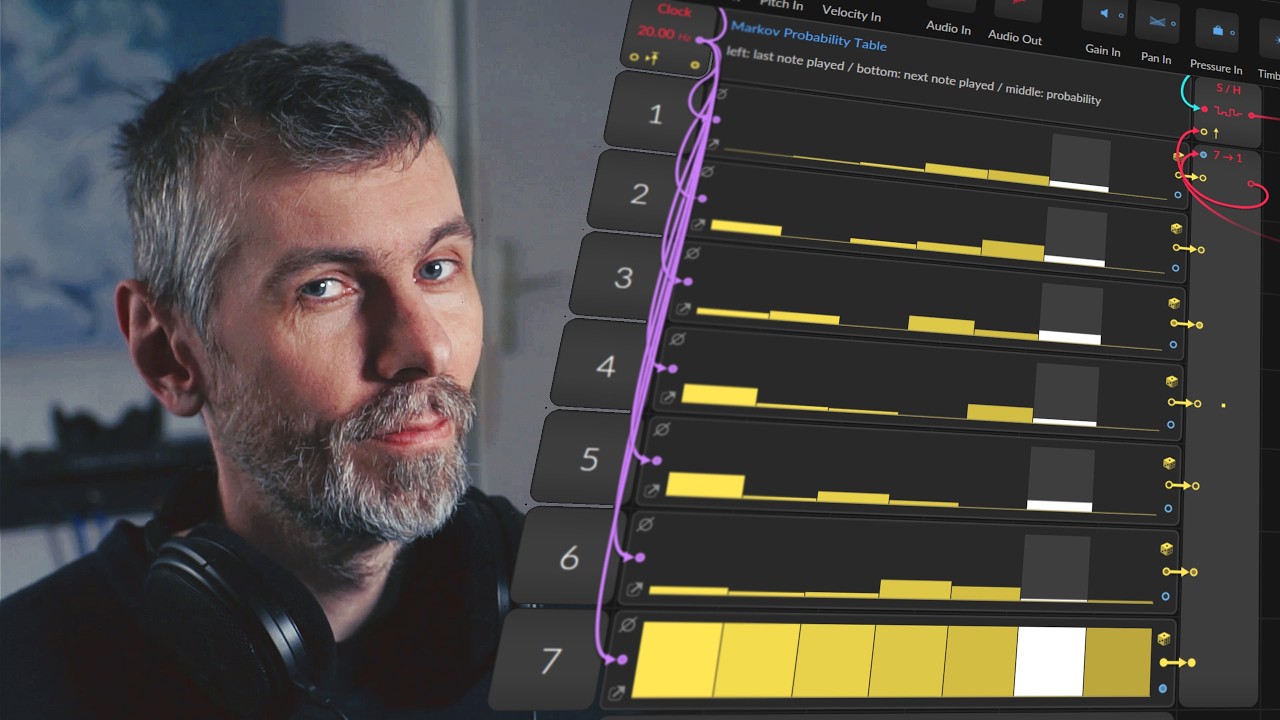
I recently shared how to use my updated Markov Chains preset. This preset is a melody generator based on probabilities, starting with a root note (e.g., D#3 in D# minor scale) and moving through notes using probability sliders. The concept is inspired by Hook Theory’s chord progression graphs.

Key Points:

Melody Generation: Uses probabilities to move from one note to the next, starting from a root note.

Scale Flexibility: Can be set to any scale, not just D# minor.

Probability Sliders: Control the likelihood of transitioning to specific notes.

Trigger Modifications: Adjusts trigger length for sustained notes.

Note Transformation: Transforms notes to different octaves and intervals (e.g., fourths, fifths).

Voice Stacking: Creates multiple versions of the patch with different pitches and volumes.

Modulation: Uses LFOs to add pitch wobble and volume variation.

Reverb and Effects: Adds reverb, chorus, and delay for a fuller sound.

Harmonic Adjustments: Can remove pitch quantizer for eerie, dissonant sounds.

VST Integration: Compatible with various VSTs for different sounds.

Availability: Preset available for download and detailed in the video description.

This setup is useful for generating melodies and creating rich, ambient soundscapes.

Download the Project in the Video: https://bit.ly/4cnY8cW

Download the Markov Preset: https://bit.ly/4cto86U

old Video: https://youtu.be/-17ZBvwGoGI
Files

where to go next?

I'm revisiting my older Markov Chain preset for @bitwig where notes are selected based on probablities. This can lead to nice sounding sequences. But here im creating some chords for nice backdrop atmospherics. Watch my older Video: https://youtu.be/-17ZBvwGoGI Download the patch: https://bit.ly/4cto86U Video transcribed, summarized and Q&A on my Blog (no ads): https://polarity.me/posts/polarity-music/2024-06-19-melodies-based-on-markov-chains/ -- 💕 Support me on Patreon: https://bit.ly/3PgbxZz 💰 or donate via Paypal: https://bit.ly/3cae9t8 🎧 Buy my Music: https://polarity.bandcamp.com/ 💾 Download my Tools / Github / Resources: https://polarity-dnb.de/blog/polarity-music-tools-samples-and-bitwig-presets-update-2019.html 💻 Check out my gear on Kit: https://kit.co/polarity/polarity-music-kit -- DEALZ: 🛒 Buy Bitwig Studio & Support me https://bit.ly/3yQEyDU 🛒 Upgrade Bitwig Studio & Support me https://bit.ly/3OimEjc 🛒 VST/AU Plugin Deals https://bit.ly/3zcvo66 -- SOCIAL MEDIA Discord: https://discord.gg/eWwFBww Blog: https://polarity-dnb.de/blog/ Twitter: https://twitter.com/polarity Reddit: https://www.reddit.com/user/polarity-berlin/ Business Inquiries: robert@polarity-dnb.de Paypal Donations: donate@polarity-dnb.de

Comments

JosephEarly

I really love this. It sounds so much better than most VST options I've tried for auto generating this kind of material. If I understand how to change the scale correctly, I would just modify the notes in the Markov Sequencer at the start of the chain?

sprklnwtr

This is great! Is there a way to reset the Markov chain sequencer to the first state (first row) with a trigger/gate? I've been trying to get this to work, but so far have had no luck. This way, you could reset the sequencer every bar or few bars to give the output a bit more structure.

Rubin

This is great, thank you !

Alex Sychov

Of course it's a bit "boring" so let's add. . . . .

Alexandre Enkerli

The Hooktheory page you’ve used: https://www.hooktheory.com/chordProgressionNode Applied to scale degrees, it reminds me of the histogram objects, that we can use in Plugdata (through Else and Cyclone). For instance: > `[rand.hist]` generates weighted random numbers based on a histogram (which specifies how many times an index is output). and: > `[histogram]`records into a table how many times it received a positive integer number (There’s also an object for pairs…) Then, “you just need to” input the note distribution. It’s something I’d like to do in some of my patches, related to a scale database: I’ve generated all possible combinations of 12TET notes as pitch class sets that I can then manipulate easily. Getting histograms for probabilities to go from one note to another would help in this kind of Markov chain which is different from the typical “drunk walk” (there’s also a `[drunk]` object, which works a little bit like a slewed random LFO).