Home

 Creators
 Search
 Recent
 Random
 Posts
 DMs
 Tags
 Random
 Importer
 Import
 FAQ
 Account
 Register
 Login
 Favorites
 Keys
 Logout
 Telegram

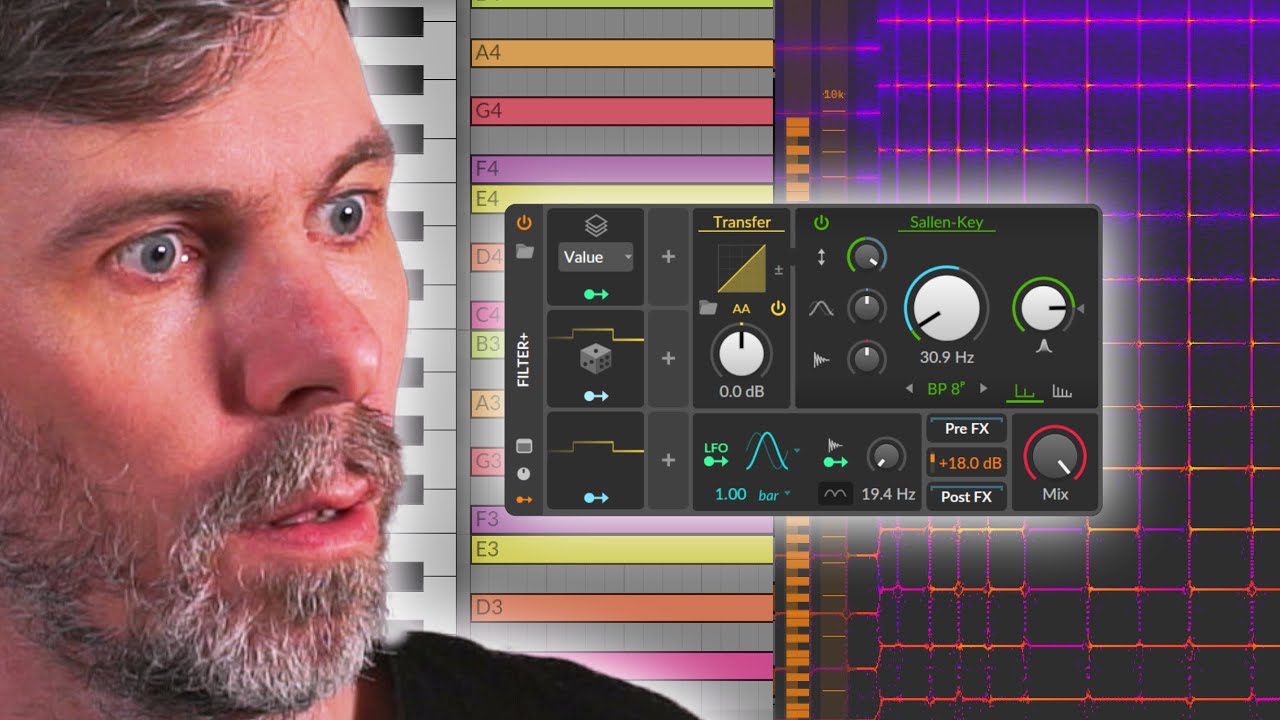
Melodic Filter Modulations in Bitwig (Patreon)
Content
Today I explored how to keep filter modulations musically in scale, blending harmony theory with sound design.
By understanding that most scales are built from stacking fifths, I showed how to use quantizers in the modulation system to ensure we only hit notes within a chosen scale. This approach allows for musical results even when using random modulation, and it's not limited to Bitwig Studio but can be applied in any DAW or modular setup.
It’s a great technique for creating harmonically aware sound design and adding a musical touch to filter movements.
Demonstrates how to modulate a filter to only allow frequencies in a chosen musical scale, using Bitwig Studio as an example.
Explains the concept is applicable to any DAW or modular system, not just Bitwig.
Shows how random modulation of filter frequency is usually out of scale, resulting in non-harmonic sounds.
Describes how musical scales can be constructed by stacking fifths (7 semitones apart), relating to the circle of fifths.
Illustrates that C major and A minor use the same notes, only differing by starting point.
Provides a method to ensure modulation stays within a scale using quantizers:
Choose the root note for the scale.
Set quantizer resolution to 6 and modulation range to 42 semitones (six 7-semitone intervals).
Adjust the center frequency to match the related note of your chosen scale.
Emphasizes you can apply this logic to easily hit in-scale notes using modulators or quantizers in synths and effects.
Suggests alternative method using Bitwig's voice stacking and modulation with value mapping, spacing voices by 7 semitones for harmonic results.
Notes this approach is useful sound design knowledge blending harmony theory and technical modulation.
Mentions presets will be available for Bitwig, making in-scale modulation easier for complex filter responses.
Highlights the broader relevance to any environment where modulation can be set in semitone steps.