Home

 Creators
 Search
 Recent
 Random
 Posts
 DMs
 Tags
 Random
 Importer
 Import
 FAQ
 Account
 Register
 Login
 Favorites
 Keys
 Logout
 Telegram

Updated: Polarity-SC - Spectral Supressor (Patreon)
Content
Updated 2026-04-27: Output gain & matching doesn't influence dry signal anymore! So the mix slider makes sense again.
Download / Landing Page: https://polarity.me/go.php?c=polarity-sc
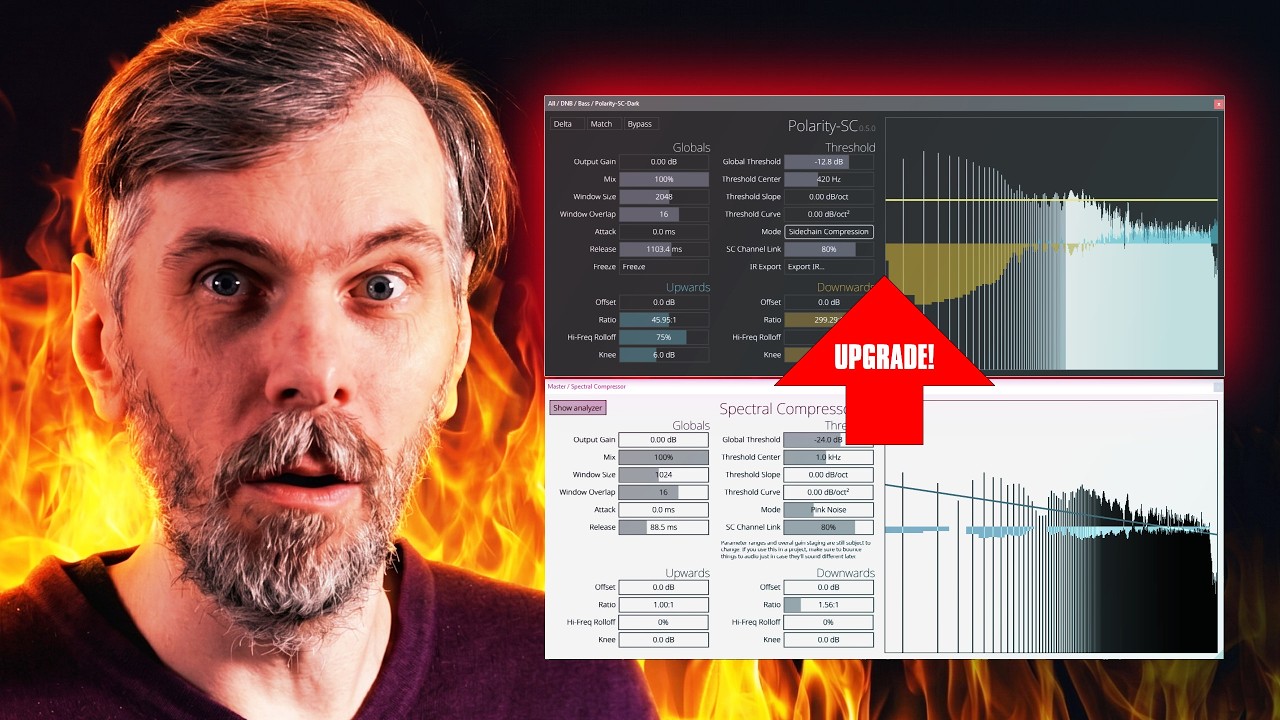
Polarity SC is a free open-source spectral compressor and suppressor derived from Robert van der Helm’s Spectral Compressor, with a darker redesigned interface and several practical workflow upgrades. It is useful for precise spectral ducking, resonance suppression, sidechain matching, and pink-noise-based shaping, making it effective on bass buses, music buses, and even the master. New features such as Delta monitoring, spectral freeze, and impulse-response export extend it beyond dynamic processing into static EQ and convolution-based workflows. Available in VST3 and CLAP for Windows, macOS, and Linux, it remains lightweight on CPU and is currently offered as a beta release.
Key Takeaways
Polarity SC is a modified open-source version of Robert van der Helm’s Spectral Compressor, rebuilt on the same Rust codebase with a darker UI, added features, and free binaries for Windows, macOS, and Linux in VST3 and CLAP formats.
A practical sidechain ducking workflow is to insert Polarity SC on a bass or music bus, feed drums into the sidechain, set attack to 0 ms, use a very short release around 5 ms, and lower the ratio to duck only the frequencies that clash with the kick, snare, and hats.
The plug-in can act as a resonance suppressor by using downward spectral compression on tonal material such as pads; lowering attack/release makes suppression faster, while very long release times (up to 10,000 ms) make it behave more gradually and can work well on the master bus.
The new Delta button outputs only the removed content, making it possible to monitor suppressed resonances directly or use the processor like a spectral gate, especially when combined with threshold and window-size adjustments.
The Freeze function converts the current dynamic spectral reduction into a static curve, effectively turning the result into a temporary static EQ instead of continuously reacting to the incoming signal.
Freeze state is not persistent across reloads: the static reduction curve is not saved in a buffer/array, so reopening the plug-in or project requires freezing the spectrum again.
The frozen spectral curve can be exported as an impulse response (IR) and loaded into a convolution processor to recreate the EQ-like shaping without needing the original plug-in, which is useful for sharing projects with people who do not own the same tools.
Additional workflow features include color-coded compression modes, level matching, and bypass: upward compression is blue, downward compression is yellow, and Match compensates for loudness loss after heavy spectral reduction so input/output