Home

 Creators
 Search
 Recent
 Random
 Posts
 DMs
 Tags
 Random
 Importer
 Import
 FAQ
 Account
 Register
 Login
 Favorites
 Keys
 Logout
 Telegram

practical advice: amp tone controls (Patreon)
Content
I wanted to get this into the episodes with Dan Boeckner, but I could go on forever about everything, and we've gotta get to pedals on the third & final installment, so here you go:
You might very reasonably assume that if you've got Treble, Middle, and Bass all set to 5 (or 6, or "noon," depending on how the controls are numbered), you've got equal amounts of high, middle, and low frequencies in your sound. That's not even remotely true, and your amp, in fact, has been designed to keep it from being true. Most humans' ears don't find a perfectly balanced or "flat" frequency profile particularly attractive, and even if they did, it would be nearly impossible to flatten out an amp's output with its tone controls.
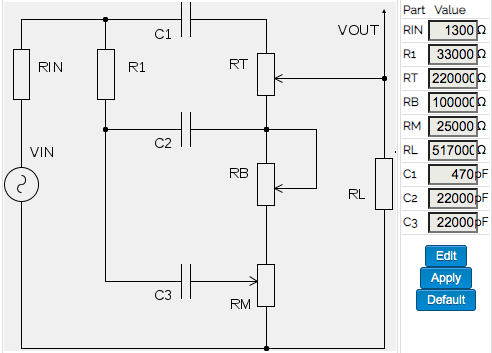
The part of the amplifier circuit that corresponds to the Treble/Mid/Bass knobs is called the tone stack, and it's made of a series of bandpass filters that feed, or "cascade into," each other. Here, for example, is the tone stack of a vintage Marshall:
RT, RB, and RM are the variable resistors (the things you change by turning the knobs) for Treble, Bass, and Midrange, respectively. You'll observe that Bass comes before Treble in this tone stack, and in most others, which becomes important. Variations on this design are known as the "TMB tone stack" for treble/mid/bass, and, more specifically, the "FMV tone stack," because it's used in Fenders, Marshalls, and Voxes. Since most amp designs can be traced back, in one way or another, to a Fender, Marshall, or Vox, it's a useful starting point for amps in general.
Oh, and as for "flat response"? Here's the frequency output of that tone stack with all the knobs set at 5:
Nowhere near equal. As with most amps,
• it's inaudible below about 30-40 Hz,
• it's got a significant "bump" or bass boost between about 50 and 200 Hz,
• it's got a major "scoop" or cut in the midrange from about 300 to 1.5k,
• and it's loud and basically even in the treble from 4k upward. (The range of human hearing is roughly 20 Hz to 20,000 Hz, or 20k, but a guitar produces very little sonic information above 10-12k.)
If you, like me, prefer a thicker, more liquid tone and have always found Marshalls a little too goddamn bright and sibilant and "fizzy," well, now you've got some idea why: they're built to be that way. The earliest Marshalls were all adaptations of the Fender Bassman circuit (specifically the 5F6-A tweed Bassman model, c. 1958), and they were designed to add extra top end to what had originally been a bass amp, and to help guitarists cut through the sound mix with a very sharp, metallic high end.
Remember, no PAs in those days, no sound reinforcement, no microphones on the amps when you played live. If you're, let's say, the Who in 1966, you're desperate to find something that'll get loud enough for big theaters and festival gigs, and you want some distortion, but you don't want the amp to cave in and turn to a complete fuzzed-out mess. Hence both the excess brightness and the higher wattage: a Bassman was around 40 watts, and by 1966, a Bassman-derived Marshall was 100 watts, and could probably hit 125-150 with the volume all the way up and a guitarist bashing away. (If you're the Who, the volume is all the way up, and there is much bashing. O, the bashing there to be found.)
So what's going on in these tone stacks, how does their design affect the sound, and how can you use them?
#1: Position of the tone stack. As a piece of engineering – basically a cascaded series of RC filters – the tone stack is very inefficient, or "lossy." It really chews through available supplies of current. Its position in the circuit, therefore, has a huge effect on your final tone.
To choose a couple extreme examples: in a black 1965 Fender Twin Reverb, one of the more punishingly clean amps ever made, the tone stack comes directly after the very first tube gain stage. You're just amplifying your guitar signal enough to be usable, and then SMACK, it gets sliced up by the tone controls. This has 2 major effects: #1, it crushes the signal down, which makes the amp very hard to push into distortion – you're always working with a small signal, right up till the output stage. But, #2, it makes the tone controls very effective, because they're getting at the signal before it's been multiplied over and over again. Turn the knobs in an old Fender, you hear major differences.
Put that up against a Marshall "Plexi," i.e. a late-’60s 100-watt Super Lead. There, the tone stack is at the end of the preamp, right before the volume control. That means you've got plenty of signal coming in, more than enough to overdrive the phase inverter tube and power amp at lower volume than the Twin Reverb. (An overdriven Twin sounds great; it's also right around the volume threshold of permanent hearing damage.)
But there's a tradeoff: if you've played an old Marshall, or a modern version of one (Germino, Top Hat, Metropoulos, etc.), you know the Treble/Middle/Bass controls hardly do anything. They're too late in the circuit; they're getting thwacked with a signal which is already so amplified that they can hardly do anything to tame it.
(Mesa, as usual, figured out the way around this: most of their Boogie-series amps have 2 sets of tone controls, the normal T/M/B knobs early in the circuit plus a 5-band graphic EQ at the end. That way, you can sculpt the contours of your tone early on, then send that sculpted signal through a massive high-gain cascade, and then give it a final edit with the 5 sliders at the end, like so:
If you see another amp with those EQ sliders, it's probably derived from a Boogie.)
Tone stack factor #2: is it buffered? One of the key differences between, say, black 1960s Fenders and the tweed Bassman is that the tone stack in the Bassman is buffered, or punched up with a higher signal, to make up for the lossy nature of tone stacks. (Bassman > Marshall > thousands of other amps.)
The main way to buffer a tone stack in a guitar amp is to use what's called a cathode follower. A cathode follower isn't a special device; it's an alternate way to use a common preamp tube. The vast majority of those tubes are employed as common triode gain stages, which is what I explained last time, but they can also serve other purposes.
In a common gain stage, the output of the tube is taken from the plate (or anode), where the changing signal at the grid has created a new, higher-voltage version of your guitar signal. In a cathode follower, however, the output is taken from the – you guessed it – cathode, which is blasting out electrons in response to the changes of your guitar signal. When you take the output from the cathode, then, you've just changed a voltage-gain stage into a current-gain stage. There's no extra voltage, and thus no increased volume, but you've now got a lot more raw electricity to work with.
That means the tone stack's inherent lossiness won't chew through your signal as much, and you won't lose all the gain you've been building in previous stages. That also means, however, that the tone controls won't do nearly as much, because they're overwhelmed by the strength of the signal. Hence the famous "do-nothing" controls of old Marshalls, and the reason a lot of famous players just turned everything up to 10 and forgot about it.
Tone stack factor #3: what are the component values? If you look again at that first image of the tone stack –
– you'll see that all those numbers in the vertical boxes on the right are values of the various capacitors and resistors. Those values are different in every amp (though often not very different), and they determine quite a bit of what the knobs on the front of the thing actually do.
You could spend hours on a single tone-stack circuit analysis, but just for a couple examples: the resistor marked R1 is called the slope resistor, and helps determine the low-end cutoff frequency of the bandwidth that your controls will actually effect. The smaller the slope resistor, the more overall bass and treble you can dial into your amp. Here, it's 33kΩ (kilo-ohms), which is a common small value and helps produce the bass and treble boost you saw earlier.
The two-line symbols marked C1, C2, and C3 are the treble, bass, and midrange capacitors. They dictate the size of the waveband controlled by their respective knobs: the smaller the capacitor, the more it cuts out everything but high treble, and the bigger it gets, the more midrange and bass it will pass through. These are massively important: on this vintage Marshall, the treble cap is 470pF (picofarads), which is a medium value with a lot of sizzly treble in it. On most Mesa Dual Rectifiers, the treble cap is 680pF, which turns the Treble knob into almost more of a high-midrange control and makes the amp sound thicker, richer, and less scratchy. On a 1960s Fender, the treble cap is usually 250pF, which means tons of high, sparkly treble and very little midrange. You get the idea.
So, what does this mean for you as a player?
Well, among other things, it means that there's no such thing as a flat signal, and that turning one knob affects all the others: as you can see, the tone stack controls aren't separate, they cascade into each other, so every tone stack is interactive, whether it advertises itself that way or not. It is NOT like turning frequencies up and down on a graphic EQ. Some guitarists will set their tone controls roughly in the middle and then use a graphic EQ pedal, either straight into the amp or in its effects loop, to sculpt their sounds more precisely.
Things to know about using a tone stack:
Treble, because it's first in line, is something of an auxiliary gain control; it can help tame or bump up the distortion in your preamp. And likewise because it's first, it also makes the other controls more and more powerless as you turn it up. If you've got your Treble knob on 10, Mid and Bass are hardly doing anything.
Bass doesn't just add low frequencies, it also cuts or "scoops out" the midrange as you turn it up. A lot of older amps had "fixed midrange resistors," which were essentially like setting the Mid control at 3 and then breaking it off, so the more you cranked Bass, the more the mids got overpowered. If you've got one of those amps and need more midrange, try turning Bass and Treble down to zero and then slowly turning each one up to somewhere between 1 and 3.
Addendum to the prior two controls: on amps with separate Gain and master Volume controls, adding gain will also add some treble and a lot of bass. The higher the Gain, the lower you want your Bass. On all my Mesa/Boogies with lots of preamp gain, I keep Bass somewhere between 9 o'clock and 10:30 (roughly 2.5 to 4).
Middle, because it's last in the stack and receives the whole signal, acts as a secondary volume control. Your amp gets louder as you turn up the mids, and you also become more audible in a mix, because you're carving out a frequency range to which human ears are very sensitive. Turning up Mids will also raise the frequency of your Treble control, so keep an ear on that and be ready to move them in conjunction. On most FMV-style amps, the Mid control will really start to sharpen the treble around 1:30 (roughly 7 if your controls go 1-10).
The Robin Trower Midrange Trick: Everybody should do this at least once. Turn all your controls down to zero, then slowly turn up the Mid control while playing a note over and over. You'll hear how the sculpting of the midrange determines the whole character of the amp, and you'll also hear the point where your Mid control starts to add in extra treble (which can be good or bad, depending on what you want). Get your Mid control where it sounds right, and then fill in Treble and Bass around it.
I hereby name this maneuver for Robin Trower, who used to combat the fizzy, hissy treble of his Marshalls by playing them with Mid on 10 and Treble/Bass on 0.
Files