Home

 Creators
 Search
 Recent
 Random
 Posts
 DMs
 Tags
 Random
 Importer
 Import
 FAQ
 Account
 Register
 Login
 Favorites
 Keys
 Logout
 Telegram

Arc Philosophy & Knowledge: Part 28 – Verminism Core (Patreon)
Content
In the cracks and crevasse that thread the ground in the light starved world of Kingdom Death vermin thrive. Scurrying around the spaces between rocks, scavenging on remains of carcasses and whatever other detritus that may be around these creatures have not only adapted to a place lacking illumination they have excelled in darkness. Vermin in Kingdom Death are the analogue to our real world invertebrates, small creatures protected by an external exoskeleton that provides support and protection while also greatly limiting the size they can grow to.
To open this section on my favourite tier 2 philosophy I'm going to get into our real world vermin a little first of all because like many monster designs in this game they have their inspiration out here in our reality. The Invertebrate Kingdom is a harsh one filled with some of the most brutal interactions between species, I'm going to mostly stay away from pictures but be aware that some of the ways that these little monsters behave towards each other are more horrific than anything which happens in Kingdom Death's reality.
I'll be trying to use the term “invertebrate” when referring to our “real world vermin” in order to distinguish them from the vermin in the game, that's quite a wide term because it covers all animals that do not develop a vertebrate (spine). This term includes jellyfish, leeches, insects, squid, arachnids, molluscs, sponges and more; but for the most part our direct comparisons with vermin come from the insect and arachnid family, but there is one Crustacean in the crab spider, a Frog and even a Bunny/Tribble (the Tribble is a Star Trek creature) with the Easter promotional Haremite. There are also more vermin in the wider world of Kingdom Death than we see represented in the Vermin cards. Still, the named resource vermin in that aforementioned deck are:
Blind Rocker (Cockroach Queen Deathmas Beta)
Crab Spider and its Fiddler Crab Spider mutation
Cyclops Fly
Gibbering Haremite
Golden Frog (a vertebrate)
Hissing Cockroach
Lonely Ant
Nightmare Tick
Sword Beetle
So the term vermin is not a strict category of identical creatures, but more the collective name that survivors have assigned to all of these smaller critters. They can also all be compared to real world equivalents by their naming conventions so I don't need to go through each one in detail and can instead get into some of the specifics of these critters. Except maybe the Haremite, but watch The Trouble with Tribbles if you want the primer on those.
The vast majority of these vermin are supported by exoskeletons, this is one of the limiting factors that keeps invertebrates small, they are not capable of growing larger in our time because of a combination of lower oxygen levels than in the earlier eras of the Earth's history and the Square-Cube law. To pull apart the second one, the Square-Cube law refers to how as animals get larger in size their volume (mass) increases by a cube of the scale factor where as the support structure (bone, muscle, hydraulics) increase by only a square of the scale factor. So there is a point where the creatures are so large that there is too much creature for the bones and muscles to support it. One of the reasons that aquatic creatures can grow so gigantic is because they have additional support for their size in the medium of water. They don't need legs that can support their massive size because their fluid medium (water) is denser than ours (air) and provides additional support. Exoskeletons suffer from the square cube law even more because they have their support on the outside, reducing its ratio even further.
This is why I've mentioned in the past that Spidicules could only manage to grow to the size it is by having an internal skeletal structure rather than a true exoskeleton, the Opilione (Harvestman/Harvester) that Spidicules is based on would never be able to grow to the gargantuan size of Spidicules because it would collapse and break apart under its own weight without some form of internal bone structure or a kind of magic, even a higher oxygen level (which seems to be a part of Kingdom Death's world due to the amount of gigantism we see) would not be sufficient here.
Outside of nature, another key influence in Verminism is the works of Junji Ito. I've mentioned before about the various parts of Junji Ito's work that have parallels with Kingdom Death, some direct and some because both creative endeavours often wander into the cosmic horror genre. One of the most overt references in Verminism however is the artwork for rank 3, which depicts insects on the torso of a survivor positioned as if they are organs. This short story is called Dissection Girl has a similar outcome with titular dissection girl turning out to have internal organs constructed from multiple different animals including a centipede, a frog and a snail. As much as I adore Ito's artwork, I do think that the “vermin anatomy” depiction from KyuYong Eom in the Verminism philosophy book is even more fascinating and visceral.
When it comes to the thematics of the mechanical elements in this philosophy, a lot of emphasis is placed on quantity of vermin, you are rewarded for collecting and storing vermin in your settlement with six being the threshold for the best rewards, but you generally want to go beyond that in order to have a good stockpile of subjects to lord over and take advantage of. We also have mechanical themes tied to paired weapons, symmetry, attack speed and a minor sub-theme of venom; these reflect vermin with two pincers, multiple limbs and of course the various nasty forms of chemicals that these creatures inject each other with.
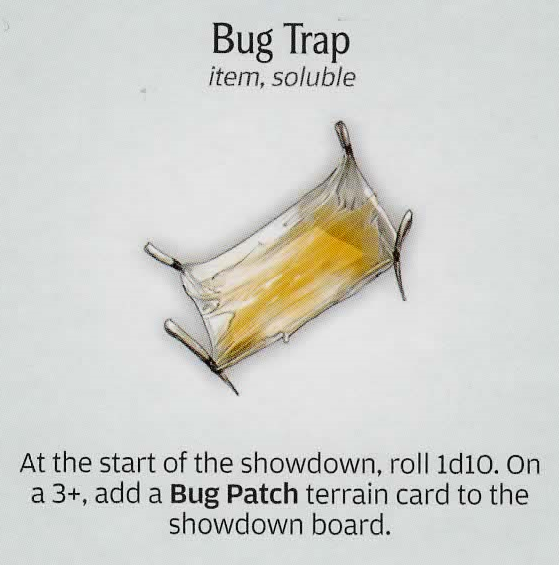
That means a settlement with Verminism will find more usage from paired weapons and bug patches than normal, while also having to be careful in how they utilise cooking. The Bug Trap in particular, despite being a gear card that will often do nothing at all, becomes worth the risk of it not paying out because of that driving need to get 6+ vermin resources into storage and have more vermin beyond that available for various Verminism Mechanics.
For myself, the most fascinating part of this philosophy outside of my general interest in insects (I interned in the National Museum of Wales and learnt Chow Gar Tong Long (Praying Mantis) Kung Fu because of this lifelong interest) is the focus on paired and symmetry. Symmetrical gear grids are a very unusual and difficult thing to put together in Kingdom Death because of its armor system and denial of any duplicate gear cards in a gear grid outside of weapons. Limitations like this are always engaging in games because if they are worth the effort then they create unique and creative solutions. Amongst the knowledges we have here are offerings that included gaining paired on any one-handed weapons we desire, the ability to gain Deflect 1, 2 or 3 for said paired weapons; automatic critical wounds and if we manage to construct an entirely mirrored set of left and right columns on a survivor's gear grid we can even trade high speed into luck via the Queen of Hands knowledge. Beyond knowledges we are also offered various abilities, such as trading in vermin resources for Sharp, Trap cancels or even full heals plus bleeding removal.
This really is an absolutely wild and engaging philosophy to play with and that's a big part of why I decided to start off this year with a deep dive into it, but before we get into the crunch of the rank ups it's worth digging into the tools that one can utilise in order to increase the vermin gain rate of the settlement.
First of these is quarry showdown selection, we have showdowns that offer terrain that has a chance of generating vermin, the Screaming Antelope and the Dung Beetle Knight both have a guaranteed Bug Patch in their set up and the Phoenix has the Nightmare Tree as a permanent part of its showdown design. While grinding the same monster over and over is not for everyone, the Nightmare Tree and Bug Patch offer semi-reliable routes to gaining the vermin you need (On the opposite side of the coin, the Frogdog is terrible due to having no random terrain at all). Other ways to help bolster this number are gear or knowledge orientated. The Tier 1 philosopy Faceism's core tenet Physiognomy provides additional terrain draws, more random terrain drawn means more chances of tasty bugs. Then there is the Bone Sickle, that offers chances of gaining bugs via Herb Gathering and of course the Bug Trap from the Barber Surgeon, a card that I normally don't rate because it has a chance to do absolutely nothing except occupy a slot in your gear grid. It doesn't even feature affinities to help it contribute to builds and that is such a large crime. Situational gear needs to have passive benefits for it to be worth the grid slot, this is something the Bone Sickle succeeds at where the Bug Trap fails.
However, Verminism does change that because the passive benefits of Vermin get scaled up from being Cooking ingredients into becoming a core part of certain survivor play patterns. So despite it being a bag piece of gear, the Bug Trap becomes more desirable, mostly because there's not many other good options once you have a sickle. One final quick note before moving on, there is only one Bug Patch terrain card in the AI deck, so while having multiple Bug Traps will increase the odds of getting that patch onto the board, one can't get additional patches unfortunately and Gatherism doesn't offer us any upgraded or additional versions either.
Hunt XP Track and Neurosis
The hunt track is set up to be one of the slower developing ones, with a steady 4 hunt XP per rank for the second to fourth ranks, resulting in just two hunt XP before retirement, something requires shenanigans to keep on sending the survivor out on hunts. This is the kind of track that demands powerful options to be unlocked along the way, and that is certainly the case, but we also get one of the tamest neurosis in the game with just +1 systemic pressure (SP).
SP is absolutely not a nothing, it represents a significantly increased risk of maiming or death on severe injuries but if you don't take severe injuries, it does nothing at all. Which at the point where Tier 2 philosophies start to turn up should be relatively straightforward to navigate via a combination of survivor role specialisation and the deflection protection offered by Verminism's core tenet. It's a very thematic neurosis, but it's also smidgen soft compared to some of the others, not that I'm complaining because I certainly wouldn't want it to be changed.
Rank 1- Shattered Shell
The resident bug lady known as the Cockroach Queen makes her appearance here in the art, one of the interesting elements of Verminism's aesthetic is how it either leans into symmetry or dissymmetry heavily. The Cockroach Queen herself is a prime example of the latter as she favours an asymmetrical haircut that covers the right side of her face. This is a consistent design choice across all depictions of her and it's interesting, especially given that in Verminism the odd numbered ranks have asymmetrical beings and the even numbered have symmetrical ones.
We gain +1 Lumi and roll on the rank table.
1 and a 2 results in a permanent -1 speed, while speed loss isn't something that causes massive issues most of the time in this game because you can switch to using slow weapons or weapons that have 3+ speed in order to even this out; it does matter when we're considering Verminism survivors because part of the mechanical design leverages high speed.
On a 3 to 7 we gain an immediate vermin resource and our next departure from the settlement with this survivor inflicts 1 bleeding token on them. That bleeding token is not a major issue, and in fact can be leveraged with Crimson Crocodile armor, so on the whole we're fine with this because it progresses the settlement towards the desirable 6+ vermin in the settlement storage.
If we have CC 18+ then we also gain an observation in Hissing Arms, Tier 2 Philosophies are handed out at CC 13, which means we'll be getting this bonus fairly early on. It's not nothing, but Hissing Arms is also a fairly rapid knowledge to progress through to completion.
Finally the 8 to 10 result gives +2 lumi and +1 understanding along with a CC24+ Bonus of +1 evasion. You can't complain about these, yes the evasion isn't optimal for the damage orientated slant of Verminism, but it's “free” and it does help leverage Hissing Arms more.
Rank 2 – Vermin Lord
Warhammer reference spotted; Skaven are in Kingdom Death confirmed.
The artwork here is a clear tribute to the Vitruvian Man drawn by da Vinci around 1490, we have some variation with bent limbs rather than them all being extended and the portrait layout also removes the golden ratio aspects of the original. It is still a fun and very weird piece, especially when considering the additional “background” limbs looking almost detached from the front body's anatomy. It's a fascinating piece with a lot of unusual elements like the lightning, writing on the pillar, and even the clashing perspective which suggests gravity pulling from both the bottom of the piece and behind it. It features a lot of symmetry, but also isn't completely symmetrical.
We gain +1 lumi and roll 1d10 to randomly decide what kind of ruler of bugs this survivor will be.
On a 1 to 3 a random vermin resource is drawn and then immediately consumed, this is a pretty terrifying prospect. When you look through the vermin options the Cyclops Fly, Nightmare Tick and Sword Beetle all have a 30% chance of causing instant death, which is high enough that I rarely risk consuming the vermin outside of cooking. No choice here though, so good luck, maybe you'll draw and consume a Crab Spider instead.
4 to 8 gives us our second Verminism knowledge in Mirror Eyes and a free Bug Trap at CC 27; which isn't that useful because if you were going to use Bug Traps it should have been crafted ages ago,
The 9 and 10 results in +3 lumi, +3 Understanding and a random vermin resource. For me this is the most desirable result once you've already unlocked Mirror Eyes. That understanding boost is pretty large and one would never say no to more vermin or lumi.
Overall there's not that much to comment on in this rank beyond the artwork, it's got a lot of flavour test mixed in here, the 4 to 8 result in particular is delightfully weird, but overall the mechanics here are plain.
Rank 3 – Dominion
The third rank is where all that saving of vermin will pay off, as we gain +2 lumi and a fixed reward based on the number of Vermin hanging out around the settlement storage. We probably want to be at 5 vermin one time we reach this number because that gives us the Envenom Edge knowledge and that offers bonus auto-wounds to the monster, but most of the time I'm looking to unlock Queen of Hands here. Because this isn't a randomly rolled table section, you should have a lot of control over what happens here, if you're not at the right number of vermin you can stall the survivor's advancement by not taking them out until you are at the correct number. So the 2 or fewer vermin result shouldn't happen to you at all (unless you were playing blind). We'll get into Queen of Hands next article, it's a super unique and powerful offensively orientated single rank knowledge that costs 8 lumi, so getting it guaranteed here at this rank is a boon.
With all of that written there's not much else to cover except the superb artwork which has a horde of insects gathered on our one eyed survivor's torso, positioned so they duplicate the form of an open body. This is the one which I referenced back when mentioning Ito's Dissection Girl story, and again without any disrespect to Ito, this piece here is elevated over his drawing. The use of the spiny fins to create the illusion of an opened ribcage, the mass of centipede/millipede like creatures that create the intestines, that grub sat where the liver would be and the tick-like eye creature forming the heart. It's an insanely grotesque and macabre piece of elevated art that I think is one of the best pieces in the Gambler's Chest. A superb piece of art direction and artist skill coming together in a phenomenal way.
Rank 4 – Transfiguration
"Look, I'm a beautiful butterfly!"
Transfiguration is the conversion of a something into a more beautiful form, in particular this form will be more spiritual or exalted than the original. From the warped perspective of the Verminism survivors the image here on this rank would be an example of that. I've mentioned Junji Ito multiple times in this article already, but I think that this piece more than any of the others captures the disturbing mood, feel and texture of Ito's art. This creature is reminiscent of the Oblivion Mosquito, but distinctly its own thing, it's almost Gyo like in how lifeless the human part of the creature is, while we see a recognisable woman's upper portion, the true face of this creature seems to be the one that is staring at us from the top portion of the torso.
We also have all of these additional women being birthed from the abdomen of this horror, I'm not sure if there is any further meaning to them all being women, KyuYong Eom does draw men as a part of his comic art but he certainly seems to prefer to draw women when it comes to Kingdom Death pieces. It could be artistic choice, it could also be art direction to reference insect hives and how they tend to be dominated by female insects. Regardless of how you read it, this entire illustration is a macabre punctuation point to complete the Verminsm Survivor's journey.
+1 lumi, roll a dice, gain the ability to depart with vermin resources and become bug:
The 1 to 3 result gives our Verminisurvivor +2 strength and the ability to archive a sword beetle to gain sharp on all attacks for the rest of the showdown. This can allow you to bring weapons that have strong abilities but are lacking in strength in order to take advantage of them, and it can also be combined with monster movement attack armor sets for even more strength leverage. This is an expensive rate to be using Sword Beetles though, it's unlikely you'll get +1 sword beetle every lantern year in order to maintain this rate.
4-8 is +2 accuracy and the ability to archive a cyclops fly in order to discard the trap and reshuffle the hit location deck. You don't even redraw here, so you're scot-free for this particular attack. It's a great tool to have in your back pocket because some showdowns you won't even need to use it because you can face tank the trap or someone else has hit it. This is my favourite of the three results even though I think that the 9-10 is the strongest.
The 9 and 10 gives +2 evasion and the ability to archive a Nightmare Tick for a full heal + all Bleeding Tokens discarded. Like the Cyclops Fly above, this is something you won't need to do every single showdown, so it's more sustainable than the Sword Beetle situation.
It is worth noting that in most cases, a Verminsm survivor who reaches this rank will likely have just one or two hunts left in them before retirement hits. We do have tools to keep sending out retired survivors, which is why I've considered the strain on vermin resources when assessing which of the abilities I think are best.
I'm also very pleased to see that my ranking of Nightmare Tick > Cyclops Fly > Sword Beetle aligns with the design team's internal assessment. It is great to see that we're in harmony for something like this as it demonstrates how Team Death have seen what players do with their mechanics and adjust as appropriate.
Thoughts So Far
We still have the knowledges to go through, but I think it is clear that like Regalism I really love what Verminism brings to the game. Across its theme, artwork and rank mechanics there is so much that is to be adored. The art in particular is so distinct from my other favourites which are Regalism's linework and Faceism's vivid vibes but despite that difference, Verminism's illustrations are something that I find to be incredibly engaging. This is thread that continues through the knowledges and we'll be getting into them next time.
Files