Home

 Creators
 Search
 Recent
 Random
 Posts
 DMs
 Tags
 Random
 Importer
 Import
 FAQ
 Account
 Register
 Login
 Favorites
 Keys
 Logout
 Telegram

Two tips you may have missed (Patreon)
Content
Hello everyone,
In a recent QOTD (question of the day, more on that below) over on Discord I asked who was or wasn't using quantisers. It was an interesting discussion as the QOTD always is but I also posed two lesser known uses for quantisers which was bit crushing (audio or CV) and generating rhythms with quantisers.
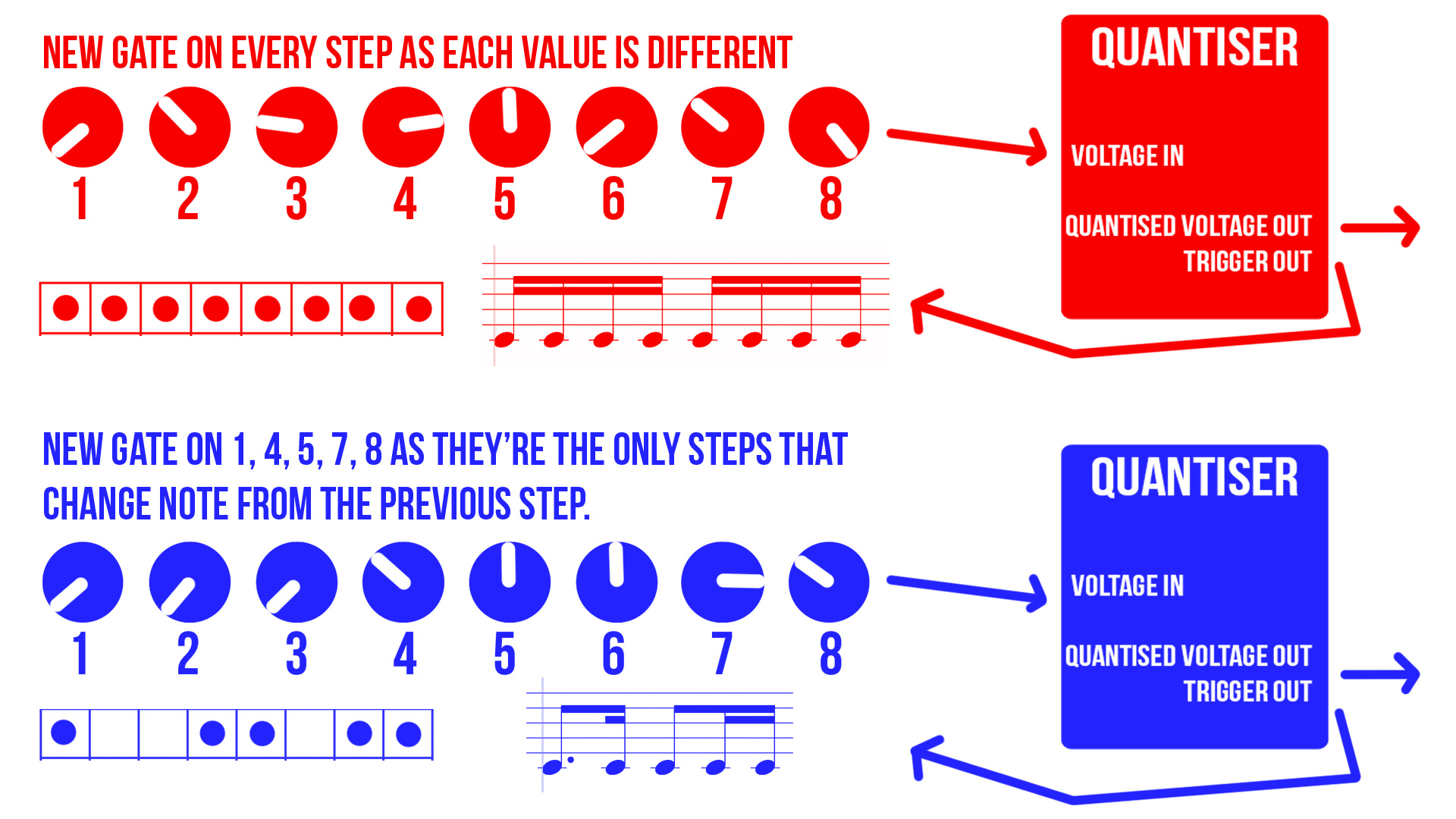
I'll copy and paste my responses below, please note they're just quick responses to the Discord discussion these will be refined (as will the graphic above) as they're things I'd like to make videos on for my currently under-loved (not done one in ages) Better Bleeps series of videos. But as I know not everyone is on Discord I wanted to share that here so I hope you find these useful and interesting things to explore with your own quantisers and systems. QOTD / QUESTION OF THE DAY - this is something I do on the Discord server (exclusive DivKid Patreon Discord server that is) where as a community (you can make suggestions too for topics/quetsions) we talk around a specific question or talking point each day. I post a QOTD and that leads to lots of great responses. Often very educational for all of us. Be sure to link your Patreon and Discord accounts (make a Discord account if not, well worth it and free!) to join us other there. This link will guide you through getting set up with Discord linked to Patreon - https://support.patreon.com/hc/en-us/articles/212052266-Get-my-Discord-role . We're also discussing ways to better document the great ideas and discussion and I'll be launching into that soon to create a growing point of references that's hopefully easy to dip into as a resource for you all.
Chat soon!
BIT CRUSHING WITH QUANTISERS
a quantiser is working in the equivalent level domain as bit depth would be for digital audio. It's take a voltage level and forcing it to fit into a set of defined values (the notes available). If all semi tones were on for chromatic quantising (all available keyboard notes) that would be splitting an octave of pitch information into 12 steps. So 0-1V would have a 12 steps of 0.833333333 (recurring) to make up those notes. Of course if you go across say 5 octaves that's 5 sets of 12 steps up the range, which would be 60 potential values (5x12). So if we think of audio now that travels from -5 to +5V (quantisers may or may not respond to negative voltages, they may rectify the inputs or ignore the negative, either could be interesting) that's a going to work in a similar way to turning the audio into a digital stream of 120 values or 60 values (if it ignores the negative). So in a digital audio sense that's bit reduced the audio. Start turning notes on and off and you're further bit reducing. Let's pretend our audio is 0-5V for simplicity ... with all notes on that's 60 steps into the audio. With just octaves that's 6 steps (as you'd have 0, 1, 2, 3, 4, 5) as the only values that could pass through. Adding and removing notes would give varying sounds.Well worth exploring. GENERATING RHYTHMS WITH QUANTISERSThis needs a quantiser that gives a trigger output when a new note is quantised. If you take a basic analogue sequencer with no gate outputs and say it's 8 steps and all 8 steps are different values. Put that into a quantiser it will quantise that to a scale but also give you 8 trigger outputs, as the quantiser gives a trigger out for each note quantised pitch. Now at that point all it's doing is giving you the same clock signal that you drive the sequencer from. BUT the cool bit is if you have a sequence where notes are on the same value and therefore the quantiser doesn't change. You'll get something rhythmic. Screw it ... I'll make up a graphic for this hang on (please don't share this anywhere I'll refine it for later content).
Files