Home

 Creators
 Search
 Recent
 Random
 Posts
 DMs
 Tags
 Random
 Importer
 Import
 FAQ
 Account
 Register
 Login
 Favorites
 Keys
 Logout
 Telegram

[WIP 1] Emperor John VIII Palaiologos Clothing Study (Patreon)
Content
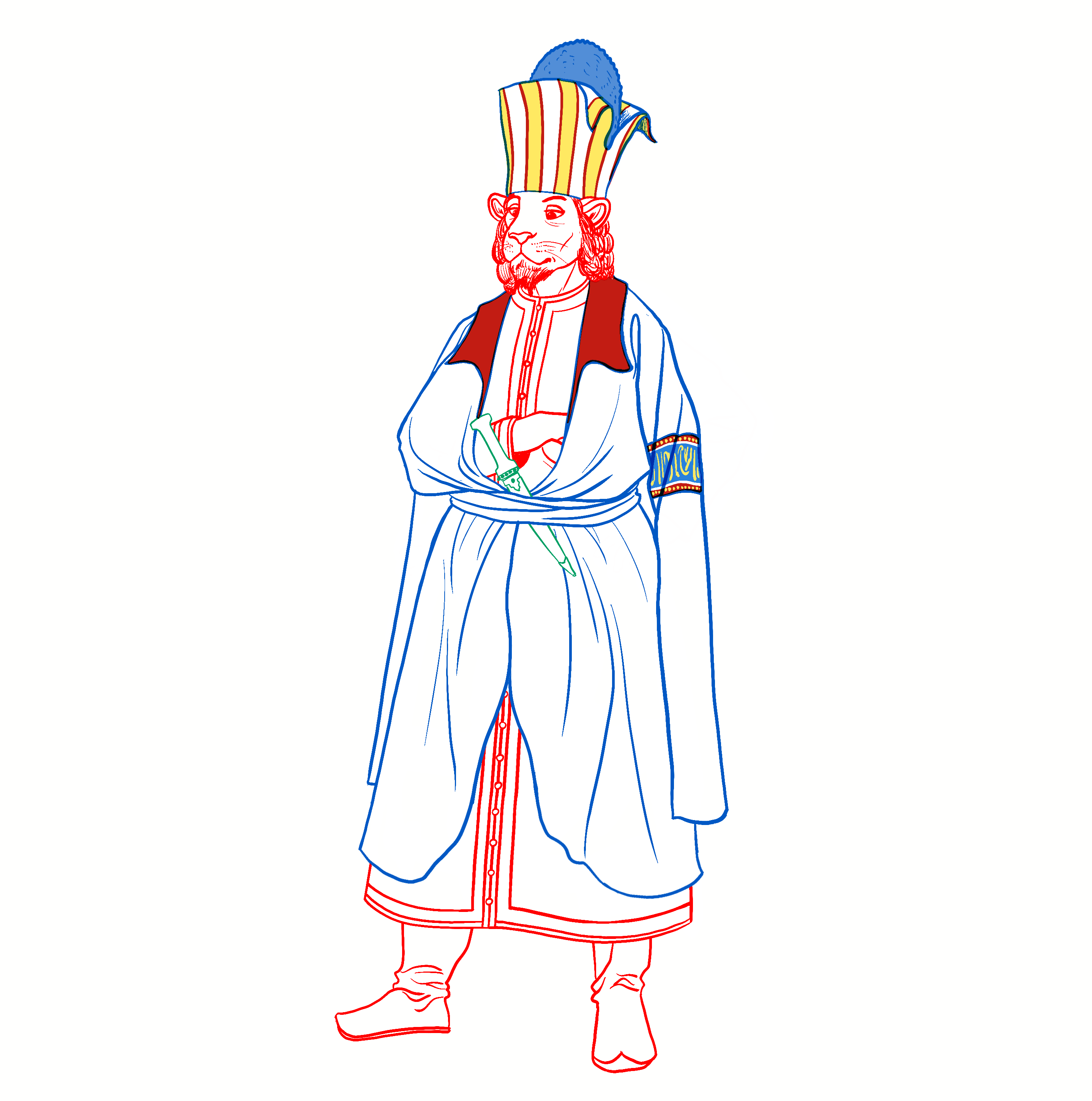
Hello, my Patreon supporters! I’m very sorry for the long absent. This drawing was supposed to be a simple one-character portrait, but it took me down a rabbit hole of never-ending research. I will try my best to at least finish the flat colors before this month ends. I might use this clothing study for a more proper illustration.
========
8th of February, 1438. John VIII Palaiologos (Ioannes VIII. re. 1425-1448), the Emperor of the Romans, arrived in Venice along with a massive delegation consisting of some 700 people. They were visiting Italy to join the ecumenical council in Ferrara (moved to Florence in 1439 due to a plague outbreak). This council, attempting to unify the Western Catholic and Eastern Orthodox Churches, was called by Pope Eugenius IV (re. 1431-1447). John VIII, facing the threat of the rapidly expanding Ottoman Turks, took this offer as an opportunity to ally with the Catholic Church and get military aid from Western Europe.
The arrival of the Imperial delegation coincided with the early Renaissance movement of Italy. It was a much-needed cultural exchange for both sides. Humanists in Florence were eager to absorb the Byzantines’ extensive knowledge of Greek and ancient literature. Even John VIII himself quoted poetry from memory, explaining first to his hosts that “there is a poet among the Greeks called Homer.” The Byzantines were similaraly thrilled to find themselves in an environment that encouraged new ideas while also revering the ancient past. Even back home, some of them lamented that “wisdom has long since left Attica and is now living in Italy and its cities.” Thus, John VIII’s voyage to Italy was one of the historical events that accelerated the revival of Greek studies in Renaissance Europe.
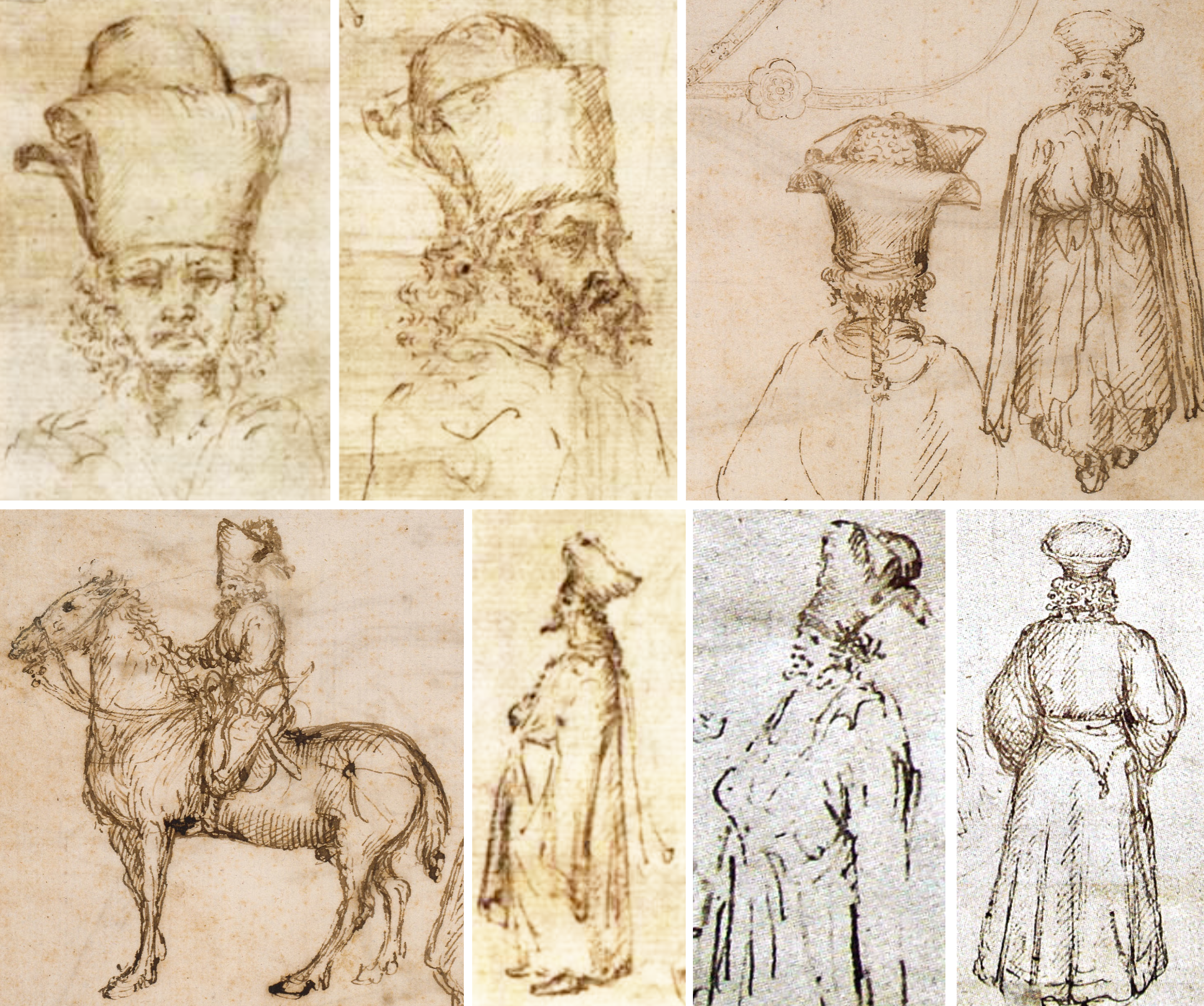
Among those present in Ferrara to witness the council was the highly renowned painter Pisanello. Antonio Pisano (1396-1455?), or ‘Pisanello’ is regarded as one of Italy’s greatest early Renaissance artists. He was fascinated by the exotic appearance of the Byzantine visitors, and sketched the appearance of the Emperor and his retinue on site. These sketchbook drawings, dismembered by an early collector, are now housed in two different museums—the Musée du Louvre and the Art Institute of Chicago. It is a vivid eye-witness depiction of a Byzantine Emperor, which differs significantly from the heavily stylised and dignified Byzantine portraits of the time.
However, Pisanello wasn’t doing this just for his leisure. He would work on the commemorative bronze medal portrait of John VIII next year, which was likely commissioned by the pope himself. So, these sketches were the preparatory drawings for the final project.
Because of this, we can see the creative process of Pisanello in these sketches. The Emperor is sketched in a number of different views, poses, and attires. It appears that the artist was trying out different views before constructing the final composition. Pisanello also wrote the notes on the side to record the colors that couldn’t be drawn with black ink. This suggests that Pisanello was initially commissioned to work on a full-color portrait of John VIII, but unfortunately it never came into fruition. I will discuss these notes in the second WIP post, along with the flat color of my drawing.
The sketches can be divided into two different attires. One is the hunting outfit, and the other is the ceremonial robe. I’ll break down these garments into each element.
========
1. Hunting Outfit
The most iconic outfit of John VIII is his hunting attire, which ended up being chosen as a model for the finished medal. We can resonably assume that this dress was for hunting because, 1. The Emperor is mounted and armed with bow and arrow. 2. Brimmed hat was commonly used for hunting because it can offer a shade against sunlight. 3. John VIII was famously known as a keen hunter, to the point of causing complaints from the local Italians due to excessive hunting and property damages.
Pisanello also wrote the accompanying notes on the side to record the colors that couldn’t be drawn with a black ink. I will discuss these notes in the second WIP post, along with flat color of my drawing.
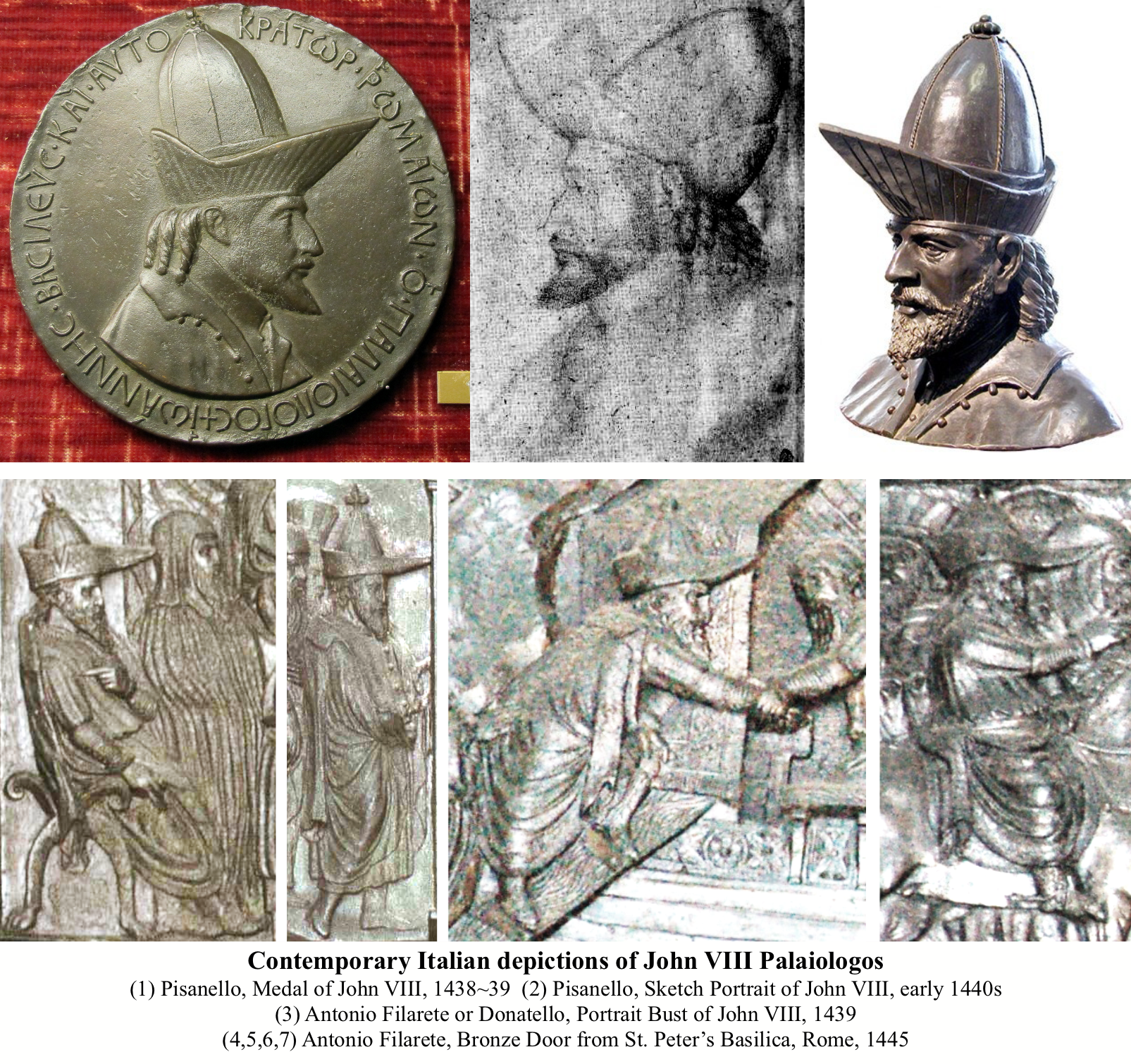
The details of the hat and clothing can be seen in the finished medal, along with other contemporary depictions of the Emperor.
Pisanello wasn’t the only Italian artist who was dazzled by the Emperor’s appearance. Along with Pisanello’s medal, a portrait bust of John VIII was made by Antonio Filarete or Donatello. A few years later, in 1445, Filarete worked on a new bronze door for St. Peter’s Basilica in Rome and added the panels depicting the Ferrara-Florence council to commemorate Pope Eugenius’ achievements. Here we can see the Emperor in a full-body portrait, embarking on a galley and conversing with the papal council.
Without a doubt, the most eye-catching aspect of this outfit is the hat. Accounts from the Florentine onlookers never fails to mention it. Bartolomeo del Corazza wrote in his diary that the Emperor wore a “white hat coming to a point in front”, and it was topped by a “ruby bigger than a pigeon’s egg”. Vespasiano da Bisticci, compiling the account some decades later, mentions “a cap in the Greek fashion, on the top of which was a magnificent jewel.”
This high, conical, brimmed hat has been the topic of intense scholarly debate for decades. Although it has become synonymous with the Byzantines in Western Europe, the appearance of this hat in Byzantine sources is spotty. It shows up in a couple of illuminated manuscripts, worn by all social classes from peasants to nobles. One provincial official, Manuel Laskaris Chatzikes, wears it in his funerary portrait.
However, this hat is never explicitly described in extant Byzantine literature. Which makes it almost impossible to identify its proper Greek name. Various suggestions have been made by different scholars, from skiadion (σκιάδιον), kamêlavkion (καμηλαύκιον), and kapasion (καπάσιον). I follow 'kapasion,' suggested by Timothy Dawson (2015), because it is from the most up-to-date analysis of this hat.
Given how this hat is strikingly different from the ‘Byzantine’ or ‘Roman’ fashion that most people think of, it naturally begs the question of its origin.
Although aforementioned Dawson suggests that it is a natural development of a pre-existing Byzantine court hat, I don’t think that’s the case because the evident parallel was widely being used in the neighboring Islamic world. Islamic illuminated manuscripts from the 14~15th centuries are abundant with conical, brimmed hats. From the Mamluks of Egypt to the Timurids of Central Asia, this hat was very popular in the courts of the Sultans, Amirs, Khalifas, and Padishahs. They distinguished the wearer’s rank according to the type of the hat, which differed in shape and color.
The Byzantines were very open in adopting Eastern influences on their fashion. Persian influence was already becoming evident in the late Antiquity. By the time of the Komnenos dynasty (1081–1185), remnants of ancient Roman clothing were being relegated to vestigial elements in ceremonial regalias. After the Palaiologos dynasty (1261-1453) restored the Empire, the Eastern influence has become even more dominant.
Therefore, it is natural that John VIII is wearing extravagant Eastern-influenced clothing.
So, if the Byzantines adopted this hat from the Muslim neighbors, where did the Islamic states get this hat from? The answer is even further east. The Mongols, the East Asian nomads who ruled the largest contiguous empire in history, are the true origin of this hat.
A round, brimmed hat was the traditional headgear of the Mongols at least from the 13th century. The earliest evidence is the royal portrait of Khubilai Khan (re. 1260-1294), depicting him on a hunt with his entourage. The Khaan is wearing a white hat with a red brim, which matches the colors of John VIII’s hat.
This Mongolian hat spread all over their dominion, and it persisted even centuries after their empire's division and slow demise. To the east (Koreans of Goryeo and early Joseon), south (Indians of the Mughal Empire), and west (Persians, Turks, and Mamluks), this hat was worn everywhere. And this Mongolian influence had finally reached the court of Constantinopolis, the Empire of the Romans.
Doubling down on the eastern influence, John VIII’s weapons (leather-sheathed saber, bow, darts, bowcase, belt, and quiver) are all in typical Mamluk and Ottoman styles. Specifically, the bow is most likely Syrian fahlah bow, which was prized and highly sought after in Europe. Even his pale yellow boots resembles the Mamluk winter boots (khuff) made of yellow leather (adim) imported from Ta’if.
It is likely that the Mamluk Sultan of Egypt sent these accoutrements as a royal gift along with the ceremonial robe that I’ll describe below.
========
2. Ceremonial Outfit
For a long time, these sketches of a man with a tall hat and long robe were presumed to be one of John VIII’s retinue. Some have even speculated that these figures portray the patriarch of Constantinopolis Ioseph II, who was part of the delegation. However, Michael Vickers (1978) convincingly rebutted this identification. Instead, they all represent the Emperor in a different outfit.
The most convincing evidence is found in the upper margin of the Paris recto, above the mounted Emperor. Pisanello painstakingly outlined an Arabic inscription in thuluth calligraphy, along with decorative arabesque bands. It is perfectly legible, which is impressive given that Pisanello did not know Arabic at all. Medieval and Renaissance artists at the time usually resorted to fake Arabic calligraphy whenever they needed an oriental flair. Pisanello, on the other hand, went so far as indenting the paper with a stylus before inking. The Arabic inscription reads as follows: “Glory to our lord the sultan, the ruler, al-Mu’ayyad Abu al-Nasr Shaykh, may his victory [be glorious].”
This clearly shows that the Arabic inscription is part of a tiraz, made in the court of Mamluk Sultan al-Mu’ayyad Shaykh (re. 1412–1421). Tiraz is a fabric woven in a state-run factory that was sewn onto robes as armbands. The tiraz indicated that the robe was bestowed by the ruler as a reward for loyalty. That is why the tiraz was typically inscribed with the ruler’s name.
Therefore, it can be deduced that al-Mu’ayyad Shaykh gave this tiraz and, by extension, the robe of honor (khilat), as a diplomatic gift to the Byzantine Emperor. Based on respective chronology, this robe was most likely received by John VIII’s father, Manuel II (re. 1391~1425).
Although Pisanello made an effort to draw the tiraz and hat, the sketches for the robe itself are small and undetailed. The only undisputable elements are the extremely long sleeves that reach the ankle and the rectangular lapels. Both features strongly resemble the appearance of John VIII from Filarete’s bronze door. The remaining details that will be explained below are largely based on my interpretations.
First, the back view of the Emperor (Louvre recto) shows the Emperor wrapping a wide cloth on the waist level. This is comparable to the image of Manuel II in Très Riches Heures de Duc de Berry (15th-century French manuscript). However, in the frontal view (particularly the Chicago recto), this waist cloth is obstructed by the bulbous robe over it. This is most likely because the front panel of the robe is tucked up higher to make room for the Emperor’s arms. Following this hypothesis, the long, curvy line under the waist is likely the remaining part of the front panel falling down.
In his complementary notes, Pisanello makes no mention of the undergarment. However, the front and back views of the Emperor show that he wears a long coat underneath his outer robe. This undercoat extends past the tucked-up robe and reaches the ankle. The hunting outfit is not this long, implying that he is dressed in another type of clothing.
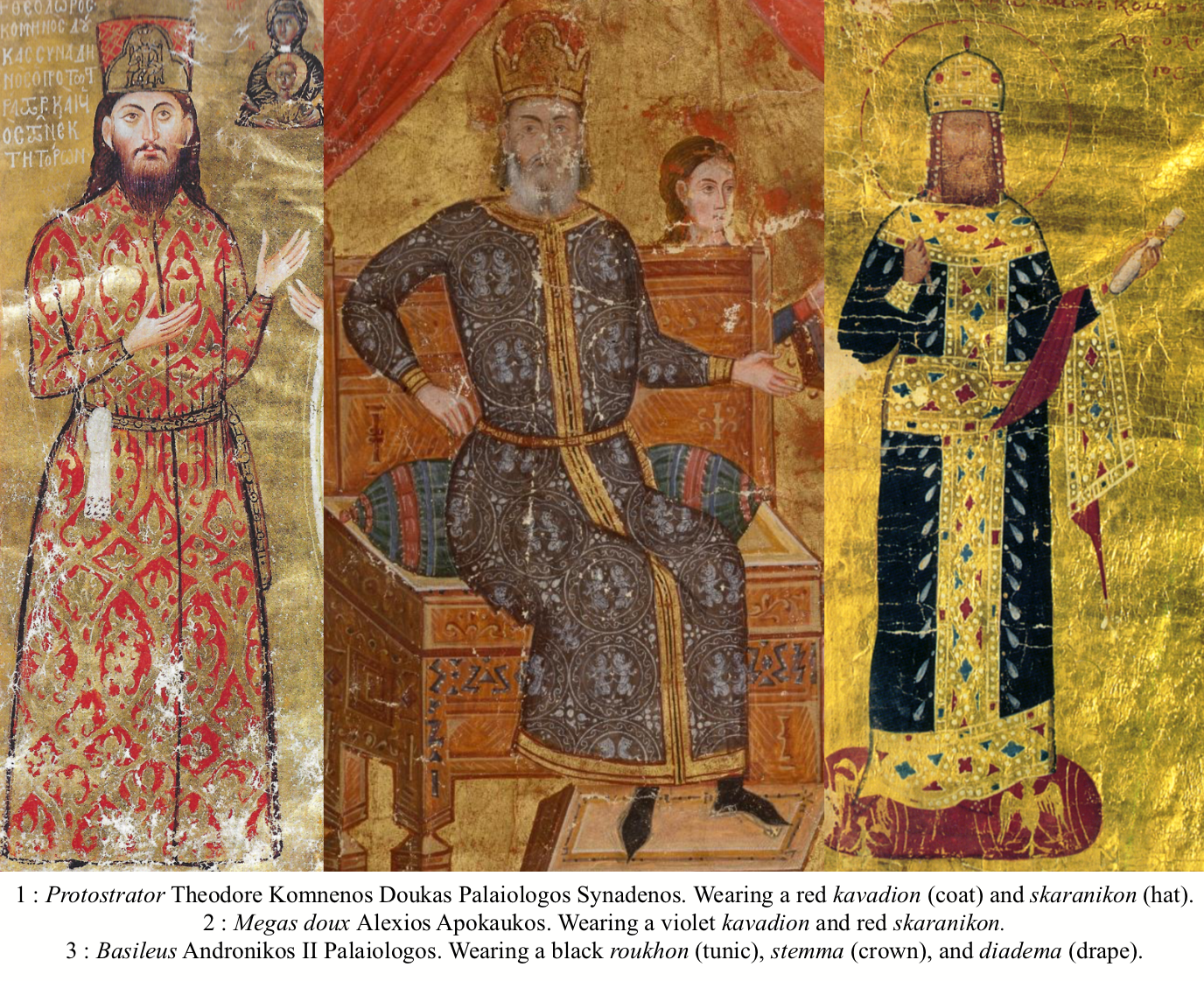
The likely answer can be seen from Filarete’s door. In one of the panels, John VIII is wearing a buttoned coat under the long-sleeved robe. This closely matches the kavadion (καβάδιον) coat that was ubiquitous in the Palaiologi court. According to the Treaties on the Offices, virtually every listed rank wore a kavadion in official ceremonies. Various donor portraits and illuminated manuscripts also show high officials wearing a kavadion. Although most imperial portraits of the time show the emperor wearing the black roukhon (ῥούχον, tunic), this was only worn with the crown (stemma) and the ornamental drape (diadêma).
Therefore, the most reasonable assumption is that John VIII wore a kavadion with an Egyptian robe. The kavadion was formal enough to wear in the council, but much less cumbersome than the other ceremonial garments like the roukhon.
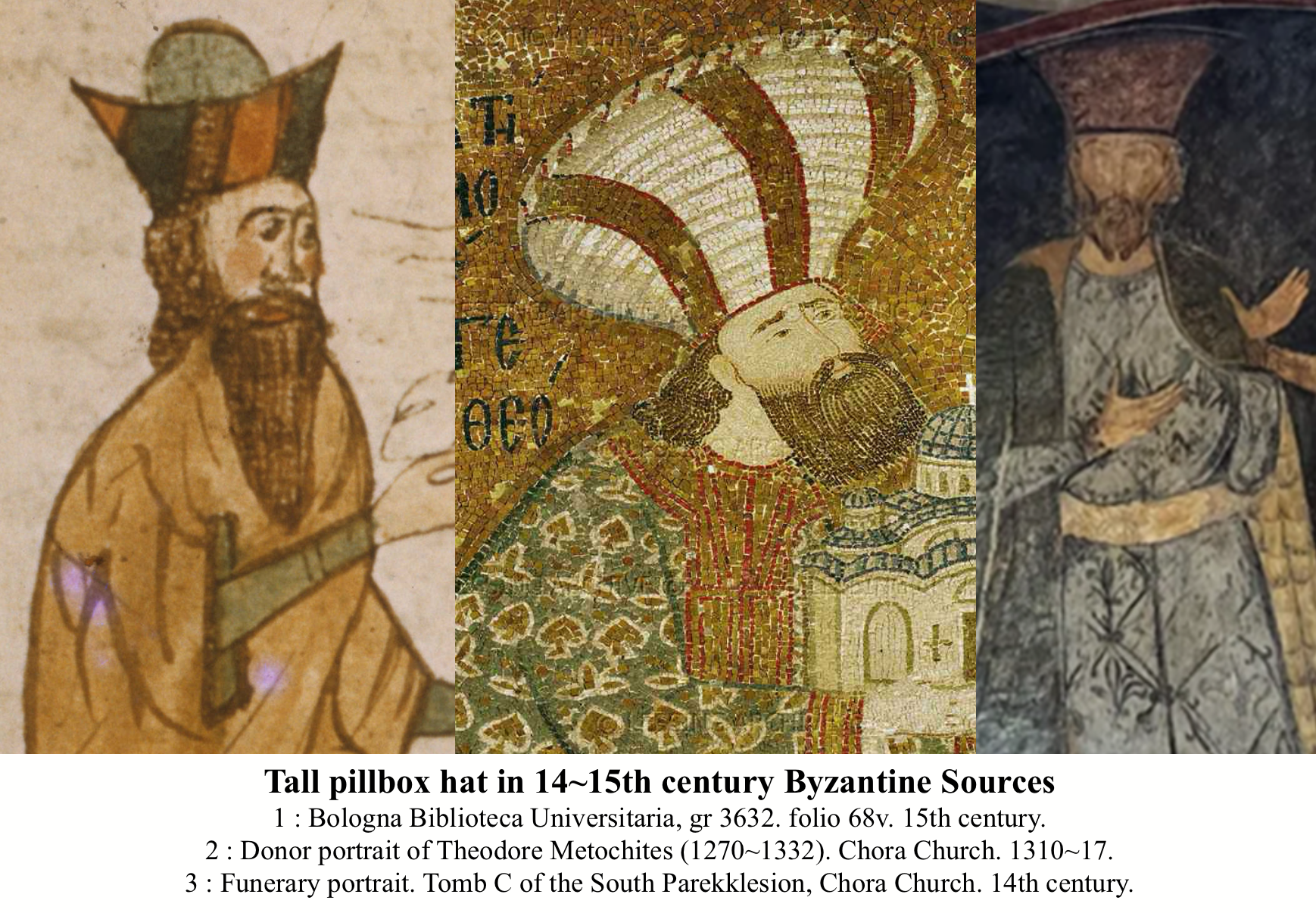
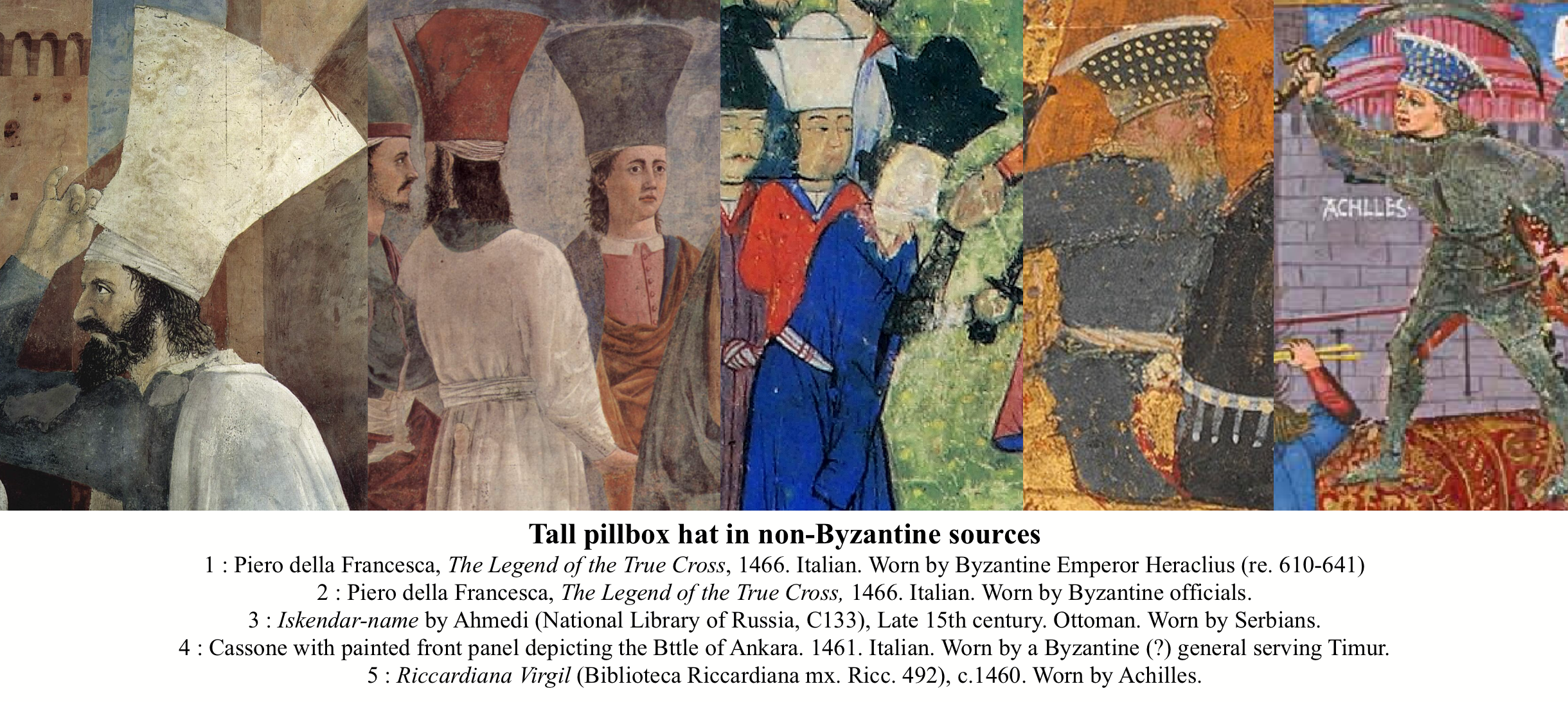
Another important element of this ensemble is his peculiar hat. This tall, pillbox-shaped hat with a dome in the middle is even more mysterious than the kapasion hat. It has a lot of common aspects with the kapasion. It is seldom shown in Byzantine pictorial sources; no one really knows its name, and Renaissance European artists used this hat as a stereotypical ‘Greco-Roman’ motif in their artworks.
However, unlike the kapasion, this hat seems to have slipped under the attention of major Byzantine academics. As far as I could find, this hat has never been a subject of intense debate. Dawson (2015) fails to mention this hat in his book about Byzantine court regalia, and most scholars just refer to it as a hat associated with high-ranking officials without attempting to identify its name or origin.
The first thing that came to my mind was propolôma (προπόλομα), an inverted cone-shaped hat worn by Byzantine noblewomen in the 10th to 12th centuries. While the shape looks vaguely similar, propolôma isn’t mentioned anywhere in the Palaiologos period Byzantine literature and court regalia lists. And all depictions of the propolôma lack the tall dome, which is prominent in Pisanello’s sketch.
The only revealing evidence is an Ottoman manuscript of Iskendar-name from the late 15th century. In the miniature depicting the murder of Murad I (re. 1362~1389), his Serbian assassinators wear this hat. Given that Serbia modeled their court regalia after the Byzantines, it is possible that the pillbox hat also comes from them. Furthermore, the high cap similar to this Byzantine hat, called Işlic (Ishlik), was worn by the local aristocrats of the Balkans in the Ottoman period.
Anyway, I’m very excited to draw this particular attire of John VIII, because no one ever attempted to properly reconstruct his Egyptian ceremonial dress. Even Pisanello himself just left a rough sketch and didn’t used it in the final project.
========
3. Hunting Outfit With A Coat
This is a hybrid of two outfits, primarily based on John VIII’s appearance in Filarete’s bronze door. He is wearing a long coat with hanging sleeves with a kapasion hat. This coat closely matches the Egyptian robe in Pisanello’s sketches, especially the long sleeves and lapels. Furthermore, many Islamic manuscripts depicts their rulers wearing both brimmed hat and long coat. Thus, I believe this combination is plausible.
Files