Home

 Creators
 Search
 Recent
 Random
 Posts
 DMs
 Tags
 Random
 Importer
 Import
 FAQ
 Account
 Register
 Login
 Favorites
 Keys
 Logout
 Telegram

[WIP 2] Emperor John VIII Palaiologos Clothing Study (Patreon)
Content
I don't mean to sound like a broken record, but I sincerely apologize for the slow progress on this drawing. The research was never-ending, and drawing it was time-consuming and exhausting. For the final version, I’ll probably make an infographic of each attire and add a condensed version of a Patreon article. As of now, these are just flat colors.
I’m also in contact with Dr. Timothy Dawson, a leading researcher of Romano-Byzantine clothing. I have asked him about the peculiar pillbox hat and color notes of Pisanello. He is looking for the references at the moment. Therefore, some of the details of the drawing might be changed in the final version depending on his feedback.
==========
As I mentioned in the previous post, Pisanello left some notes in the sketches to record the details that couldn’t be drawn at the moment. Although some parts are frustratingly vague, we can still reconstruct at least part of the Emperor’s attire with a relative certainty using these memos.
1. Hunting Outfit
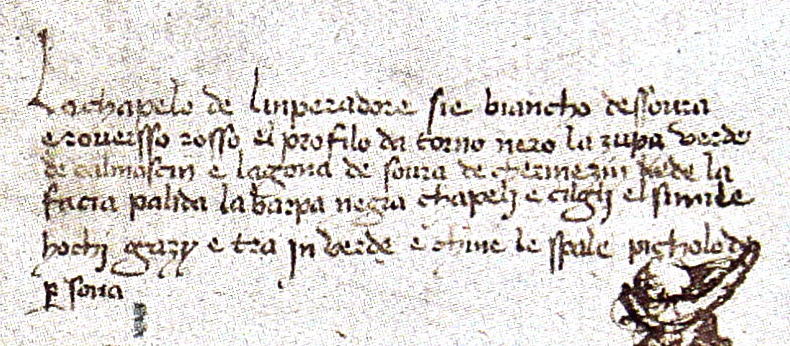
On the center of the Louvre sketch page, there is a detailed description of the clothing and physical appearance of emperor John VIII Palaiologos. On the right is a complete paragraph describing his hunting outfit:
“Lo chapelo de linperadore sie biancho dessoura [di sopra] / e rouersso [rovescio] rosso el profilo da torno nero la zupa [giubba] verde / de dalmascin e lagona de soura [sopra] de chermezin... de la / facia palida la barpa [barba] negra chapelj e cilglj [ciglie] el simile / hochi grizy [grigi] e tra jn verde e chine le spale picholo di / p[er]sona”.
The memo is written in 15th-century Italian with many period-specific words, which makes it hard to translate. Below is the most commonly used English translation cited from Evans (2004):
“The hat of the emperor should be white on the outside, on the reverse red, the border around it black, the doublet of green damask and the gown on top of crimson, of pale face, the beard black, hair and eyebrows likewise, eyes gray tending to green and sloping shoulders, small in person”
The hat’s color is self-explanatory. The dome in the center is white, while the brim is mostly red with a black outline. This closely resembles the color schemes of Mongol-inspired hats that were popular over the world at the time.
Italian accounts at the time provide another detail about the emperor’s hat. According to the diary of Bartolomeo del Corazza, when John VIII entered Florence he was wearing “a white hat coming to a point in front in which he had a ruby bigger than a pigeon’s egg and many other precious stones.” Vespasiano de Bisticci also writes that the emperor wore “a cap in the Greek fashion, on the top of which was a magnificent jewel.” These accounts emphasize on the huge precious stone topping his hat. Indeed, Pisanello and Filarete each depicts John’s hat with some kind of ornament on top. I drew a red ruby with pearls and gold beads, following the design of Filarete’s bust.
Pisanello describes two garments that the emperor wore. A ‘giubba (zupa)’ made of green damask textile, and the crimson ‘gonna (lagona)’. These Italian words deserve closer examination because their historical meaning differs significantly from modern ones. (Askr Skaðason provided valuable help on this part by consulting multiple Italian dictionaries!)
A ‘giubba (zupa)' in modern Italian refers to a large overcoat with buttons. However, in the relevant period I’m focusing on, its meaning was ‘a tunic of oriental origin, with sleeves, worn by men and women as underclothes.’ It usually reached the waist and was made with embroidered precious textiles. Therefore, the closest equivalent in modern English would be a 'shirt.' It is in the 1700s that the word ‘giubba’ came to mean justaucorps, a knee-length buttoned coat, which is similar to the modern definition. Therefore, a ‘doublet’ used in popular English translation is misleading, to say the least.
‘Gonna (lagona)’ has the largest variations between translations. Depending on the translator, it varies from ‘gown’, to ‘robe’, to ‘skirt’. In modern Italian, ‘gonna’ does mean ‘skirt’. However, its archaic meaning was a generic term for overgarments. Pisanello even clarifies this by adding ‘di sopra (worn above)’.
Considering everything, John VIII was most likely wearing a green buttoned damask shirt with a crimson overgarment. This is consistent with Pisanello and Filarete’s depiction of John, in which he wears a buttoned shirt with a lapeled overgarment.
In this context, one piece of evidence turned out to be particularly revealing. While there are no surviving color portraits of John VIII by Pisanello, there is one illuminated portrait of the emperor with closely comparable design. It appears pasted onto a page of a psalter, which is now in the library of the Holy Monastery of Saint Catherine in Sinai. Several authors, including Marcell Restle, believed that this portrait is ‘worthy of the hand of Pisanello himself.’ And in this portrait, John is dressed in a red buttoned overgarment. Aside from the fact that his shirt is white rather than green, the depiction is very close to Pisanello’s color notes. Therefore, I chose to adopt the color scheme of this portrait. I colored the lapels white and added the floral motif to the red jacket.
The medal of Pisanello shows that the emperor is wearing even longer clothing that reaches the calves under these layers. Some reconstructions (such as the drawing of Angus McBride made for Osprey Publications) colored this part as red because of the incorrect interpretation of the word ‘lagona’ as the ‘skirt.’ However, Pisanello never really described this particular clothing. I colored this undergarment blue, inspired by the depiction of another Byzantine emperor, Manuel II, in the French illuminated manuscript. The color of his hunting gear and boots is based on the other notes by Pisanello, which I will describe shortly after.
2. Ceremonial Outfit
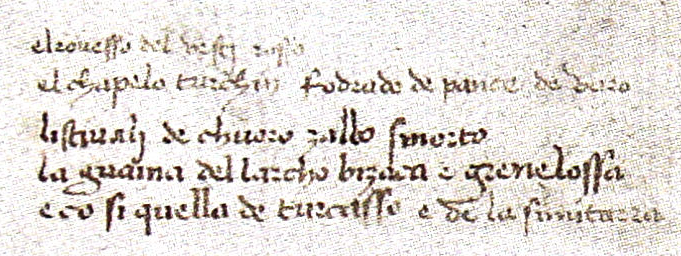
On the left of the aforementioned paragraph, there is an another description of the emperor’s attire:
“el rouesso del vestj rosso / el chapelo turchin fodrado de panete da varo / listivalj de chuoro zallo smorto / la guaina del larcho bizaca e grenellosa / eco si quella de turcasso e de la simitarra”
“The reverse of the gown red / the deep blue hat lined with multicolored [?] cloth / the boots of dull yellow leather / the sheath of the bow brown and grained / as is the quiver and the scimitar.”
Given that the emperor’s hunting attire is already described in the previous paragraph, this most likely refers to his ceremonial outfit and hunting gear. However, in comparison to the hunting outfit, the description is quite ambiguous. For example, he does not specify the primary color of the mamluk robe and instead wrote that the ‘reverse (rouesso)’ of the robe is red. I interpreted this description as referring to the inner lining of the robe, which would be visible with the folded lapels.
Regarding the hat, I applied the main color of the hat (deep blue) to the inner dome and ‘multicolored’ cloth for the surrounding pillbox-shaped part. The striped design of red and yellow is based on the mosaic portrait of Theodore Metochites, who is wearing a similar hat.
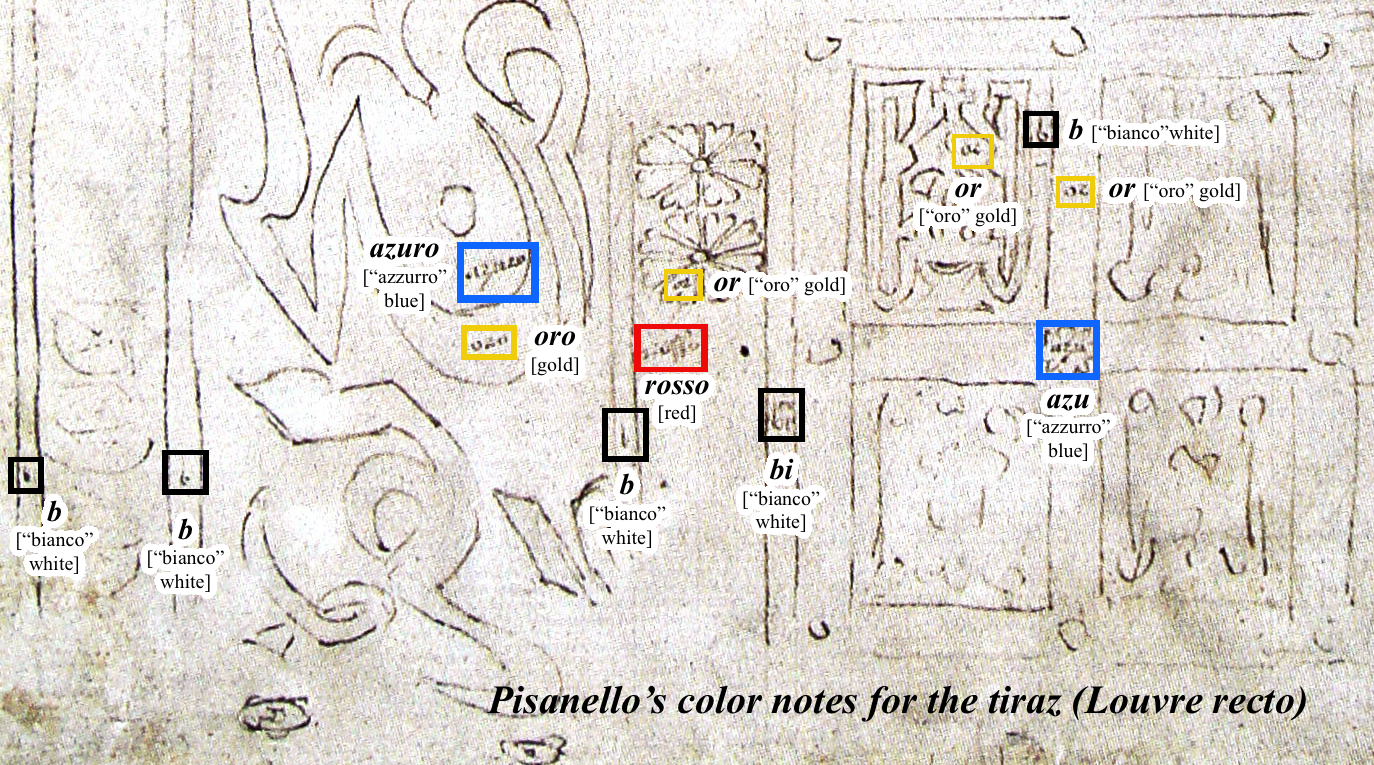
In the previous post, I mentioned the incredibly detailed rendering of the tiraz design of the gown. Pisanello even managed to squeeze in the color of each ornamental design by writing small, abbreviated notes to the design itself. He wrote ‘b’ or ‘bi’ for white (bianco), ‘oro’ or ‘or’ for gold (oro), ‘azuro’ or ‘azur’ for blue (azzurro), and ‘rosso’ for red. Using these minute scribbles, I was able to reproduce the tiraz and arabesque design accurate to Pisanello’s sketch.
And this revealed something very intriguing. The decorated squares surrounding the Arabic inscription are likely meant to be repeated throughout the whole robe. Pisanello drew only one repeat of the design as a shortcut, a practice typical of textile designs in early 15th-century Italian pattern drawings. Therefore, the whole robe was predominantly of white and gold. These are likely the main colors of the robe that Pisanello failed to mention before.
There is corroborating evidence for this hypothesis. Earlier in 1400, Byzantine emperor Manuel II, who was a father of John VIII, visited Western Europe for similar reasons with John. He even went as far as France and England. And accounts from these countries all emphasize the white robe of Emperor Manuel.
According to Michel Pintoin, when Manuel II visited France, he was “dressed in an imperial robe of white silk, rode a white horse that the king [Charles VI of France] had presented to him along the way.” Adam of Usk writes that when the emperor arrived in London, he and his men “always went about dressed uniformly in long robes cut like tabards which were all of one colour, namely white.”
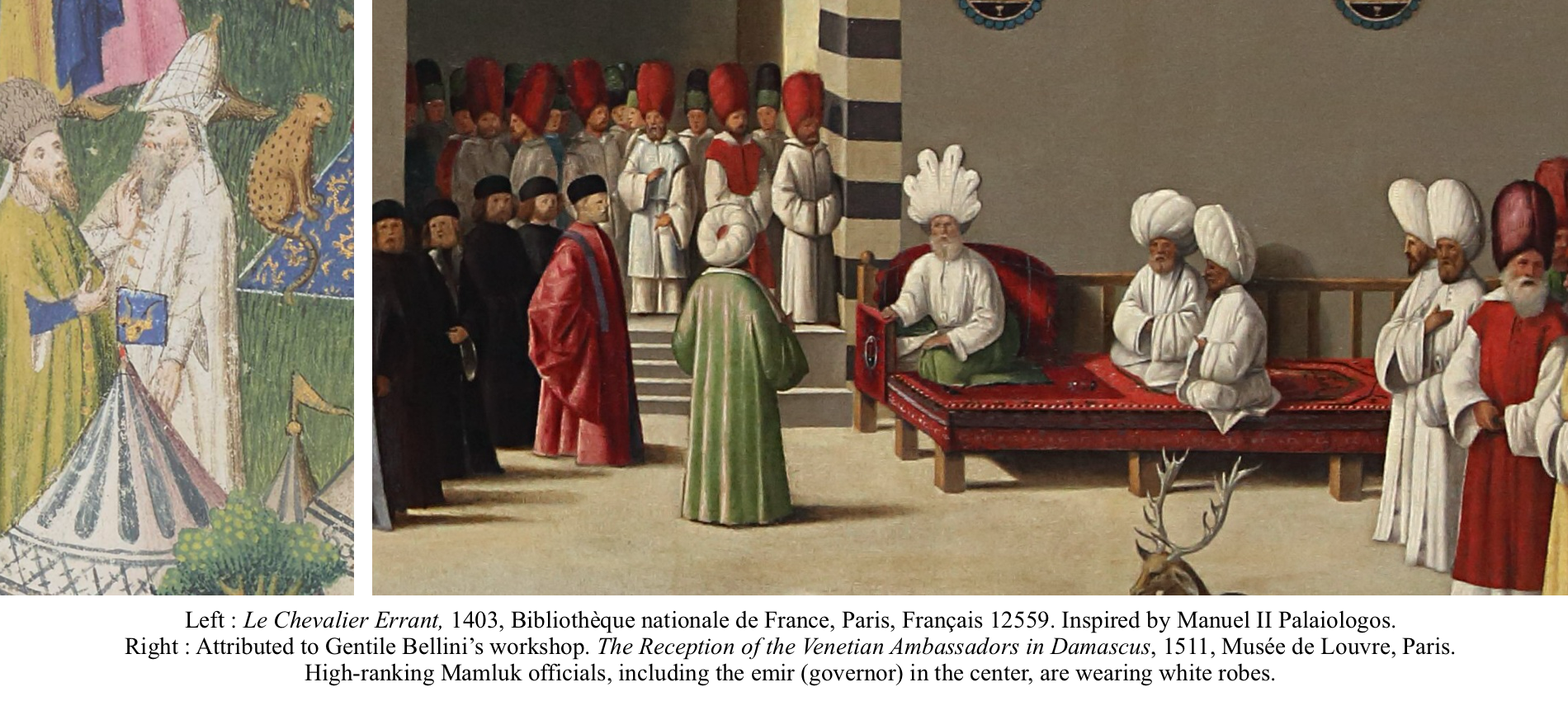
Très Riches Heures de Duc de Berry, a well-known French illuminated manuscript of the time, depicts Manuel wearing a blue robe. However, another French manuscript from the same period, Le Chevalier errant, does depict him wearing a long, white robe that is not dissimilar to Pisanello’s sketches.
Considering that it was Manuel II who originally received the gown depicted in Pisanello’s sketch—based on the Arabic inscription on the tiraz—it further supports that the main color of this particular robe was white.
Indeed, long, sumptuous robes made of high-quality brocades and silks were extensively used in the Mamluk court. There were various kinds of robes, such as farrajiyya, jubba, and kaftan. Although the Mamluks preferred bright colors such as blue, green, and red, white Mamluk robes do appear in a number of European period paintings.
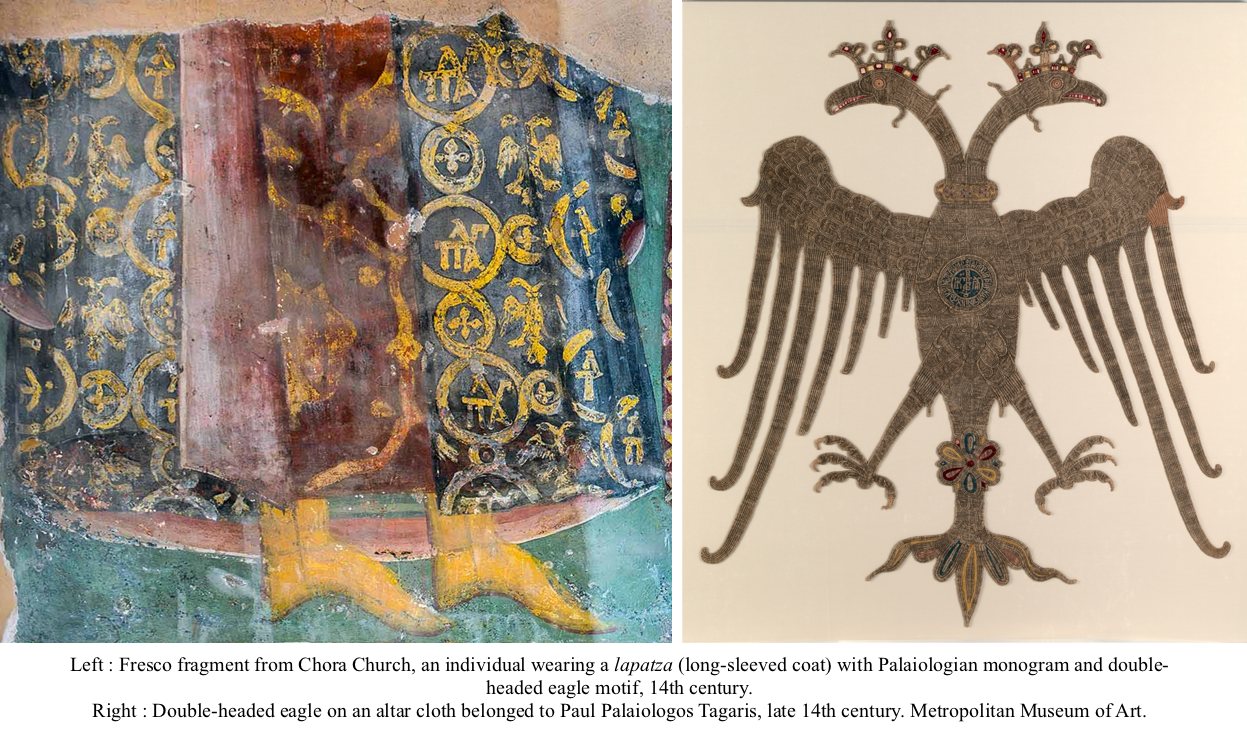
The kavadion he wears underneath the white gown is drawn after a fresco from the Chora church. The design features the double-headed eagle, a Byzantine state emblem, and the royal cypher (sympilema) of the Palaiologos dynasty, made up of Greek alphabets ΠΑΛΓ. I chose the primary color for the kavadion as black, because by the Palaiologos period, black had supplanted purple as the royal color. The majority of imperial portraits from this period shows emperors wearing a black roukhon (tunic) rather than the costly Tyrian purple.
Lastly, Carmen C. Bambach observed that the emperor in this outfit ‘carries a weapon that appears to be a dagger, which is quickly sketched as hanging from his right side’. However, because the available scans of the sketches (particularly the Louvre one) are not very high-resolution, it was difficult to determine which detail she was discussing. So I drew the dagger tucked at the front using the vague outline from the frontal view of Chicago recto. The dagger is based on a 15th century Persian specimen from the Wallace collection in London.
Files