 Home

 Creators
 Search
 Recent
 Random
 Posts
 DMs
 Tags
 Random
 Importer
 Import
 FAQ
 Account
 Register
 Login
 Favorites
 Keys
 Logout
 Telegram

A Glimpse Behind the Curtain (Patreon)
Content
As you may remember, in January of this year I stepped back from Speculate, the show I'd co-hosted since 2014, and which has been doing actual play since 2018.
For those who aren't familiar, actual play is the term for stories told using ttrpgs as a core element. If you know Critical Role, you know an actual play show. Some of the other most popular actual play shows include The Adventure Zone, Dungeons & Daddies, Dimension 20, and Friends at the Table.
Minor History Digression
"Doing actual play since 2018" now actually makes Speculate one of the older actual play shows, in what I think of as the third generation of actual play (the first being everything before about 2014, the second being 2014-2017, and the third being 2018 to the start of 2020. Actual play exploded as a form with remote games in 2020 with people at home wanting to play games and connect. Actual Play was also a way for theatre, tv, and film creators to still make work when it was not safe to stand up shows in theaters or do film shoots.)
Lessons Learned
When I left Speculate, I knew I wanted to start another actual play project. And in the time since then, I've done a lot of thinking about what I want this project to be, how I want it to be different from Speculate and how I want it to build on what I already liked about Speculate.
Speculate, being traditionally live rather than pre-taped, was already a pretty unfiltered, unedited show. We did a little pre-recording here and there, and more in 2023 due to some scheduling constraints and some experimentation.
Having done some pre-recording, I quickly became a fan of that approach due to the way it builds in more flexibility for taking breaks, for doing check-ins with players, and in removing the pressure to interact with chat while people reacted live to what was happening in the game.
Pre-recorded shows also let you edit the video before release, remove the pressure of needing someone to be actively producing the show while livestreaming, and let you do things like record a whole miniseries before any of it airs so you can edit everything with the same overlay assets, you can edit the beginning to emphasize elements that end up being important in the ending, etc. Many of the kinds of things that are benefits to filming an entire season of a tv show before any of it starts airing, as is common now in the streaming era.
What Comes Next?
What I decided to do was give myself the time and space to record some workshop games that I knew from the beginning were not going to be broadcast. I use the term workshop thinking about how theatre does workshops but also because I specifically like workshop for the freedom it gives me to experiment.
My intention with this new show is to focus on elements of making an actual play that I am most passionate about and where I feel like I and the collaborators I can likely work with can excel rather than trying to compete with the biggest shows in the field.
1) Because those shows have infinitely more money than I do (Critical Role, Dimension 20) and the crew to go with it.
2) Because the casts of the most popular shows are mostly or entirely professional actors/improvisors (improv comedians mostly). And I am not a professional actor/improvisor with a background like theirs.
But what I am is a novelist, a game designer, and an experienced facilitator of collaboration.
The mobilizing question of this idea is then: "What does an actual play look like that lets me use my strengths to their greatest?"
Process & Collaboration
I landed on these two elements as the ones I want to focus on.
Process - by this, I mean actual play that engages deeply and meaningfully with the mechanics of the game we're playing. This also means highlighting how the mechanics are contributing to the creation of the overall work rather than editing out the dice rolls and mechanics discussion (a choice that is common in a number of prominent actual plays - not something that is automatically bad, just not my preference). Process also means making a show that contains the story created by our collaboration but is also telling the story of how we made it. It's a fly-on-the-wall view of the writers room and the show that comes out of that collaboration between the writers.
This love of process comes from a few things - loving The Princess Bride film as a kid but also Who Framed Roger Rabbit?, The Last Action Hero, and getting into TTRPGs at an early age. That love of process grew during the DVD commentary era - getting to hear 10+ hours of various creators of the Lord of the Rings films discussing every aspect of making the films, listening to Ron Moore's podcasts that he released alongside the episodes of Battlestar Galactica.
Collaboration
Being a chatty, social person, I love collaboration - the way that if you put two minds together, they can create something drastically better and/or faster than what either of them could create on their own. I love the collaboration of learning, of teaching, the collaboration involved in social dance like Argentine Tango, etc.
Some of the most fun I have had as a writer was the writers' summit for Born to the Blade. I'd never co-written a work of fiction for publication before that, and found that the kind of fun I'd have playing TTRPGs was in fact accessible as a writer, it just involved collaboration. Ta-da!
Most actual play involves ttrpgs that have a strong division of narrative authority between a GM and players, with the GM holding almost all the narrative authority and parceling it out in little bites to the players. It's still collaboration, and it can be very effective collaboration. But one of the things I love best about the Powered by the Apocalypse and Forged in the Dark design styles is their greater focus on collaboration and a flatter hierarchy of narrative authority (when compared to most other forms of ttrpgs, especially the very traditional D&D style of the oppositional DM as well as the GM-dominated neo-trad or OC style of ttrpgs (the typology/taxonomy of game and design styles is a whole thing).
I've had tons of fun running games where I give/yield a lot of narrative authority to the players and then get to be delighted as they add to the story in ways I couldn't have imagined. So I want to push even farther on that.
One way to do so is to play GMless games, where no one player gets final say on all the events of the story. This includes games like Dream Apart/Dream Askew, Fight With Spirit, and Once More Into the Void. But in playing GMless games and reading GMless games and GMless modes for games (like the Dragonfly rules for The Wildsea).
Along the way, I was reminded that some designers and scholars suggest a reframe from GMless games to GMful games - it's not that no one is the GM, it's that everyone is a GM and you all work together as equals. That reframe has been exciting and empowering, and I'm very eager to pursue that idea in workshops playing GMless/GMful games but also in playing games that do have a GM/Player split but actively working to minimize the power differential in narrative authority so that while the GM may represent the forces of antagonism and introduce threats, etc., they aren't the Almighty Storyteller on the Hill who dictate reality and adjudicate conflicts like an impartial judge. Again, this is about taking the way I like to play and leaning into it, seeing how far I can push it and what happens when I do that.
Conclusion
Since I'm still doing contract work on Daggerheart, I haven't had a lot of time or energy to do new recordings and practice editing and all that at the rate I might have originally wanted. But I do have new things in the works to keep this ball rolling forward, and when I have something I feel good about, I am very excited to share it here with y'all and more broadly!
In the Meantime
Since I'm not putting out new actual play much right now, I'll have to settle for recommending some other projects to check out:
MEKONG
MEKONG is an epic mecha space opera set powered by Beam Saber, set in an original universe by Jerry La. Join an adventure that follows in the footsteps of Herbert's Dune, Lucas' Star Wars, Tomino's Mobile Suit Gundam, and del Toro's Pacific Rim, told by an all-Asian cast in an original universe inspired by Southeast Asian history and folklore (text from the creators)
My notes: A highly filmic actual play that centers southeast asian folklore, mythology, and creative perspectives in utilizing Beam Saber to tell an original space opera story through actual play.
GUDIYA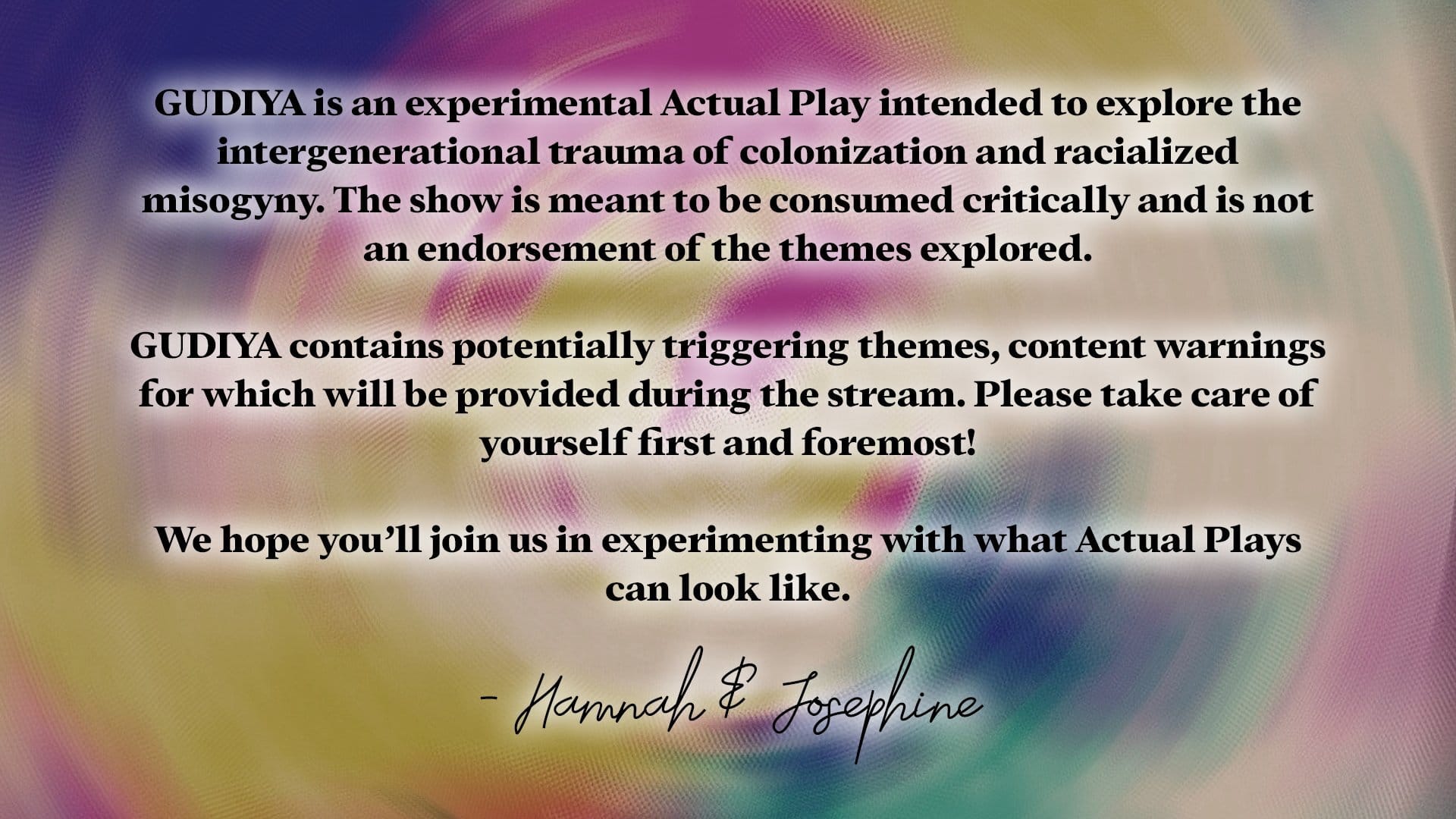
(graphic and text courtesy of the show's creators)
My notes: A one-shot of Bluebeard's Bride re-framed to engage with themes of colonialism, gender identity, misogny, and more. A powerful and intense show with amazing overlays and powerful performances.
My First Dungeon: Orbital Blues
My First Dungeon’s first sponsored season will take listeners to the frontier galaxy for a story of camaraderie, revenge, and, of course, sadness. Soul Muppet Publishing has created a game that captures that particular flavor of retro space westerns while bringing thoughtful mechanics to reckoning with one’s demons. The cast of this season—all familiar voices to fans of My First Dungeon—is thrilled to be exploring this game as they create a crew united in both sadness and love. In the end, this is a celebration of Orbital Blues and a call for fans new and old to support the brand new supplement Orbital Blues: Afterburn. Listeners can expect to laugh, cry, and grit their teeth through this action packed season alongside the crew of The 21st Night of September. (text from the creators)
My notes: My First Dungeon's sound design is absolutely top-notch, and the cast leaned all the way in to the Blues mechanics that are at the heart of the game, packing a ton of drama into a short six-episode series. This was the first full season of My First Dungeon I listened to but it will definitely not be the last.
