Home

 Creators
 Search
 Recent
 Random
 Posts
 DMs
 Tags
 Random
 Importer
 Import
 FAQ
 Account
 Register
 Login
 Favorites
 Keys
 Logout
 Telegram

[VR Poker] Publish Thoughts (Patreon)
Content
I'm excited that people love this game world. It's been out for a week, and I received a lot of good reviews for it.
For the past week, I've been focusing on polishing the stability of the table, making sure it functions reliably without critical bugs. Next week, I'm going to work on more QoL features such as a top-up option, skins/items that are available with in-game currency, and Patreon VIP benefits.
There are also some random occasional bugs, such as: Can't see hole cards, table turn stuck when the room master crashed, profile record is not registering match history properly. I will look into those and fix them one by one next week, too.
The rest is just a short story about how this game was made (for anyone interested):
The idea of creating a Texas Hold’em world first came to me during a casual visit to a friend. They were hosting a private poker game in the classic semi-auto poker world made by おおかみちゃん.
I loved the game — it was fun, smooth, and at the time I genuinely believed it was the best poker table in VRChat. The interaction felt great, the audio and visual effects were high quality, and the whole experience was close to playing poker in real life. Although we occasionally had to restart with a fresh instance because of bugs, everyone still enjoyed it a lot. That made me wonder: maybe there are more poker players out there who would be interested in a different take on a poker table.
So I built a prototype. I looked at PokerStars VR (Vegas Infinite) for inspiration on how they designed user interactions in a VR casino. Unfortunately, those ideas didn’t translate well into the VRChat SDK. The controls felt clunky and difficult to use. Eventually, I stopped working on the project.
Later, when Olympus Lounge – Texas Hold’em by Sayuyu was released, I tried it with some friends. I was impressed by how fully automated the table was. I can code, but I know programming has never been my strongest advantage, and there are many far more skilled developers out there. I looked at their table and thought: this is very well done, but it could be even more popular with a different design direction.
With the belief that people would enjoy my vision, I picked up the poker project again. It was a risky choice. Many poker worlds already existed—semi-auto or fully automated—yet none of them maintained long-term popularity. It almost felt hopeless, as if it was impossible to make a Texas Hold’em world succeed in VRChat. I was confident I could make a better-looking table, but would visuals alone make a difference? I wasn’t sure.
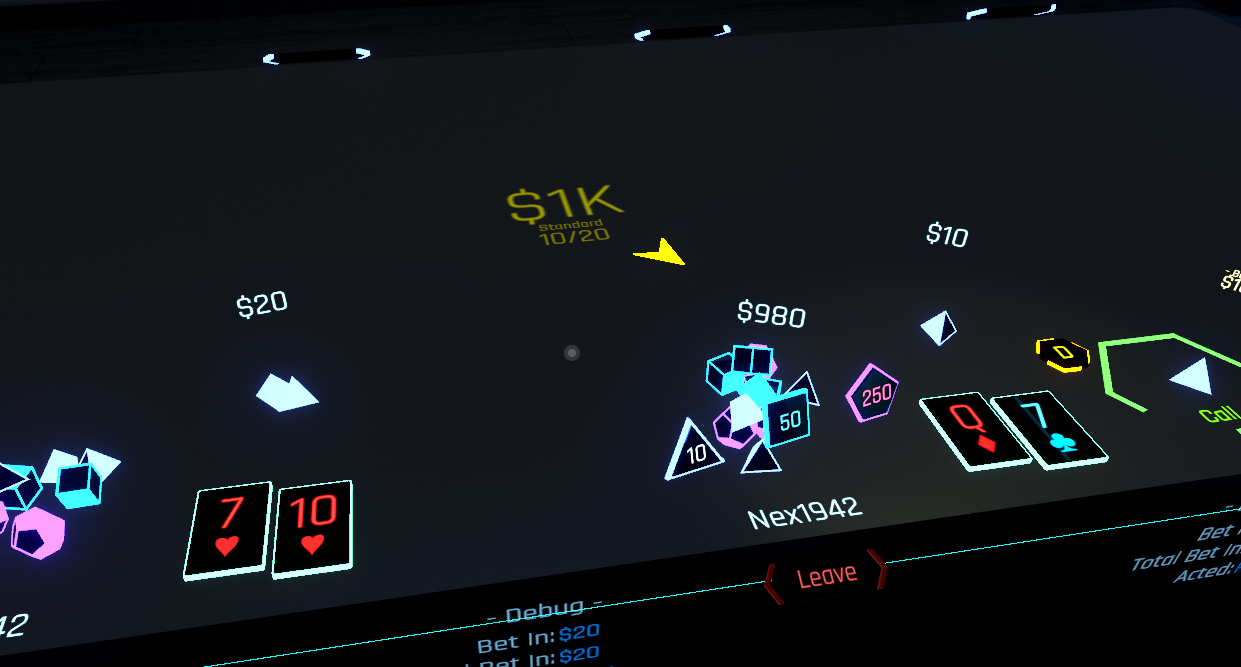
The first thing that came to mind for the design direction was: it doesn’t need to be realistic. We’re used to flat chips, stacked piles, and paper cards on a green felt table — but that’s only because it’s the most practical option in real life. In VR, I don’t have to follow those limitations. I took inspiration from the Risky Dice QuickBrown Design Studio for the chip design. Clean, sleek, and stylish — glowing cubes are much more fun than flat discs with no personality. And I don’t need to worry about counting, sorting, or “replacing batteries” for their imaginary LED lights.
The second principle was simplicity. I don’t want an overwhelming panel filled with numbers, buttons, and sliders. Nobody wants an “aircraft cockpit” just to play some cards. I want a chill poker experience. So I removed the grab-chip interaction entirely. It looks cool at first, but it becomes tiring over time — especially when there’s no real table in VR to rest your arms on. Three buttons to adjust the bet, one for bet/check/raise, and one for fold — that’s all anyone needs. I combined multiple UI elements to reduce clutter even further: the Reset Bet button is merged with the buy-in stack, the All-In action is by holding any of the bet buttons, and the fold button is tucked away on the hole cards. My goal was to create the simplest and most intuitive poker interface possible.
The third principle was comfort and safety. I understand a lot of VRChat players prefer calm, cozy indoor spaces. The environment needs to feel enclosed, warm, slightly dim, and safe. Worlds that are too bright or too open tend to make people subconsciously tense or tired. That’s why most popular chill worlds use home-like interiors. I left the environment design to my collaborator Mei — she’s incredibly talented at creating cozy atmospheres. Due to inexperience, I didn’t allocate enough space for things like a leaderboard, bank profile, or additional tables, so the layout isn’t perfect. We plan to improve that in the near future.
And that’s the story of how this poker world was made. I published it last Friday and went to bed feeling nervous and uncertain. The first thing I did after waking up was check my phone — and seeing more than 200 players in the world made me shout internally: Yes!
Files