 Home

 Creators
 Search
 Recent
 Random
 Posts
 DMs
 Tags
 Random
 Importer
 Import
 FAQ
 Account
 Register
 Login
 Favorites
 Keys
 Logout
 Telegram

Paul's Preview: UFC 245 (Patreon)
Content
With 2019 ending, the UFC wants to end it with a truly great event that will wow the fans. They couldn’t get a card stacked enough, so we got this current lineup instead. On paper there’s nothing wrong with the event, but when you compare it to the PPV right before it, you can’t help but think they should’ve switched the events around. The fans get treated to three title fights, a gamble that could backfire time-wise if all of them end up going to a decision. In the main event, we have Kamaru Usman facing off against Colby Covington for the undisputed welterweight title. Right below that, Max Holloway looks to continue his featherweight legacy by beating Alexander Volkanovski, the #1 contender who’s looking to become Australia’s second UFC champion. Let’s take a closer look at these fights and what each person brings to the cage.
Kamaru Usman vs Colby Covington
Kamaru Usman has had one hell of a UFC run. After winning the 21st edition of The Ultimate Fighter (American Top Team vs Blackzilians), Usman rattled off 8 straight wins before facing off against Tyron Woodley for the welterweight title. Even though he came in as an underdog, Usman shocked the world by outlasting and beating Woodley soundly by decision. Many pundits expected their wrestling to cancel each other out, thus favoring Woodley to land heavy strikes and finish Usman early on. Usman not only took down Woodley but kept him down and dirty boxed him whenever they got to the clinch. Usman’s wrestling isn’t flashy, but there’s a lot of variety to his takedowns. He is aided greatly by one crucial ally: the fence. Wrestling as a sport is done on the mats where there aren’t any closed barriers to press upon. Fighting (at least in a cage) gives the wrestler an opportunity to push their opponents against the fence and constantly go for takedowns where there are no escapes left behind. Some fighters have found a way around this problem, utilizing the fence to walk themselves back up (ala Robert Whittaker), but for the most part getting pressed up against the cage by wrestler means that you’re not in an ideal position. Usman doesn’t care if it looks ugly, as long as your back is against the fence, he’s happy and now he can get to work.

Usman doesn’t have a preferred takedown to call his own, whatever will work is good enough. The easier it comes, the better. Usman is on the larger side of most welterweights, and when you compare him to monsters like Darren Till, he looks pretty average. This doesn’t take into account his wide frame and long limbs. At 6’ with a 76” reach, he has the same measurements as Demian Maia or Stephen Thompson, but his style is drastically different. As mentioned above, Usman favors pressuring his opponents to the fence and dirty boxing his way in. Short punches to the ribs, knees to the midsection, with the occasional hooks and uppercuts off the clinch are some of his favorites to use. Once he’s in close, Usman will attempt single legs, trips, or anything that can get a hold of his opponents hips and hoist them into the air. Usman’s ground and pound isn’t anything to write home about, but it is consistent. Against both Woodley and Dos Anjos, Usman made sure to consistently strike both of them from on top long enough to keep the fight from being stood up. If this sounds familiar, that’s because it’s the strategy made famous by another former UFC champion Randy Couture. The more you dig into it, the more their styles seem oddly similar.


While on the feet, Usman’s striking is serviceable, and he does do a decent job of switch hitting. He’s not Max Holloway or TJ Dillashaw by any means, but it’s done at a quick enough pace before opponents can figure out that he’s in a different stance. He makes use of his jabs as measuring sticks to see if he’s close enough in range to clinch, but he will throw the occasional straight punch to keep his opponents guessing. Mixing in some nice kicks (to disguise the stance switch) and you have a formidable enough threat on the feet. Usman doesn’t have crippling KO power, but over time as the rounds stretch on, fatigue sets in and makes fighters more vulnerable. Usman’s record shows only 1 KO win in the UFC, but it doesn’t mean he hasn’t hurt his opponents standing. It’s usually on the ground where he does the majority of the damage (more on this later).
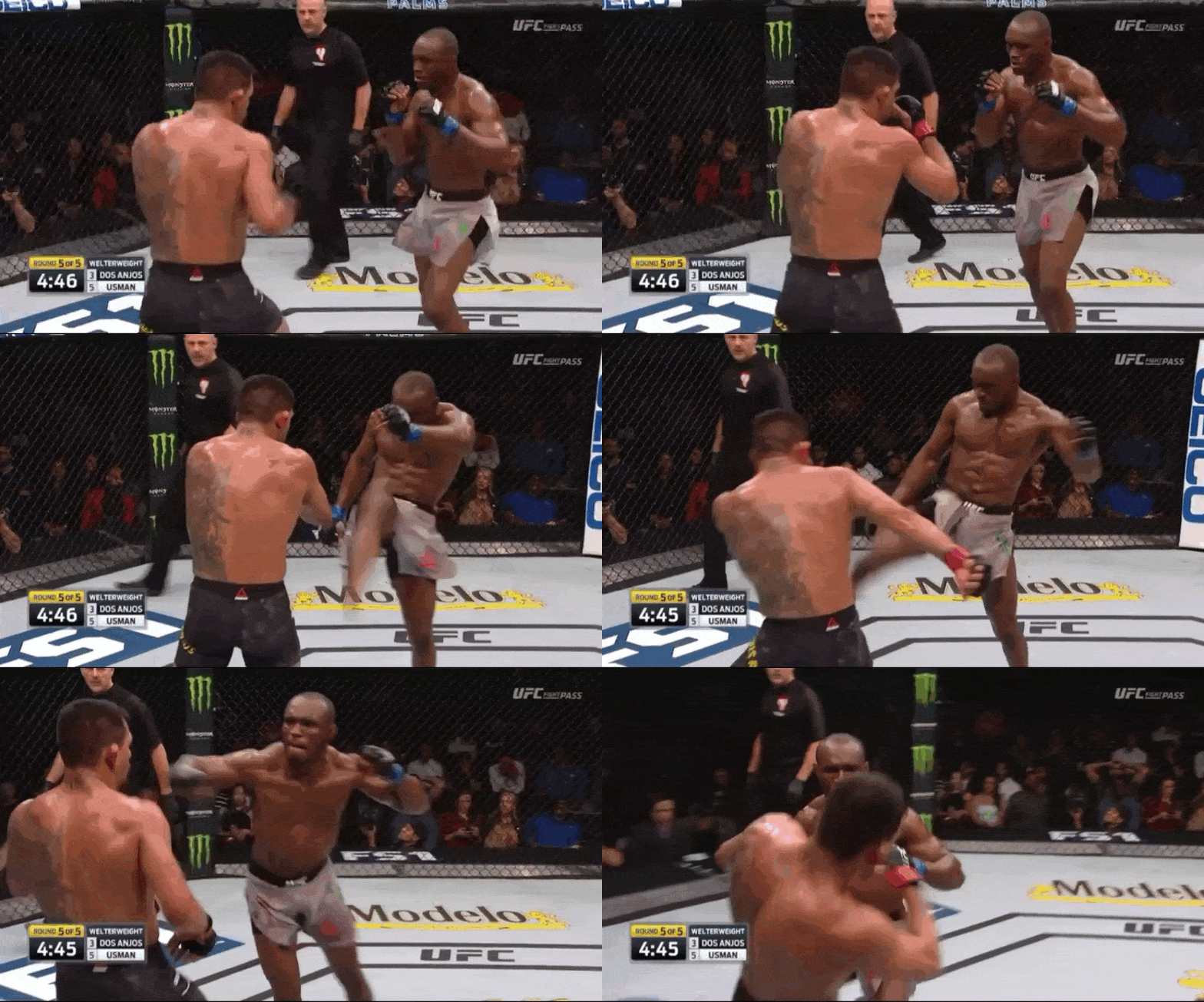
Nice disguise of a stance switch

Usman drops Maia in the 4th round
Trying to keep Usman from becoming the undisputed welterweight champion is Colby Covington. Outside of Usman, there is almost no one that can keep the pace that Covington can. Standing in the southpaw stance, Covington likes to come in methodically to set up his grappling. Despite his wrestling heavy match against Rafael Dos Anjos where he won the interim title, Covington displayed decent striking against Robbie Lawler. Knowing that he often holds the wrestling advantage and has great cardiovascular conditioning, Covington is comfortable moving forward and mixing in his kicks and his punches, daring his opponents to shoot in on him or try to wear him out for a decision. Some of his most frequent moves include the left high kick, right hook to jab, and overhand left. Covington’s style of striking into takedowns is reminiscent of a younger Jake Shields. Their takedowns and striking isn’t a perfect mirror of each other, but stylistically the strengths are the same. Shields might have the advantage with submissions, but Covington has the better gas tank. Fair trade, I guess?


Speaking of cardio, although Covington lacks the raw strength to brutalize opponents with ground and pound, his conditioning is well-known and allows him to try some flashier moves during his striking phase. He has been described by Dan Lambert (founder of American Top Team) as having a third lung and it shows in his fights. After throwing spinning kicks or elbows, Covington knows that his opponents are on the back foot and easier to try force down since they aren’t in the best position to sprawl. Most explosive/dynamic wrestlers limit the amount of takedowns they use since it requires so much energy, but Covington doesn’t have that problem. You can see it in fighters like Chad Mendes who are extremely athletic and explosive, but can’t do blast doubles for 5 rounds. Even if Covington’s pace is slightly slower as the rounds go on, it’s still frenetic enough to keep his opponents from getting ahead on the scorecards.

Covington does a good job of chain wrestling to create grappling opportunities and going for a variety of entries: single leg, double leg, knee tap, or back takes are all on the table; he’s not picky about which method he uses. He is comfortable in getting you to engage with him in tie ups and battle for grips, since this allows him to extend the time necessary to try and angle out and go for single and double legs. By constantly applying pressure in clinches against the fence, Covington makes you use your energy to defend constantly. In five round fights this comes in handy since he can usually out-last his opponents, who have to play a game of whether they should try to explode during exchanges and risk getting tired or try and conserve their energy and attempt to finish Covington later on when hopefully he gets exhausted (this was a strategy that many of Jose Aldo’s early opponents tried to utilize, despite it almost never working out). Surprisingly, once the fight does go to the ground, Covington doesn’t seem to care too much about positioning and ground & pound. Since many opponents still find a way to scramble back up and attempt to keep the fight on their feet, this allows Covington to go for his takedowns all over again. It doesn’t matter if he can’t get the finish, as long Covington can put the pressure on you for the entire duration of the fight, he’s confident that he can get the decision win comfortably.
Despite both Usman and Covington being wrestlers that usually win by decision, they have completely different approaches when it comes to how they get to the scorecards. The main difference between the two is that Usman prefers to do his striking while on top through superior wrestling positioning (to minimize the damage he receives) and Covington wants to inflect as much damage standing before dragging you down and making you work your way back up until you’re exhausted and vulnerable. A quick look at their common opponents, Demian Maia and Rafael Dos Anjos, confirms this fact. The stats might be a bit misleading since it shows that Usman has a much higher striking percentage and absorbs less damage than Colby, but that’s just the nature of choosing to do the majority of your attacks on the ground as opposed to on the feet. It doesn’t mean that Usman has the superior strategy, it just means he can juke the Compu-box numbers in his favor. But then again, it’s not as if Covington is exactly melting guys and finishing them with overwhelming pressure and volume. For all the grief that Michael Bisping got early in his career for not having power, he was still able to accrue damage on his opponents to the point where they would exhaust themselves and leave an opening for a TKO.
With all that said, it’s pretty clear that Usman is going to want to grind Covington against the cage and wear him down to the ground while Colby wants to pick Usman apart at range and go for takedowns during striking exchanges. For Colby to win, he’s going to have to wear down Usman on the feet before spamming the takedown attempts. While standing, Covington has a slight advantage due to his volume striking, but it doesn’t mean he’s got the clear edge. Covington isn’t the prolific jab monster of that GSP was, but he looked comfortable enough on the feet that he exchanged punches with Lawler without looking too out of place. Perhaps it was also due to Lawler’s willingness to slip punches and stay in the pocket that helped Covington feel more comfortable on the feet, but credit where credit is due: he stood with Lawler and didn’t get his head lobbed off. This might come in handy against Usman. Despite having good forward pressure and general cage awareness, no one has ever really made Usman pay for his sometimes-sloppy footwork. Usman relies on his movement to corner you eventually, and strikers in general are afraid of throwing kicks and standing still long enough to plant their feet. Against Woodley, Usman plodded forward without any fear of the takedown, something he might not have the luxury of against Covington. Chaining takedowns repeatedly might create the scrambles that Covington needs to turn this fight in his favor, but by no means is this an easy task.

Covington has been rattled before by the likes of Dos Anjos and has looked awkward at times after striking exchanges. In fact, this might be the area where Covington is most vulnerable: post-strike.
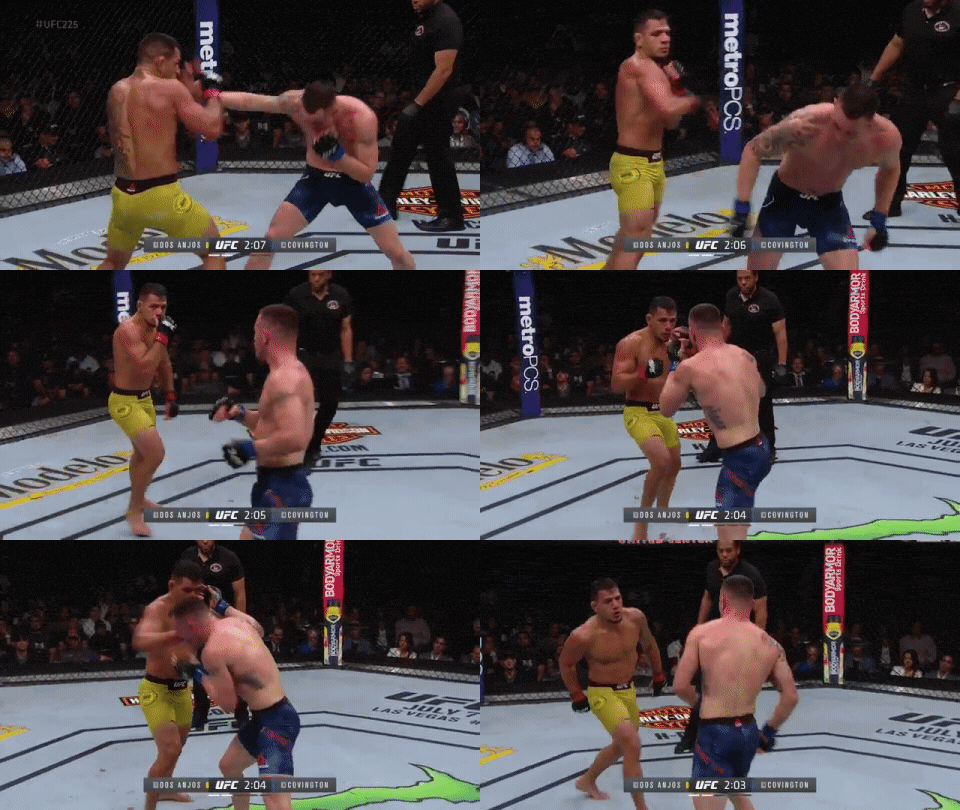
Like many grapplers turned strikers before him, Covington has the habit of admiring his work and hanging out too long in the open. He’s been able to get away with it since many of his opponents fear the takedown and are hesitant to counter. This also leaves him vulnerable to getting taken down himself, as RDA so aptly demonstrated.

If we compare most recent opponents, it’s clear that Usman had an easier time with Dos Anjos than Covington. As the fight wore on, it was clear that Dos Anjos was tiring against Usman and his output greatly slowed down. Against Covington, Dos Anjos was losing the fight on points, but still had spurts of offense even in the later rounds and had success on the feet. Covington starts quicker than Usman, but he slows down eventually. Usman starts slower but can maintain his pace for longer. As the fight wears on, this is going to be important. As for weapons while on the feet, Usman’s front kick did a fantastic job of neutralizing Woodley’s right hand and he seems to develop answers for his opponents as the fight wears on. Like an AI machine, Usman will adapt and eventually figure out how to corner opponents and take away their strengths. Although he doesn’t explode out for takedowns, he fights at a speed that never seems to slow down.
There is no science to fight prediction, and both Usman and Covington have weaknesses that can be exploited by each other. No matter who wins in this fight, at least we’ll have an undisputed champion at long last. That is, unless there’s some garbage decision like a draw… but that hasn’t happened before in welterweight title fights, right? Right??

Max Holloway vs Alexander Volkanovski
Co-headlining this card, we have Max Holloway trying to close the year going 2 for 2 in title defenses. Although his win streak was broken not too long ago by Dustin Poirier, Holloway remains the featherweight champion and looked at ease defending his belt against the always tough Frankie Edgar. Holloway is one of the tallest fighters in the division at 5’11”, but his reach is definitely on the shorter end (69”). Even with this limitation of sorts, he has managed to showcase one of the best striking acumen in all of MMA outside of Israel Adesanya. One of the things that even casual observers will notice is his constant use of the jab. Holloway uses the jab to probe, blind, hurt, block, and eventually frustrate you into making mistakes. The jab is his sword, his shield, and his spear. Holloway’s striking is simply overwhelming and it doesn’t give you time to adjust and adapt. When Holloway jabs, you can be sure that a right straight is soon to follow, you just don’t know when. In addition to making things difficult with just the 1,2’s Holloway loves throwing hooks. When they’re thrown off the jab to the body or head, it doesn’t give the opponents a lot of time to adjust, and Holloway’s not shy about doubling up on those either. Constant body shots is usually how he gets his opponents to lower their hands long enough for head shots, and it serves a dual purpose of sapping the gas tank, one punch at a time.


But how is he able to disguise all those punches and kicks? Two words: stance switching. Holloway is completely comfortable fighting you from either side, and what’s scary is that he’s effective at both. There are things that he favors from one stance (jabs in orthodox, straights in southpaw), but he can move smoothly with very little tells. He can do this by making sure that he switches while in motion and adding in false directions. By faking going one way and switching stances, his opponents are left having to adjust to a now new stance, but Holloway is already setting up another strike or feint. This kind of work rate was seen beautifully in his fights against Cub Swanson, Anthony Pettis, and Jose Aldo. This kind of footwork also means that opponents now have a new power strike that the need to avoid, and it’s what has caused so many to get caught off guard (sometimes, even finished).


But these are all attacks. There must be something else that Holloway does to get his opponents to strike first so he can counter. The answer to that is feinting. Feinting is an art of its own, but if done sloppily it makes you look like a cheap imitation of a what slick fighter looks like. Holloway is amazing at feinting, and his fights against Aldo, Ortega, and Edgar were brilliant demonstrations of this. In fact, his best moments in the Ortega fight and Dustin Poirier rematch came when he got both fighters to overreact so he can sneak in his own counters. Combined with his high output and stance switching, opponents have a hard time gauging whether to hold their ground and counter or slip away and reset. It’s a tough spot to be in.


Volkanovski has a tough task ahead of him, and it won’t be easy to derail the current featherweight king. Much like Holloway’s most recent opponent, Frankie Edgar, Volkanovski stands at 5’6” but he has a 71” reach (slightly longer than Holloway). Even though he has a background in wrestling and rugby, Volkanovski fancies himself as a kickboxer. Having gone 7-0 in the UFC, Volkanovski went from regional talent to legitimate contender in a 3 years span. His ability to pressure opponents against the fence is fantastic, and given that he’s often outsized, the cage does a good job of cutting off escape routes. To further help things move along, Volkanovski uses a long stepping jab while moving forward. This isn’t always a fight stopper, but it does get the opponent moving back closer to the fence. Against the likes of Jose Aldo and Darren Elkins, Volkanovski feinted and stutter stepped his man towards the edge, daring them to make their exit. If they darted to their right, a left high kick or hook was waiting for them. If they tried to move to the left, a straight right was cocked and ready. Just like the aforementioned Holloway, Volkanovski is no stranger to constantly feinting, and he does a pretty damn good of it as well.


Once the fight does get close to the fence, Volkanovski loves using his double legs or trip takedowns to get the opponent to the ground. Once there, Volkanovski’s ground and pound is enough to let him advance position, but he’s not concerned about mauling guys like Khabib Nurmagomedov. Rather, he’s content beating you up and having you work your way back up on your feet so he can repeat this pattern all over again. Rinse and repeat.

On the occasion that he faces off against a wrestler that can stuff his takedowns (or at least make it more difficult than necessary), Volkanovski has no problem keeping the fight standing. Against Chad Mendes, Volkanovski was able to go toe to toe with what appeared to be his mirror image and more than held his own. In close exchanges, Volkanovski made the most of his hooks and body shots, tiring out Mendes and sapping away his gas tank. Another strong wrestler that gave Volkanovski issues with takedowns was Elkins, but a different strategy was utilized for him. Volkanovski pressed Elkins against the fence with double underhooks, the moment he released the position he threw elbows to Elkin’s head.


For Holloway, the game plan is going to be similar to the one he used against Edgar and Aldo. Constant feinting and volume are going to be key in overwhelming Volkanovski and getting him to overcommit. Volkanovski kicks better than Edgar, but not as well as Aldo. On the other hand, Volkanovski wrestles better than Aldo, but not as well as Edgar. This presents a unique challenge for Holloway, and he’s going to have to remember that when he starts engaging. Holloway generally does a great job of avoiding the fence, and he’s going to have to do that for the entirety of the fight to avoid the takedowns. Even though he’s the taller man, he’s still giving up reach against Volkanovski and should be careful when gauging distance. The long stepping jab of Volkanovski can cover a lot of ground quickly, and if not careful he can absorb more strikes than necessary. The shoulder roll that Poirier employed was clearly giving Holloway problems in their fight, and he verbally mentioned how the high guard was hurting his hands in between rounds. You can bet that Volkanovski and his team picked up on this defense, and it might be something they bring to this fight.
Volkanovski is going to have to mimic several different fighters and use their best weapons to try and dethrone Holloway. Holloway has looked vulnerable in spurts, and against some opponents he’s left his lead leg in orthodox stance out for far too long. Being reliant on the jab means that you’re sacrificing your lead leg to be punted out, and it’s something Volkanovski has taken advantage of. Volkanovski’s height and size means that he’s constantly having to find his range quickly, since he either has to stay all the way out to avoid getting picked apart or in your face so that his reach becomes viable. Even though Holloway is excellent at setting up feints, Volkanovski is also quite adept here. By mixing in his Greco-Roman wrestling skills, Volkanovski can try and mix in some dirty boxing to hurt Holloway and make him pay off clinch breaks. This is something Andy Ruiz Jr. is quite fond of, and it’s as sneaky as it is devastating if done quickly enough. Holloway has an excellent takedown defense game by preventing you from clamping your hands together, but trips bypass this requirement. Even though Holloway can draw out attacks from you with jabs, it might not be as effective against someone who level changes as frequently.
Even though it’s the co-main event, this match-up has all the makings of an instant classic. Here’s to hoping that whoever comes out on top, we have a quality fight that the rest of the division can live up to.
P.S. For a breakdown of the Amanda Nunes vs. Germaine De Randamie fight, our friend Elias Cepeda has done an amazing job detailing the strengths and weaknesses of both fighters. Please give it a read!
