 Home

 Creators
 Search
 Recent
 Random
 Posts
 DMs
 Tags
 Random
 Importer
 Import
 FAQ
 Account
 Register
 Login
 Favorites
 Keys
 Logout
 Telegram

Paul's Preview: Adesanya (c) vs. Romero (Patreon)
Content
The middleweight division is at an interesting place. At the top of the heap, you have Israel Adesanya, the undisputed champion who is coming off a win over former champ Robert Whittaker. As far as rankings go, the next in line for a title shot should have been Paulo Costa. Unfortunately, Costa seemed to have suffered a bicep injury in his victory over Yoel Romero back in October 2019 and would be out until April 2020. The UFC doesn’t care about fighter timelines and had already penciled in Adesanya vs. Costa for March. As of this writing, Whittaker is still ranked #1 in the division with Costa at #2. With Whittaker just coming off a loss to Adesanya (and unable to fight for personal reasons), the UFC went down the list and settled on… Yoel Romero. Despite being 1-2 in his last 3 fights, you can make the argument that stylistically, Romero presents a lot of problems for Adesanya. If you’re Adesanya, what better way to silence the critics than facing off against someone that’s tailor-made to give you problems? Yes, I know that Romero is on a losing streak AND missed weight for 2 of his list 3 bouts. Sure, the UFC could have waited just a little bit longer and booked Adesanya vs. Costa to clear up the rankings. But as fight fans, we’re treated to another spectacular 185-pound clash, and who isn’t ready to see Adesanya again? Both fighters are always exciting and between the two of them, they have seven Fight of the Night bonuses. Even though Costa got the short end of the stick, let’s enjoy this matchup and see what makes each fighter great, starting with the champ.
During Whittaker’s absence, Adesanya made quite the name for himself by staking himself as the next middleweight great. He rattled off 6 straight victories in the UFC, winning the interim championship belt in the process. When he finally got the chance to square off against Whittaker himself, he made the most of his opportunity and finished the then champion in less than two rounds. Adesanya’s last two fights were for the title (interim title against Kelvin Gastelum and undisputed title against Whittaker), and there’s a lot to unpack in those two fights. Both of those matches can show key points in how Adesanya might approach his fight against Romero, along with highlighting some weaknesses he should work on improving. First, let’s take a closer look at his most recent fight against Whittaker.
Whittaker fought a good chuck of this matchup attacking in a straight line, leading early with low line kicks and in his usual crouched stance (with his head slightly leaning towards his left). The kicks were a good idea, Kelvin Gastelum had a lot of success pinning Adesanya in place when he threw him, and Whittaker is quick enough to land them most of the time when they were thrown. When he threw these kicks as Adesanya was angling off, he got off a few follow up shots and had him looking vulnerable. One of the early problems that showed up for Whittaker was leading with power jabs. Setting up feints and breaking opponent’s rhythm is something of a specialty for Whittaker, but it was largely absent this time around. For anyone who’s curious as to what this looks like when it’s on point, look no further than Whittaker’s fights against Rafael Natal, Clint Hester, and Brad Tavares.
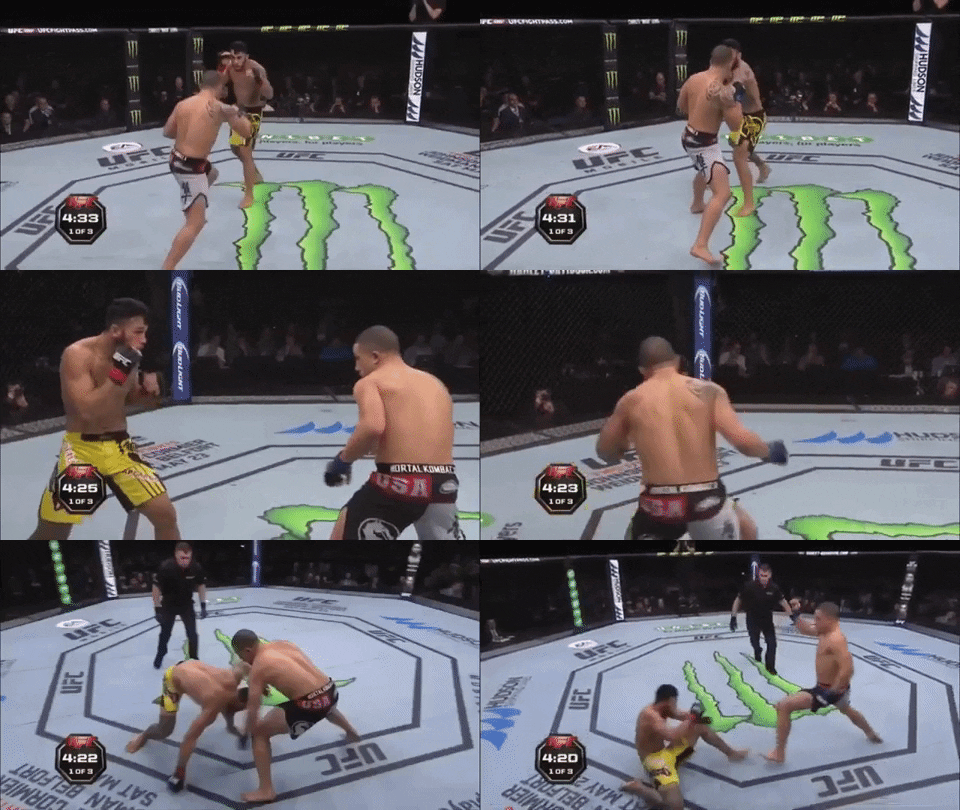
(In this fight against Tavares, Whittaker’s jab can morph quickly into his patented left hook.)
For his part, Adesanya kept his cool and use effective stance switching to keep Whittaker from rushing in as well as checking a lot of jabs that were thrown his way. Adesanya would stick his own jab out whenever Whittaker would recklessly charge in with his left hook, and he moved his head ever so slightly to get offline and evade the blow. Once he was out of harm’s way, Adesanya returned fire with counters onto Whittaker who was moving in on a straight line.
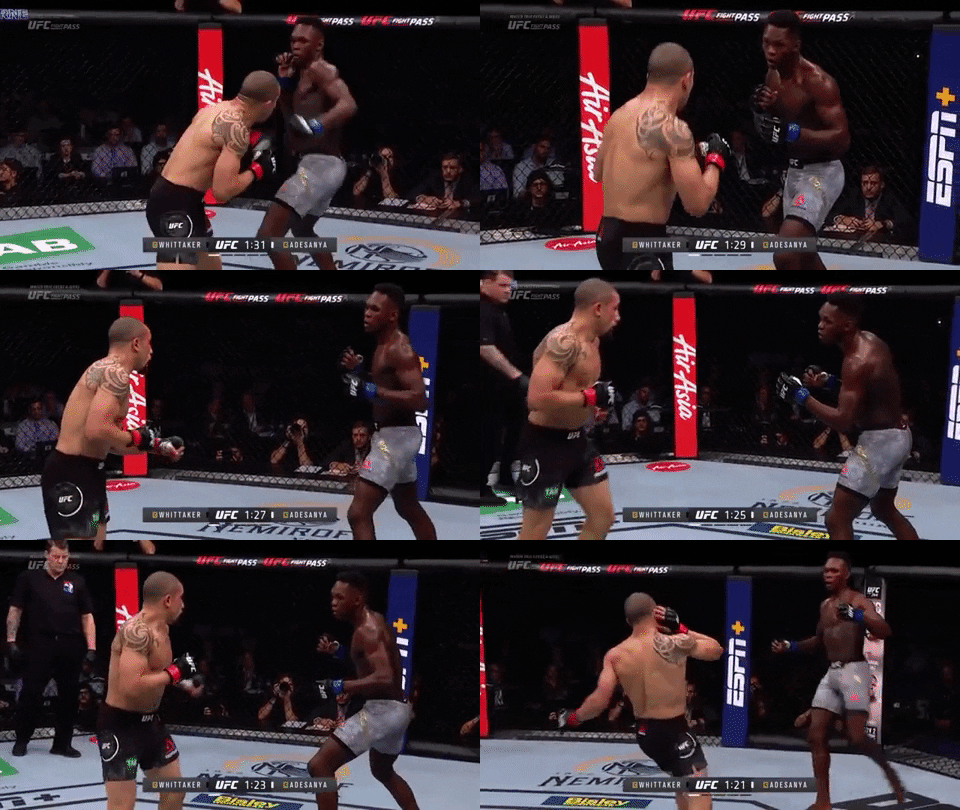
(After almost eating a head kick from Adesanya, Whittaker throws the low line kick. Adesanya withdraws his lead leg quickly before throwing the head kick again. Only a quick block from Whittaker saves him from absorbing the full impact.)
There were times when Whittaker came dangerously close to taking off Adesanya’s head with an overhand right (which might be the reason he was throwing them so often in the first place), but a slight lean back was enough to see the punch just fly on by. A right hook that was thrown wildly at the end of round 1 almost got Whittaker finished early. Adesanya leaned back to avoid the brunt of the hook and clipped Whittaker on the jaw with his own right hook, dropping him right at the horn.
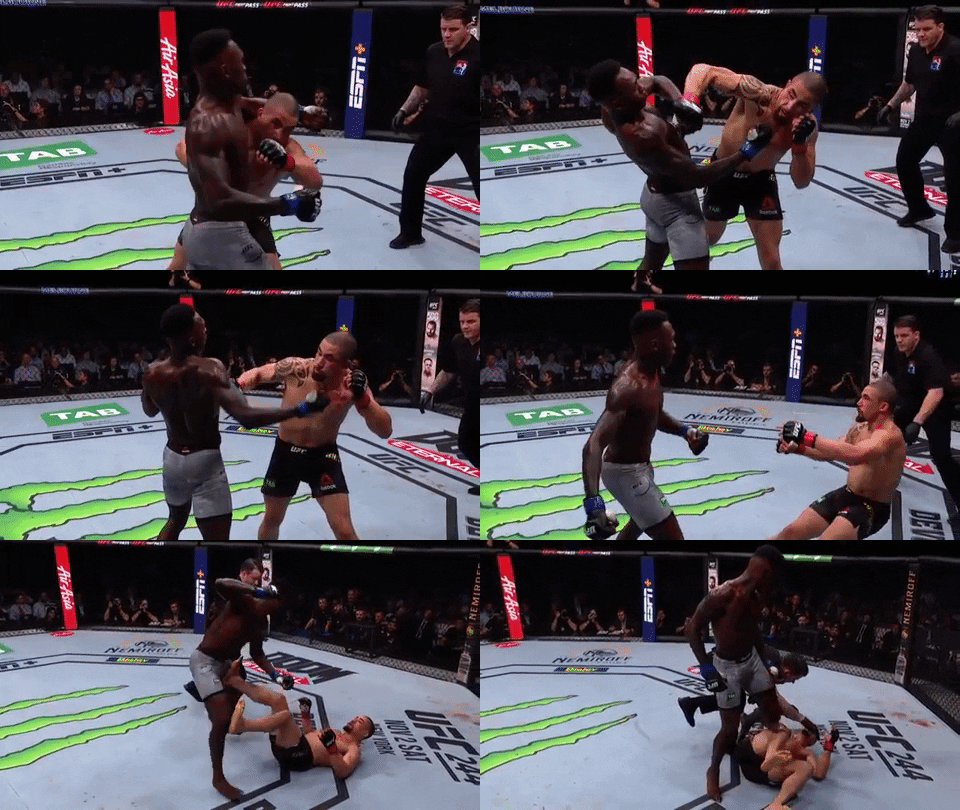
(If a few more seconds were left in the round, it’s certainly possible that Adesanya could have ended the night quicker.)
In the beginnings of round 2, you could see that Whittaker knew he lost that round and that Adesanya might move in for the finish. He started off with more stiff jabs into overhand rights and hooks, landing them with a bit of success. Adesanya’s primary method of exiting is either leaning back slightly or stance switching, but no matter what he only takes a few steps back before angling out. This is important because going straight back would mean his back is caught along the fence, and it’s how he was cornered in his earlier UFC matches.
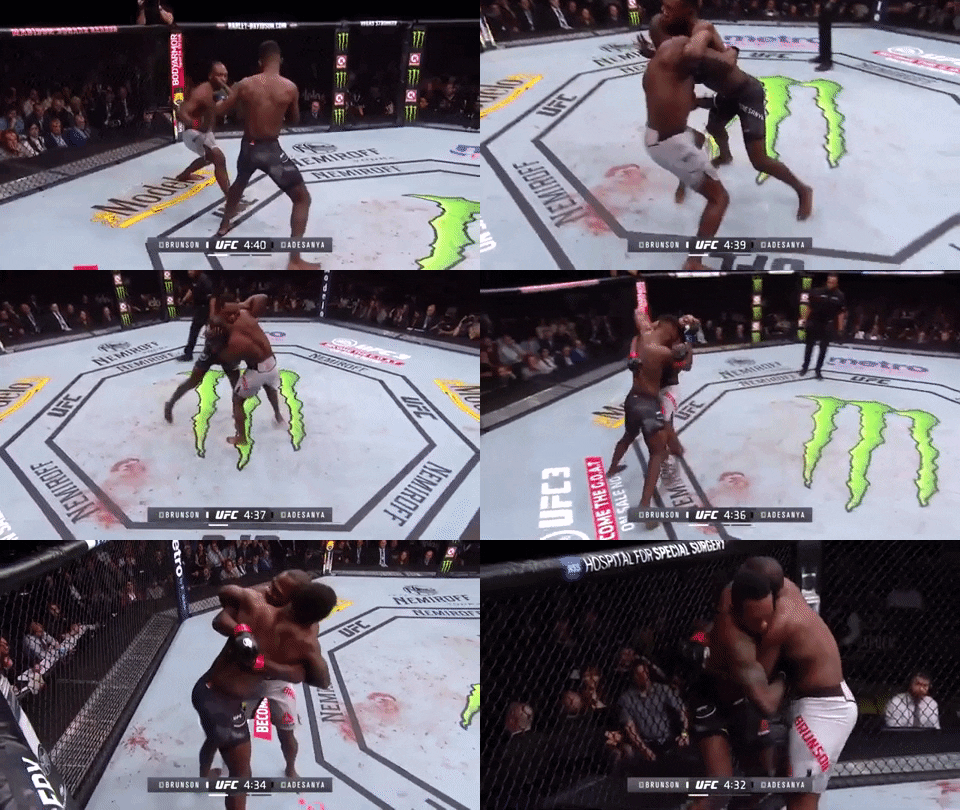
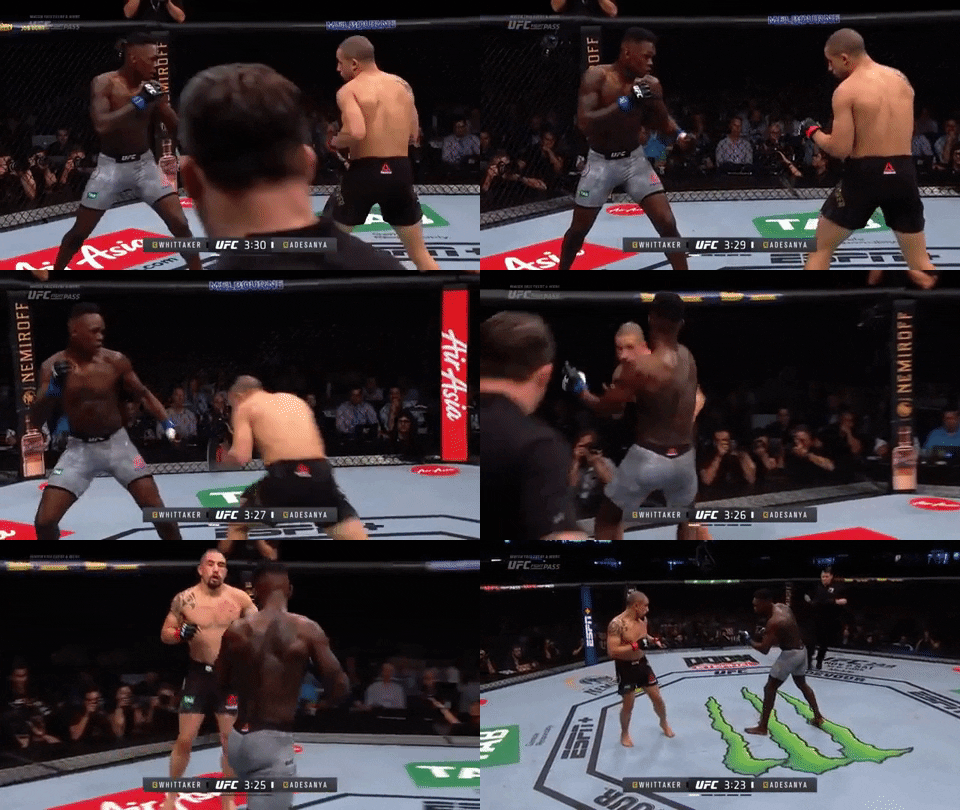
(From being muscled around by Brunson to keeping things in the center of the cage against Whittaker.)
It’s truly a marvel to see how far Adesanya has come in his UFC career. He went from being taken down against the fence by the likes of Rob Wilkinson to fighting almost exclusively inside the two black lines against Robert Whittaker. Round 2 was also when Adesanya really started to piece together some real offense against Whittaker, whether it was showing off more of the counter hooks during his lean backs or throwing his own jabs down the center. Speaking of jabs, Adesanya’s jabs came from his waist, almost daring Whittaker to throw more strikes at his face. There’s also the possibility that Adesanya had that arm hanging lower than usual to prevent possible takedown attempts. Because the punches were coming from below Whittaker’s line of vision, he would have to look down to see where it would land, leaving him hesitating with his own offense. Knowing that body shots and takedown attempts weren’t incoming, Adesanya didn’t have to worry about protecting his midsection or being ready to defend a takedown. Just like he did at the end of round 1 and moments of round 2, Adesanya leaned back and caught Whittaker flush with a left hook as he’s leaning back, fulfilling his prophecy of making sure Whittaker pays when he throws his own left hook. A few follow up punches later, and we now have a new undisputed middleweight champion.
(Speaking with Submission Radio, Adesanya talked openly about how he’s going make Whittaker aware of his shortcomings when throwing the left hook.)
Although Adesanya made this one look easy, he had a much tougher fight against Kelvin Gastelum. Gastelum had the most success against Adesanya despite being possible the smallest middleweight in the UFC roster (at the very least in the top ten). Despite having an 8” reach disadvantage, Gastelum was able to use angles to get inside of Adesanya and soften him up with jabs and hooks to the body. His darting side to side movement and forward pressure offset the reach disadvantage and gave Adesanya some serious problems, even wobbling and dropping him. Adesanya looks great on the offensive but doesn’t look nearly as scary when he’s forced backwards. He needs a lot of space to operate effectively and if you’re able to deny him the real estate, he becomes a lot more hittable. Gastelum was also able to score a clean takedown against Adesanya after he whiffed on a right straight and left his hips wide open. Kicks were also something that Gastelum wasn’t afraid to trade with Adesanya, and he scored plenty of his own low kicks (and even landed a high kick that rocked Adesanya). When the fight was a brawl, Adesanya looked beatable. Despite all the things that Gastelum did well, Adesanya wasn’t without his merits.
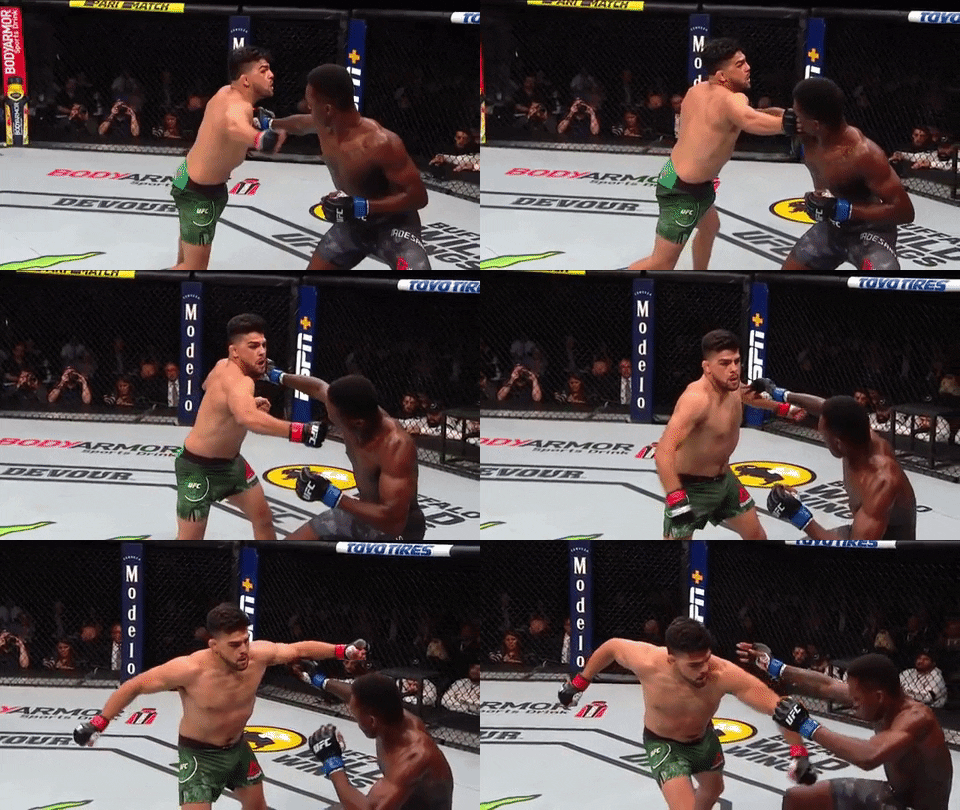
(Forcing Adesanya back, Gastelum lands with a right hook that dropped him early.)
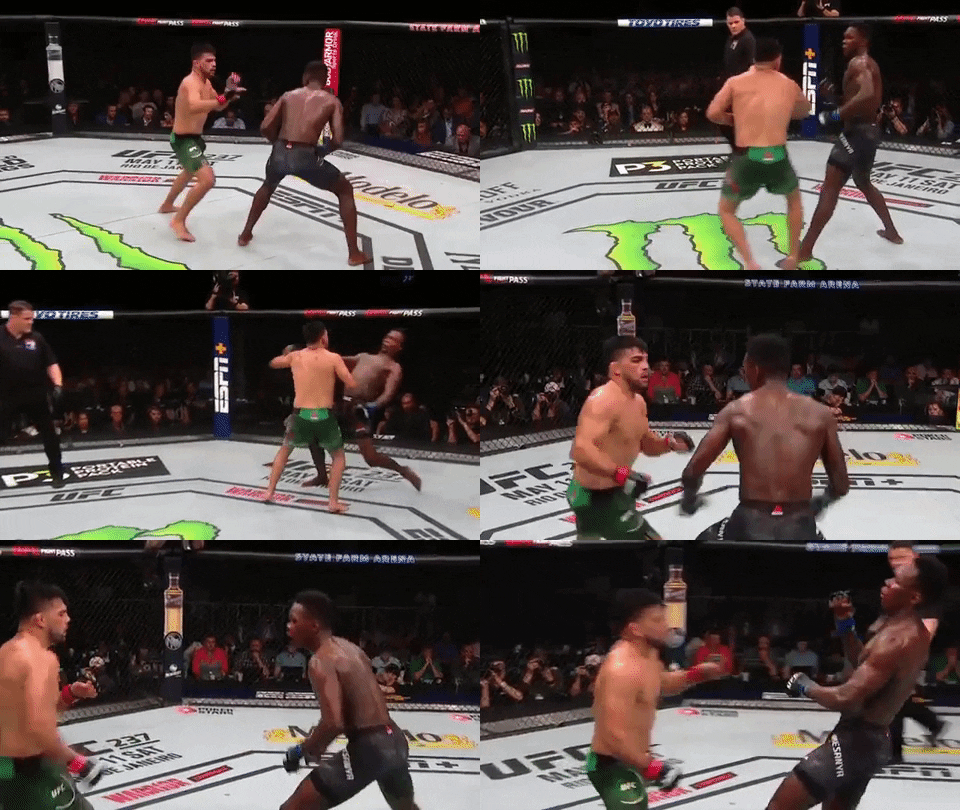
(You can only feint and slip so much, constant pressure and volume punches will land eventually if you keep up the pace.)
There’s a reason why Adesanya was the favorite going into this match: he is the bigger middleweight with a much more decorated kickboxing background. Adesanya was able to keep Gastelum at range and guessing which attacks will be thrown. One of the best at feinting in the UFC (outside of Max Holloway and Alexander Volkanovski), Adesanya will feint 5-6 times to land an actual strike. Shoulder feints are an effective tool utilized by prolific jabbers, and hip feints can cause opponents to stop in their tracks since they’re not sure whether to retreat back or try and check the kick. To ensure that he would be the winner in the later rounds, Adesanya kept kicking Gastelum to the body and legs so that his conditioning would drop off. When Adesanya mixed in jabs to the face and midsection, it made Gastelum hesitate when advancing. The moves paid off as Gastelum wilted in the final round while it looked like Adesanya could have finished him if there were just a few more seconds on the clock.
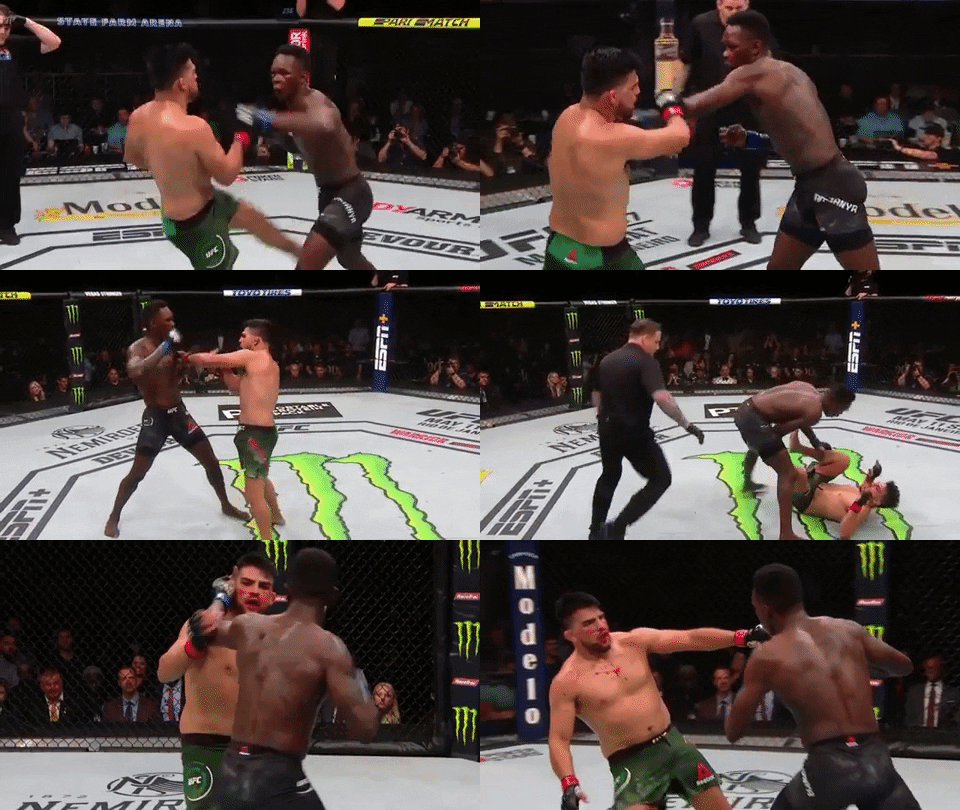
(Even until the final moments, Adesanya kept up the accuracy and placed his shots well, dropping Gastelum and winning the interim title.)
At 6’4” with an 80” reach, Adesanya is on the taller side of middleweight and is often looking down at his opponents (literally and figuratively). Although he has had to make modifications to his striking since transitioning over from kickboxing full time, a good chunk of his strategies and key moves have stayed the same. Since Adesanya has a better than average reach for the division, it would be stupid of him to not take advantage. In the grappling department, Adesanya uses his length and leverage to thrust his forearms on the opponents’ shoulders or neck, choosing to frame as his first line of defense. From there, he can utilize effective footwork to pivot out of harm’s way or work his way into the clinch (much like Anderson Silva). The days of simply sprawling and working your way back up are long gone, a fighter needs to be able to come up with better defensive strategies when confronted with crafty grapplers.
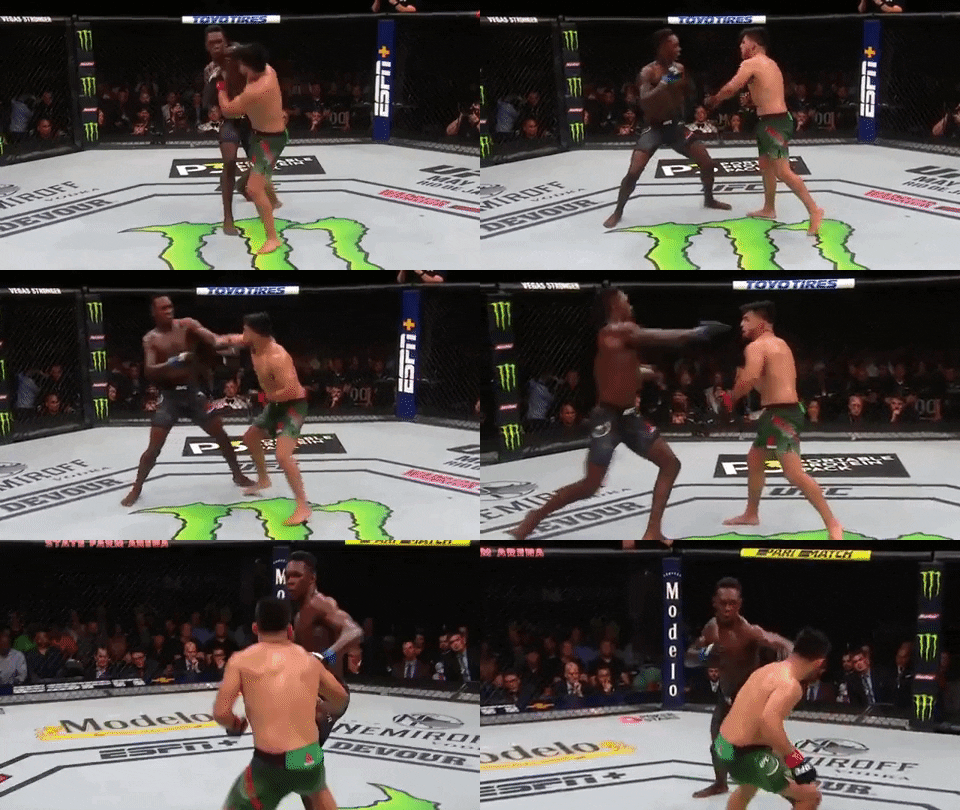
(Sticking his lead hand out and framing off Gastelum’s neck, Adesanya can return fire with straights and kicks.)
Despite all his fancy kicks and taunts, it’s the basic punches and regular round kicks that score the most damage for Adesanya. When he caught Gastelum and Brunson, it was mostly straight punches, not hooks that rocked them both. He’s able to disguise a lot of his strikes by constantly feinting (as mentioned above). By adding some stutter to his punches and steps, Adesanya can put you on edge from the get-go without actually using up a lot of energy. The threat of kicks alone are often enough to get people thinking twice before rushing in. When Adesanya connects with kicks (usually round or low kicks), he’ll momentarily go southpaw afterwards to set up a pivot to the outside, a Vasyl Lomachenko favorite. This usually gives him the dominant position needed to follow up with punches or frame off you if he feels a takedown coming. This setup also helps him land his flashier moves, like the question mark kick. These attacks either come after the opponent is fatigued and suffering from an overworked central nervous system or early on to set up false expectations. Much like former middleweight great Anderson Silva, Adesanya does his best work when opponents fall for his feints and start their counterstriking early, leaving them vulnerable to Adesanya’s usually quicker responses. Since he doesn’t have the kind of power that Rumble Johnson commands, Adesanya relies on catching you when you’re off balance and not expecting to get hit. More often than not, this has worked out quite well for him.
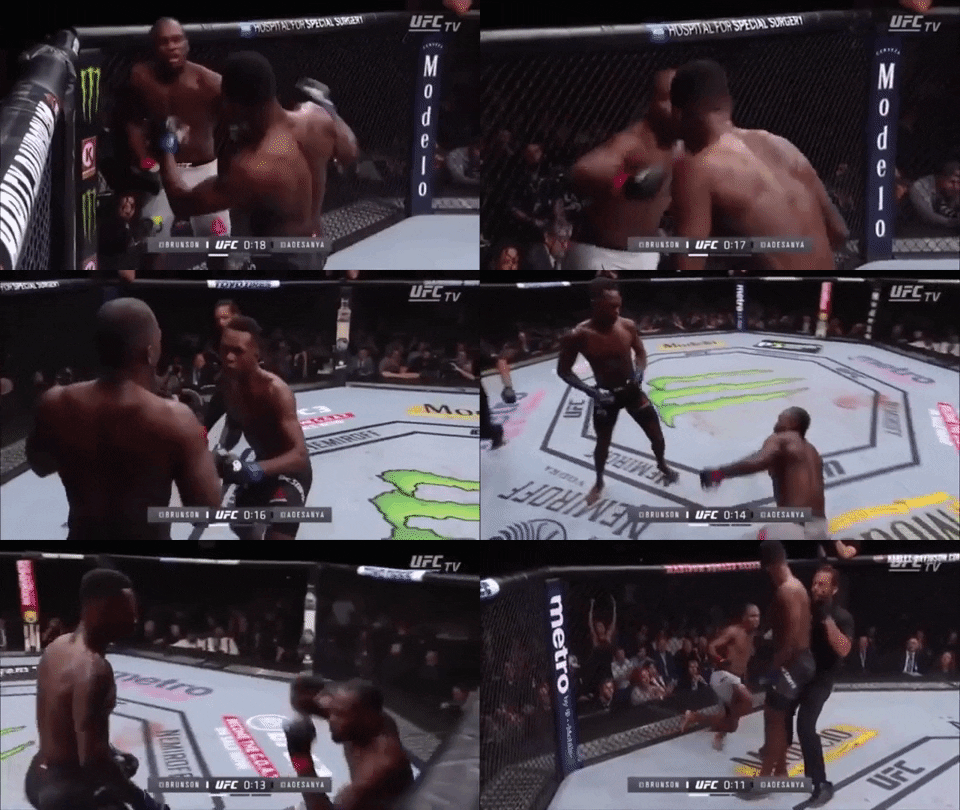
(Already severely rocked at this point, Brunson was no match for the accurate counter punching of Adesanya.)
A common criticism that Adesanya receives is that he’s never faced a strong wrestler that can keep him grounded for long periods of the fight. The closest thing that Adesanya has faced to a decorated wrestler was Derek Brunson, a 3-time Division II All-American. You can also make a case for Gastelum (Arizona state high school champion) and Whittaker (Australian National Wrestling Champion), but all three of them aren’t close to the pedigree of Yoel Romero. As a wrestler, Romero is a former world gold medalist and an Olympic silver medalist, winning a total of 6 medals in both the worlds and Olympics. Outside of Henry Cejudo, he is the most decorated wrestler in the UFC, and he just so happens to be a middleweight (when he’s not a few pounds over). To make things even scarier, his ability to suddenly burst through with strikes means that you are always just one second away from being on the wrong side of a flying knee or an overhand left. His ability to switch smoothly from striking to grappling has given many fighters problems, and stylistically he can be someone that presents an interesting challenge for Adesanya. Even though he’s officially 0-2 in his last two fights, both matches were much closer than what the record states and a solid argument can be made that he should be 2-0 instead.
In his most recent fight against Costa, Romero made a solid case that he’s still a threat to anyone in the division. Despite Costa winning on all the judges’ scorecards, most MMA outlets all scored the fight either 30-27 or 29-28 for Romero, and the result was heavily booed by the fans in attendance. It’s not hard to see why so many scored the fight for Romero, he out-struck Costa (even if you combined the head and body strikes), but there was one area that favored the Brazilian: the dreaded “octagon control”. Recently we witnessed Jon Jones getting handily outpointed by Dominick Reyes, only to hold on to his title due to being “more aggressive.” Romero’s usual habit of playing defense and waiting to explode into attacks often ends with some form of devastating finish, but in a 3-round fight he carries the risk of losing a decision (especially if he wasn’t active enough). One look at his record will show that most of his finishes have all come in the 3rd round, but he’s not always dominant up to that point. Costa was able to withstand the onslaught of Romero’s jabs, kicks, and straights and go the distance.
Costa used constant pressure to keep Romero moving and switching from orthodox to southpaw. Other fighters might have opted to wait and see what Romero does before advancing, but Costa threw that caution to the wind and kept moving forward. Costa did his best John Lineker impression and swung meat hooks to Romero, targeting his body and head. Although Costa had a harder time dealing with the cross guard and shoulder rolling of Romero, he was having a lot of success landing hooks and kicks to Romero’s body.
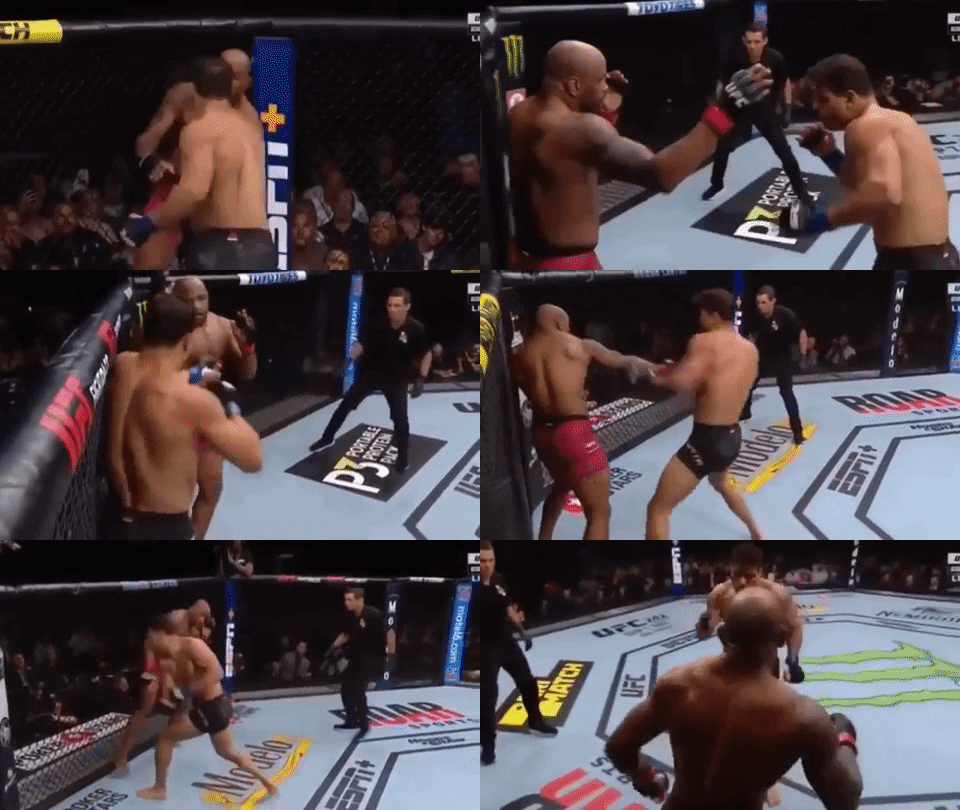
(Backing up Romero is no easy task, and willing to trade with him is dangerous proposition. However, Costa showed no fear in chasing him.)
Romero’s use of the high cross guard is great at dissuading you from throwing hooks and straights but it leaves him vulnerable in the midsection. Costa’s best strikes were his hooks and round kicks to the body and low kicks to Romero’s legs. Combined with his constant forward movement, an argument can be made that he did enough to win the fight. Romero was able to slip a good chunk of the punches to the head, but it doesn’t change the fact that he still was content in leaning back against the cage and let Costa tee off from time to time. Unless you slip and counter with a brutal KO strike or at least knock the other person down, the fight will probably be favored for the fighter who’s the one that doesn’t have his back to the fence.
Even though it was a loss on his record, there were a lot of things that Romero did well in the fight. On display was a decent jabbing game, constantly needling Costa and forcing him to cover up in spurts. To add to this problem for Costa, Romero was landing a lot of leg kicks with only a few of them getting checked. Costa was so fixated on landing his own round kicks to Romero that his lead left leg was completely open and able to be punted. Towards the end of the rounds, Romero would do his best to time takedowns and try to steal the fight on the scorecards. It’s not exactly a fight stopper, but it does show that Romero is picking up a lot of veteran moves and that despite his age, he can still learn a few tricks.
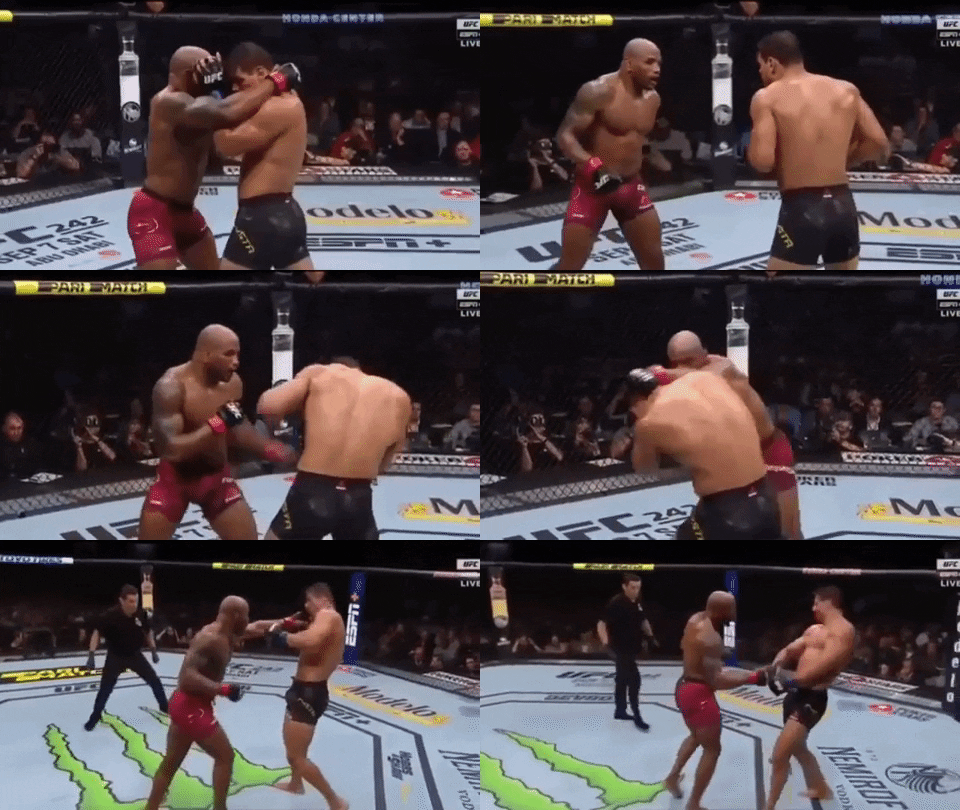
(Check out this awesome jab into a clinch by Romero, which sets up a missed right hand but gives him the chance to land a backhand. I bet Costa wasn’t expecting that.)
Against Robert Whittaker the second time around, Romero showed that he can adjust based on his opponents and he isn’t afraid to try new things. This was an amazing fight and if you haven’t watched it yet, please do so. Despite being only 5’10” with a 74” reach, Romero’s lifelong training as a top-level athlete allows him to absorb physical movements quickly and become a natural when it comes to kinetic motions. Even though he fought Whittaker the first time as a southpaw, he spent large chunks of this bout in the orthodox stance. This threw Whittaker for a slight curveball since you could tell he was planning on facing a southpaw. Whittaker relied heavily on the side kicks (ironically, Romero’s choice of weapon in their first fight) even at the risk of giving up his back if he whiffed. Paired up with lead inside low kicks and the cross guard, Romero marched forward and dared Whittaker to hit him. I don’t know if it was his plan to try and get Whittaker to break his hands on his elbows and forearms, but that’s exactly what happened to Whittaker’s right hand early on.
Even with a broken right hand, Whittaker did plenty of damage with his lead jab and left hook. By the end of the second round, Romero’s right eye was swollen quite a bit, leading many to question how the half-blind Cuban could beat Whittaker now. Remember how earlier I mentioned that Whittaker had his right hand broken? It also meant that he had one less weapon to work with. And with Romero’s new orthodox stance, Whittaker had less success with his rear front kick. In their first fight, Romero was able to do quite a bit of damage to Whittaker’s lead left leg with his side kick, which forced Whittaker to start exchanges with his rear front kick. This might seem dangerous, but it allowed Whittaker to kick Romero with force and keep him at range. Afterwards, Whittaker landed in southpaw stance where he could now throw his overhand left with more power. This time around, throwing a front kick with his lead foot while attempting a left hook immediately after was a bit too much, and Romero timed a perfect left-right hook to drop Whittaker in the 3rd round. Despite flirting with disaster, Whittaker survived the round and spent most of the 4th doubling up on his jabs and throwing high kicks to work around Romero’s high guard. Then the 5th round came and almost everything changed.
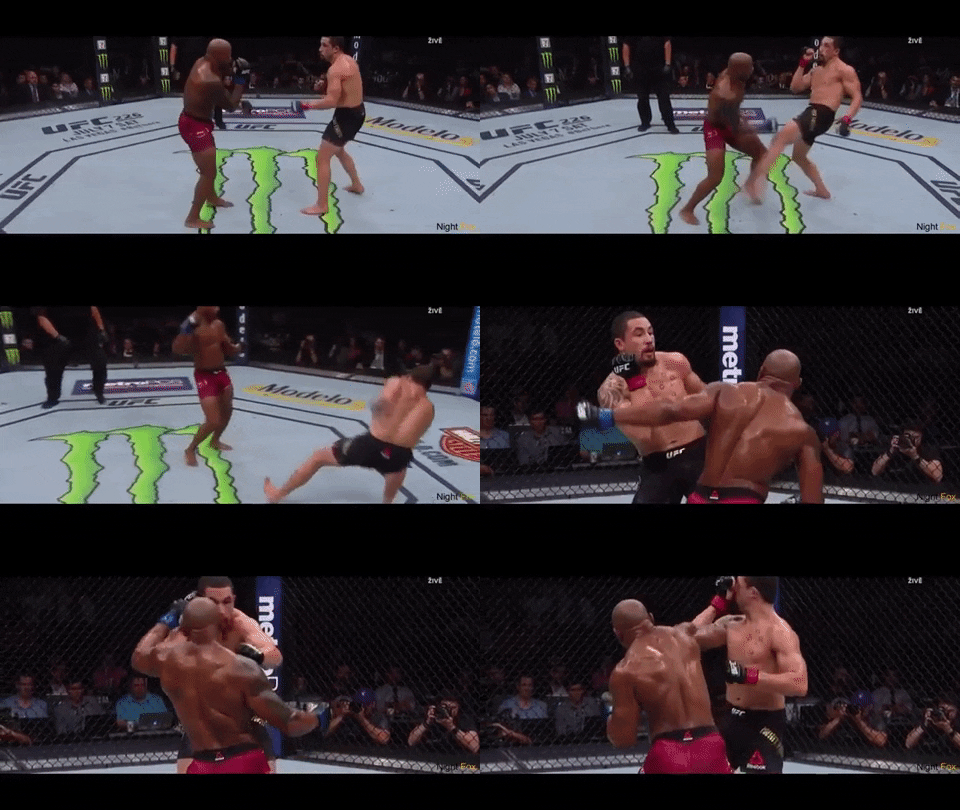
(Whittaker survived this nightmare and actually did pretty well in the 4th. Credit to Romero for timing it well.)
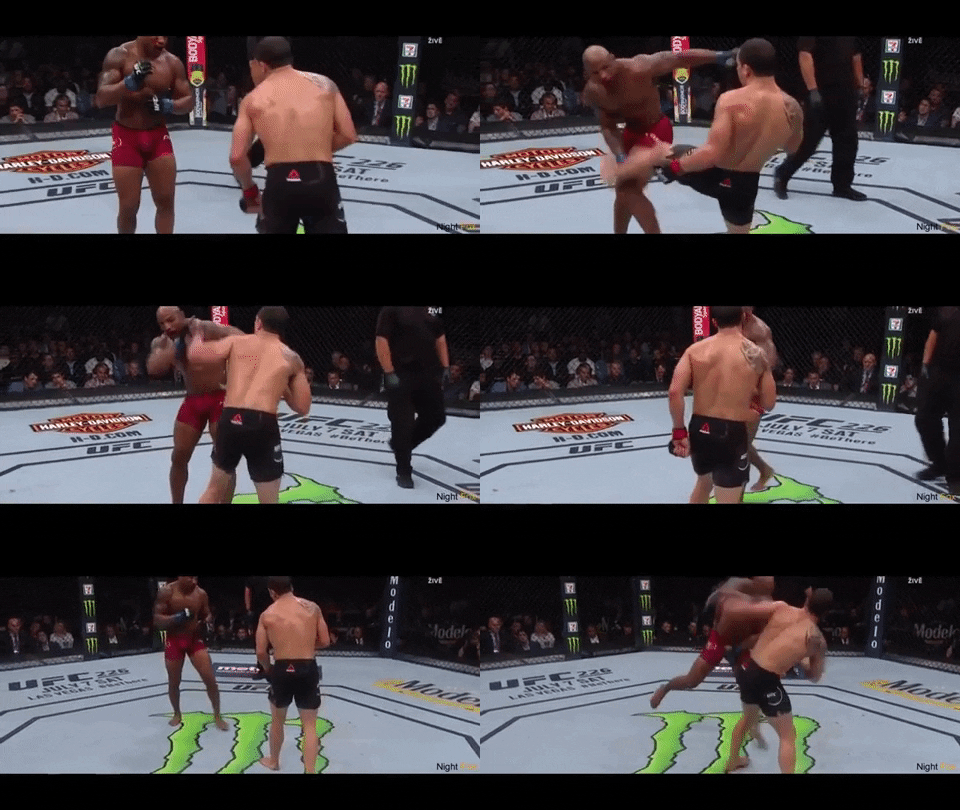
(Kicks, double jabs, and left hooks kept Romero at bay for the most part.)
The last round of their rematch showed that even in the final few minutes of a championship fight, Romero is dangerous and can hurt you at the drop of a hat. Romero attempted to trap Whittaker’s lead leg with a low kick to left hand, one of his favorites and one that he used beautifully against Tim Kennedy. He switched to southpaw to try this move, but Whittaker smartly ducked under a murderous left hook. Unfortunately for him, Romero doubled up and threw the left hook again, this time connecting on a vulnerable Whittaker who got dropped immediately. Doubling (or tripling) up with hooks on the same side is a great way to change things up from the monotony of switching from left to right or right to left. Look no further than Nick Diaz who does a fantastic job of this in MMA, and Ricky Hatton as another example in the boxing ring.
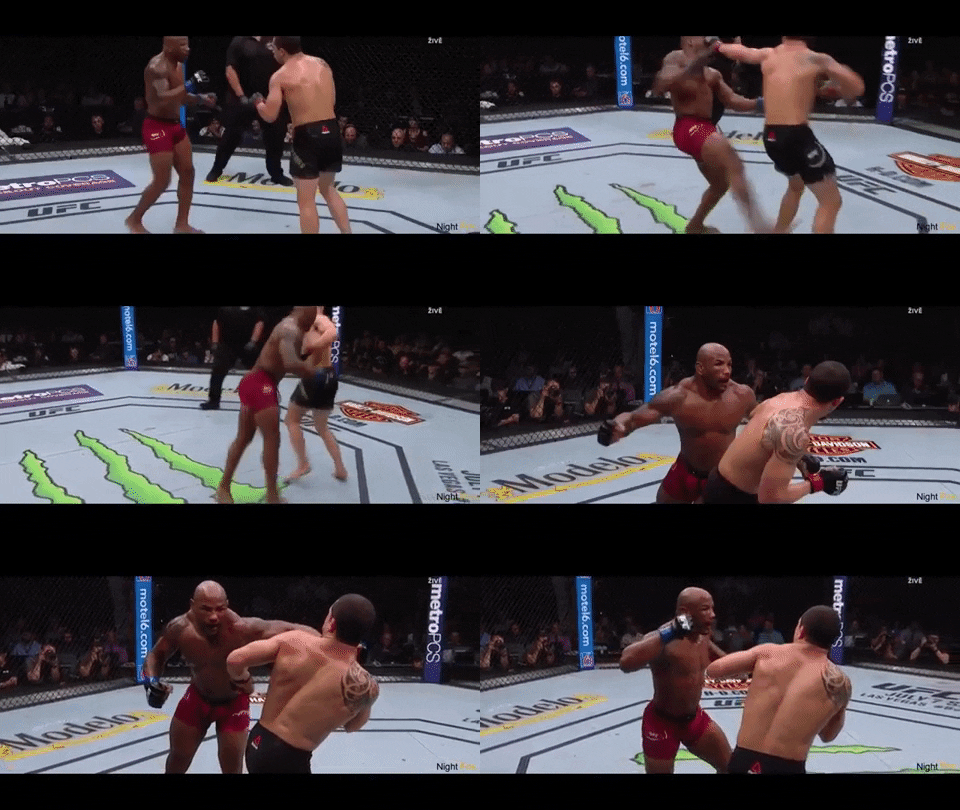
(Already have slipped one hook, Whittaker is in no position to properly defend a follow up. He eats the hook right on the chin and falls to the canvas again.)
Even though Whittaker retained the belt, there were enough in the MMA media that either called it a draw or gave it Romero. This is the danger of simply looking at a fighter’s records and judging their entire career off it. Simply looking at the wins and losses doesn’t show how dangerous the fighter is or what their strengths are. Romero is famous for being able to lull you into a false sense of safety by hanging back and letting you come to him. He usually uses this time to pace himself and prepare to lunge in on any possible openings that might present themselves. Most of the time, his opponents are so worried about getting clipped early so they’ll hang back and stay tentative and not engage as much as they should, giving Romero opportunities to land with his own offense and peel away at your defense. The terrifying thing is that you can be winning the entire fight, until he finishes you. Luke Rockhold, Chris Weidman, and Lyoto Machida were all doing well until one well placed strike from Romero ended it all. Can Romero beat Adesanya? Definitely. Can Adesanya beat Romero? Absolutely. The only difference is their path to victory.
For Adesanya, Robert Whittaker laid out a lot of the game plan in how to beat Romero. One of the best ways to tire him out is to constantly attack him with a varied striking arsenal, favoring fast in and out movement and strikes that can land from a distance. By pumping out feints, doubling/tripling his jab, utilizing rear front kicks, low line kicks, and the occasional head kick, Whittaker kept Romero at bay (for the most part) and won two fights back to back. When you’re constantly forced to react and move on the backfoot, it’s going to fatigue you no matter how well conditioned you are.
Even though it might seem like suicide to throw so many kicks against a wrestler, Whittaker showed that this is a sound strategy to use. Whittaker pressed forward throwing out his right front kick (in the first fight) and side kicks (in the rematch), often leading with it, countering with it, and just throwing it anytime Romero got too close for comfort. Despite the risks, the kicks did a great job of keeping Romero at a distance and allowed Whittaker the chance to land his patented left hook constantly. Mixing in high kicks and jabs, Romero was constantly forced backwards and attempted takedowns from too far out. Even Romero’s low line kicks can be countered if timed correctly. Adesanya came dangerously close to catching Whittaker whenever he led with the low line kicks, returning fire with a high kick. It’s unlikely that Adesanya can match Romero in a wrestling contest, but this is an MMA match. Whittaker made sure to make it to the fence and wall walk up while making sure Romero couldn’t get in any hooks, denying him any extended time on the mats. Adesanya’s great use of framing and wall walking can help him stay on the feet. Dominick Reyes proved in his most recent fight against Jones that even if you don’t have a wrestling background, takedown defense is easier to implement than a strong offensive wrestling game.
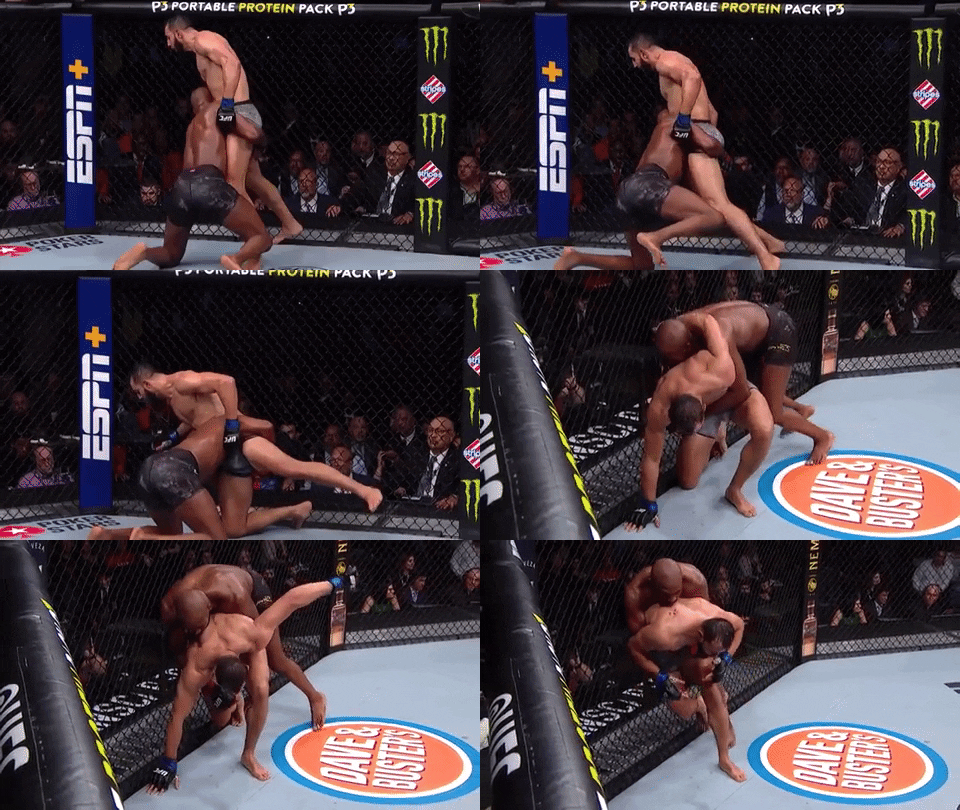
(Here, Reyes used the same principles of wall walking that Whittaker utilized in both fights against Romero. Note how by keeping his leg and hip near the fence prevents Jones from sinking in his hooks.)
Romero’s strategy has largely been laid out by Gastelum and it has one key feature: attacks to the midsection. I keep mentioning Gastelum, but it can’t be overstated how much we learned about Adesanya and his vulnerabilities in that fight. Even though Gastelum had a shorter reach than Whittaker, he was able to get in on the inside more often and land with punches. Gastelum was able to do this because he mixed in jabs to the head with hooks and straights to the body. To show how effective the body punches are, look at Floyd Mayweather Jr. Widely considered one of the greatest defensive boxers ever, even if he had trouble when he got punched towards his stomach since it can’t be simply moved off line or leaned back to avoid damage. This was something that Whittaker’s team should have scouted and could have worked on earlier, but Romero should utilize them often.
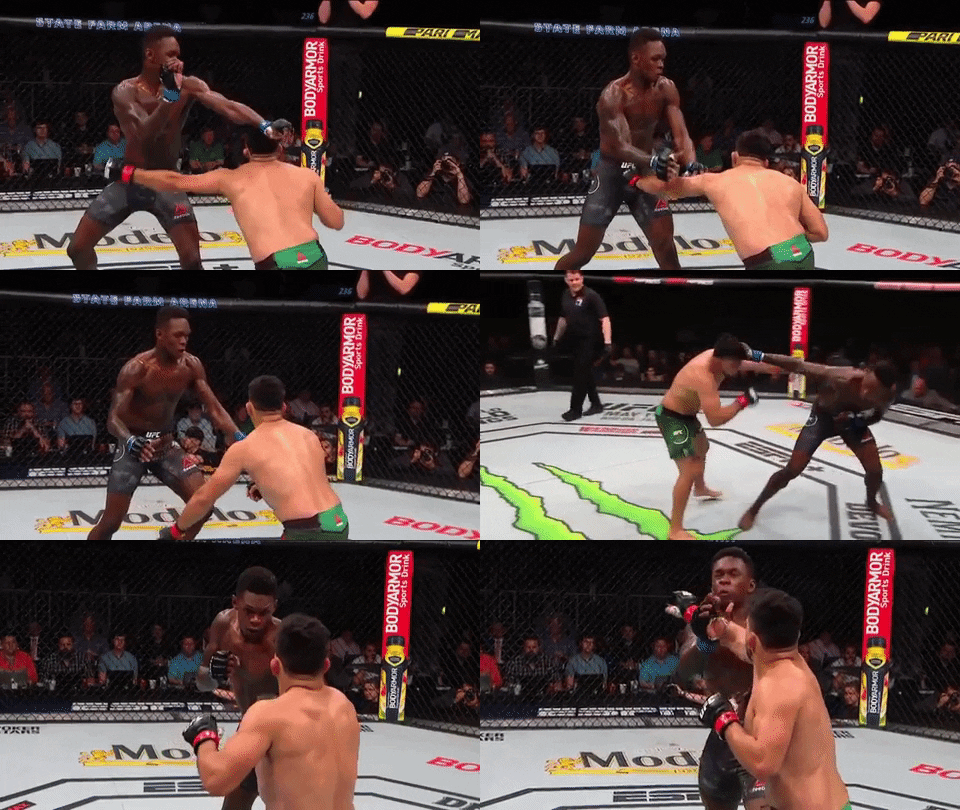
(Body shots, alternating long hooks, and lunging jabs can be effective if you’re quick enough.)
Even though Adesanya is the better kickboxer, Romero shouldn’t be afraid to exchange kicks. As stated in numerous previews (and fight studies), kicking with a kicker is a great way to keep them from being able to land with reckless abandon. Even if your kicks are ugly and don’t “look pretty”, as long as they keep a fighter in place and allows you to follow up with punches, it’s a win. Gastelum’s kicks didn’t look nearly as nice as Adesanya’s, but they got the job done and kept him in position long enough for him to land with some punches after.
Romero’s high guard can shield him from jabs and hooks, but it shouldn’t be something that he hangs onto religiously. Using it to lull Adesanya to get closer before he explodes could prove to be beneficial, and Romero definitely has the timing and power to do so. Just like in the second Whittaker fight, Romero should definitely consider doubling and tripling up on attacks. Whittaker had success whenever he threw these kicks as Adesanya was angling away, there’s no reason Romero can’t as well. Adesanya can be hit, but you have to keep him aware of the threats you bring. Otherwise, Adesanya can set his pace comfortably and attack at his leisure. By forcing him to fire early, there’s a good chance you can catch him with your own offense. An older Anderson Silva was still able to get Adesanya to bite on some of his feints and landed more than you’d think.
The circumstances that brought this fight together isn’t perfect. However, we get to see if Adesanya can back up his prediction of finishing Romero. So far, no one in the UFC has been able to do so. Come Saturday night, we’ll get to see if City Kickboxing can keep the title or if American Top Team will add another champion to their stable.
