Home

 Creators
 Search
 Recent
 Random
 Posts
 DMs
 Tags
 Random
 Importer
 Import
 FAQ
 Account
 Register
 Login
 Favorites
 Keys
 Logout
 Telegram

Informed Consent - chapter 7 (with images) (Patreon)
Content
The email arrives at 6:47 on Monday morning, before I'm out of bed.
Please come by my office at 8:00 today before your shift. -S.B.
No subject line. No explanation. I read it on my phone with the screen an inch from my face, the blue light cutting through the dark of the bedroom. The sheets are warm. My right breast is pressed flat against the mattress. I don't move.
I shower. The water hits my shoulders and runs down the slope of my chest and pools in the new hollow of my waist before it falls. My nipples tighten in the steam. I wash my hair with the grapefruit shampoo that's mine now, bought with my own money, and the smell of it fills the bathroom the way hers used to.
The drive to St. Luke's takes eighteen minutes. The Monday traffic is abysmal. I park in the staff lot and stay behind the wheel with the heater fan still blowing after I cut the engine. The parking lot is half full. The building is brick and glass and I've walked into it every morning of my time here.
Sonia's office is at the end of the lab corridor. The door is open. The monitor faces out. The plant on the shelf hasn't changed. The stapler hasn't moved.
She looks up when I come in. She's not typing. Her hands are folded on the desk blotter, and the glasses are on the beaded chain, and the monitor is dark.
"Close the door," she says.
I close the door.
She doesn't ask me to sit. I sit anyway, in the chair near her desk, the one with the vinyl seat that sticks to the backs of your legs in summer.
"I've been doing this for twenty years," she says. "I've never had to have this conversation."
I don't say anything.
"I know what happened to the Voss specimen," she says. She says it the way she'd report a lab value. Flat. "I know what the tube was. I know who drew it. I know the rejection record was falsified from your terminal at a time when the lab had already closed. I know the courier log shows no discrepancy because the tube was never in the bag. I know you called in sick the following Monday and were out the week. I know what the fever means."
She picks up a pen and sets it down.
"And nobody needed that tube," she says. "The assay ran on the three that arrived. There was no order for a fourth and no clinical reason for one. So it wasn't a mistake, and it wasn't an impulse of the moment. It was drawn on purpose. The intent existed before the opportunity did."
She looks at me.
"And I know what you look like now," she says.
The room is small. The centrifuge hums through the wall, a low, constant vibration I've stopped hearing and hear now.
"I'm not going to report it," she says. "I'm telling you that plainly so you understand what I'm offering you. I reconciled the record Friday. The accession is closed. The tube is gone. The file is clean."
She looks at me.
"You can resign," she says. "Effective today. I'll process the paperwork. You'll get two weeks' severance and a neutral reference. Or I can walk this upstairs and you can explain to the board why a patient sample left this building in your body."
The word body hangs there.
"I'll resign," I say.
She nods. She opens a drawer and takes out a single sheet of paper, already printed, already dated. My resignation letter. She wrote it for me. The date is today. The signature line is blank.
"Sign it," she says.
I sign it. My name is Marcus on the paper. The signature is the same signature I've been signing for four years, the M and the loop of the c and the trailing line that used to mean something. The pen is hers, a cheap ballpoint with the clinic logo on the clip.
She takes the paper back and puts it in a manila folder and closes the folder.
"Your badge," she says.
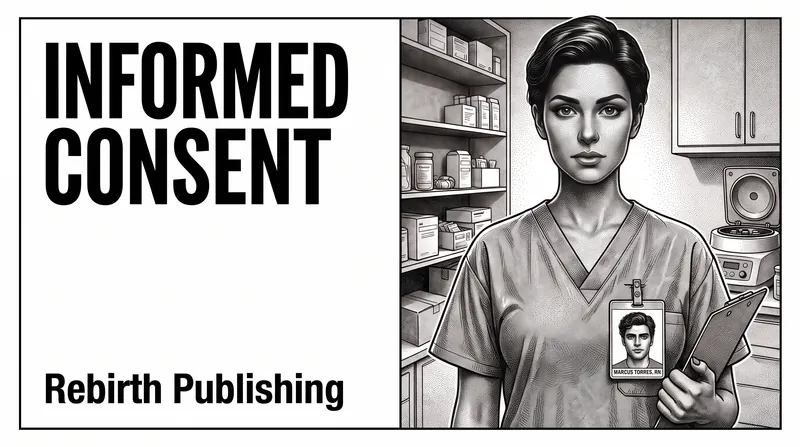
I unclip it from my scrub top. The photo faces up between us. Four years old. The jaw. The stubble. The man.
She picks it up and looks at it, and then looks at me, and then at it again. She holds the comparison for three full seconds, the way you check an ID against a face at a border. I stand there and let myself be checked. My face does nothing. I make it do nothing, and under the stillness everything moves: the pulse in my throat, the heat crawling up the back of my neck, the urge to turn my head forty-five degrees and give her the angle that matches least. The man in the photo has a jaw you could set a level on. The woman standing at her desk under the fluorescent light doesn't. Neither of us says it. She opens the drawer and drops the badge in on top of paper clips and a spare set of keys, and it makes a small plastic sound, and she closes the drawer on it. The drawer doesn't stick. Everything in her office works.
"You can go," she says.
I stand up. The vinyl seat releases my legs with a small sound. I put my hand on the door knob.
"Why," she says.
I stop.
She's not looking at me. She's looking at the closed folder on her desk, her hands flat on top of it, the purple beads hanging still against her chest.
"I've been running the reconciliation for a month," she says. "I knew in the first week. I've been watching you come in every morning and do your job and take your gloves off and wash your hands and go home, and I kept asking myself why a competent nurse with four years of clean charts would steal a patient sample and inject herself with it in a supply closet."
She looks up.
"Then I watched you change," she says. "Week by week. And I stopped asking why."
The centrifuge spins down through the wall with a descending whine.
"I don't know what you think this is," she says. "I don't know if you think I understand it, or if you think I'm being kind. I'm not being kind. I'm being practical. Better if you walk out quietly and I close the file. The specimen was never clinically required and the accession is shut. Nothing left this building that anybody is owed. That makes it a personnel matter and personnel matters are mine until I decide they aren't. A board hearing would destroy this clinic. Dr. Yuen would lose her license. The patients would lose their care. You'd lose more than your job."
She turns the pen over once and sets it down.
"And there's the part I should have led with. Since March you've had that in your arms and you've been putting a needle in eleven people a day. I've pulled the stick log every Monday morning since I worked it out. Zero. Four Mondays of zero." She squares the folder against the blotter. "You didn't hurt anybody. I've had the numbers tell me so every week and I still want you out of this building by noon."
She picks up the pen again.
"But I want you to know," she says, "that I see you. I see exactly what you did."
I stand in the doorway with my hand on the knob. The hallway is empty. The lab techs are behind glass at the far end, bent over a centrifuge, their backs to the corridor.
"Thank you," I say.
She doesn't answer. She's already turned the monitor back on.
I walk down the corridor and through the double doors. Appurva is at the draw stations, breaking down her tray, the label maker hanging off her pocket.
"There you are," she says. "You were in there forever. What'd she want?"
"Personnel stuff."
"Ugh. The badge thing? They make you take a photo like it's a mugshot." She snaps the lid down on a sharps container. "Hey. Dumplings. This week, for real. You've been dodging me since March."
"Yeah," I say. "Dumplings."
"Thursday. After shift. I'm holding you to it."
"Yeah. Thursday."
"Good." She's already moving, rack in her hand, a woman with a nine-fifteen. "And I'm telling Denise you took my smalls. Blood money."
I stand there one second longer than the exchange needs. Then I go past the break room and the supply closet and the waiting room. A man in the waiting room is reading a magazine with the pages turned down at the corners. A woman is holding a sleeping toddler. The receptionist is on the phone, saying Tuesday, we have Tuesday at two.
The elevator is at the end of the hall. I press the button. The doors open. I step in.
The parking lot is full now. The morning light is flat and white and the cars are baking in it. I find mine by the row marker, B-7, the same row I've parked in since my first shift. I get in and start the engine and the air conditioning kicks on, blowing hot for the first thirty seconds before it remembers to be cold.
I sit there. My hands are on the wheel. The badge is gone from my chest and the weight of it, which I never noticed, is suddenly missing.
I don't cry. I wait to cry and the crying doesn't come. What comes instead is a flat even nothing. The same nothing as after the fever. The body finished and not caught up yet.
I drive home. The apartment is dark. The bed is unmade. I stand in the kitchen and open the fridge and there's nothing in it but mustard and a jar of pickles and two beers.
I take one of the beers. I open it. I drink it standing at the counter in the apartment where I used to be a nurse, and the beer is cold and bitter and it tastes like the end of something I chose.
My phone buzzes. Giorgio. You in Friday?
I look at the message for a long time. The poker group is the only thing left that started before and continues after. The only room where I walk in and the floor doesn't shift.
I type back: In.
Then I finish the beer and put the bottle in the recycling and go to bed and sleep for fourteen hours.
When I wake it's Tuesday and the light is wrong for morning. I stand at the bathroom mirror out of old habit and look for the day's increment, the thing I'd have written down. There's nothing to find. Not because nothing is happening. Because I stopped checking.
I take my clothes off and stand in front of the long mirror in the hallway and do it properly, all of it, for the first time since the fitting room.
The hair is getting longer and has decided to go slightly wrong on the left. The face I know. What I haven't looked at straight on is the rest, and the rest has finished. Breasts with weight in them, the left a little lower, a faint blue vein under it and the pale lines at the sides gone silver where they were pink. A waist that goes in, and then the hips, which are the widest part of me now and are the reason for the shoes and the stairs and the way my thighs meet. The stomach is soft in a way I never let it be. Arms without the ropes in them. Hands I wouldn't pick out of a lineup.
There's nobody in this glass I have to explain.
I turn to the side, which is where the change is loudest, and then back, and I stand there with my arms at my sides and let it be an ordinary Tuesday morning in an apartment with no couch.
This is what I traded a man's blood for. It's a body. It's the body I wanted, and it works, and it aches on the left side of my back from sleeping wrong.
The notebook is in the nightstand drawer, the drawer that sticks. The last entry is the swelling note from the week of the bleed. The pen is still open in the spine where I left it. I could catch the record up, measure, estimate the gap, bring it current. A nurse keeps records, and I'm not a nurse anymore. I put the pen in the drawer and close it and it sticks and I leave it stuck. Whatever the numbers are now, they're just my measurements.
I make coffee in the Austin mug and drink it standing at the counter.
Nico's apartment is over the garage of a house in Berkeley, up a flight of outdoor stairs that ice over in winter, he tells me. Inside it's one room and a kitchen and a bathroom with a window that doesn't close all the way. A couch with a folded blanket on the arm. A TV on a dresser. A framed jersey, Broncos, the name half-turned to the wall. His boots by the door, laces still tied, knocked over sideways.
"It looks like a man lives here," he says. "I've been told that before."
"It looks like a man who works lives here."
He cooks chicken in a cast iron pan with too much oil and it spits and he holds the lid up as a shield, laughing at himself, and I stand in the kitchen doorway with a glass of wine and watch the backs of his shoulders work. He made rice in a pot, no rice cooker, and it's a little gummy and I don't say anything. There's a salad from a bag. The whole thing takes twenty minutes and we eat at a two-person table that's missing one chair, so he sits on a stool from the workbench in the corner.
"Next time your place," he says.
"There's nothing at my place. I sold the couch."
"Then I'll bring the stool."
After dinner we end up on the couch because there's nowhere else, the plates still on the table, the pan soaking. He has a record player, actual vinyl, a milk crate of it, and he puts something on that he says his father played, a man singing in a low register with a band that sounds like it's in the next room. I don't catch the name. He sits at one end and I sit with my feet up, legs across his lap, and his hand rests on my shin, his thumb moving once in a while over the bone like he's not aware it's moving.
He tells me about the job they're finishing, a restaurant buildout on South Broadway, the owner who keeps changing the tile. I tell him nothing about my week. There's nothing about my week I can tell him. Monday is a manila folder in a drawer in a basement office and a neutral reference. The story I give him is: I left the clinic, it was time, I'm figuring out what's next. He nods like people do when a thing sounds harder than they want to make you say.
"You're the first woman I've dated who quit her job in the middle of us," he says, not unkindly. "Usually they wait till after to blow their lives up."
"I'm considerate that way."
He kisses me somewhere in the second glass of wine, and it's unhurried, one hand coming up to the side of my neck, his palm warm from the dishwater. We stay on the couch a long time doing only that, and it's a thing I'd forgotten, or never had, the way it can be the whole event and not a door to somewhere else. My mouth goes warm and a little numb. His stubble catches on my chin. The record ends and the needle rides the runout groove, tick, tick, tick, and neither of us gets up to fix it for a while.
When his hand slides up my back under my shirt I arch into it. When it comes around front, over the cup of the bra, I make a sound into his mouth that I didn't decide to make. My breasts have settled into themselves, the soreness down to a low hum that flares under pressure, and his hand is careful and then less careful, and the ache and the pleasure arrive braided together and I couldn't separate them if I wanted to.
At some point he shifts and his weight comes down over me, one knee between mine on the couch cushion, and my body does the thing it has never done with anyone. It makes room. My hips tip up under him without my deciding it. My thighs open around his leg. The old body met weight with weight, squared against it, braced. This one receives, and receiving turns out to be active, a thing the muscles do on purpose, my back curving off the cushion to meet him, my hand flat on the back of his neck where his pulse runs fast under the skin. His belt buckle is cold through my shirt. He is broader than me by a margin I can feel in my ribs, and for the first time in my adult life I'm the smaller body under someone, and nothing in me objects to it. The heat sits low and patient, and I could stay exactly that way for a long time.
He reaches for the button of my jeans and unzips them.
I catch his wrist.
He stops immediately, both hands coming up and out, palms open, like a man showing a table he's not holding cards. "Okay," he says. "Okay. Hey." He sits back a few inches. "Too fast."
"It's not you."
"I know," he says, and then, because he's not stupid, "Is it me?"
"It's not you." I pull my shirt down. My heart is going hard and under it the heat is still there, low and wet, the body still mid-yes, because the want doesn't stop when I stop it. "I want to. I just… there's a thing. I need some time."
"You don't owe me a thing," he says. "We go as slow as you want. I've got nowhere to be."
He means it. He means it, and he kisses my forehead, and he gets up and lifts the needle off the record and puts on something else, and we sit there with his arm around my shoulders and my body cooling down by degrees.
Sexual contact. Blood contact. Those are the vectors. A condom is a barrier, and barriers fail, and even a barrier that holds doesn't make the thing honest. I could ask for his status, show him nothing of mine, build the whole arrangement on tests and latex and the words low risk, and every night of it would run on what he doesn't know. I've already lived in one relationship where I was the only one in the room who knew what was happening. I know exactly how that room feels from the inside.
So the hand comes off the waistband. Every time.
"I'm on a timeline I can't explain yet," I say, and it's the closest I've come to the truth out loud. "It's not a no. It's a not yet, and I need the not yet to be mine."
"Take it," he says. "Whatever it is, take it."
He walks me down the stairs at midnight and kisses me against my car, cold metal through my jacket, his mouth warm, and I drive home with my lips raw.
Friday he texts at five. Big night with the boys?
I write back, Every Friday. Nine years.
He sends back a thumbs up, and then a minute later, Where do you guys play?
Sully's. Arvada. Garage, cheap chairs, bad lighting.
And they all know about me? he asks.
I look at that a while. He means: do they know you have a boyfriend, or something like one, a man you're taking slow. That's the cleanest reading and I take it.
They know, I write. Giorgio asks about you.
What'd you tell him?
That you cook with too much oil.
The dots come and go and come back. Drive safe. Tell Kwame I said he's going to lose.
I told him about Kwame at some point, the way he deals. I told him the names. He keeps them like he keeps everything, easily, in the front of his mind.
Sully's garage is cold at the edges and warm at the table. The trophy is on the shelf. Marty is on a streak and insufferable about it, and Kwame takes thirty-five dollars off him over three hours with no expression on his face at all, and Marty says he let it happen because Kwame's car needed work, and nobody acknowledges this. Giorgio asks about Nico and I say it's good, it's easy, and Giorgio says good, easy is underrated, and deals me in.
It's a normal night. The most normal room in my life, and I lose eleven dollars and drive home with the heater on my feet.
Nico is awake when I text him I got home. He calls instead of texting back.
"You smell like cigars?" he says.
"Sully's garage. Nobody smokes anymore, it just lives in the walls."
"Who won?"
"Kwame. Marty paid for it."
He laughs. Then a pause, and the pause has a shape.
"So these guys," he says. "Nine years. They were all friends with you before."
"Before what?"
"Before me," he says. "Before us. They knew you back whenever."
"When I was a nurse."
"Yeah."
He's circling something. I can hear him circling it. The version of me that exists in that garage has a history he wasn't in, four people who watched me arrive as myself and kept their chairs, and to him that history is just a longer friendship than the three weeks he's had. He can't see the thing that's actually strange about the room. He's uneasy about the ordinary version of it, a woman and four men and nine years, and I can't correct his unease without handing him the real one.
"Any of them ever…" he says, and stops.
"Giorgio's my best friend," I say. "Marty's been divorced twice. Kwame counts my chips. Sully's a good guy." I skip the driveway. I'll always skip the driveway. "Nobody's ever. It's poker."
"It's not poker, it's five guys and one woman in a garage every Friday."
"It's four guys and a woman."
"That's not better, Mara."
He's never said my name like that. Loaded. Like the name is a handle he's trying to get a grip on.
"I can stay home," I say. "If it matters that much, I'll stay home."
"No." He exhales. "No, that's not… I'm not that guy. I don't want to be that guy." A truck goes past on his street, loud, and the window he can't close lets it in. "It's dumb. It bothers me and it's dumb and I know it's dumb."
"Why does it bother you?"
Long pause. A truck on his end, then nothing.
"Because when you're there you're theirs," he says. "You've got nine years of a version of you that I've never met. You walk out of here on Fridays and you go be somebody I don't know."
It's the truest wrong thing anyone has ever said about me, because the version of me he's never met isn't in the garage; she's in a badge photo in a drawer in a basement, in a driveway at midnight with a man who couldn't finish my name.
"They don't know a different me," I say. "There's just the one."
"Then I want to meet them," he says. "Bring me. Some Friday."
I should say no. The word is right there. Giorgio would be warm, Sully would get out the good tequila, Marty would be careful, Kwame would count his chips, and Nico would be welcomed like weather, and the whole night would run on what he doesn't know about the room he walked into.
"You don't play cards," I say.
"I lose money at cards. I'm told it's fun."
I give him the slow exhale of a laugh he wants to hear. "Sometime," I say.
"That's a yes."
"That's a sometime."
We say goodnight. I set the phone on the nightstand, screen down, and sit on the edge of the bed in my clothes, jacket still on, the garage smell in my hair.
On the dresser is the printout I made Tuesday at the library, folded twice, a list of clinics that do anonymous testing. My results came back in a patient portal with a login I made under the name on the receipt from the store. Everything negative. Everything a form can clear, cleared. And under all of it the one test that doesn't exist, the one nobody runs, because the virus I carry isn't on any panel. I am the panel.
I lie down on top of the covers in my jeans and look at the ceiling and think about his hands coming up, palms open, showing me nothing to hide. I want the night that's on the other side of the telling. I just have to survive the telling first.
Nico texts at noon: What do I bring to poker night with your ex-boyfriends?
I write back: They're not my ex-boyfriends.
Then: Beer. And don't let Marty talk you into tequila shots.
He sends a thumbs up. He sends it twice. I watch the second one come in and know he's nervous, because he never does that.
I drive over at six. The sun is low and the light is doing that thing where it hits the windshield at the angle that makes every scratch visible. My hands on the wheel are smooth-knuckled. The grip is easy. The reach to the turn signal is shorter than it used to be. I don't notice these things anymore unless I look for them, and today I'm looking for them because Nico is going to be in a room with four men who remember.
Sully's driveway has Giorgio's truck, Kwame's Civic, and Marty's blue sedan. Nico's truck isn't there yet. I park on the street and sit for a minute with the engine off.
The garage door is up. The light is on. Marty is telling a story with his hands, both of them going, the chips stacked in front of him forgotten.
"…so I said, that's not a salad, that's a bowl of ranch with lettuce in it…"
Giorgio sees me first. He stands. He always stands.
"Mara," he says, and the name is easy in his mouth now, weeks of practice behind it. He hugs me, one arm, the way he does.
"Where's the boyfriend?" Sully says. He's got the good tequila out, the bottle with the cork, sitting on the workbench next to the bottle opener.
"He's coming."
"He better bring beer," Marty says. "I told Kwame you said he was bringing beer."
"I didn't say that."
"That's what you said."
Kwame cuts the deck and doesn't look up. "Sit down. We're starting."
I sit. The good chair. My chair now. I hold the seltzer Sully bought in my hand.
Nico's truck pulls up ten minutes later. I hear the engine before I see it, the diesel rattle. He gets out carrying a twelve-pack and wearing a jacket I haven't seen, dark green, and he walks up the driveway like a man who has never once wondered whether he's allowed to.
Sully meets him at the edge of the garage. They shake hands. Sully is taller and Nico is broader and they size each other up, quick and wordless.
"Nico," Nico says.
"Sully. This is my garage."
Giorgio comes over next. The handshake lasts longer. Giorgio is doing something with his face, a careful arrangement of welcome, and Nico matches it without knowing what he's matching.
"Giorgio," Giorgio says.
"I've heard a lot about you," Nico says.
"All lies."
Marty is standing now, his chair pushed back, his hand out before Nico finishes turning toward him. "Marty. I buy the beer nobody drinks. You brought the good stuff."
"It's what was at the store."
"It's what she told you to get," Marty says, and grins at me, and the grin is the old grin, the one from before, uncomplicated and a little stupid.
Kwame doesn't stand. He holds out a fist and Nico bumps it and Kwame goes back to shuffling.
"Sit," Kwame says. "Deal you in."
Nico sits next to me. The chair is too small for him, too small for all of them, and his knee touches mine under the table and stays there. I don't move away.
The first hour is the test and everyone passes it. Nico folds three hands and wins one with a pair of sevens he didn't know was good until Kwame told him. Marty tells the salmon story, sister-turned-date and all, and Nico laughs in the right place, and Marty looks pleased. Sully opens the tequila and pours shots and Nico takes his and drinks it without making a face.
"You play?" Sully says.
"I lose," Nico says. "I'm told it's fun."
"It's only fun if you lose to me."
Giorgio is quiet. He's watching Nico the way he watched me the first Friday I came back, checking for the thing underneath. His eyes go from Nico's face to mine and back, and I can't tell what he's looking for.
"You two met through Vicky," Giorgio says. Not a question.
"Her office," Nico says. "We did the buildout on her floor. She kept coming down to complain about the dust."
"That sounds like her," I say.
"She's got opinions about dust."
Marty laughs. Sully laughs. Giorgio smiles. The laughter is real and it's warm and it takes him in without checking anything, and I sit in the middle of it and feel something shift in the room that I don't have a word for.
The second hour is easier. Nico wins a pot with a bluff that shouldn't have worked and Kwame pays him in exact change, counting twice. Marty gets up to use the bathroom and comes back with a bag of chips and opens them with his teeth. Sully tells the story about the guy at work who microwaved fish and Nico tells one about a client who wanted the bathroom tile to match her dog's collar and the garage fills up with the kind of talk that doesn't mean anything and holds everything.
Giorgio leans over during a shuffle. "He's good," he says, quiet, just for me.
"Yeah."
"He's not scared of us."
"Should he be?"
Giorgio smiles. "No." He picks up his cards. "You did good."
He says it like he means the hand I just played. He means the other thing.
The third hour is when it happens. Marty is dealing. Nico is telling a story about a job in Boulder, a client who kept changing the grout color, and he's got his hand on my knee under the table, and the hand is warm and I'm not thinking about it, and then Marty looks at the two of us and says, "You two are cute."
It's a nothing sentence. Marty says it the way he'd comment on the weather.
But Giorgio nods. And Sully says, "Yeah, they are." And Kwame, dealing the river, says, "She did better than you, Marty," and everyone laughs, and Nico laughs, and his hand squeezes my knee.
They accept us. As a couple. Marty says cute and means it and moves on to the next card, and nobody at this table has ever moved on from anything about me that fast.
Nico squeezes my knee again. He's happy. I can feel it coming off him, the uncomplicated gladness of a man who walked into a garage full of strangers and was handed a beer and told a story and made them laugh.
"You want another shot?" Sully says, reaching for the bottle.
"I'm driving," Nico says, nodding at his own truck through the open garage door.
"Have one anyway, you've got all night to sober up." He points the bottle at me. "She's the one who never drinks past two. Even before."
The word before lands and sits there. Sully doesn't notice. He's pouring.
Nico's hand is still on my knee. I put my hand over his and leave it there.
At midnight we cash out. Nico lost twenty-three dollars and is happy about it. Marty lost forty and is pretending he's not. Kwame squared everything away and paid himself last.
In the driveway, Giorgio shakes Nico's hand again. "Come back," he says.
"I will."
He means it. I can hear it. He means it, and Giorgio means it, and the two of them are going to be friends, and it costs me nothing to watch it happen.
Nico drives his truck home. I drive my car. We don't caravan. He texts me from the road: Your friends are great. Why were you worried?
I wasn't worried, I write back. But that's not true. I was worried the room would crack open. I was worried the carefulness would show. I was worried someone would slip and say the old name or the old pronoun and the whole thing would come down.
Nobody slipped. Nobody came close. The room held.
I park in front of my building and sit in the car. The streetlight is burned out. The apartment is dark. I don't go in yet.
Nico texts again: Can I come over?
I read the message twice. His hand on my knee. His mouth on my mouth. His body warm and solid and present, and the thing I haven't told him sitting between us like a third person in every room we've been in.
Not tonight, I write. This week. I want to talk about something.
The dots come and go. Then: Okay. Whatever it is, I'm here.
I put the phone face down on the seat. I sit in the car with the engine off and the cooling tick of the engine block counting out the seconds, and I don't go inside until the cold comes through the door panel and into my side, and then I go.
Files