Home

 Creators
 Search
 Recent
 Random
 Posts
 DMs
 Tags
 Random
 Importer
 Import
 FAQ
 Account
 Register
 Login
 Favorites
 Keys
 Logout
 Telegram

Places Mentioned in Lafcadio Hearn's Story: "Kitsune" (Patreon)
Content
This one is for Michelle(^_−)−☆. She asked about a couple places mentioned in the latest Bedtime Story ("Kitsune") by Lafcadio Hearn, and I realized she was as interested as I was whether or not these places were still around and what they looked like as I was. I did do a little searching after I read the story. Here is what I was able to find.
1. First, Hearn-sensei talks about Izumo and Matsue, Shimane Prefecture, where he only lived fifteen months before moving to Kumamoto. But it was in Matsue that he met his wife, Setsu. The place left a deep impression on him.
This photo is from here. Remember he mentioned the foxes with broken noses?
That page says he used to take walks around Shiroyama Inari Jinja / 城山稲荷神社 often. I also found that he really enjoyed Jozan Shrine. Lots of kitune statues there.
2. Miketsu no Kami is easier found as Miketsu Kami / 御狐神 or 御食津神. But I also found 三狐神 but pronounced Sakuji. This looks like a deep and fascinating topic. I didn't have time to get very deep into it yet.
3. Kitsuki Taisha / 杵築大社 is the shrine he says is the oldest in Japan, but no foxes there.
4. One that Michelle asked about that I am having trouble finding is the one he mentioned in Yokohama (in the Yoshiwara neighborhood, he says). He talks about all the torii gates and the hundreds of foxes. I'm going to keep trying to find this one.
5. Hideyoshi writing to the Inari God. There's this.
6. A splendid print of the Bandi-san eruption / 磐梯山
7. Jigyoba no Inari is how it's written in the essay. Mr. Hearn says in the footnotes that it stands for Earthwork Street, which has me thinking it's 土業場. Which I haven't really been able to find anything on. Maybe I'm not looking hard enough.
From the the piece: "For example, there stands in a very obscure street of Matsue—one of those streets no stranger is likely to enter unless he loses his way—a temple called Jigyoba-no-Inari, [16] and also Kodomo-no-Inari, or 'the Children's Inari.' It is very small, but very famous..."
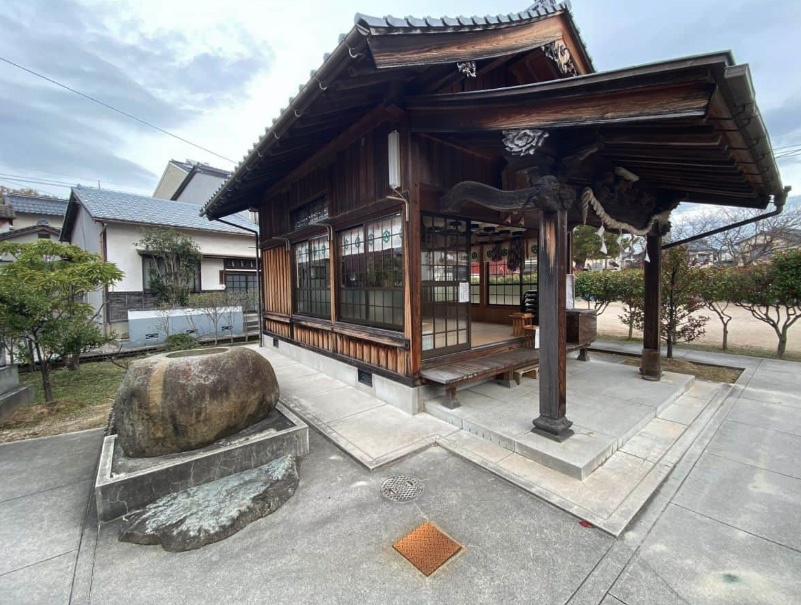
I'm reading that as the temple is called Jigyoba no Inari, but it's also called Kodomo no Inari. Not that there are two shrines. If this is the case, I found a very small shrine that is called today: Komori Inari Shrine / 子守稲荷神社. The fellow who wrote that bit in the link says it's the one that Lafcadio Hearn visited and it also called Kodomo no Inari. Here's another site.
It looks like people pray for protection of their children, longevity in battle, safety at home, protection from insects, to stop wetting the bed, and healing up from any illness. Which is fascinating, because in the more modern era we don't need to pray for help with hot baths and shaving heads. Although...the longevity in battle is still on the list. So, hmm...
And it looks like they don't do the photos on the walls anymore either.
Note: Komori / 子守 just means protecting children. It's often used to mean babysitting or just watching out for a child.
Oh, I just found this website in English and it looks like a wealth of information.
Okay, I'm going to read more of the Green Shinto website, because I'm very intrigued with everything there. And it looks like he traveled throughout Japan studying and blogging as he went. Which is exactly what I want to do, so what wonderful synchronicity here.
Getting nearer to the end of the year. Please stay safe everyone. I'm worried about those who are in extreme weather conditions. I wasn't able to contact my parents on Christmas (they're in the midwest, US) and I feared the worst. After calling all day, worried sick, in a panic, I finally found a friend on Facebook to check on them. Turns out they were just having a really nice time meeting with friends and all. Didn't think of calling their daughter on Christmas. *humph*
XO,
terrie
Files