Home Creators Posts Import Register Favorites Logout

Content

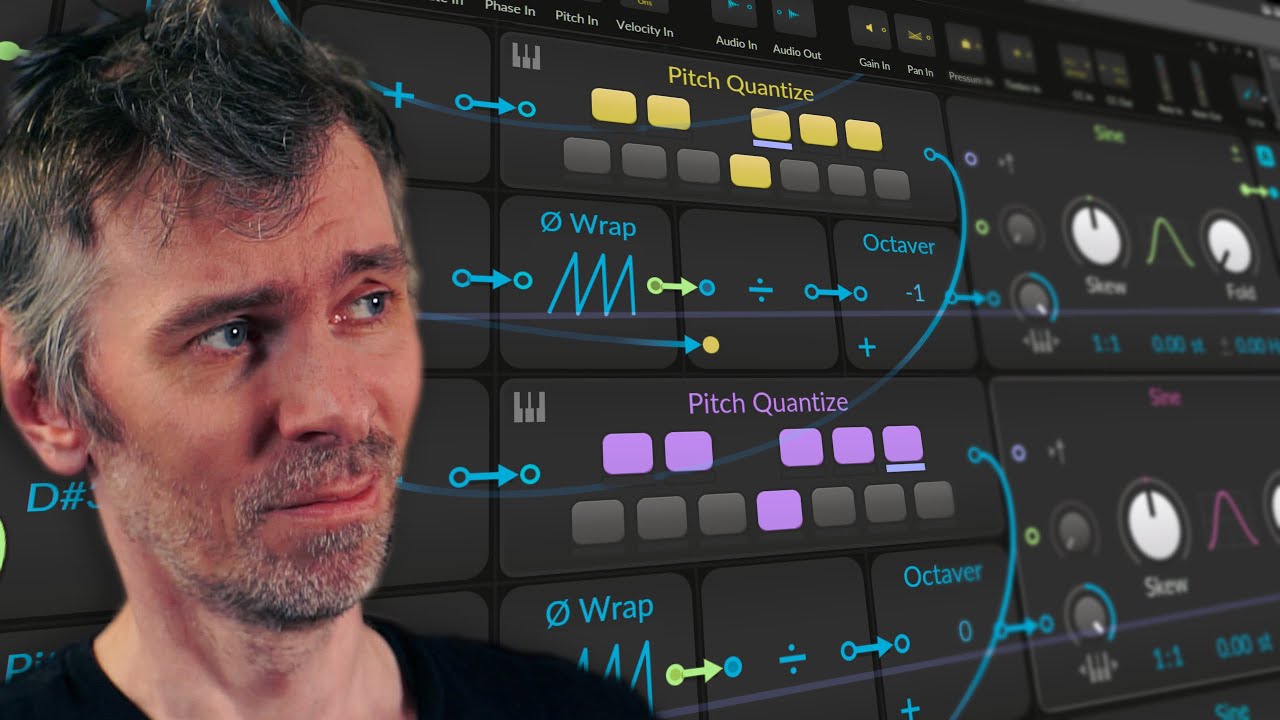
In this video, I demonstrate how to create descending sequences in Bitwig Studio using its grid system. I set up a basic signal chain with a sine oscillator, AD envelope, amplifier, and trigger module, and then use a pitch bus to decrease the pitch with each trigger. Additionally, I show how to keep the pitch within a desired octave range using an octave wrapper, and how to incorporate polyrhythmic patterns using the transport module.

Basic setup with sine oscillator, AD envelope, amplifier (set to 75%), and trigger module.

Use a pitch bus to decrease pitch by semitones (e.g., -3 semitones per step).

Add a counter to control pitch steps, converting trigger signals to whole numbers.

Octave wrapper ensures the pitch stays within a specific octave range (e.g., between C3 and C4).

Transport module creates polyrhythmic sequences by adjusting trigger timing (e.g., 3, 5, or 16 steps per bar).

Combine descending/ascending sequences with effects like reverb and delay for added texture.

Preset Download: https://bit.ly/4haQFB7
Files

Why can't he make music like a normal person?

Exploring some descending/ascending melodies combined with polyrhythms and octave wrappers in the Bitwig Grid. I hope you learn something and get some new ideas. Patch download: https://bit.ly/4haQFB7 Video transcribed, summarized and Q&A on my Blog (no ads): https://polarity.me/posts/polarity-music/2024-10-17-descending-generative-polyrhythmic-melodies/ -- 💕 Support me on Patreon: https://bit.ly/3PgbxZz 💰 donate via Paypal: https://bit.ly/3cae9t8 🎧 my Music: https://polarity.bandcamp.com/ 💾 my Tools: https://polarity.me/posts/articles/2024-08-04-polarity-tools/ 💻 my Gear: https://kit.co/polarity/polarity-music-kit 👉 Discord: https://discord.gg/eWwFBww 👉 Website: https://polarity.me -- 🛒 Buy/Upgrade Bitwig Studio & Support me https://bit.ly/3yQEyDU 🛒 VST/AU Plugin Deals https://bit.ly/3zcvo66

Comments

Alexandre Enkerli

Reminds me of Cem Olcay’s FuncBud plugin (it’s AUv3 so it only works on Apple platforms). It takes a series of simple arithmetic functions, with a number of repeats, and applies the value to a position in a scale, with octave limits (and velocity variations, etc.). So, to play a scale, you just do `x+1`, a descending arpeggio on a tria is `x-2`with two repeats, etc. A “formula” I like does a common pattern in practicing for Jazz improvisation: ascending arpeggio on a 7th chord, then one step up in the scale for a descending 7th chord arpeggio, and so on. The pattern is three repeats of `x+2`, `x+1`once, three repeats of `x-2`and `x+1`once. Sounds complicated. It’s really not. And a lot of fun. Been thinking about reproducing some of these functionalities in the Grid and/or Plugdata.