Home

 Creators
 Search
 Recent
 Random
 Posts
 DMs
 Tags
 Random
 Importer
 Import
 FAQ
 Account
 Register
 Login
 Favorites
 Keys
 Logout
 Telegram

Polarity-SC Update - This Free Spectral Plugin Just Got Smarter (Patreon)
Content
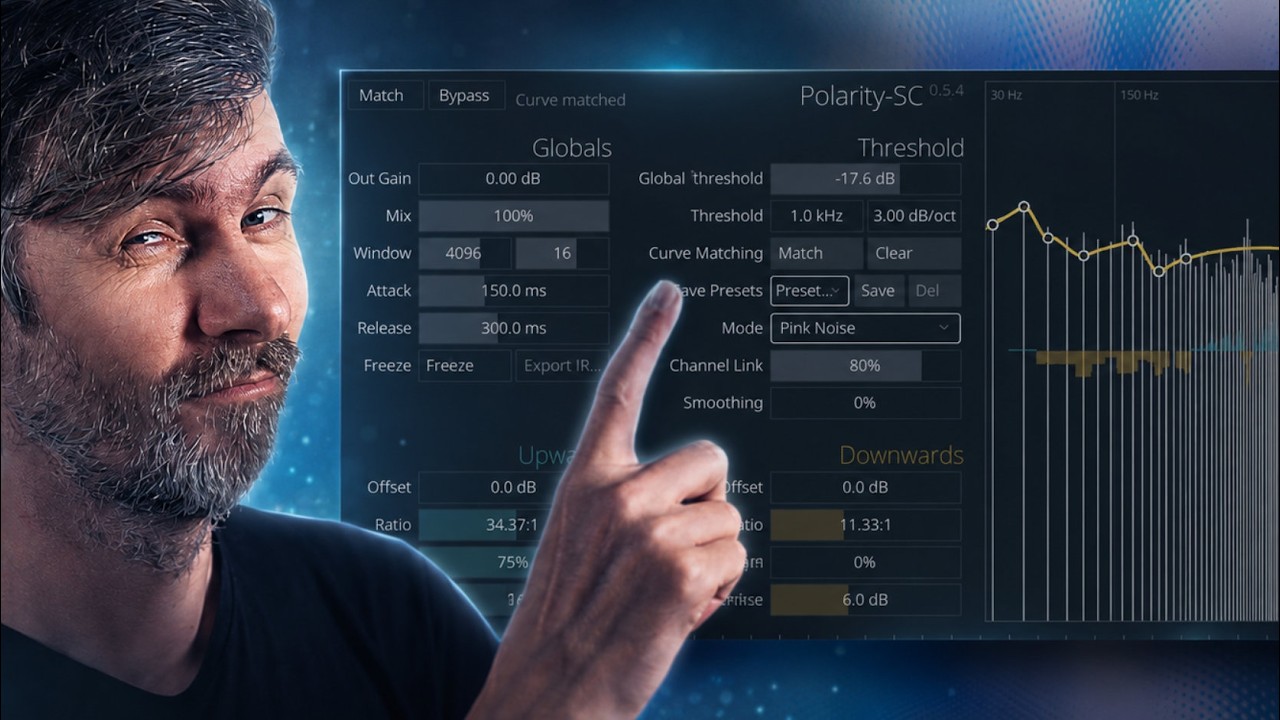
New Friday, new Update for Polarity-SC. The latest update adds threshold curve presets, savable custom curves, and a curve-matching function that captures the average spectrum of incoming material for more transparent suppression. It also improves analyzer calibration so pink noise displays as a straight line and threshold values reflect real dB-per-octave behavior, making setup clearer and results easier to trust in mixing and bus processing.
👉 Downloads: https://polarity.me/go.php?c=polarity-sc
Key Takeaways #
Polarity SC is a free, open-source spectral compressor / spectral suppressor available on Windows, macOS, and Linux as VST3 and CLAP only; AU is not planned in the next few months due to implementation complexity.
The update adds predefined threshold curve presets for common use cases, including equal loudness, drum bus, master bus, and bass bus, so the threshold shape can be loaded quickly instead of drawn manually.
Users can now draw custom threshold curves and save, reload, reuse, or delete them as presets directly from the preset menu.
A new Match function listens for about five seconds and generates a threshold curve from the average frequency content of the current material, which can then be saved as a reusable preset.
A practical workflow is to match the source spectrum first, then set compression to act only slightly above that matched curve, which helps suppress dynamic resonances or peaky outliers without broadly reshaping the EQ balance.
The analyzer has been corrected so pink noise displays as a straight line, aligning the visualization with tools like FabFilter Pro-Q, instead of showing the previous slight tilt.
The threshold slope and related controls now display absolute values, with 3 dB per octave shown as the true straight-line pink-noise reference; the threshold center / rotation point defines the frequency where the global threshold is anchored.
In sidechain compression mode, the default visual/threshold reference switches to a white-noise-style tilted display, which is presented as more suitable for sidechain tasks such as kick-to-bass interaction; the tilt can still be adjusted manually.