Home

 Creators
 Search
 Recent
 Random
 Posts
 DMs
 Tags
 Random
 Importer
 Import
 FAQ
 Account
 Register
 Login
 Favorites
 Keys
 Logout
 Telegram

Bitwig 6.1 Sampler in the Grid (Patreon)
Content
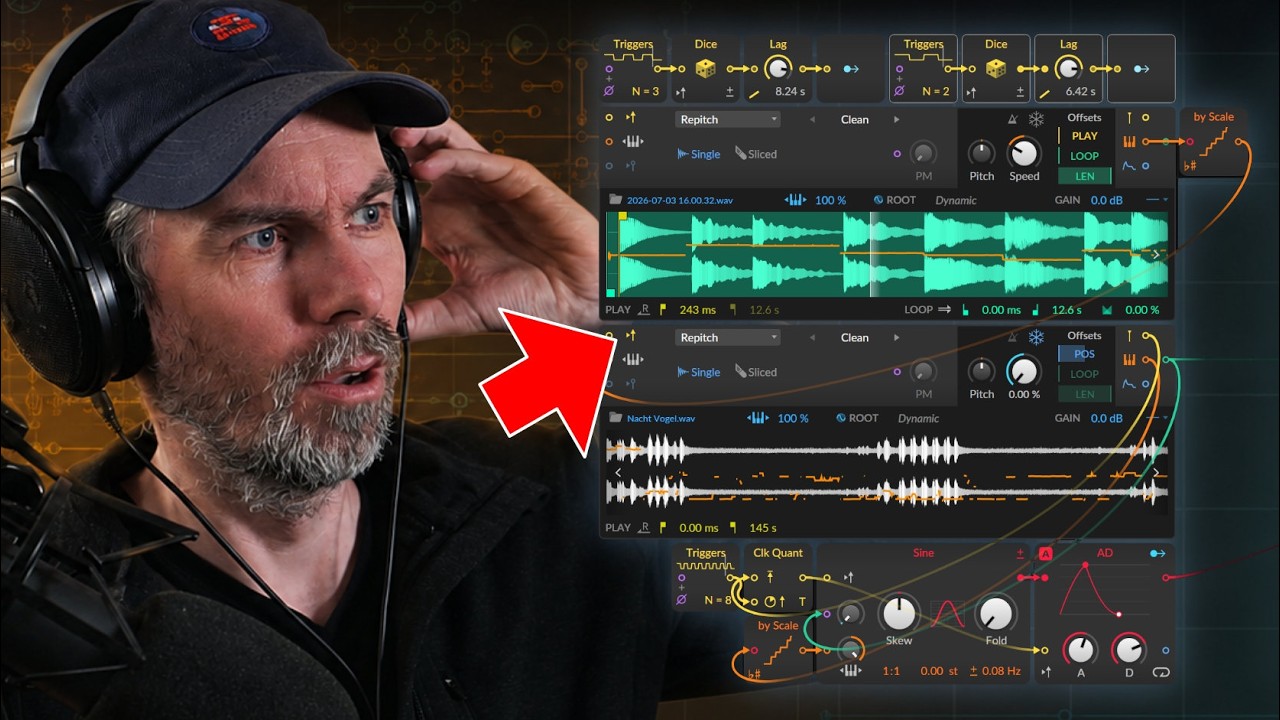
Bitwig Studio 6.1 Grid Sampler analysis out ports add direct access to onset, pitch, and envelope data from loaded audio, turning a sample into a control source for modular patching. This matters in practice because detected notes and transients can drive oscillators, envelopes, triggers, and timing logic inside The Grid without manual MIDI programming.
With pitch and onset extraction, audio can be quantized to scales, aligned to the beat grid, or reused to repitch another sampler layer for generative sequencing, glitch textures, and sample-aware modulation. The feature is especially useful for experimental sound design, even though current pitch and transient detection may still require refinement for precise tracking.
Key Takeaways
In Bitwig Studio 6.1, the Grid Sampler has an “Enable analysis out ports” option in the inspector that exposes three new outputs on the module: Onsets, Pitch, and Envelope.
Dynamic pitch detection must be enabled at least once for usable pitch analysis; after analysis, the Sampler can output detected note information from the loaded audio into Grid modules such as a Quantizer or Pitch Quantizer.
The onset output can be used as a trigger source for envelopes or events, and a threshold stage can filter weak detections so only stronger transients generate triggers.
The envelope output can shape another oscillator directly by multiplying it with a synth source, allowing the amplitude contour of the sample to control a generated tone without using the sample’s audio output.
The sample audio output can be combined with detected pitch to build hybrid patches, such as using the sample to phase-modulate a sine oscillator while pitch analysis drives note tracking.
Pitch and onset data can be musically constrained inside the Grid: detected pitches can be sent through a Scale / pitch quantizer to force notes into a key, and detected onsets can be sent through a Clock Quantizer to align triggers to a rhythmic grid.
A practical resampling workflow is to use one Sampler for analysis and a second Sampler for playback: detect pitch from the first, quantize or scale-correct it, then feed that corrected pitch into the second Sampler to pitch-correct chopped audio hits.
Current limitations include imprecise pitch detection, especially on noisier material, and non-persistent manual onset edits: manually adjusted slice onsets in sliced mode are not retained when switching modes, so corrected onset data cannot currently drive the analysis outputs reliably.