 Home

 Creators
 Search
 Recent
 Missing
 Random
 Posts
 DMs
 Tags
 Random
 Importer
 Import
 FAQ
 Account
 Register
 Login
 Favorites
 Keys
 Logout
 Telegram

Out of the Aeons 8: What Be Those Lights Yonder? (Patreon)
Downloads
Missing 1 full-res photo, 1 file, as this post has not yet been imported.
Content
Lo! Once more unto our spider fine consciousnesses the bolt of horology is thrown, revealing and obscuring as, comet like, it plunges through the ether and into your inbox.

The Swabian comet brings the Swabian plague...surely a scenario in itself. The Book of Miracles (Augsburg, 16th century)
The hour is June 16th, 1487. The place: a Nottinghamshire ridge, England. The bother: the Battle of Stoke Field…or at least, that battle as the backdrop to divination, defeat and disappearance. For, despite the momentous collapse of a final Yorkist rebellion, the question we are driven by sorcerous methods to ask is what happened to Francis, 1st Viscount Lovell, at the end of that last great battle between the Two Roses of York and Lancaster? For Lovell was reported as escaping the field amidst the rebel rout, the eve of which had just so happened to be marked by strange lights seen in the skies above. But his death was never recorded and his body was never officially found…

"Plucking the Red and White Roses in the Old Temple Gardens" after the original 1910 fresco painting by Henry Albert Payne - almost certainly Shakespeare's invention and not real history at all...
My task for this summoning is thankfully not to summarise the curiously English concept of The Wars of the Roses – or indeed the War of the Roses – or indeed The Cousins’ War or The Contention or any other name the civil conflict of 1455 to 1487 has been given. A lifetime of reading awaits any who wish to study the business further, and one may start here or better yet read Alison Weir's fine overview of the matter. No, my interest lies in a very personal response to fugitive figures in the footnotes of history, mixed with a family obsession with Plantagenet dreams and Shakespearean themes.

The hauntingly brilliant cover of the 1964 Marlowe Players 'Henry VI Part II' recordings, by Arthur Wragg
My mother has always had a soft spot for Richard III and I was raised in a house flooded with fiction (good and bad) about the “real Richard”, as opposed to the propaganda job the Tudors wanted to present of the villainous hunchback, known by his detractors as 'The Hog'. A staunch believer that Richard was not responsible for the death of the Princes in the Tower, my mum was always suggesting his character assassination was part of plot to discredit the Plantagenet name. A name I think my mum still feels is a rather nice one. Sorry mum. As always, the winners write the history...

Saint or sinner...? Richard transformed to an Icon of misunderstood regal elegance, artist unknown (design by BBC History Magazine & Immediate Media Co.)
A few years later in my teens I started watching Kurosawa’s moody studies of once loyal swordsmen turned outlaws by misfortune and defeat. The curious parallels between civil struggles struck me. I began to imagine the knights, the earls and the viscounts of England through the lens of a samurai’s defiance. Kurosawa has a way of making his ronin and his banditry seem almost contemporary in their humanity. Flawed, filled with anger, of the earth and blood, his protagonists seem to be dealing with mud and hunger as much as honour and loyalty. I began to wonder what it was that makes Toshiro Mifune’s performances so relatable. At the same time I was beginning to understand something of how little we all really change over the centuries.

Kurosawa's Seven Samurai with the magnificent Toshiro Mifune in the foreground - a big player party behind...Credit: Alamy
This earthy, modern relation to wandering swordsmen and roguish scavengers has fuelled the eye of my horology for some years (I know - I should see a doctor about that...). Who knows what figures of note have fled the battlefield, aided by men and women whose names are lost to the annals? In my late twenties I even began a script for four actors, inspired by the last days of the Wars of the Roses, a mood piece in the style of Christopher Fry’s A Sleep of Prisoners via Akira Kurosawa’s Rashomon. The characters were swordsmen and attendants, not nobles or kings - men and women who survived in the margins of history. It was this echo of the marginalia of things that inspired deeper scrutiny when the name of Lovell was chanced upon in my horological scrying. Especially once the curious details of the Viscount's escape and disappearance were discovered. A vision of the true events of Stoke Field – or that should be what lay behind the aftermath of the battle - was beginning to form in my arcane sight...

Figures battling in the margins of history... (Ms 107, Bréviaire de Renaud de Bar (1302-1304), fol.-89r-89r, Bibliothèque de Verdun)
Francis Lovell was a high-born rogue of fortune. His journey to that field in England was marked with many twists and turns. Having fled Bosworth and the death of his King, he sought sanctuary in Colchester. From there he moved North and attempted to arrange an armed rebellion against Henry VII with the aid of Sir Humphrey Stafford. Spies prevented the rebellion and Lovell fled once again, this time to the fells of Cumbria. Undaunted, there he planned an assassination attempt on Henry. This too failed and he was forced to retreat to Flanders, to the camp of Margaret of York, a fellow survivor of the civil war. Yet Lovell's hopes for rebellion remained and he joined John de la Pole, the Earl of Lincoln, and together they engineered the Lambert Simnell enterprise.

Fittingly for a man who disappeared from history, Lovell has no portrait. Here is a man in a helmet. Dinko Cepak/EyeEm/Getty Images
On the business of marginal figures from history, and in the shadow of Kurosawa's Kagemusha, another classic tale of high-born impersonation, it would be wrong not to mention the surreal figure of The Player King, Lambert Simnel. This ten year old boy's claim to the English throne was slim at best, but proved the final flourish of the plan for the rebellion. Raised to be a king by an ambitious priest, Simnel was almost certainly a commoner who was said to possess a passing likeness to Richard of Shrewsbury, the younger son of Edward IV. Later Simnel would astonishingly be declared to be the escaped Edward, Earl of Warwick instead. Either way it was of course Francis Lovell who crowned the boy in Ireland, before the journey to Nottinghamshire and the battle that would end the saga for once and for all.

A likeness of Richard of Shrewsbury, to whom Simnell was compared - from 'The Two Princes in the Tower' by John Everett Millais
We need not linger on the horrors compounded by civil war. The scene where a son kills a father and a father kills a son in Henry VI Part III speaks volumes as to the brutal nature of such internecine struggle. But the cost of war was not merely physical but also spiritual. Shakespeare was particularly keen to observe the drama of supernatural signs as glimpsed on the night before such a battle. Strange thoughts and visions seen on the eve of such a confrontation are revealed as prophetic and kingly. Death in the name of a true cause is made the great leveller - bringing Princes to the fires of the common soldiery, a weird alliance of classless dread can be found. Where in Richard III Shakespeare has his crippled boar of a king confront his villainy in ghostly visions and prophecy, Lovell and his Plantagenet pretender Simnel had to read the night sky for an understanding of the eerie colours seen.

The 1833 Leonid Meteor storm. Edmund Weiß (1888)
It is just possible that the lights seen yonder before that final battle could have been light reflected from armour onto clouds. The June sun can shine brightly in the early hours and rumour has it that only the Lancastrians could see said illumination. Some few fled, thinking it an ill omen, before the Earl of Oxford stayed the rout. By contrast, the events of the battle were bloody and grim for the Yorkists. Led by the Earl of Lincoln, John de la Pole, the rebel army was largely composed of hastily levied Irish foot-soldiers and German mercenaries. De la Pole advanced first, pressing the Royal Vanguard under the Earl of Oxford. But Oxford's men were hardened troops and the victors of Bosworth. They swiftly counterattacked. The result was a massacre. De la Pole was killed and Simnel captured - he was eventually pardoned, no doubt due to his having been little more than a figurehead in the business and was infamously permitted to work in the King's scullery for his reward. The Yorkist force was scattered and slain. The field ran with blood, so much so the natural escarpment nearby is known as the Red Gutter. With the defeat the last hope of a Plantagenet crown faded into history.
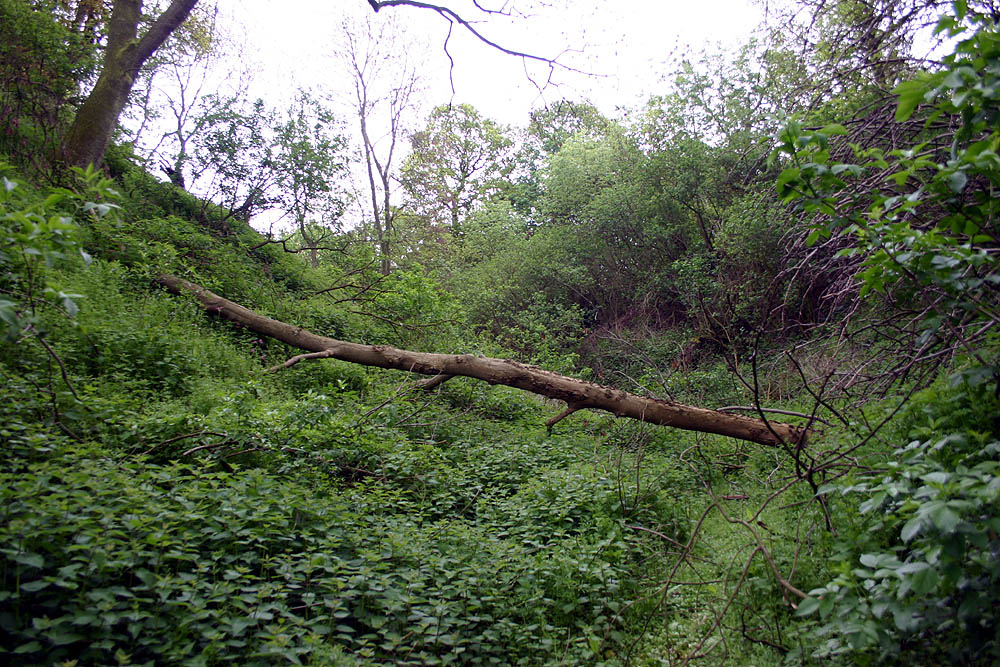
Red Gutter from the Battlefield Trust's eerie collection - where the retreat turned to a massacre...
Many presumed that Lovell escaped to Scotland, for King James IV granted him safe conduct, but no record is found of him there. A skeleton was discovered in a secret chamber, said to have crumbled to dust as soon as it was uncovered, at the family home of Minster Lovell, Oxfordshire. Some felt this could have been the Viscount, but following the rebellion the house was not attended by Lovell's servants and shortly after fell into Loyalist hands. Finally some surmise an unnamed knight's tomb, found at All Hallow's Church, Gedling, close to the battle field, could be the final resting place of the wounded King-Maker. The tomb holds no other clues, but for a faded inscription of it belonging to one fallen at Stoke Field. Yet the mystery of Lovell's final end and, further yet, what brought such strange Illumination down to earth on that fateful summer's day in England, has at last become clear through the Arcane methods of the Apocalypse Players. And so it is with a steely resolve that we present the true events of the 16th June 1487, in our Out of the Aeons scenario seed: What Be Those Lights Yonder?...
JC
Files
Previews only


