Home

 Creators
 Search
 Recent
 Random
 Posts
 DMs
 Tags
 Random
 Importer
 Import
 FAQ
 Account
 Register
 Login
 Favorites
 Keys
 Logout
 Telegram

From 3D Layout to Hand Drawn Background - An Interview (Patreon)
Videos
-
2206ef44d1c16d5c5e4325f25e261b73.mp4
Downloads
Content
This interview was conducted and edited by Maki, who works with Paul as a creative partner overseeing visual direction and production.
Maki:While working on the temple backgrounds, one member noted how much time your 3D approach might save compared to the kind of pipelines big studios tend to favor. That felt like a good place to pause and talk through how you actually use this technique and why it produces a different result. What does that look like in practice?Paul:Of course! The first thing I do is build the environment in 3D, but not because I want a finished 3D background. There are several shots that all take place inside the same space, so the 3D is really there to lock down scale, perspective, and camera placement early on. That way everything stays consistent as the sequence develops.
Here's the 3D layout I'm working from:
Maki:So at this stage, the 3D is laying a quiet foundation that the rest of the work builds on later.
Paul:Exactly. Once the camera is set, the 3D stops driving the look of the shot. I am not trying to copy it exactly. From that point on, I’m deciding what information the shot actually needs once it’s all together and moving.
Maki:If you have ever painted tabletop miniatures, is it the same idea? That the miniature gives you the shape, but the paint job is what people actually see.
Paul:That's a really good comparison, actually! The 3D gives me something solid and accurate underneath, but the final background is still an interpretation. When I ink and hand colour it, I work as if the 3D never existed. I choose the lines instead of just tracing them, and details are simplified or exaggerated depending on how the shot needs to read once animation is layered in.
Here's the finished background after that process:
Maki:That's a big change in atmosphere! Looking at the finished background on its own, this is one of those cases where a simpler composition creates a bigger payoff, right?
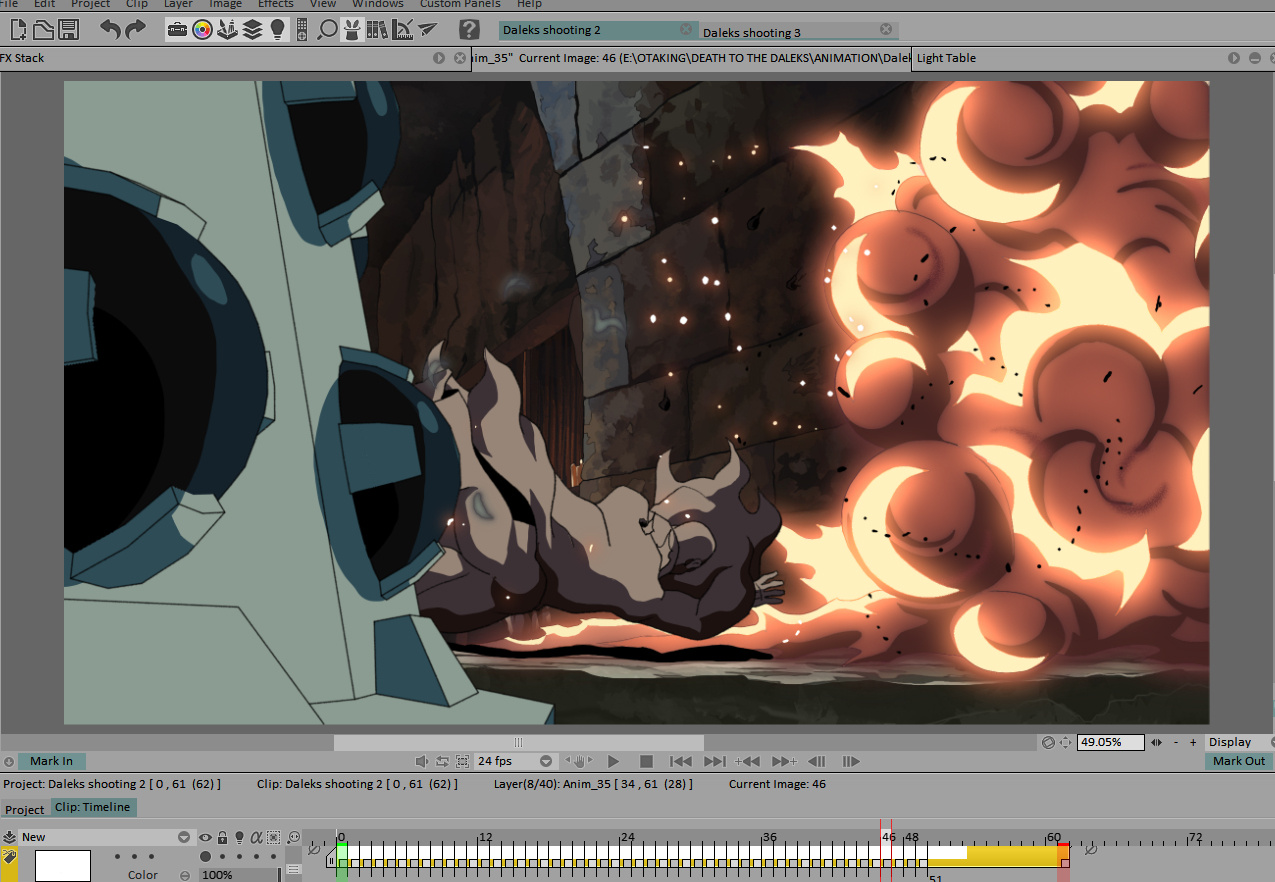
Paul:That's deliberate, yeah. There's a lot of animation happening in this shot, so the background needs to support the action rather than compete with it.
Here's a screencap with the animation layered in:
Maki:Viewers generally refer to your style as old school, even though the structure is still coming from the 3D. Why do you think that is?
Paul:I think that comes down to who’s making the final stylistic decisions. In a lot of modern animation pipelines, the 3D environment is pushed very close to the final image, with lighting and surface detail largely decided in 3D. That makes a lot of sense when many artists need to work in parallel and keep everything consistent.
You can see that approach pretty clearly in something like the recent Demon Slayer movie. The environments look very impressive, and using 3D in that way helps large teams move quickly and stay aligned across a huge number of shots.
It's not a criticism at all, it is just a different set of priorities. One thing I have noticed, though, is that fully rendered 3D tends to age quite quickly, whereas hand drawn backgrounds from 80s films still hold up beautifully. You can pause almost any frame of Akira and see an incredible amount of care in the drawing.
I prefer using modern tools to handle the structure, but letting the drawing do the visible work. That was just how backgrounds had to be handled before everything could be rendered directly.Maki:From the outside, this approach feels like it could save time. Where do you actually feel that time is being saved for you?
Paul:For me, it’s less about finishing a background faster and more about not having to redo things later. Locking down the space and camera early means fewer corrections once animation starts. A lot of time disappears quietly in revision passes, and this helps avoid that.
Maki:I'm always curious how noticeable the underlying 3D feels to viewers once everything is moving.
Paul:Ideally it just does its job and disappears. It's like Japanese to English translation in that way (I used to work as a translator before doing animation) - we were always told that the translator should be invisible. If they do their job well, nobody even notices they were there. Anyway, that's where the shot is sitting at the moment. Production is moving along, one piece at a time!
Files